Chapter 24What a Ship Is
In her last year of service San Jacinto carried thirty officers and about three hundred enlisted sailors in a hull about 567 feet long. She displaced between 9,500 and 10,000 tons by the Navy’s differing figures. Four General Electric gas turbines drove her two propellers, whose blades could be turned to drive her ahead or astern, and her two vertical launchers held 122 missiles between them.1
That is a description of a machine, and for most of this history she has been treated as one: designed, contracted, launched, deployed, damaged, repaired, retired. But a machine does not have reunions. Nobody drives across the country to stand on a pier for a piece of equipment, or keeps its coffee mug for thirty-five years, or argues with strangers who call it by the wrong name. This last chapter is about the other thing she was.
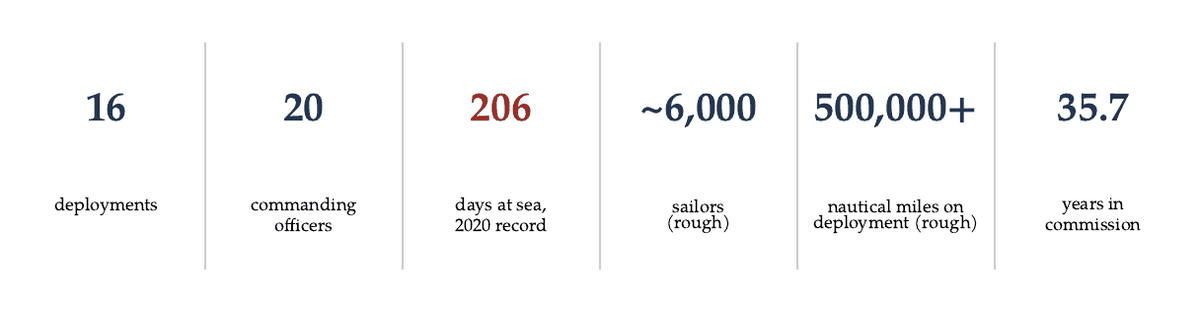
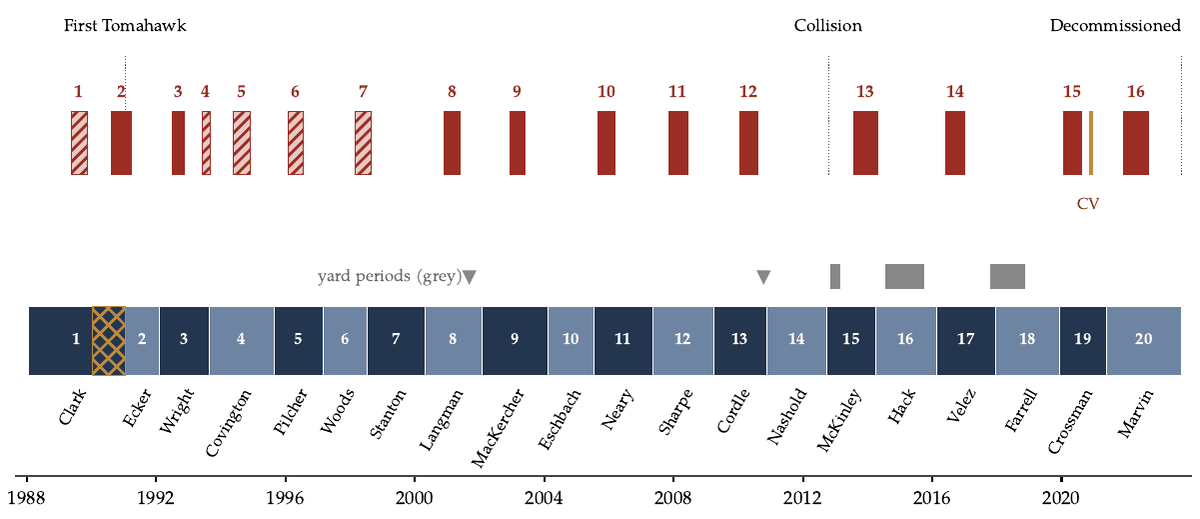
More than six thousand sailors served in her over thirty-five years, by the estimate of the admiral who presided at her decommissioning. She had twenty commanding officers, one for every year and three-quarters of her life on average, and each took her over from a predecessor and handed her to a successor.2 Most of her sailors served a tour of a few years and moved on to other ships or ashore. A few stayed far longer. One of the first crew who reported to her in 1987 remembers serving in her until 2000, and another left in 1993 and came back for four more years in 1995.13
Six thousand people in thirty-five years means that the crew turned over completely many times. Nobody who decommissioned her had commissioned her. The steel stayed and the people changed, a few dozen at a time, so gradually that there was never a day when the crew was new. That is the first thing a ship is: a way for people who never meet to hand the same work to one another.
What she kept
A good deal of the story was kept in the ship. Her name, her motto, “Victory is certain,” and the nicknames her crews gave her, the Jac and the Happy Jac, passed from one crew to the next, and so did the name her officers gave her sailors, Gunslingers, which some crews wore gladly and others put up with. The cell of the launcher that fired the first Tomahawk of 17 January 1991 stayed marked. A sailor who joined her in 2011 remembers that its hatch cover was painted with the image of a tomahawk hatchet, twenty years after the launch.14 Her bell carried another kind of record. By 2011, a sailor who polished it each morning told his shipmates, the names of about a dozen children christened aboard had been engraved on it.14
The bell was also used to greet people. In 2012 her executive officer had a ninety-one-year-old former chief boatswain’s mate, a survivor of Pearl Harbor, rung aboard with it, the honor due a man of his old rate.14 In January 2018, when members of her first crew came back to the ship in the yard at Norfolk for the thirtieth anniversary of her commissioning, one of them remembers that the bell was rung as he came aboard and again as he left, and that it rang a great deal that day for his shipmates.13
The Navy’s senior enlisted sailors, the chief petty officers, did much of the passing on. A chief is a specialist with a decade or more in a trade who leads a division of junior sailors, and chiefs often stay longer in a ship than the officers above them or the sailors below. A new chief is made in a ship’s chiefs’ mess by an initiation. One chief who was initiated in hers on 15 September 1995 still counted the day, twenty-eight years later, as the most important of his life.13 Some came back. The senior chief who ran the sonar division in the 2010s had been a junior sailor in the same ship around the turn of the century, and what he told his sailors about the old days was how the crew of 2013 knew anything about the crew of 2000.
In June 2009, by crew recollection, a chief culinary specialist reported aboard as the first enlisted woman assigned to the ship, and within about a year her enlisted crew was integrated.3
Little else of the ship’s daily life was written down. What her people did on the night watches, in the engineering spaces and the galley, and through the long days of a deployment survives, where it survives at all, in what they remember. The official record of a warship is a list of where she went. It does not say that the coffee was sour or that the berthing flooded, or what a boatswain’s mate, a cook and a sonar technician thought of each other, and without those things the list is not a history of anything a person lived through.
What she did
What she did makes a long list. In the first days of the Gulf War, in January 1991, she was the Red Sea battle force’s anti-air warfare commander and fired the first Tomahawk missiles launched in combat. In the Red Sea her boarding teams inspected several dozen ships for contraband bound for Iraq.4 She served in Operation Southern Watch over Iraq, in Operation Iraqi Freedom, in the operations against terrorism that followed the attacks of 11 September 2001, and in Operation Inherent Resolve against the Islamic State.4 In 2010 her boarding team freed five Yemeni hostages from suspected pirates who had held their dhow for a day.5 In 2013 she answered a late-night call from a Turkish warship in the central Mediterranean and sent her boat across for a mariner who needed medical care.6 She was the air and missile defense commander of carrier strike groups in 2016 and 2020, and she was in the Mediterranean with the Truman group when Russia invaded Ukraine in February 2022. In 2020 she stayed at sea for 206 consecutive days, a Navy record, and a few months later she was off Cape Verde, on a mission whose purpose the public learned from a newspaper.6
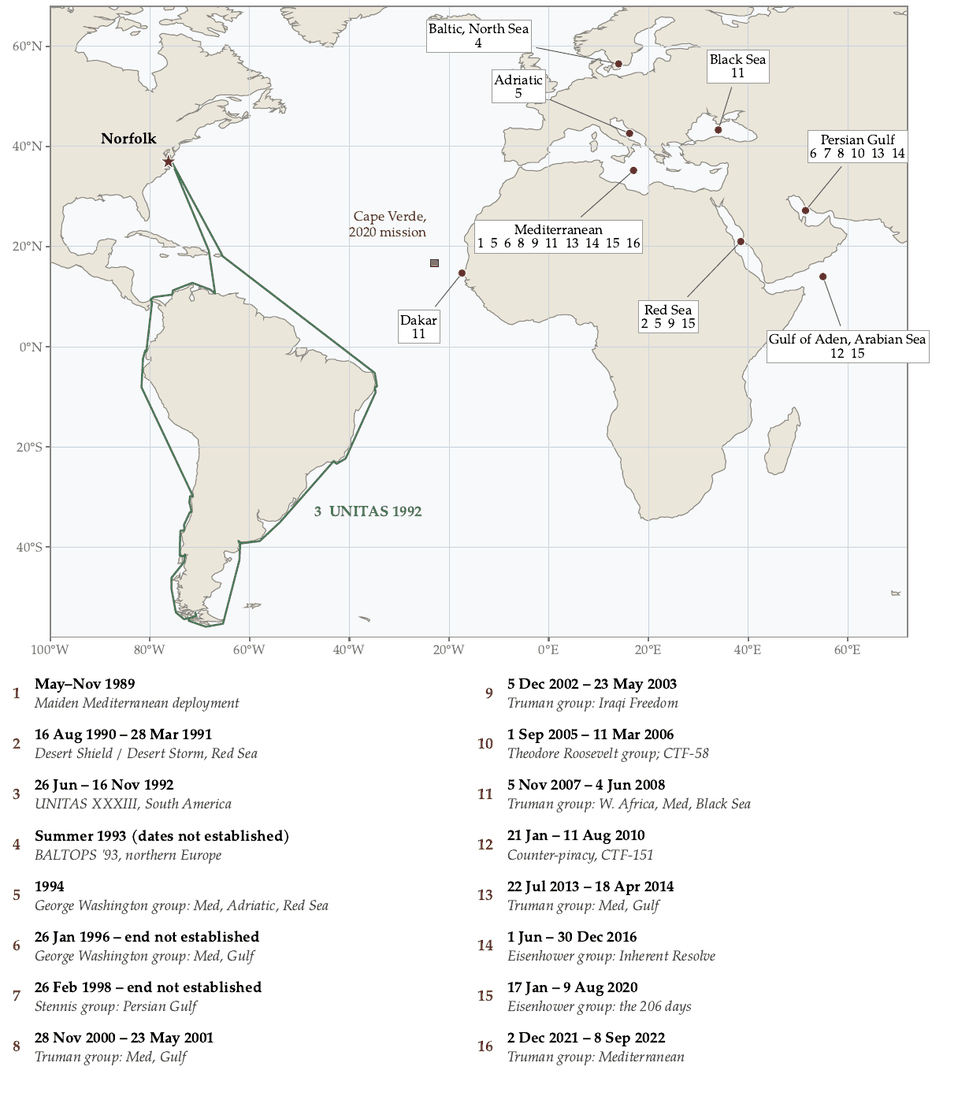
On 13 October 2012, off northeast Florida, running at nearly twenty knots across a six-foot sea to catch up with an aircraft carrier, she struck the submarine Montpelier as it came up toward periscope depth. No one in either ship was hurt. The cruiser’s sonar dome was torn in sixteen places, and the submarine lost her upper rudder. The Navy’s investigation found failures in the planning of the exercise and in the management of its risks, and the admiral who endorsed its findings wrote that safety is the first priority of any exercise.7
Read as a whole, the list has a shape. She was built for one job, defending a carrier against a mass attack by Soviet missiles, and she was never asked to do it in earnest. What she did instead, year after year, was whatever needed doing in the place the carrier happened to be: fire cruise missiles, board freighters, chase skiffs, guard oil platforms, pull fishermen out of the water, carry a commodore, and wait. And the things for which she is remembered, the first Tomahawk, the 206 days, the collision, were none of them the thing she was designed to do.
There is a second shape under the first. Five times in this history she stops to help someone: eleven Yemenis adrift in a dhow in 2000, a flooding Saudi freighter in 1996, a Turkish merchant crew in 1998, a sick Spanish sailor in 2005, a Turkish sailor in 2013, and there were more. None of it was her mission and none of it is in the list of battle stars. A warship at sea is also, most days, simply the nearest ship with a doctor, a boat and a helicopter, and her crews acted on that each time the record shows them asked.
The totals the Navy gave at the end were estimates. The admiral who presided at her decommissioning called his figures rough: sixteen deployments, more than six thousand sailors, more than 500,000 nautical miles steamed on deployment, and fifteen Battle Efficiency awards. A count from the Navy’s published list of her awards gives twelve. They are the best figures the record offers, and they are not exact.11
She had been designed to defend carrier groups against Soviet aircraft and missiles, and she ended her service as one of a class the Navy had decided to retire. The Navy later chose to keep three ships of the class in service into 2029. All three had been through its modernization program, and she had not.12
What it cost
The record shows one more thing, though no document says it outright. The ship was asked to do more each decade with less. Her crew was cut on paper by about a sixth in the 2000s while her equipment aged and her deployments lengthened. In 2012 she went to sea for an anti-submarine exercise with one of the two watch teams the Navy required, nineteen of twenty-eight operations specialists, an engine down and her quieting system secured. In 2020 her crew kept a thirty-two-year-old ship at sea for 206 days without a port and fixed what broke themselves.
None of that is in the admiral’s totals. It was paid by the people aboard, in sleep, in marriages, in months away, and it may be why a sailor of her last decade can speak of her with less affection than the plank owners do and still with pride. The first crews had a new ship. The last crews had an old one and made her do the same work.
A name
The Navy has given the name San Jacinto to three ships. The first was a frigate built in 1851, which fought for the Union in the Civil War and was sold in 1871. The second was a light aircraft carrier, commissioned on 15 November 1943, which fought in the Second World War and was decommissioned on 1 March 1947. The third was the cruiser, commissioned at Houston on 23 January 1988, honored at a decommissioning ceremony at Norfolk on 15 September 2023, and formally decommissioned and stricken on 29 September 2023.8
The name comes from the battle fought on 21 April 1836 beside the San Jacinto River, in which Sam Houston’s outnumbered army defeated Santa Anna and won the independence of Texas. Her motto came from Houston’s words to his troops before the battle, and her ties to Texas ran through her life, from a sponsor who was the wife of a Texas senator to a commissioning at Houston.8 By the Navy’s practice as it has been reported, the name of a ship struck from the Naval Vessel Register is free for a future ship, though her hull number is not.9
So there may be a fourth. If there is, her crew will inherit a battle, a frigate, a carrier and a cruiser, and most of them will know none of it, and the name will work on them anyway.
The shipmates
Her former crews kept in touch. They began finding one another online years before she was decommissioned, trading rates, years aboard, nicknames and stories; one early member places the start around 2007.10 The plank owners, the men and women of her first crew, organized the first large reunion, for the thirtieth anniversary of her commissioning in January 2018, and opened it to everyone who had served in her. The ship was then in the BAE yard at Norfolk, and her command gave them and their guests permission to come aboard.10, 13 The second reunion, for the thirty-fifth anniversary, was held in Norfolk in January 2023, eight months before she was decommissioned.10
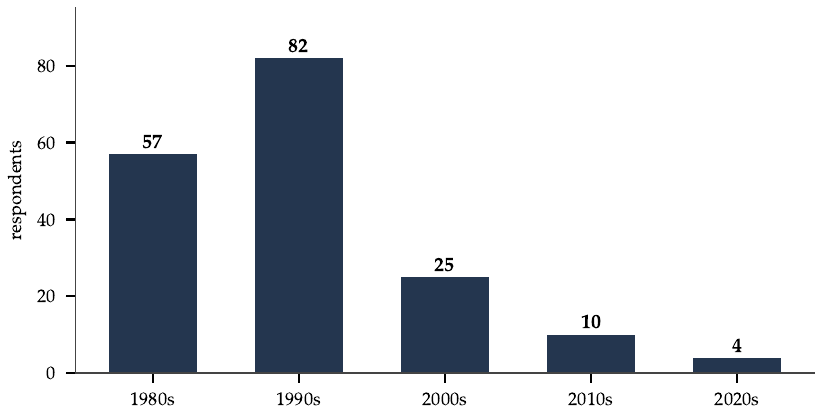
The third was held in Norfolk and Virginia Beach from 17 to 20 September 2026, three years after the ceremony. When its organizers asked former crew for their contact details in 2025, 179 had answered by late November: 57 who had reported aboard in the 1980s, 82 in the 1990s, 25 in the 2000s, 10 in the 2010s and 4 in the 2020s. Most wanted the reunion in Norfolk; Houston came second.15
The numbers say something. Three-quarters of those who answered had come aboard before 2000, when she was new or nearly so. The crews of her last fifteen years, who took her through the collision, the long deployments and the end, are barely there. Some of that is age: reunions belong to the retired. Some of it may be that the ship those later sailors knew is harder to be sentimental about.
The plans included gatherings each evening, a baseball game, a crew dinner on the last night at which each guest would receive one of three hundred serialized ceramic coins, and a memorial poster listing the shipmates who had died, a list everyone was asked to check so that no living sailor would appear on it by mistake. Several former crew offered to pay for the dinner for shipmates who could not afford it.10, 15 One shipmate who had ordered four hundred coins for the decommissioning gave away his last two at the reunion.15
The organizers had also arranged for up to fifty of them to tour the cruiser Gettysburg at Norfolk. She was one of the three cruisers of the class that the Navy had decided to keep in service.15, 12 Their own ship was three hundred miles north, tied up with the inactive fleet, with nobody aboard. To stand in a combat information center like the one they had stood watch in, they had to visit a sister.
What a ship is
A ship is steel, and the steel of this one is in Philadelphia. A ship is also a record, and hers is in this history as well as the sources allow: sixteen deployments, three wars over Iraq, one collision, one record, thirty-five years.
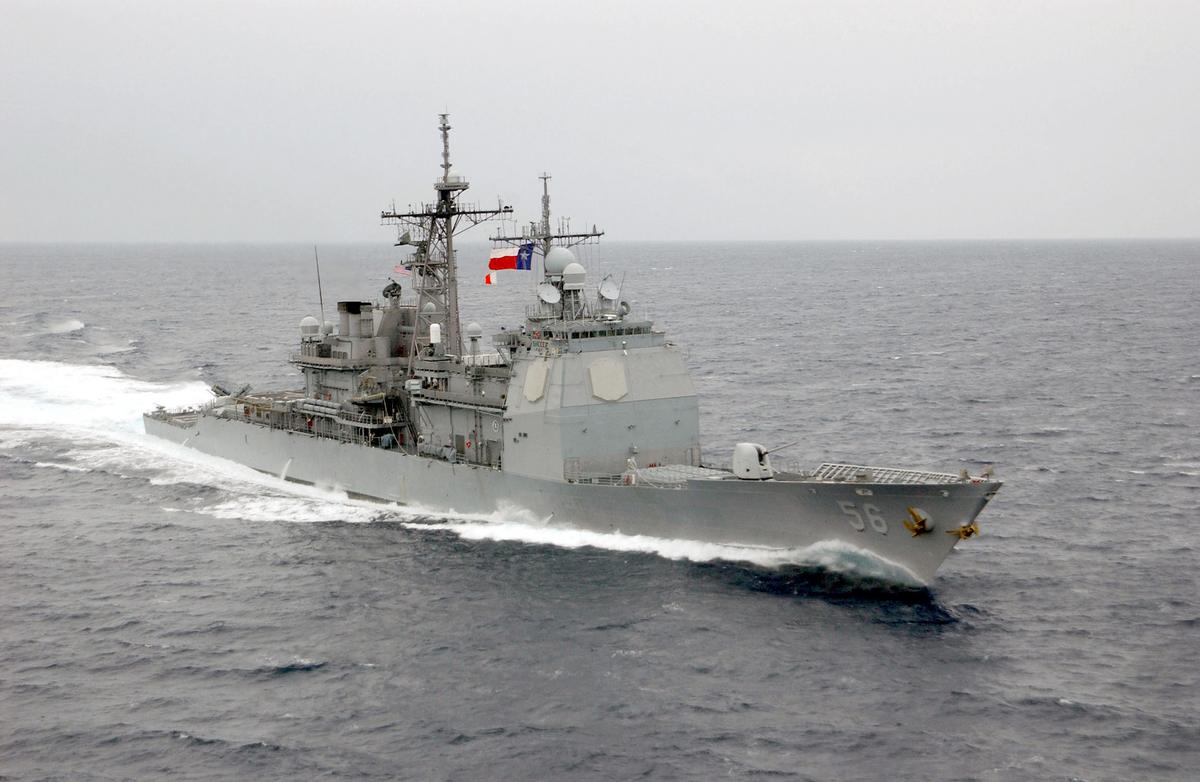
But the ship her people mean when they say the Jac is neither of those. It is the watch stood at three in the morning by someone who would rather have been asleep, and the next watch, and the one after that, for twelve thousand nights. It is a third class boatswain’s mate talking to eleven frightened men in Arabic. It is a lookout who saw a periscope and said so. It is cooks who fed three hundred and fifty people four times a day, engineers who kept an old plant turning, and sailors of every rating standing in the dark on a line while fuel came aboard. Most of them did not like each other much, and said so, and did the work anyway.
Nobody thanks a ship for her service. The people who made her one are still around, at reunions and in break rooms and behind the wheels of trucks, and when one of them is thanked, the answer is likely to be some version of this. You’re welcome. It sucked. I’d probably do it again.
Notes
- Navy release on the decommissioning, 15–16 September 2023 (30 officers and 300 enlisted at the end of her service); NAVSEA, Naval Vessel Historical Evaluation, CG-56, 21 September 2023 (displacement 9,992 tons; four General Electric LM2500 gas turbines; two controllable-reversible-pitch propellers; two 61-cell Mk 41 launchers, 122 missiles). The evaluation gives the length as 529 feet, against about 567 feet and 9,500 tons in the class descriptions cited in the Chapter 10 notes (see also Chapter 23, note 8); the narrative uses the class length and gives the range of the two displacement figures. ↩
- Vice Adm. Jim Kilby’s remarks in the same release (more than 6,000 sailors; his “rough estimates”). Twenty commanding officers: the ship’s command list; see Chapter 22 note 2 and Appendix B. ↩
- Crew recollection (see Chapter 18 notes). ↩
- Navy decommissioning release (Red Sea battle force anti-air warfare commander; first Tomahawk cruise missiles fired in combat; Operations Southern Watch, Inherent Resolve and Iraqi Freedom; counterterrorism operations after 11 September 2001; maritime interdiction); NAVSEA evaluation (boarding teams inspected several dozen ships for contraband). The number of Tomahawks fired in the war differs among sources; see Chapters 13–14 notes. ↩
- NAVSEA evaluation (26 May 2010: boarding team rescued five Yemeni hostages from 13 suspected pirates; the dhow’s master said it had been under pirate control for one day only). See also Chapter 18 notes. ↩
- The Turkish mariner of 2013 and the strike-group roles of 2016: see Chapter 20 notes 5, 14 and 15. The 2020 cruise and the Cape Verde mission: see Chapter 21 notes 6 and 11; Navy release of 21 May 2021 on the change of command (air and missile defense commander of Carrier Strike Group 10 in 2020; see Chapter 22 note 1). The 2021–22 deployment with the Truman group, which was in the Mediterranean when Russia invaded Ukraine on 24 February 2022: Chapter 22 notes. The Turkish call came shortly before 2300 on 3 August 2013 (Chapter 20, note 5). ↩
- See Chapter 19 notes (Phillips command investigation; Adm. Gortney’s endorsement of 4 January 2013; Navy Inspector General, September 2014); the sixteen damaged places on the sonar dome are from the diving contractor’s inspection of 18–19 October 2012 recorded there. ↩
- Navy decommissioning release (the first San Jacinto, a frigate built in 1851 and sold in 1871; the second, CVL-30, commissioned 15 November 1943 and decommissioned 1 March 1947; the cruiser commissioned 23 January 1988 at Houston; sponsor Dr. Wendy Lee Gramm, wife of Senator Phil Gramm; the battle of 21 April 1836; Houston’s words; the sailors’ adoption of the motto). The formal decommissioning and striking on 29 September 2023: Naval Vessel Register (Chapter 23, note 22). ↩
- Navy practice on freeing the name of a struck ship, as stated in a 15 September 2023 article on retiring ships (Support Our Troops); it has not been confirmed by a Navy source. ↩
- Crew recollection and reunion organizers’ notices: the online group (origin about 2007 per one early member); reunions of January 2018 (Norfolk, BAE yard; see Chapter 20 notes 19–20), January 2023 (Chapter 23 note 2), and 17–20 September 2026 in Norfolk (planned crew dinner, 300 serialized ceramic challenge coins and a memorial poster of shipmates who had died); that the 2026 reunion was held is confirmed by accounts posted by those who attended in the days after it (note 15), and its other details are the organizers’ plans as announced. Permission for the 2018 visitors to come aboard was relayed in December 2017 through the ship’s command master chief. ↩
- Navy decommissioning release, 15 September 2023 (DVIDS 453585; also U.S. Fleet Forces Command release of 16 September 2023 and Targeted News Service, 19 September 2023, ProQuest 2866012852): the remarks of Vice Adm. Jim Kilby, who gave sixteen deployments, over 6,000 sailors, over 500,000 nautical miles and 15 Battle E’s as “rough estimates”; see Chapter 23, notes 4 and 5, and Appendix D for the count of awards. The dimensions are from NAVSEA, Naval Vessel Historical Evaluation, CG-56 (21 September 2023) (529 feet, 9,992 tons) and from the class descriptions cited in the Chapter 10 notes (about 567 feet and 9,500 tons). ↩
- Inside the Navy, 11 November 2024, and the Seapower Almanac, January 2026: see Chapter 23, notes 13 and 14. That San Jacinto was not among the ships taken through the Navy’s phased modernization follows from the 2014 testimony cited in Chapter 20, note 24, which assigned that program to hulls CG-63 to CG-73; the record available does not show whether she was ever considered for it. ↩
- Crew recollection: a plank owner who gave his years aboard as 1987 to 2000, and another as 1987 to 1993 and 1995 to 1999, in a roll call of former crew posted in 2011; a plank owner’s account of his visit to the ship at the BAE yard on the thirtieth anniversary in January 2018, with the bell rung as he came aboard and as he left; a retired chief petty officer, writing in June 2023, who called the day of his initiation in the ship’s chiefs’ mess, 15 September 1995, the most important of his life (see Chapter 23, note 19). None of these is confirmed by a document. ↩
- The painted hatch cover: crew recollection of a sailor aboard 2011–2015 (Chapter 14, note 29). The engraved bell: crew recollection (Chapter 18, note 29). The 2012 visitor rung aboard: Navy release of 29 May 2012 (Chapter 18, note 31). ↩
- Crew recollection and reunion organizers’ notices, December 2025 to September 2026: the contact questionnaire (179 responses by 25 November 2025, by decade of arrival aboard 57, 82, 25, 10 and 4, with one who could not remember; Norfolk the first choice of place, Houston second and Jacksonville third); reunion dates 17–20 September 2026, with evening gatherings in Norfolk and Virginia Beach, a minor-league baseball game, a crew dinner (planned for the 20th, cancelled for want of reservations in July and revived in August), 300 serialized ceramic coins for dinner guests, a memorial list and offers from former crew to pay for the dinner for shipmates who could not afford it; a tour of the cruiser Gettysburg limited to fifty people; one shipmate’s account, posted on 24 September 2026, of giving away the last two of four hundred decommissioning coins at the reunion the weekend before. Whether the dinner and the Gettysburg tour took place as planned is not confirmed. That Gettysburg was one of the three cruisers kept in service: Chapter 23, note 13.
--- ↩