Part Two: Name, Keel, Commissioning
Chapter 9A Name With Weight
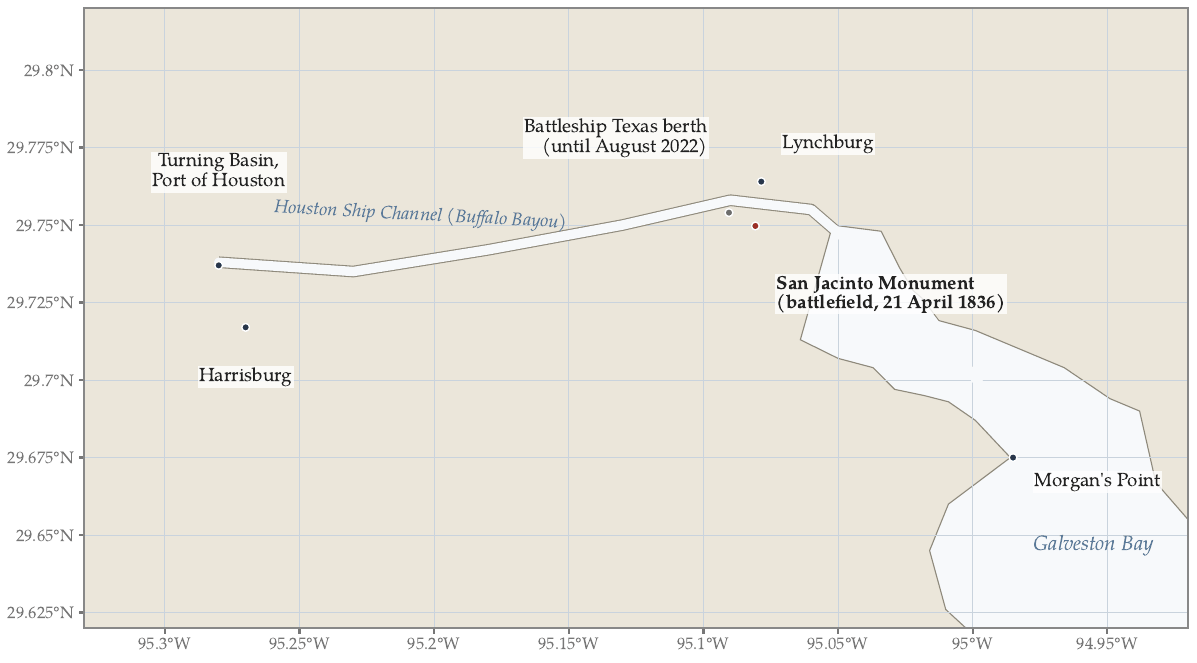
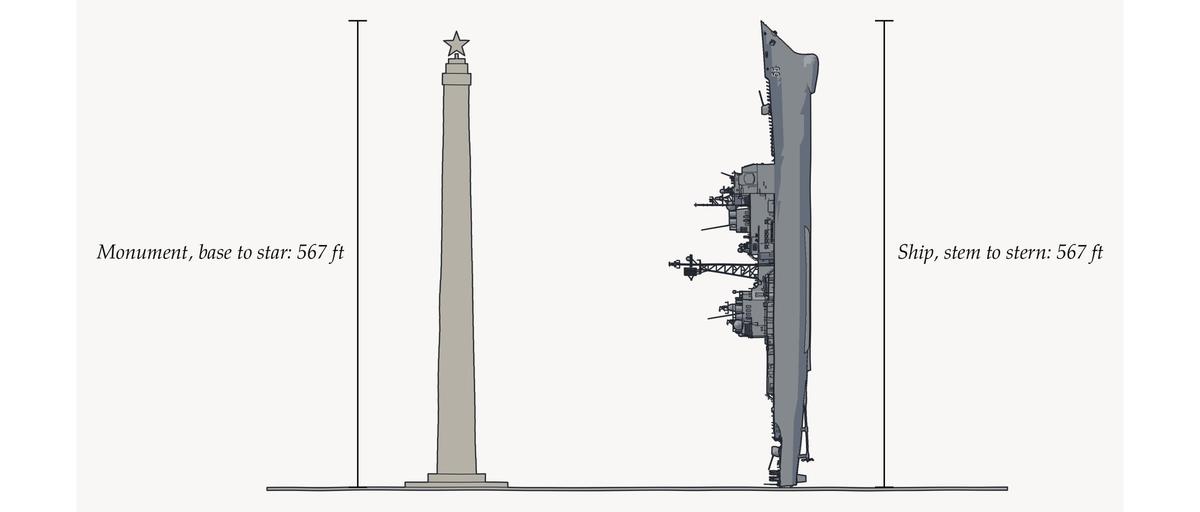
A stone column stands on the flat coastal plain east of Houston, where Buffalo Bayou runs into the San Jacinto River. It rises 567 feet, a few feet taller than the Washington Monument, which was the point. It is crowned with a thirty-four-foot star of Texas, and it marks a battlefield. When the Navy of the 1980s gave the tenth ship of a new class of cruisers the name San Jacinto, the ship that came off the ways in Mississippi was about 567 feet long, the height of the monument laid on its side.1 Nobody planned that. The name had been chosen for the battle, which was fought on that plain on the afternoon of 21 April 1836 and was over in less time than it takes a sailor to eat lunch.
A warship’s name is the one part of her that is older than her steel. The crew that reported aboard in 1988 inherited a battle, a wooden frigate that nearly started a war with Britain, and an aircraft carrier that pulled a future president out of the Pacific. Whether or not they knew the history, the name worked on them, in the flags the ship flew and the visitors she drew and the way a whole state decided she belonged to it.
The battle
In 1836 the land that is now Texas was a northern province of Mexico, and it was in rebellion. Mexico had invited American settlers into the territory in the 1820s, hoping they would farm it and hold it against the Comanche. They had come in the thousands, bringing their customs, their language and in many cases enslaved people, and by the middle of the 1830s they outnumbered the Mexican residents. The centralist government in Mexico City, led by General Antonio López de Santa Anna, tried to tighten its control. The Texians, as the settlers called themselves, took up arms in the autumn of 1835 and declared independence on 2 March 1836.2
The campaign that followed began with two disasters. Santa Anna’s army besieged the Alamo, an old mission in San Antonio, for thirteen days and stormed it before dawn on 6 March, killing nearly all of its defenders. Three weeks later, at Goliad, Mexican troops executed more than three hundred Texian prisoners who had surrendered under Colonel James Fannin. Families packed what they could carry and fled east in the muddy exodus that Texans later called the Runaway Scrape, and the Texian army under General Sam Houston, a former governor of Tennessee who had lived among the Cherokee, fell back with them. For more than a month Houston retreated, to the open dismay of many of his men, who wanted to fight. He drilled the army as he went.2 It was the only army Texas had, and he did not intend to spend it until he could win with it.
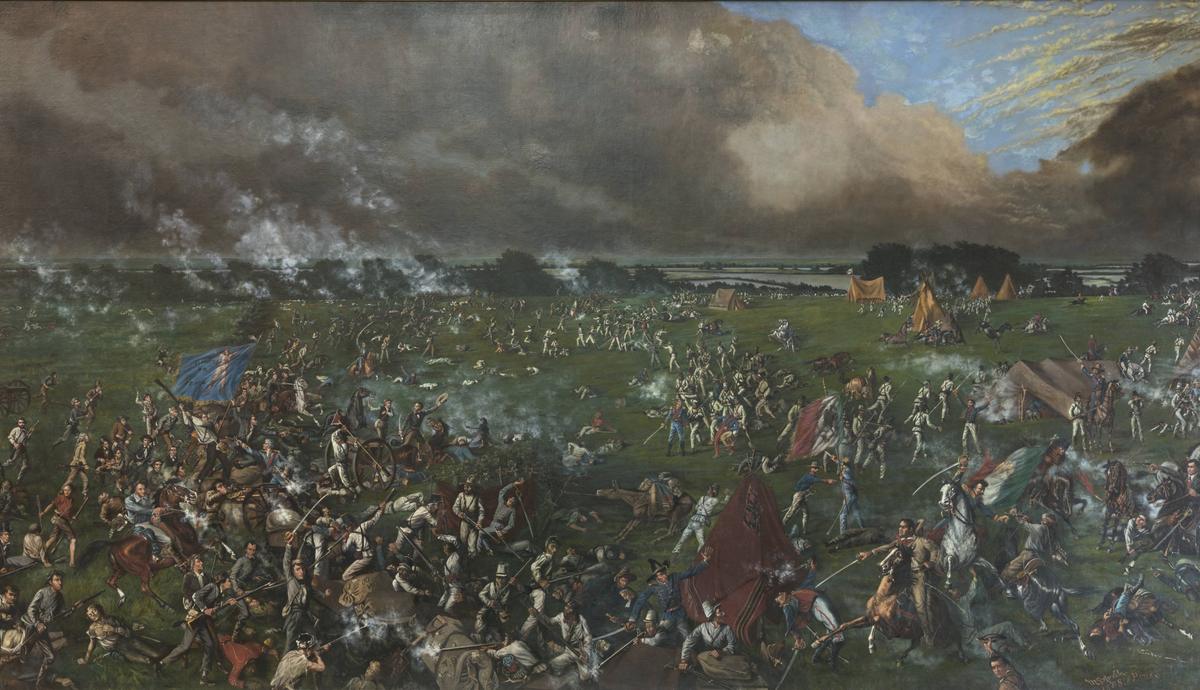
Santa Anna, believing the rebellion all but crushed, pushed ahead of most of his army with a small column, chasing the Texian government toward the coast. He reached Harrisburg on 15 April with about seven hundred men, found it empty and burned it, and went on down the west side of Buffalo Bayou and the San Jacinto River, crossing a bridge over Vince’s Bayou that he would need again to get back. On 18 April Houston’s army reached White Oak Bayou, inside what is now the city of Houston, and learned where he had gone. The Mexican commander had separated himself from the bulk of his own army and walked into a corner of land with water on three sides. The next day Houston told his men that they would soon see action and urged them to remember San Antonio and Goliad, and that evening the army crossed Buffalo Bayou below Harrisburg, leaving about 248 men, most of them sick, with the baggage. It had numbered about twelve hundred; about 910 went on.12
At dawn on 20 April the Texians captured a boat carrying supplies for Santa Anna at Lynch’s Ferry and camped in timber behind a rise. Santa Anna came up and camped on high ground above a marsh about three-quarters of a mile away, building breastworks of tree trunks, baggage and packsaddles. That afternoon Colonel Sidney Sherman led a few horsemen against the Mexican infantry and nearly brought on a general battle. One Texian was mortally wounded, and a private named Mirabeau B. Lamar rode so well that he was given command of the cavalry the next day.12 Within three years he would be president of the republic.
On the morning of the 21st General Martín Perfecto de Cós crossed Vince’s Bridge with about 540 more troops, bringing Santa Anna’s strength to about twelve hundred, many of them tired from a forced march, and Houston sent the scout Erastus “Deaf” Smith to destroy the bridge so that no more could come.3, 12 With the bridge down, neither army had an easy way out. A council of Houston’s officers shortly before noon divided, two for attacking and the rest for waiting to be attacked. Houston kept his own view to himself, then made his plan and had his secretary of war, Thomas J. Rusk, approve it. About half past three he formed his line in the trees and tall grass: Edward Burleson’s regiment in the center, Sherman’s men on the left, the artillery under George W. Hockley to Burleson’s right, Henry W. Millard’s infantry beyond it, and Lamar’s cavalry on the far right. Across the prairie the Mexican camp lay quiet in its afternoon rest, apparently without lookouts, and no one saw the Texians coming.12
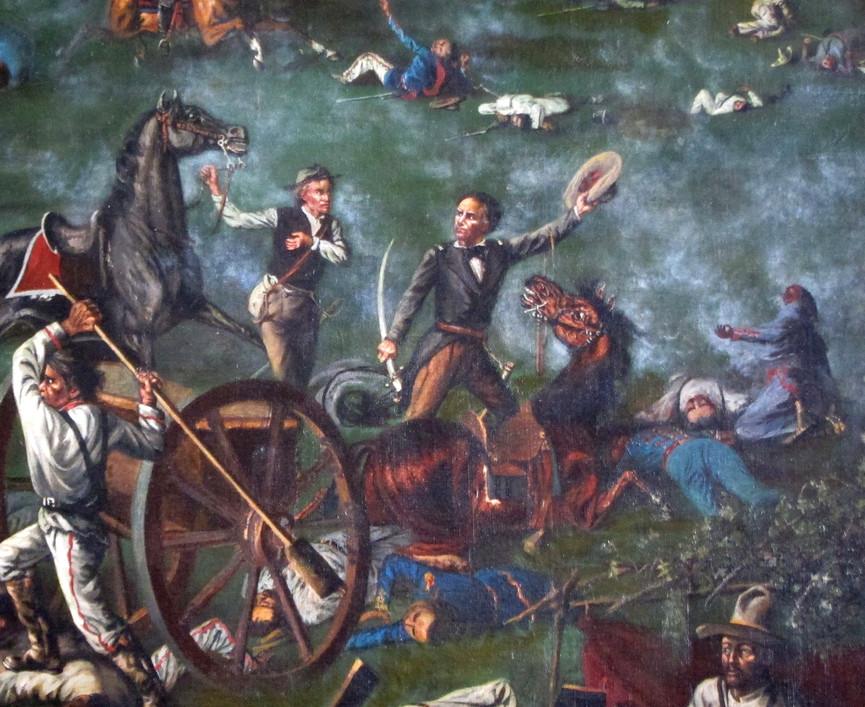
In the traditional account the Texians advanced to a fife and drum playing a popular song, “Will You Come to the Bower,” with their two small cannon, the Twin Sisters, a gift from the people of Cincinnati, wheeled forward with the line. They held their fire until they were close. Then they ran into the Mexican camp shouting the two names that had become a creed: Remember the Alamo, Remember Goliad. The Mexican army collapsed. The fighting, in the words of the standard Texas reference, lasted but eighteen minutes, although the killing and the pursuit went on long after.4, 12 Men who had spent six weeks hearing what had been done at the Alamo and Goliad were not inclined to take prisoners, and for a time their officers could not make them. By the count in Houston’s report, some 630 Mexican soldiers were killed, 208 wounded and 730 taken prisoner. The Texians lost nine men killed or mortally wounded and about thirty wounded, among them Houston, whose ankle was shattered by a musket ball. They took muskets, pistols, sabers, mules, horses, provisions, clothing, tents and $12,000 in silver.4, 12
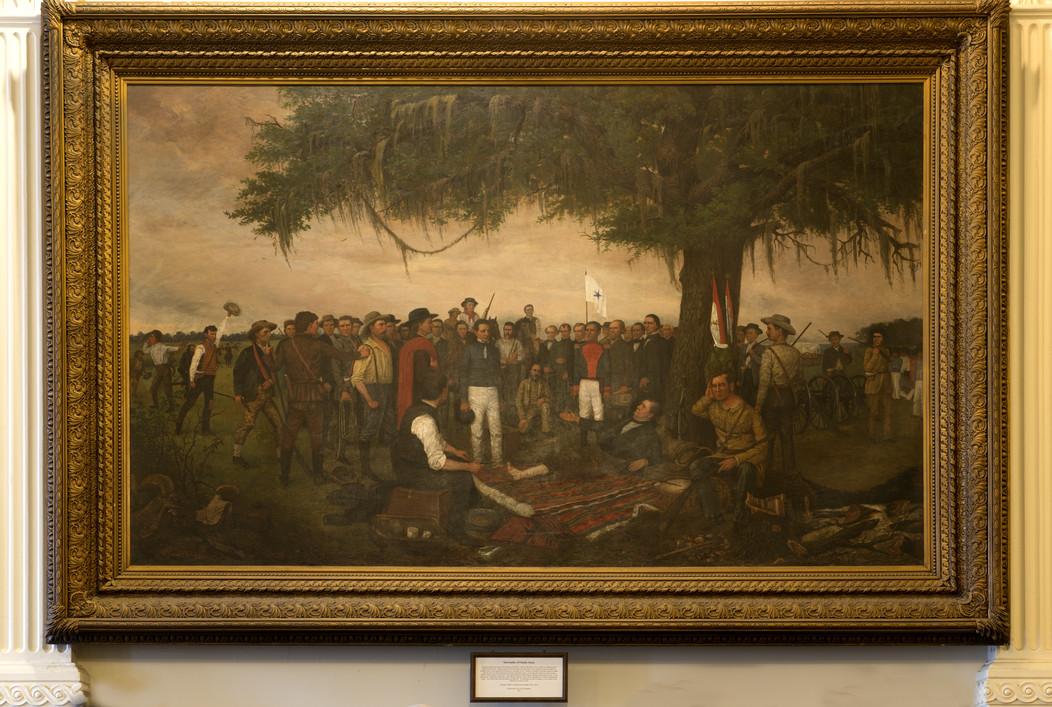
Santa Anna was not among the prisoners. On the morning of 22 April search parties went out, and one of them found a man hiding in the grass, wet and dirty and dressed as a common soldier. They did not know who he was until the other Mexican prisoners called him el presidente.12 He was brought to Houston, who was lying wounded under an oak, and in exchange for his life he signed agreements ordering Mexican troops out of Texas. The Republic of Texas, which had existed for seven weeks, had become a fact. Within a decade it was annexed to the United States, and annexation led to the war with Mexico of 1846, at whose end the United States took California and the Southwest. Measured by the land that changed hands because of it, few battles of any size have mattered more.
The frigate
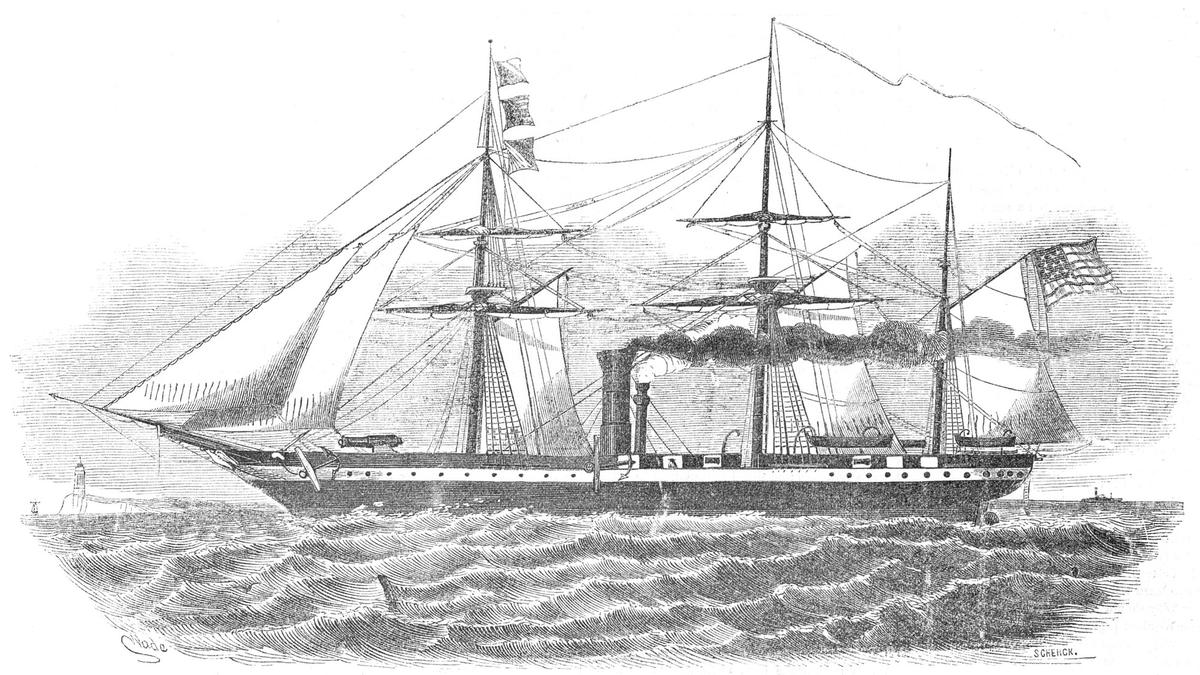
The Navy named its first San Jacinto while the war with Mexico was still being fought. She was a wooden screw frigate, laid down at the New York Navy Yard in August 1847 and launched on 16 April 1850, one of the first large American warships to be driven by a steam engine and a propeller as well as by sail.5, 13 She was built partly as an experiment, to find out how an engine and screw would serve a big seagoing ship, and the answer in her case was that they served badly. The Navy’s history calls her machinery balky and unreliable from first to last. On her trial passage from New York to Norfolk in January 1852 heavy weather disabled one engine. After a cruise in European waters dogged by breakdowns she was taken out of commission at Philadelphia in July 1853 to have new machinery fitted. Recommissioned in August 1854, she still needed repairs at Southampton, England, and in 1855 she served briefly as flagship of the Home Squadron after a Spanish frigate fired on an American mail steamer off Cuba.13 Sailors of the third San Jacinto, who by their own account served in a ship that was always broken, would have recognized the first one.
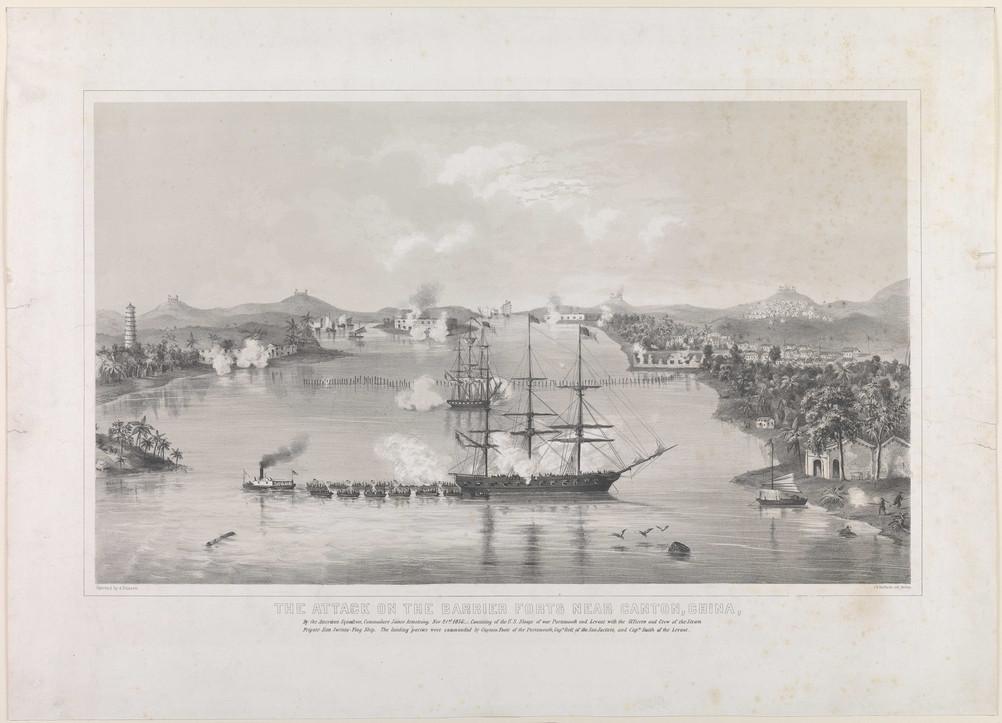
Her best years were in Asia. In October 1855 she sailed from New York as flagship of the East India Squadron, and at Penang, on the Strait of Malacca, on 2 April 1856 she embarked Townsend Harris, the merchant whom President Pierce had appointed the first American consul general to Japan. Japan had been closed to the West for two centuries and was only beginning to open under the pressure of Commodore Matthew Perry’s expedition of 1853 and 1854. The frigate carried Harris first to the mouth of the river below Bangkok, where he went up to negotiate a treaty with Siam, and then, after almost two months of engine repairs at Hong Kong, to Shimoda, which she reached on 21 August 1856. A party from the ship helped Harris raise the American flag over his new consulate, the first foreign consulate in Japan, before she sailed for Shanghai on 4 September.5, 13 In November, at the outbreak of the Second Opium War, she was off Canton when Chinese forts fired on an American boat. The Americans bombarded the forts and then stormed them, Commander Andrew H. Foote leading about three hundred men ashore, and spiked 176 cannon.13
She came home in 1858. In 1859 she was recommissioned for the Africa Squadron, which patrolled against the transatlantic slave trade, and on 8 August 1860, off the mouth of the Congo, she captured the brig Storm King. Her prize crew sailed the brig to Monrovia, Liberia, and turned over to the American agent there 616 Africans who had been taken aboard as captives.5, 13
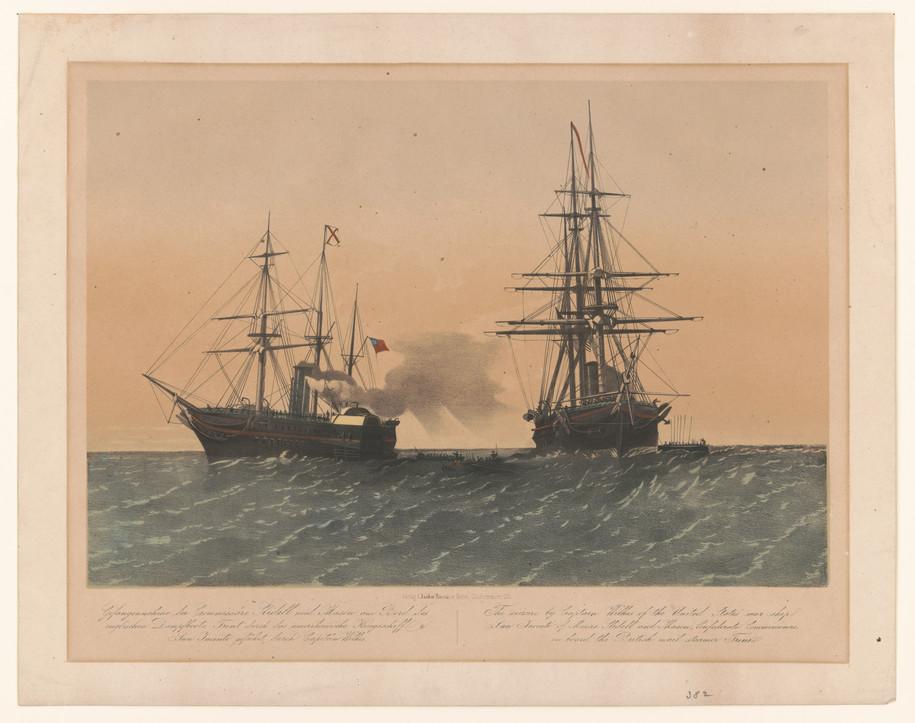
Then came the afternoon that made her famous. In the autumn of 1861 the Confederacy sent two envoys, James Mason and John Slidell, to seek recognition and help from Britain and France. They slipped out of Charleston and reached Havana, where they waited for the British mail steamer Trent, bound for St. Thomas. Captain Charles Wilkes, who had taken command of San Jacinto on 27 August while hunting the Confederate raider Sumter, arrived at Havana a day after the envoys had left it and learned their plans. Wilkes was sixty-three, famous for leading the Navy’s great exploring expedition to the Pacific and the Antarctic twenty years before, and known throughout the service as a man who did not wait for orders.18 On his own authority he waited in a narrow part of the Old Bahama Channel, about 230 miles east of Havana, and on 8 November he stopped Trent with two shots across her bow, sent a boarding party across, took off Mason, Slidell and their secretaries, and let the British ship go on her way.5, 13
Northern newspapers celebrated Wilkes. In Britain the seizure was received as an insult to the flag and a violation of neutral rights, and Lord Palmerston’s government began sending troops to Canada. For some weeks the United States and the greatest naval power in the world stood close to war, at a moment when the Union already had one war it was not winning. On 27 December Secretary of State William H. Seward disavowed the seizure, in what the Navy’s historical dictionary describes as an apology to Britain, and on 1 January 1862 the envoys, who had been held at Fort Warren in Boston Harbor, were released.5, 13 The lesson was one the Navy has had to relearn in every generation since. A single captain, a long way from home and sure he is right, can commit his whole country.
The frigate went back to the ordinary work of the war. In May 1862, with President Lincoln at Hampton Roads, she joined the bombardment of Confederate batteries at Sewell’s Point, three days before the Confederates blew up the ironclad Virginia. Sewell’s Point is now part of Naval Station Norfolk, where the third San Jacinto would be homeported for most of her life.19 She served as flagship of the blockading squadron at Key West, found the raider Alabama at Martinique in November 1862 and lost her in the night, and took a string of blockade runners. Yellow fever drove her north twice. On New Year’s Day 1865 she struck a reef near Great Abaco Island in the Bahamas and filled. Her guns and stores were saved, but she could not be refloated, and the hulk was sold at Nassau on 17 May 1871.13
The carrier
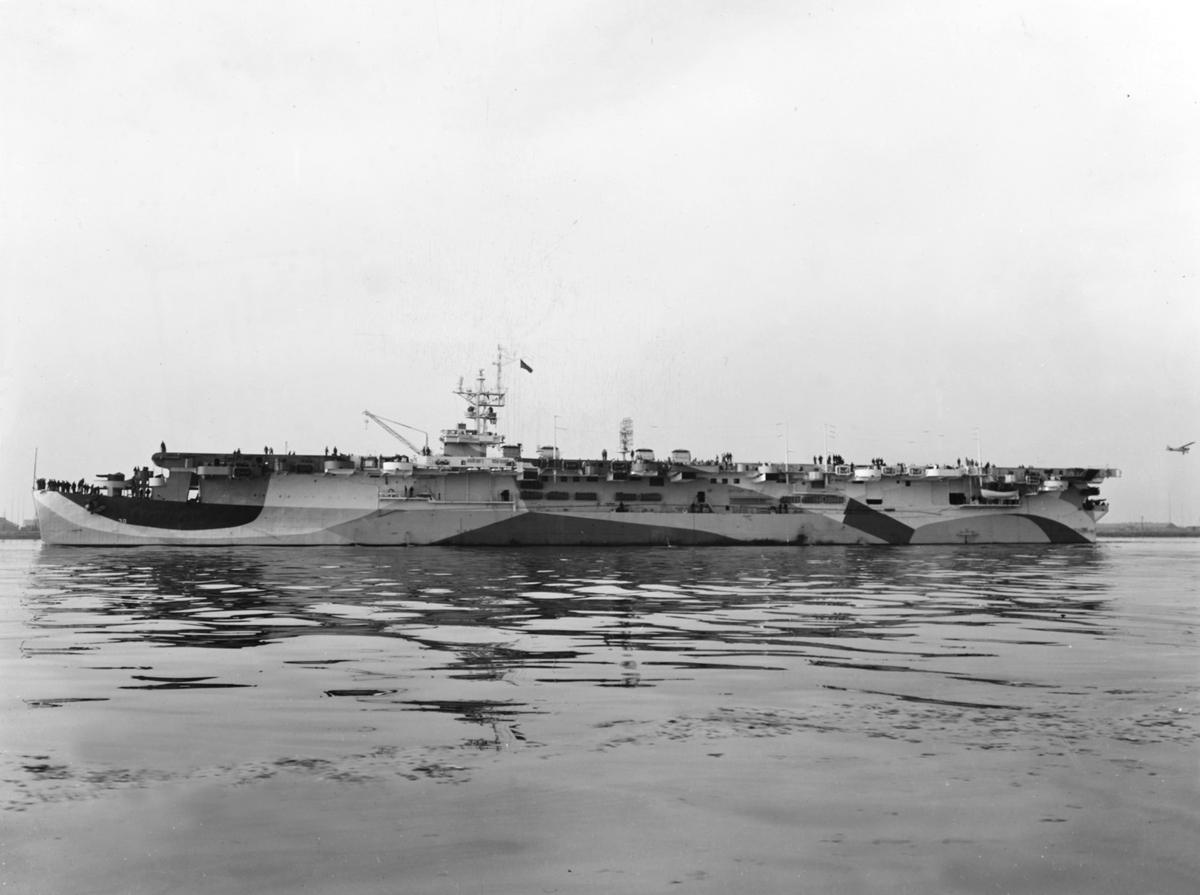
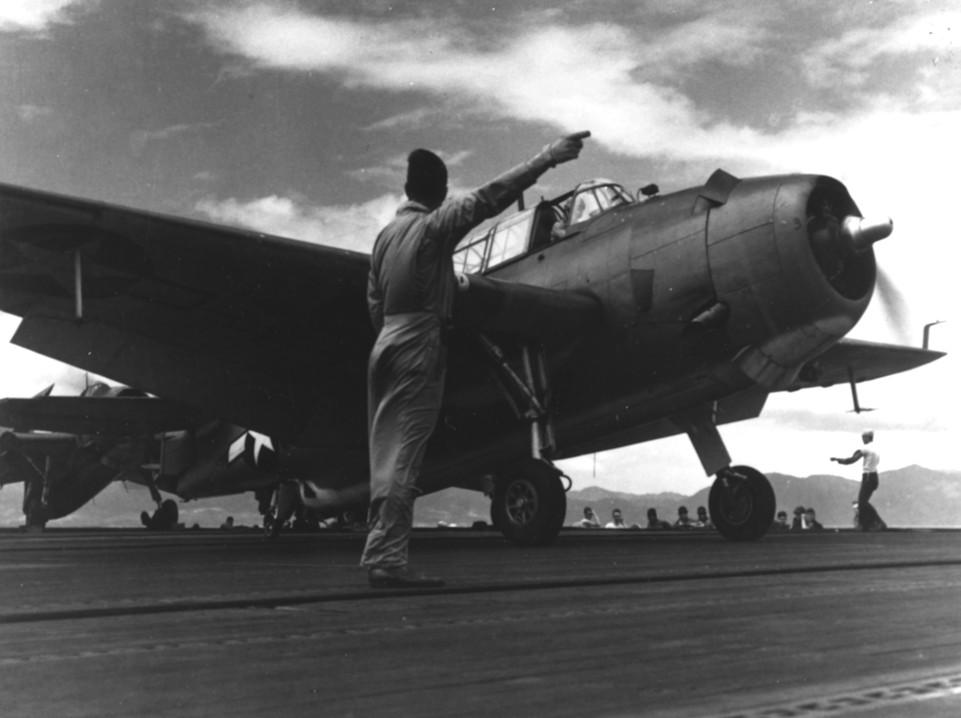
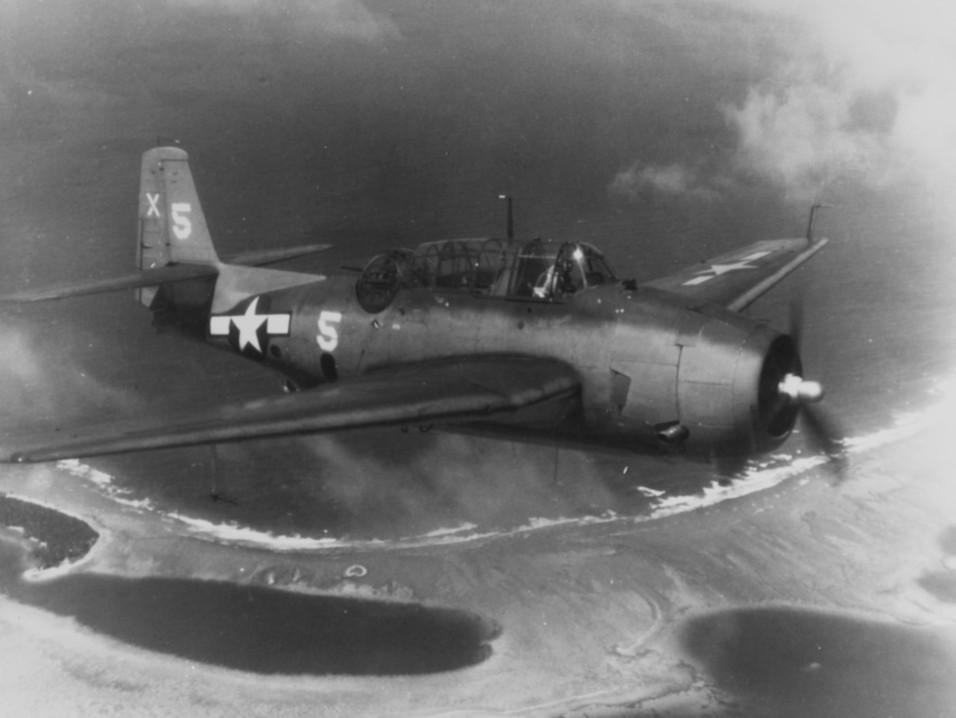
The second San Jacinto was an aircraft carrier born of wartime improvisation. In 1941 the Navy had ordered a series of Cleveland-class light cruisers from the New York Shipbuilding Corporation at Camden, New Jersey, and after Pearl Harbor, desperately short of flight decks, it converted nine of them while they were still building into small carriers, with the cruiser’s hull and machinery, a long flight deck on top and a tiny island on the starboard side. They were cramped and top-heavy and carried about a third of the aircraft of a big carrier, and they were at sea a year or more before the big carriers they stood in for. The ship that became the second San Jacinto was named Newark as a cruiser in February 1941, renamed Reprisal in June 1942, laid down on 26 October 1942 and renamed San Jacinto in January 1943. She was launched on 26 September 1943, sponsored by the wife of Jesse H. Jones, the Secretary of Commerce and a Texan, and commissioned on 15 November 1943 under Captain Harold M. Martin.6, 14 A cruiser hull asked to do a bigger ship’s job is a theme that returns in this history.
She joined Vice Admiral Marc A. Mitscher’s fast carrier force in the Pacific in the spring of 1944 with Air Group 51. On 19 June, in the air battle over the Marianas that pilots called the Turkey Shoot, the Japanese sent more than four hundred aircraft against the fleet and lost more than three hundred of them, and the carrier’s gunners helped bring down the few that got close. Through the summer she struck the Palaus and the Bonins.6, 14
On 2 September 1944 her Torpedo Squadron 51 attacked Chichi Jima, a fortified island in the Bonins about six hundred miles south of Tokyo. One of its Avengers was flown by a twenty-year-old lieutenant (junior grade), George Herbert Walker Bush, among the youngest pilots in the Navy. Anti-aircraft fire set his aircraft on fire. He completed his bombing run, turned out to sea and bailed out; both of his crewmen were lost. He spent some hours in a raft within sight of the island while fighters from the air group sank two small boats sent out to capture him, until the submarine USS Finback surfaced and picked him up.7, 14 He was awarded the Distinguished Flying Cross and rejoined the ship in November. After the war he went to Yale, to the Texas oil business and into politics, and more than forty-three years later he came back to a ship of the same name as Vice President.7
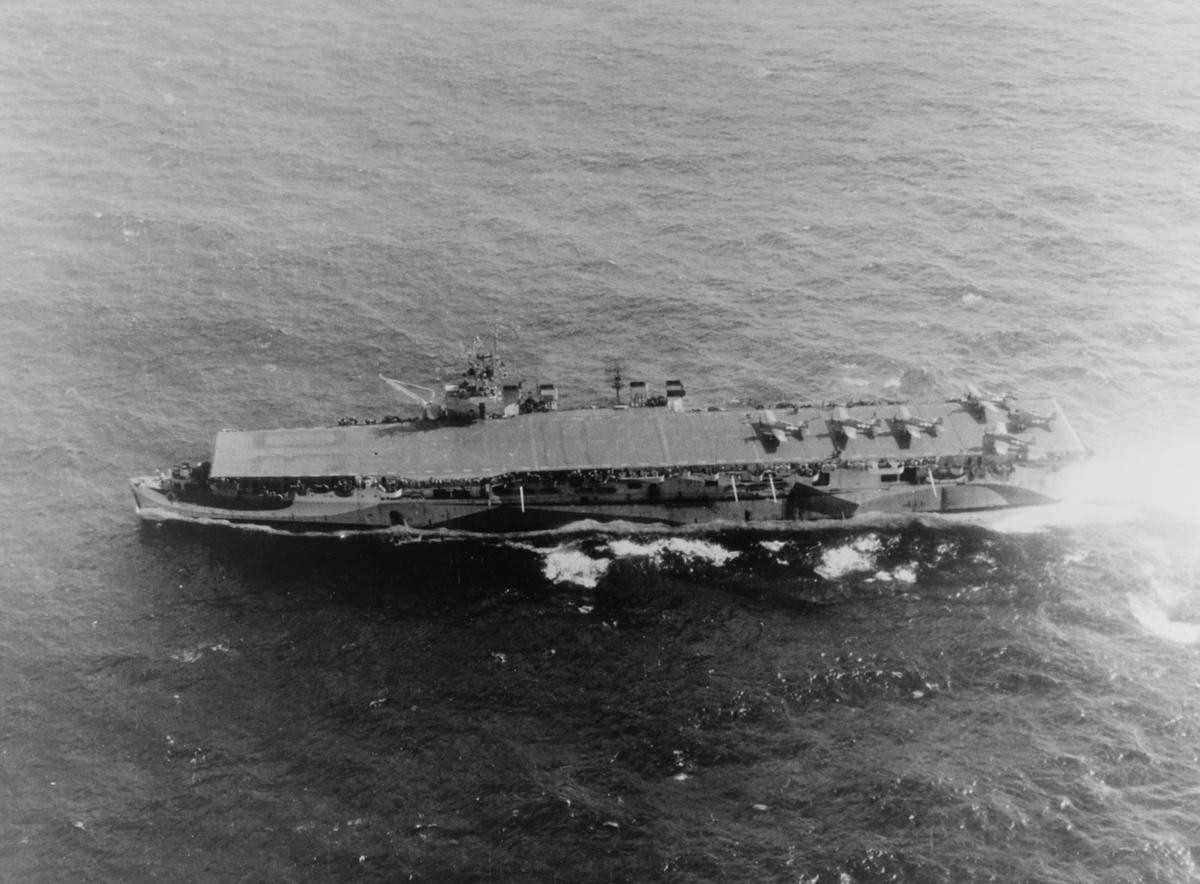
The carrier fought on to the end. In October 1944 she supported the Leyte landings and in the Battle of Leyte Gulf sent strikes against the Japanese center force in the Sibuyan Sea and the northern force off Cape Engaño, and on 30 October her guns shot down two suicide planes diving on her. In 1945 her aircraft struck Formosa, Luzon, Hong Kong and the Tokyo area, covered the landings on Iwo Jima and supported the invasion of Okinawa. On 5 April 1945, by the Navy’s account, more than five hundred Japanese aircraft attacked the fleet, and her gunners shot the wing off one suicide plane and turned its dive. Two days later, in the attack on the Japanese force led by the battleship Yamato, her bombers torpedoed the destroyer Hamakaze. When the fighting ended in August her aircraft dropped food and medicine over prison camps. She earned five battle stars and the Presidential Unit Citation. Decommissioned on 1 March 1947, she lay in the Pacific Reserve Fleet at San Diego, was reclassified as an auxiliary aircraft transport in 1959, was struck from the Navy list on 1 June 1970 and was sold for scrap on 15 December 1971.6, 14
So the name came to the cruiser with a record. The frigate had opened a consulate in Japan, freed six hundred captives and nearly started a war. The carrier had fought from the Marianas to Tokyo Bay. Both had been ships built in a hurry around an idea the Navy was still testing, and both had done more than their builders expected.
The name
| Type | Entered service | Service | End of service | |
|---|---|---|---|---|
| 1 | Screw frigate | 1850 (launched); in service from 1851 | Union Navy in the Civil War (Trent affair, 1861) | Wrecked on No Name Cay, Abaco, Bahamas, 1 Jan 1865; hulk sold 1871 |
| 2 | Light aircraft carrier (CVL-30) | Commissioned 15 Nov 1943 | Pacific War, including Okinawa, 1945; George H. W. Bush flew from her; Presidential Unit Citation | Decommissioned 1 Mar 1947 |
| 3 | Guided-missile cruiser (CG-56) | Commissioned 23 Jan 1988, Houston | Sixteen deployments; first Tomahawk of Desert Storm, 17 Jan 1991 | Ceremony 15 Sep 2023; decommissioned and stricken 29 Sep 2023; at Philadelphia, disposition pending |
Source: Chapter 24 and its note 8 (DANFS entries for all three ships); Chapter 10 (CVL-30 at Okinawa); Chapter 23. The frigate’s 1865 wreck is from DANFS and should be checked against the note before print (review item 85).
The Navy reuses its names, on the principle that a name gains weight with use. Names for its ships have traditionally been chosen and announced by the Secretary of the Navy, under the direction of the President and within rules set by Congress, from an annual list of recommendations that the service’s historians compile from their own research and from suggestions by sailors, veterans and the public, and that the Chief of Naval Operations forwards to him. By custom the name is settled before the ship is christened.9 Each type of ship has its own conventions, and they drift. Cruisers, by the Navy’s account, were once named for cities, then for states, and most recently for battles. The Ticonderoga class kept to the rule, until 2023, with a single exception, Thomas S. Gates (CG-51), named for a former Secretary of the Navy and Secretary of Defense; its other ships carried the names of battles and campaigns, Ticonderoga, Yorktown, Valley Forge, Bunker Hill, Mobile Bay, Antietam, Leyte Gulf.9 By the rule of her class, a cruiser named for the battle that won Texas its independence was the ordinary choice, and Gates the unusual one. In February 2023 the Navy renamed Chancellorsville (CG-62), named for a Confederate victory in the Civil War, as Robert Smalls.17
The letters and number on her hull follow a similar shorthand. CG is the Navy’s code for a guided-missile cruiser, CGN for the nuclear-powered version and DDG for a guided-missile destroyer, a smaller ship carrying much the same kind of equipment.10 CG-56 says in four characters that she was a cruiser armed with guided missiles and the tenth ship of her class.
Texas took the new ship to heart. From 1989 the Sam Houston Chapter of the Sons of the Republic of Texas, an organization of descendants of the republic’s citizens, gave an annual award to an enlisted sailor of the ship, and to a runner-up, and each September the chapter announced its winners at the Texian Navy Day celebration held aboard the old battleship Texas, moored at La Porte within sight of the battlefield. In 2019 the chapter renamed the honor the Bobby R. Smith USS San Jacinto Enlisted Sailor of the Year Award, for one of its past presidents.8, 15 The battleship left La Porte under tow in August 2022 for repairs at Galveston, and former crew of the cruiser living around Houston have since turned out to help the volunteers who care for her.16
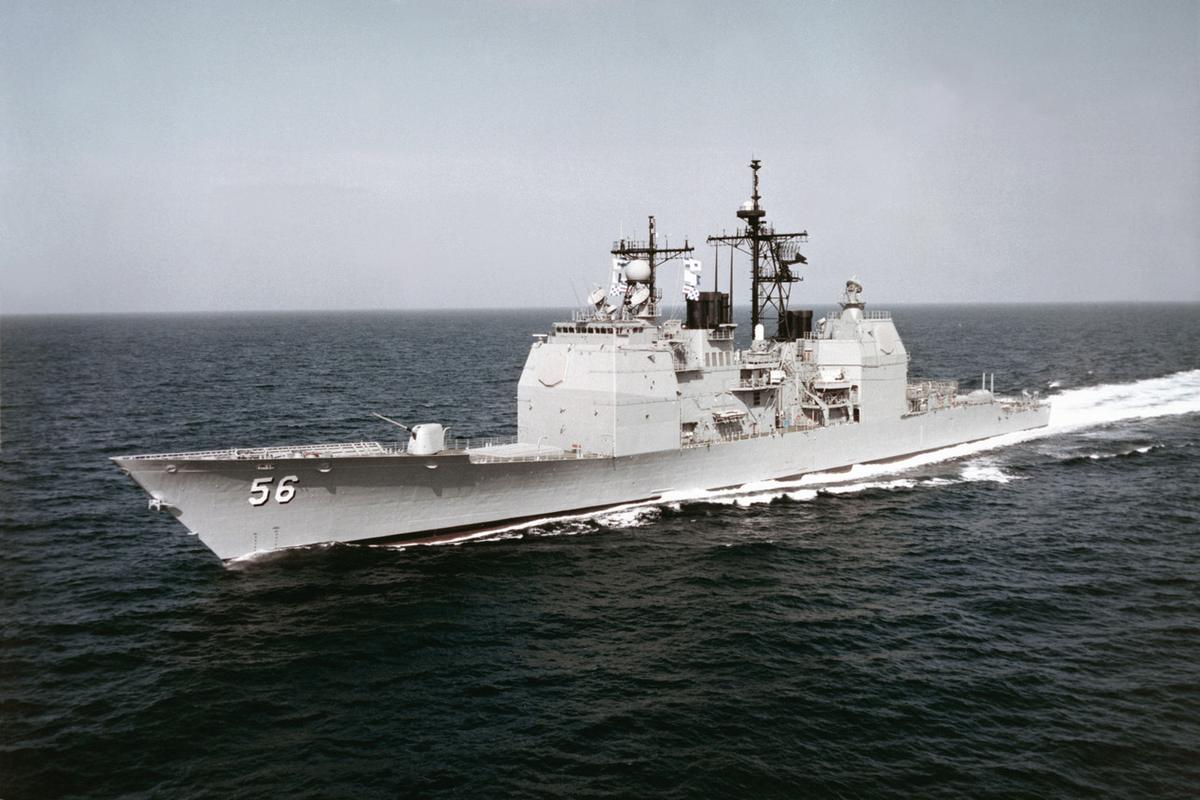
The ship acquired informal names of her own. Her crews called her the San Jac, or the Jac, or sometimes the Happy Jac. Her radio call sign was NJAC, which gave her another nickname on the voice circuits. Her officers liked to call the crew Gunslingers, a name that suited a ship with a great many weapons and Texas in her name. Her motto, Victory Is Certain, is the one most closely tied to her.11
She would serve thirty-five years. In that time she fired the first Tomahawk cruise missile the Navy launched in combat, deployed again and again to the Mediterranean and the Persian Gulf, collided with a nuclear submarine off Florida in 2012, and was decommissioned at Norfolk in September 2023. She never fought the fleet battle against the Soviet Navy for which she had been designed. She spent her life instead in the long interval after the Cold War, when ships built for one great war served in many smaller ones. Her design began in the 1960s and 1970s with a problem that the Navy of the time considered the most dangerous it faced: how a fleet could defend itself when dozens of missiles arrived at once.
Notes
- San Jacinto Monument: Texas Historical Commission, San Jacinto Battleground State Historic Site, which gives the height (567 feet) and describes the column as the tallest masonry column in the world. The ship’s length of 567 feet is given in Port of Houston Magazine, vol. 31, no. 11 (November 1987), in its notice of the ship’s commissioning. ↩
- The Texas Revolution is covered in any general history; the figures and sequence here follow the Texas Historical Commission’s battleground history and Houston’s own report of 25 April 1836, a copy of which is held by the Texas State Library and Archives Commission. ↩
- Houston’s report of 25 April 1836 (Texas State Library and Archives Commission). Texian and Mexican strengths are commonly given as about 900 and about 1,300 respectively; sources differ by tens of men. ↩
- Houston’s report gives roughly 630 Mexican dead, 208 wounded and 730 prisoners, and nine Texians killed or mortally wounded with about thirty wounded; later scholarship raises the Texian dead slightly. The tradition of the tune and the cannon is told in Kemp and Kilman, The Battle of San Jacinto and the San Jacinto Campaign (Houston, 1947). ↩
- Dictionary of American Naval Fighting Ships (DANFS), “San Jacinto I (ScFr),” Naval History and Heritage Command, for the frigate’s construction, her service under Captains Bell, Crabbe, Wilkes and others, the Townsend Harris voyage, the Storm King capture, the Trent seizure, the loss on 1 January 1865 and the sale of the hulk on 17 May 1871. NavSource’s page for the frigate gives the same dates. The Historical Dictionary of the United States Navy (2011), entry “Trent Affair,” gives 27 December 1861 as the date of Seward’s disavowal. ↩
- DANFS, “San Jacinto II (CVL-30),” Naval History and Heritage Command, for the carrier’s conversion history, her operations in 1944 and 1945, her battle stars and Presidential Unit Citation, her reserve service and her sale for scrap on 15 December 1971. ↩
- DANFS, “San Jacinto II (CVL-30),” and the George H. W. Bush Presidential Library’s account of the 2 September 1944 mission. Sources vary on the details of the loss of the two crewmen. ↩
- Sam Houston Chapter No. 38, Sons of the Republic of Texas, Bobby R. Smith U.S.S. San Jacinto Enlisted Sailor of the Year Award (flyer, December 2020), listing winners from 2000 onward and giving the award’s origin in 1989. ↩
- Ronald O’Rourke, “Navy Ship Names: Background for Congress,” ch. 2 in A. D. Eanuzzi, ed., Naval Issues: Background and Operations (Hauppauge, N.Y.: Nova Science Publishers, 2010), pp. 21–23 and note 6, for the authority to name ships, the Navy’s own description of how names are selected, the conventions for each ship type, and the exception for CG-51. ↩
- Historical Dictionary of the United States Navy (Lanham, Md.: Scarecrow Press, an imprint of Bloomsbury Publishing USA, 2011), “Ship Type Designations,” for the codes CG, CGN and DDG. ↩
- The nicknames “San Jac,” “the Jac,” “Happy Jac” and “Gunslingers,” and the call sign NJAC, come from crew recollection. ↩
- L. W. Kemp, “San Jacinto, Battle of,” Handbook of Texas Online (Texas State Historical Association), consulted 14 November 2026: Santa Anna’s arrival at Harrisburg on 15 April with about 700 men; the Texian army of about 1,200 less 248 sick men left with the baggage, and 910 Texians in the battle (the entry does not reconcile the two figures); Cós’s crossing of Vince’s Bridge with about 540 troops, bringing the Mexican force to about 1,200; the battle line formed about 3:30 p.m. on 21 April; the Twin Sisters; the battle cries; the battle “lasted but eighteen minutes”; Houston’s report of 630 Mexicans killed and 730 prisoners and of nine Texians killed or mortally wounded and thirty wounded; the captured stores and $12,000 in silver; Houston’s shattered ankle; the search parties of 22 April and the recognition of Santa Anna by other prisoners. The song “Will You Come to the Bower” is not in the entry and rests on the traditional account. ↩
- Dictionary of American Naval Fighting Ships, “San Jacinto I (Screw Frigate),” Naval History and Heritage Command, consulted 14 November 2026: laid down August 1847; launched 16 April 1850; the trial voyage of January 1852; decommissioned at Philadelphia 13 July 1853 for new machinery; sailed as East India Squadron flagship October 1855; Harris embarked at Penang 2 April 1856; the Siam treaty; repairs at Hong Kong; Shimoda 21 August 1856 and departure for Shanghai 4 September; the Barrier Forts, Foote’s landing party of about 300 and 176 cannon spiked; Storm King captured 8 August 1860 and 616 Africans freed at Monrovia; Wilkes in command from 27 August 1861; the Old Bahama Channel, about 230 miles east of Havana; the envoys held at Fort Warren and released 1 January 1862; Sewell’s Point, May 1862; Alabama at Martinique, 19 November 1862; the wreck near Great Abaco, 1 January 1865; the sale at Nassau, 17 May 1871. ↩
- Dictionary of American Naval Fighting Ships, “San Jacinto II (CVL-30),” Naval History and Heritage Command, consulted 14 November 2026: named Newark 11 February 1941; renamed Reprisal 2 June 1942 and San Jacinto about 4 January 1943; laid down 26 October 1942; launched 26 September 1943, sponsored by Mrs. Jesse Jones; commissioned 15 November 1943, Capt. Harold M. Martin; Air Group 51; the Marianas battle of 19 June 1944 (more than 400 Japanese aircraft, more than 300 shot down); the Chichi Jima mission of 2 September 1944 and the two small craft sunk; Leyte Gulf and the two suicide planes of 30 October 1944; 5 April 1945 (more than 500 attacking aircraft and the wing shot off a suicide plane); Hamakaze, 7 April 1945; the prison-camp drops; decommissioned 1 March 1947; reclassified AVT-5 on 15 May 1959; struck 1 June 1970; sold 15 December 1971; five battle stars and the Presidential Unit Citation. ↩
- Sons of the Republic of Texas, Sam Houston Chapter #38 (Katy, Texas), “Sam Houston Chapter’s Bobby R. Smith U.S.S. San Jacinto Enlisted Sailor of the Year Award,” flyer, December 2020: the award initiated in 1989; one sailor selected each year and a runner-up recognized; the names acknowledged at Texian Navy Day each September aboard USS Texas at La Porte; the award renamed in 2019. ↩
- City of Galveston public notice, August 2022, on the tow of the battleship Texas from La Porte to Galveston on 31 August 2022 for repairs; crew recollection of former crew volunteering with the Battleship Texas Foundation. ↩
- Seapower Almanac, January 2026 (Navy League of the United States), cruiser text, p. 16: Chancellorsville, named for a Confederate victory in the Civil War, renamed Robert Smalls on 27 February 2023. ↩
- Wilkes’s age and the U.S. Exploring Expedition (1838–42): source needed (DANFS or NHHC biography). unconfirmed ↩
- Sewell’s Point as the site of today’s Naval Station Norfolk: source needed (CNIC history page). unconfirmed ↩