Part Two: Name, Keel, Commissioning
Chapter 10The Cruiser That Aegis Built
On 4 May 1982, in the South Atlantic, an Argentine Navy jet flying low over the water fired a single French-built Exocet missile at the British destroyer HMS Sheffield. The missile covered its last miles a few yards above the waves, too low for the destroyer’s radar to hold, and struck her amidships. Its warhead is generally believed not to have exploded. The fire it started was enough. Twenty of her crew died, and Sheffield burned for days before she sank. The Royal Navy was one of the best-trained fleets in the world, and it had lost a modern warship to one inexpensive missile that arrived with almost no warning.1
The United States Navy did not need the Falklands to teach it that lesson. For two decades its planners had worried about the same threat on a far larger scale: dozens of missiles fired from several directions at once and timed to arrive within seconds of each other at the most valuable ships in the fleet. The cruiser that became San Jacinto’s class was designed to meet that attack. Everything about her that her crews would later live with, the crowded hull, the tall deckhouses, the dark room at her center, the captain’s rank, the roll, came from the answer the Navy found and the twenty years it took to find it.
The problem
At the center of the American fleet was the aircraft carrier. Her air wing of some eighty aircraft gave the fleet a reach no other ship could match, and she was, for all her size, vulnerable. A carrier went to sea surrounded by escorts that together made up a carrier battle group: cruisers and destroyers to defend her against air, surface and submarine attack, frigates, supply ships to refuel and rearm the group, and often an attack submarine ranging ahead. The escorts existed so that the carrier would not have to defend herself.
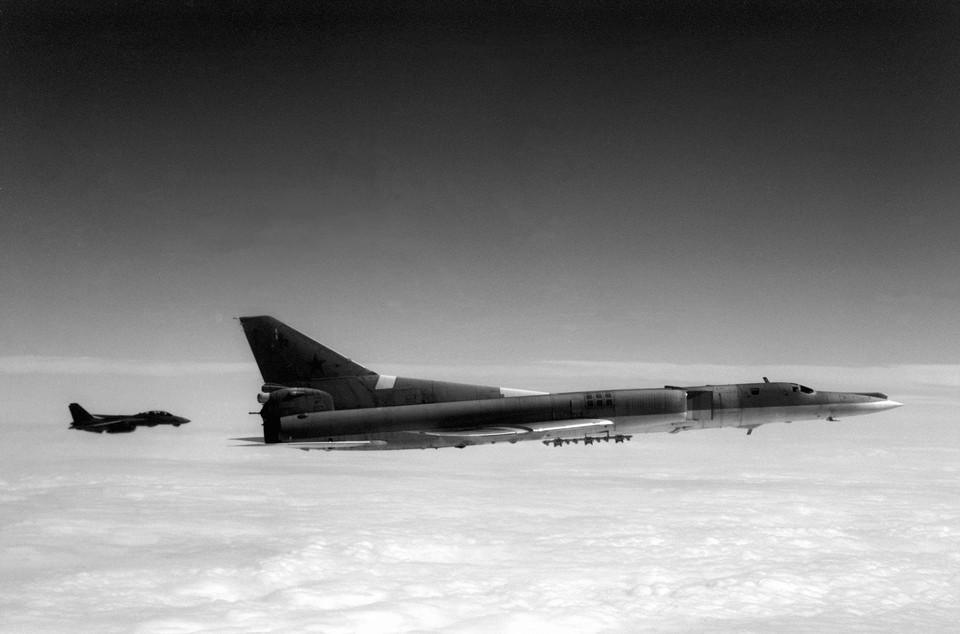
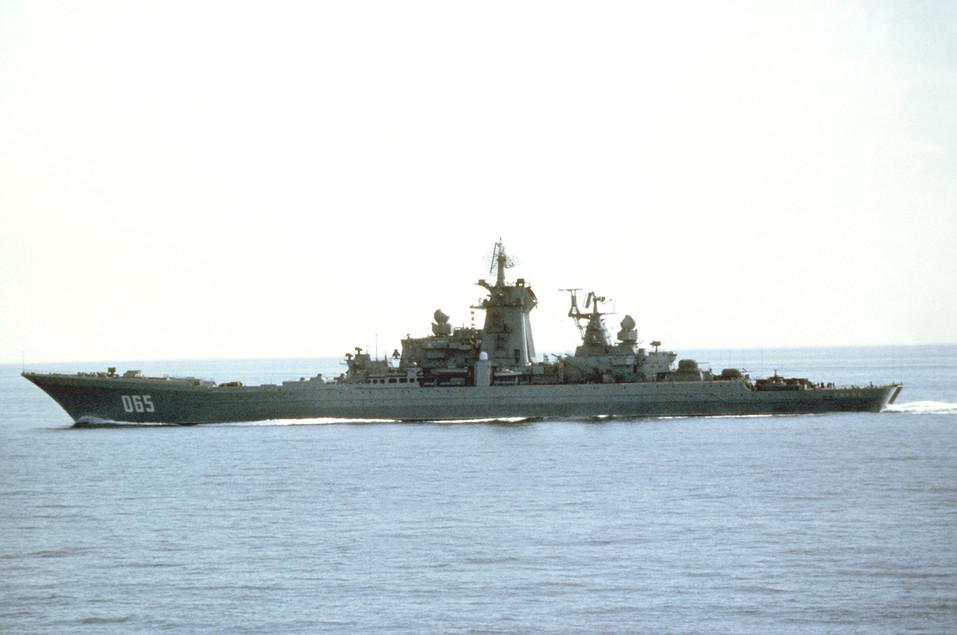
Through the Cold War the opponent the Navy planned against was the Soviet Union, and the Soviet Navy had its own plan for dealing with American carriers. Its naval air arm flew long-range bombers, among them the supersonic Tu-22M, known in the West as the Backfire, which carried large anti-ship cruise missiles such as the AS-4 Kitchen. Its submarines carried missiles of their own. Soviet doctrine called for a saturation attack: regiments of bombers and groups of submarines firing at a carrier group from several bearings at once, so that the defenders would face more incoming missiles than they had weapons, radars and time to handle.
Time was the heart of it. A missile skimming the sea stays hidden from a ship’s radar by the curve of the earth until it is a few tens of miles away, a minute or two from impact. In that time the defenders had to detect it, decide which of the tracks on their screens were hostile, assign weapons and shoot, all before the first missile arrived.2 Men at radar scopes, passing ranges and bearings by voice, could do that for one target or two. They could not do it for fifty.
The Navy had faced something like it before. In the spring of 1945, off Okinawa, Japanese Navy and Army air units threw hundreds of aircraft, most of them flown by suicide pilots, at the American fleet. The Navy’s history of the light carrier San Jacinto (CVL-30), the second ship of the name, which was in the fleet off Okinawa, puts more than five hundred attacking aircraft over the fleet on 5 April; most day-by-day chronologies of the campaign date the first great mass raid a day later. The fleet survived because its fighters were numerous and its anti-aircraft guns were everywhere, but ships were hit, and dozens were lost over the campaign. The lesson the Navy took from the kamikaze war was that a determined enemy attacking from many directions could overwhelm any air defense that depended on human operators and guns.3 A kamikaze was a guided missile with a man for a seeker. The Soviet missiles of the 1960s were faster, flew lower, and did not have to be talked into dying.
A shield
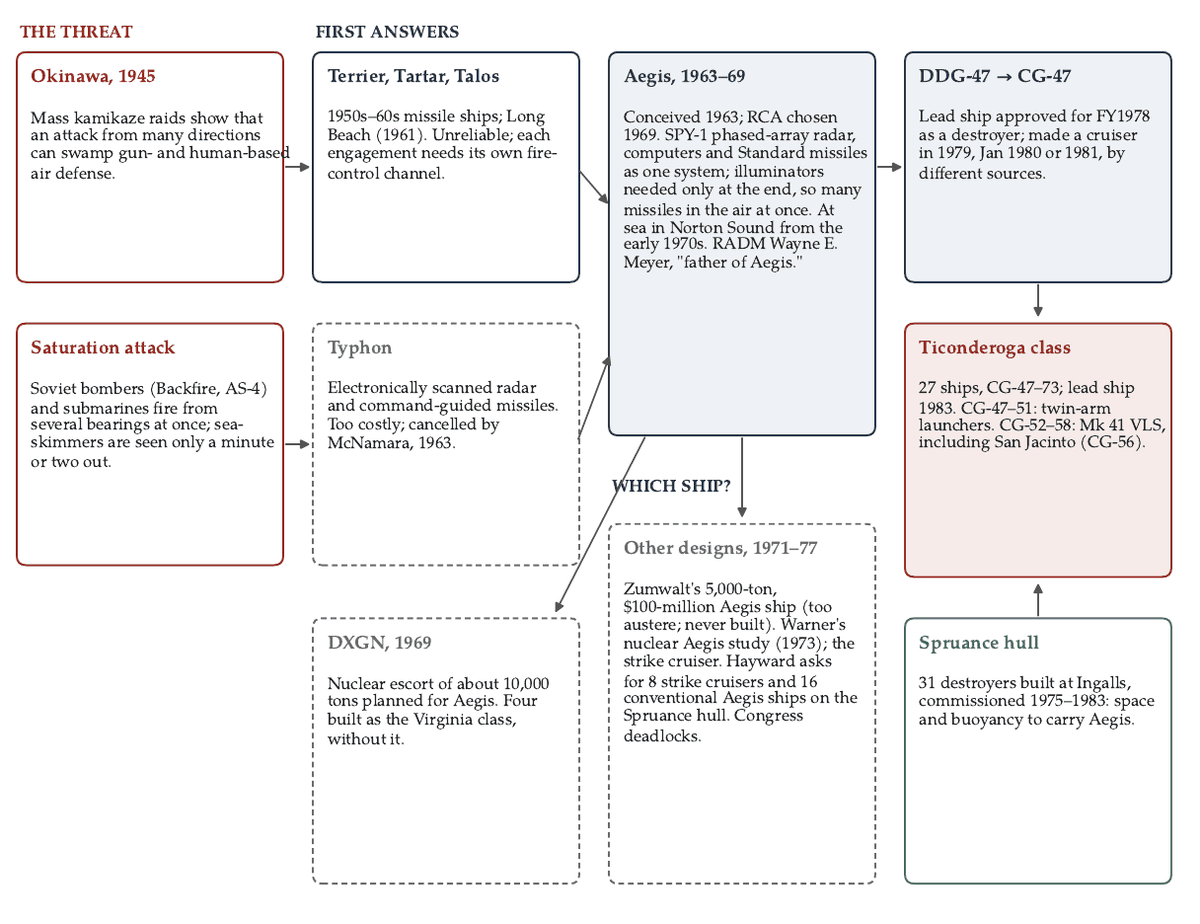
Through the 1950s and 1960s the Navy’s answer was the missile. It armed cruisers and destroyers with surface-to-air missiles, the medium-range Terrier and Tartar and the long-range Talos, and rebuilt several wartime cruisers to carry them, taking off gun turrets to make room for launchers. In 1961 it commissioned Long Beach, the first nuclear-powered surface warship, built from the keel up as a missile cruiser.
The first generation was pushed into service at the cost of reliability. By 1962 the Office of the Secretary of Defense was cataloguing a massive investment in missile systems, none of which could be called dependable, and five-inch guns were added to Long Beach and to the Albany-class conversions, ships that had been designed as the ultimate gunless missile cruisers.12 The systems also had a limit built into them. Each engagement needed its own fire-control channel, a guidance radar locked on one target from launch until the warhead burst, so that a Talos cruiser with two sets of guidance radars could fight only two targets at a time. Their search radars were dishes that swung round every few seconds. Against a handful of aircraft that was enough. Against a saturation attack it was not.4, 12
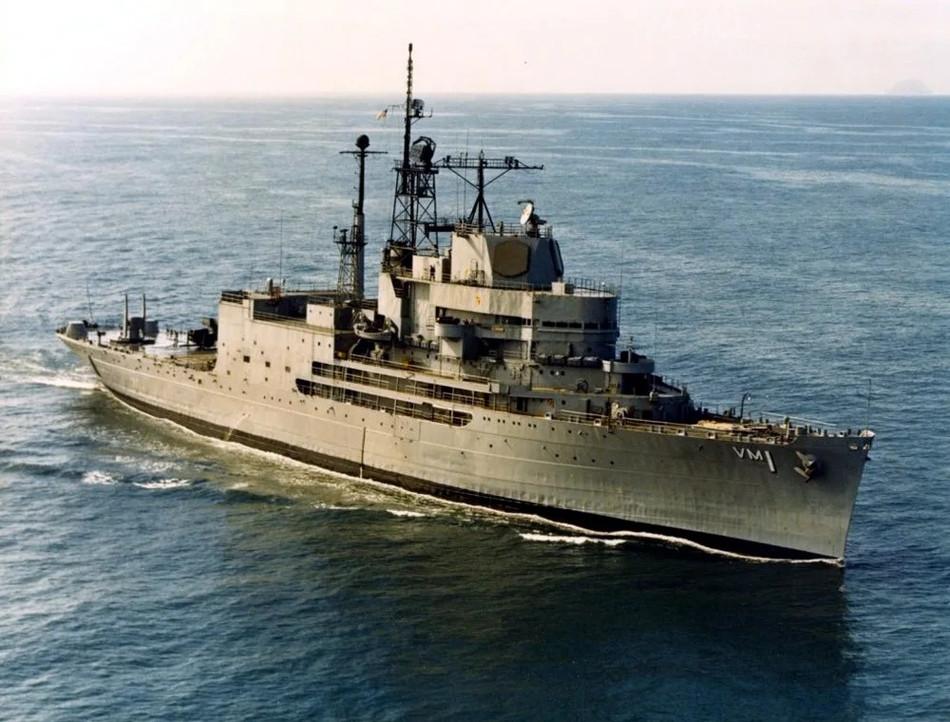
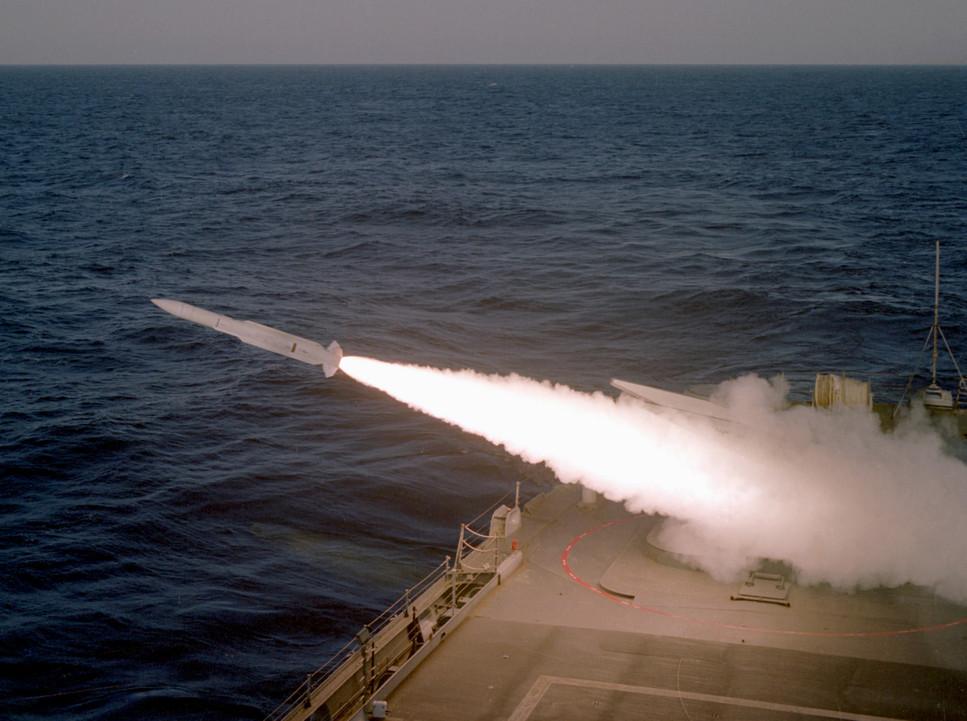
The Navy tried to leap the problem with a system called Typhon, built around a powerful electronically scanned radar and missiles that the ship would guide by command. Typhon grew costly and in its tests fell short of its goals. In October 1961 the Navy estimated that a Typhon cruiser would cost at least $175 million, against $115 million for a conventional nuclear frigate, and Secretary of Defense Robert S. McNamara had already struck the cruisers from the program. By 1963 he had concluded that the Navy’s existing missile systems were not performing anywhere near their design capability. He cancelled Typhon and spent his limited money on making the existing systems work, while keeping some funds for a cheaper approach to the same idea, the Advanced Surface Missile System. It would later be named Aegis, for the shield of Zeus in Greek myth.4
The new system was conceived in 1963 in the hope of combining Typhon’s answer to saturation with cheaper solid-state electronics. Its development dragged, partly because fixing the Talos, Terrier and Tartar systems, by then firing in combat off Vietnam, came first, and no prime contractor was chosen until 1969, when the Advanced Surface Missile System became RCA’s Aegis. Most of its cost lay in the radar and the fire-control computers; the missile was a modified Standard, the successor to Tartar. In 1969 the system was meant for a nuclear-powered escort of about 10,000 tons, then called DXGN. The Navy reckoned at the time that each carrier needed four missile escorts and that a nuclear carrier’s escorts should be nuclear too, and by 1970 as many as twenty-three nuclear frigates were in prospect, most of them with Aegis. The system did not keep pace. The four nuclear frigates actually built, which became the Virginia-class cruisers, went to sea without it.21 The delay cost the fleet a decade. The first-generation ships began to leave service in the 1970s with no successors ready, and Aegis, slowed further by the argument over what ship should carry it, entered service about ten years later than planned.12
How it worked
Aegis joined a radar, computers and missiles into a single system that could carry out the whole chain from detecting a target to destroying it, quickly and against many targets at once. The older ships had been collections of separate equipment, a search radar here, a guidance radar there, with sailors carrying information from one to the other. Aegis was designed from the start as one machine.
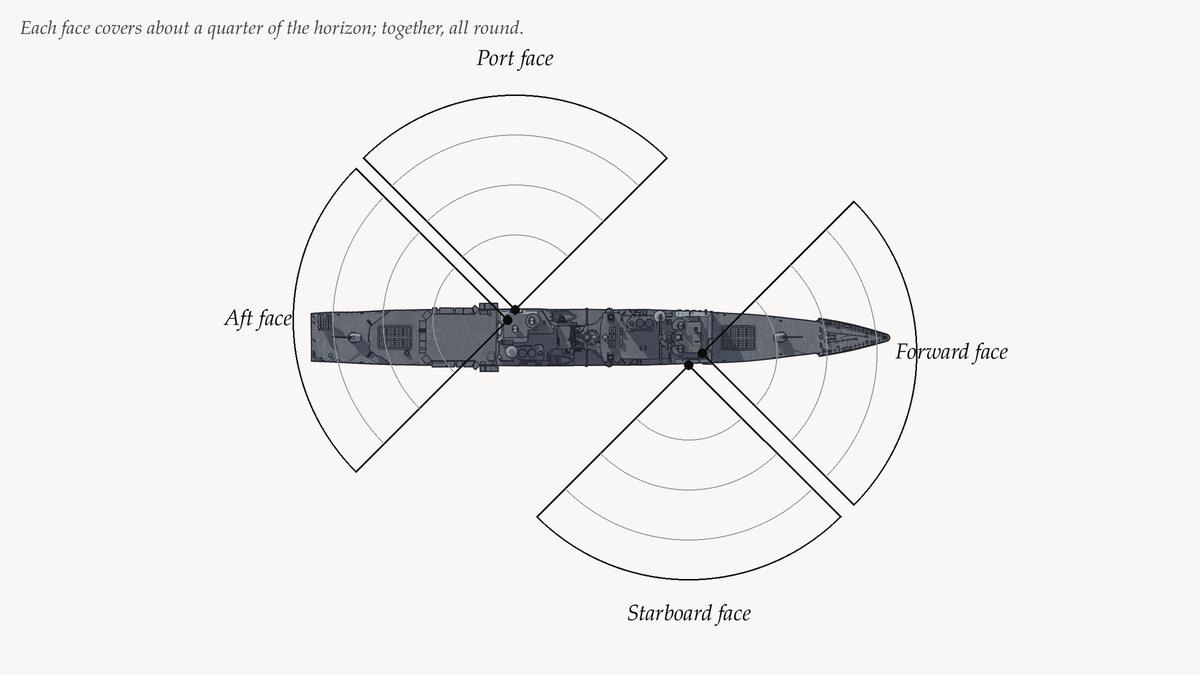
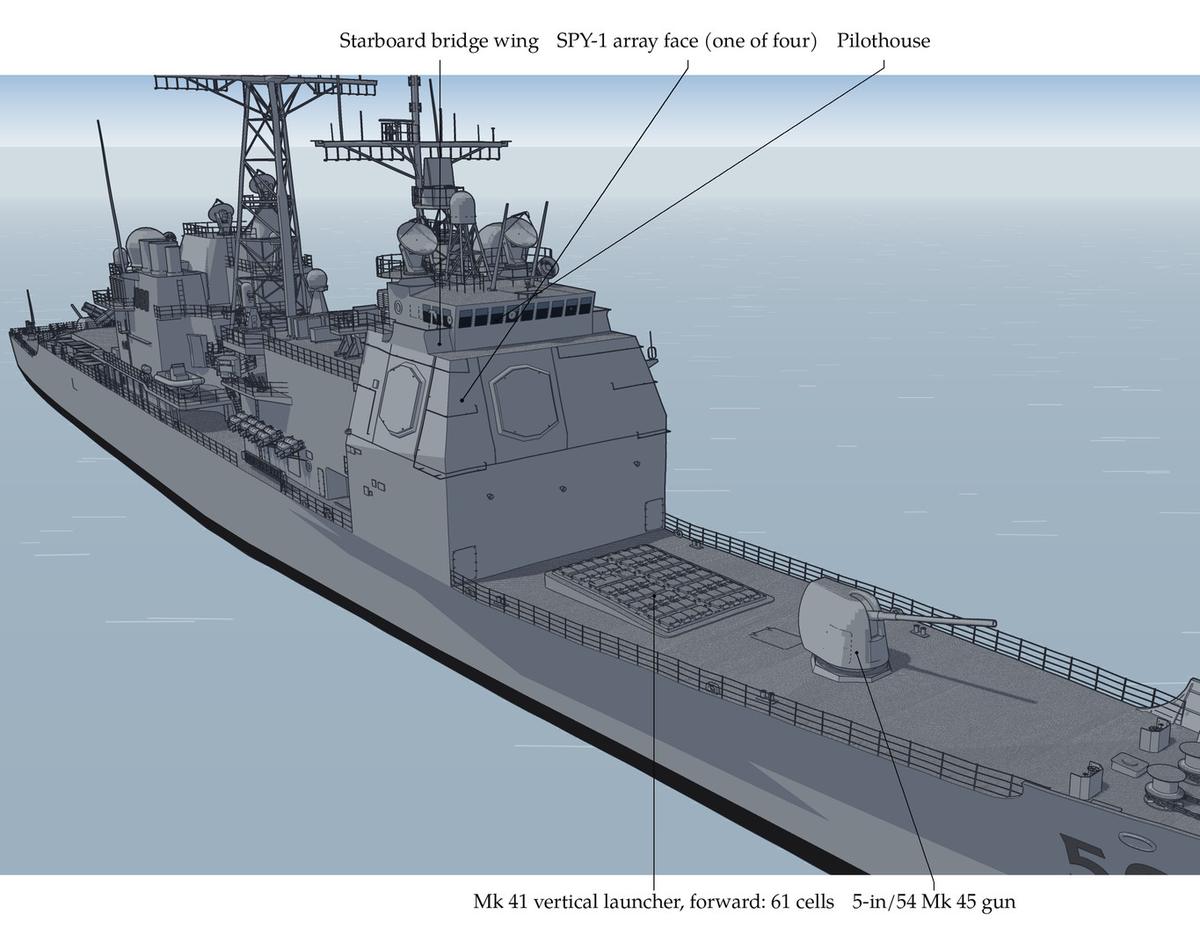
Its radar, the SPY-1, had no moving parts. It was built from four flat panels on the superstructure, each covering a quarter of the horizon and each made up of thousands of small antenna elements. By varying the timing of the signal sent to each element, the system could steer a narrow beam almost instantly to any point in the sky, and it could search, track and guide missiles at the same time, switching between those jobs in a fraction of a second. A rotating radar saw a given target once every few seconds. The SPY-1 could come back to it as often as it needed.5 Those four panels are the flat octagons on an Aegis ship’s deckhouses, the feature by which anyone on a pier can tell her from an older ship.
Two computers took the radar’s tracks, compared them with what was known of friendly aircraft and likely enemy weapons, ranked them by threat, and proposed, or in the fully automatic mode carried out, the assignment of missiles. The missile was an improved Standard, which the ship’s radar could steer by command for most of its flight. Only in the last seconds did a separate transmitter, called an illuminator, have to light up the target for the missile’s seeker to home on, and because each missile needed an illuminator only at the end, one ship could have many missiles in the air at once. That was the trick that broke the old limit of one target for each guidance radar. The Congressional Budget Office, the research agency that advises Congress on the budget, described the cruiser’s version in 1981 as having four illuminators, so that it could engage at least four targets at the same instant and control more than four missiles in flight in long-range engagements. The Navy’s historical dictionary credits the radar with detecting and tracking as many as a hundred targets at once.5 A newspaper’s account of the system in 1988 put Aegis at about half the cost of a billion-dollar cruiser and said it could control the airspace around the ship to more than two hundred miles.19
The developers first took the system to sea in a converted seaplane tender, USS Norton Sound, which carried a prototype of the radar and weapons from the early 1970s. RCA built the radar at Moorestown, New Jersey. The program was run for years by Rear Admiral Wayne E. Meyer, generally credited as its driving force and known in the Navy as the father of Aegis.6 Meyer’s method was to test each piece at sea before building the next, and to keep one office in charge of the radar, the computers, the missile and the ship together, so that no part could be blamed on another. It was slow. It also produced a system that worked when the first ship was commissioned, which the missile ships of the 1950s had not.22
Which ship
A combat system is not a warship. Somebody had to decide what hull would carry Aegis, and that argument nearly killed it.
It came to a head under Admiral Elmo Zumwalt, Chief of Naval Operations from 1970 to 1974. The Navy of the early 1970s was caught between a fleet built in the Second World War and just after it, now wearing out, and new ships that cost far more than the ones they replaced. Zumwalt’s answer was a high-low mix: a smaller number of very capable, expensive ships, which became the Spruance-class destroyers, and a larger number of cheaper escorts, which became the Oliver Hazard Perry-class frigates. Both classes cost more than the Navy had hoped, and both had critics. The Spruances were thought lightly armed for their size, the Perrys compromised.7
The small ship. Zumwalt wanted Aegis in numbers. A study by the Center for Naval Analyses, the Navy’s research organization, showed a need for 18 to 35 Aegis ships by the early 1980s, and in August 1971 he asked for a plan to put the system to sea in very large numbers, in ships much smaller and cheaper than the nuclear DXGN. The figures were set low on purpose. A first estimate of $120 to $180 million a ship became a firm limit of $100 million in 1973 dollars, with a ceiling of 5,000 tons. Of 139 computer runs in the first series of studies, only one design fell within those bounds, and it was too austere even for Zumwalt: a single launcher with sixteen missiles, no long-range air-search radar, no anti-submarine capability at all, no fire control for Harpoon, and no data links with which to share a picture with the rest of the fleet.
The limits rose to 6,000 tons and $125 million, and each version of the small Aegis ship added something back, a second launcher, a helicopter, a search radar. By early 1973 it displaced 6,161 tons and was to cost $136.1 million; later that year, with a single large launcher holding 64 missiles, it came in at 5,884 tons but about $200 million. It reached preliminary design, with procurement planned for fiscal 1977. In the dollars of 1981, the design historian calculated, the original $100 million limit came to about $600 or $650 million, while the second ship of the class actually built, CG-48, was then expected to cost about $820 million.21
The small ship was never built. The design historian later judged it fortunate that it had been abandoned, since it was not easy, miniaturization or not, to squeeze 10,000 tons’ worth of combat system into a 5,000-ton hull.21
The nuclear ship. In May 1973 Secretary of the Navy John Warner ordered a study of a nuclear Aegis ship. Admiral Hyman Rickover, who had built the nuclear submarine force, pressed for nuclear-powered surface escorts, far more expensive but able to steam for years without refueling, and nuclear ships meant only a few of them, not nearly enough to escort every carrier. The argument ran for years, and at one point it seemed that Aegis, expensive in its own right and without a ship to carry it, might be cancelled.7, 21
The design offices meanwhile worked on a nuclear-powered strike cruiser, meant to be far more than an escort, with Aegis, Tomahawk and Harpoon missiles, an eight-inch gun, armor over her magazines and quarters for an admiral and his staff. In the presentation to Secretary of Defense James Schlesinger that began the Aegis shipbuilding program, Admiral Hayward asked for eight nuclear strike cruisers and sixteen conventionally powered Aegis ships derived from the Spruance hull. In May 1975 the Navy announced that strike-cruiser construction would begin in fiscal year 1978. Congress deadlocked between the supporters of nuclear and conventional ships, and neither the lead Aegis destroyer nor the lead strike cruiser was approved for 1977.8, 21 The Ford administration then gave up the strike cruiser for a cheaper nuclear Aegis ship developed from the Virginia design and numbered CGN 42, without the armor or the flag quarters, and the Carter administration cancelled that ship as well, although it came back in the Reagan administration’s five-year shipbuilding plan.8, 21
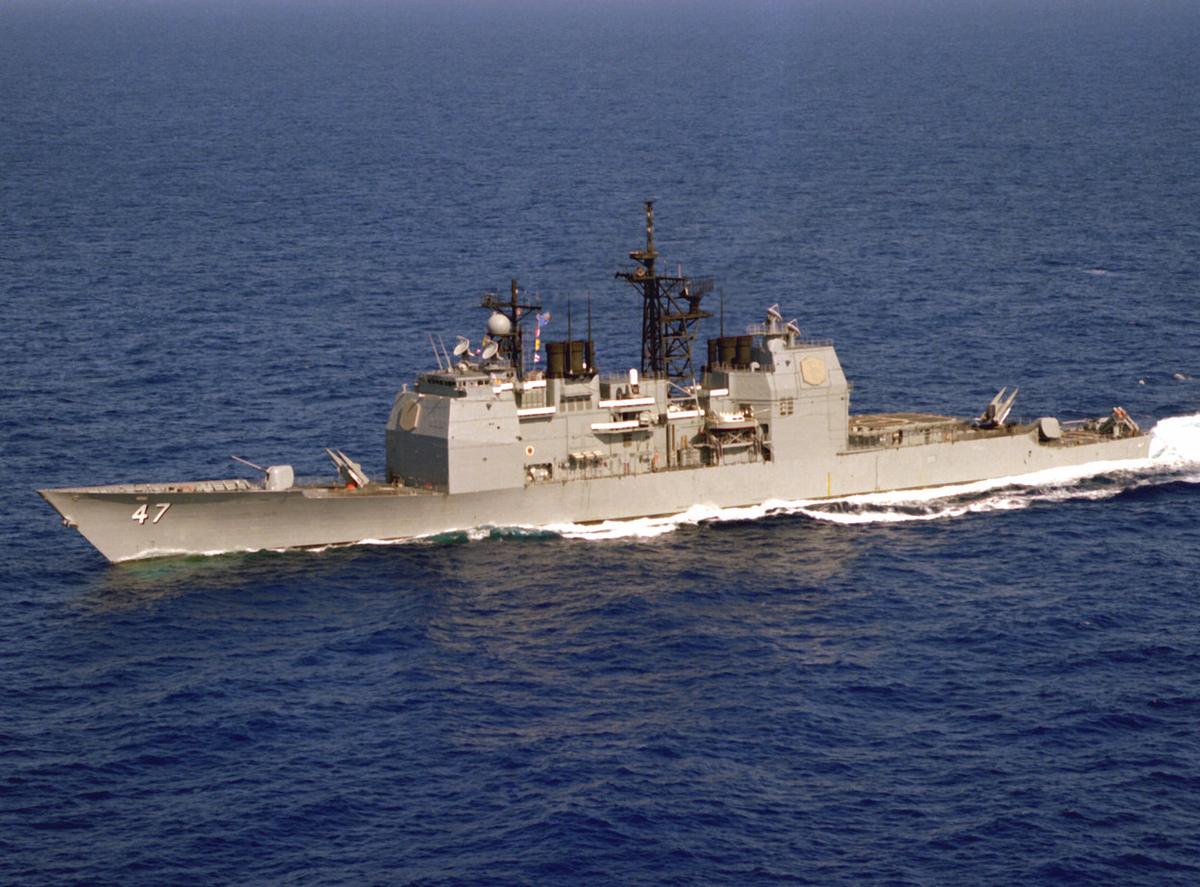
The ship that survived. What was left, after the small ship had proved too small and the nuclear ships too dear, was a plan worked out quietly in the Aegis planning office: put the system in a hull the Navy already knew.9 The lead ship, DDG-47, was approved at last in the program for fiscal 1978. The Ingalls yard of Litton Industries received the contract on 22 September 1978, and the ship was laid down on 21 January 1980, for completion in January 1983.21
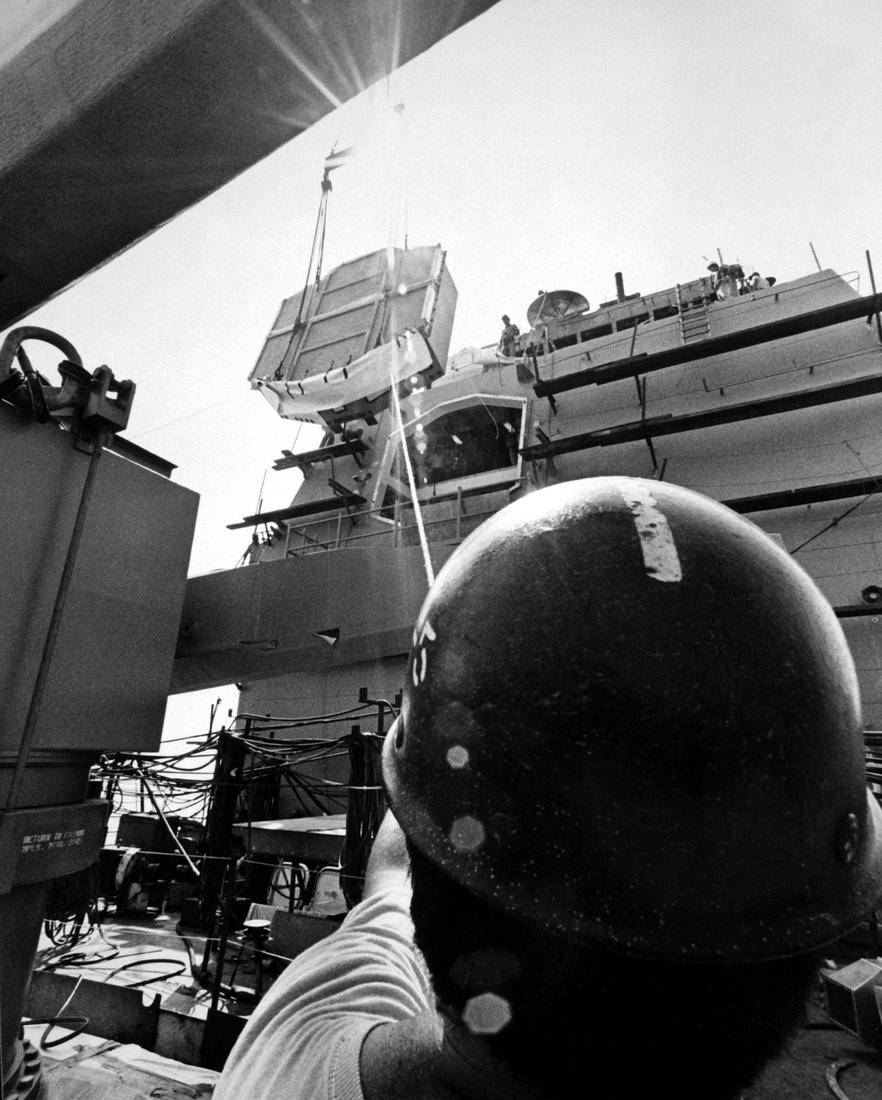
The hull was the Spruance’s. The destroyer had reserves of space and buoyancy, and the new system needed all of them; the additions for Aegis, the destroyer historian wrote, ate up virtually all of the enormous margin designed into the original ship. Its deckhouses were extremely heavy. One study of the design reckoned that Aegis added topside weight equal to three of the triple six-inch turrets of a wartime light cruiser, without the barbettes, armor and deep magazines that had helped such a ship carry her guns. The designers cut weight wherever they could and gave up some safety margins, which they could do only because the Spruances already at sea had supplied so much data. When the first ship was inclined to test her stability, she was still found to be badly overweight, and more compromises followed. The extra weight made her ride lower than a Spruance, and a raised bulwark was added at the bow to make up for the lost freeboard and keep the forecastle drier. The hull proved stronger than expected, and it could carry the load.9, 13, 21
She was a much bigger ship than the austere design of the early 1970s, which would have had one launcher and two illuminators. CG-47 had launchers forward and aft and four illuminators, and her SPY-1A radar was split between a forward and an after deckhouse, partly so that one hit could not blind it.21
The price of the bargain was paid by everyone who later served in the class. A hull with no margin left is a hull that cannot easily take the next thirty years of added equipment, and a ship that carries that much weight that high rolls. The sailors of the 2010s who said the ship was more paint than metal, and who learned to brace when she turned, were living inside decisions made in a design office before most of them were born.
Destroyer or cruiser
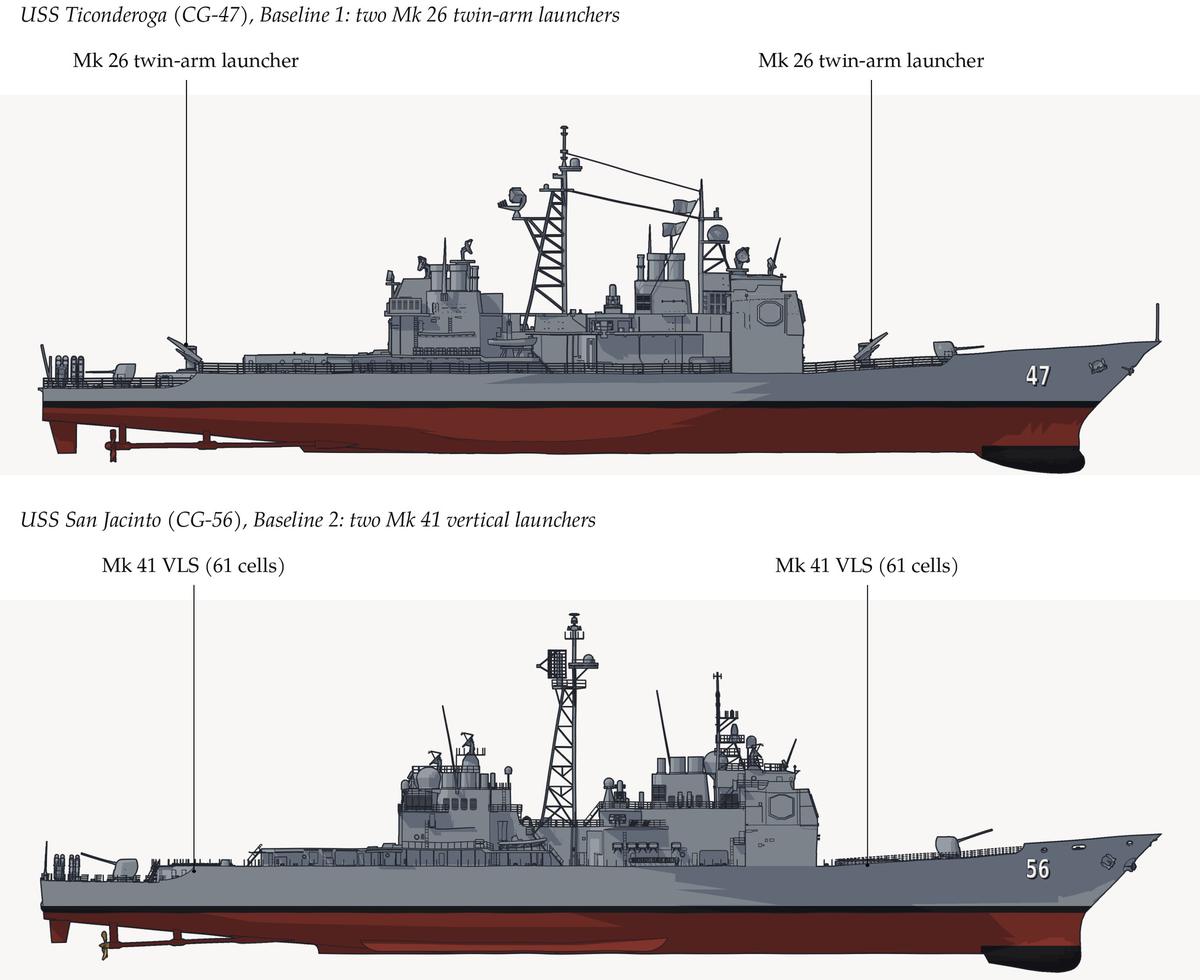
Because she was built on a destroyer hull, the first ship took the next number in the guided-missile destroyer series; the last ship of the Coontz class had been Preble, DDG-46.13 The Navy then made her a cruiser, CG-47. The sources give three dates for the change. The Congressional Budget Office’s 1981 study says 1979, the history of American destroyers says January 1980, the month her keel was laid, and the companion history of cruisers says 1981.8, 12, 21 The destroyer history calls the change little more than part of a general shift in designations, but notes that it was controversial, because a congressional action of 1974, later rescinded, had seemed to require special justification for building any non-nuclear major combatant, such as a cruiser.21 The new number left the cruiser numbers 42 through 46 unused, and the cruiser historian noted hints that numbering her CG-47 rather than CG-42 reflected a belief that a true Aegis cruiser would one day be built.
The renaming followed an earlier one. In 1975 the Navy had moved its large guided-missile frigates into the cruiser category without changing their hull numbers and had given the word frigate to the smaller ocean escorts.8 The result was a ship much bigger than the destroyer she grew from, more capable in air defense than any cruiser the Navy had had, and called a cruiser from the month her keel was laid. Not everyone was pleased. In 1981 the destroyer historian wrote that the design still carried the enmity of many naval ship designers, who thought the contractor-led process that had produced the Spruance was tainted and believed the Navy could do better in-house from a fresh start.21
Her crews never doubted what she was. Whatever the paperwork had once said, a ship that ran the air defense of a carrier group under a captain’s command was a cruiser to the people aboard her, and they said so to anyone who called her anything else.
The ship that resulted
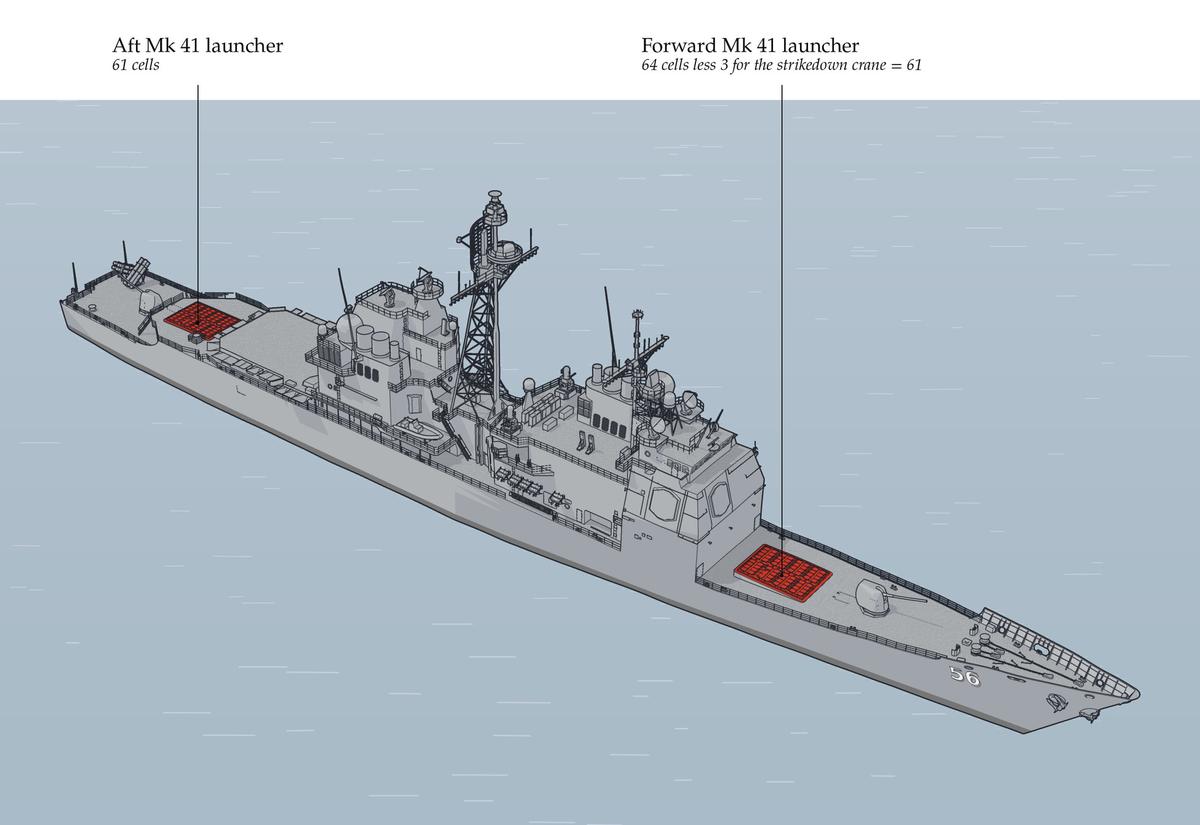
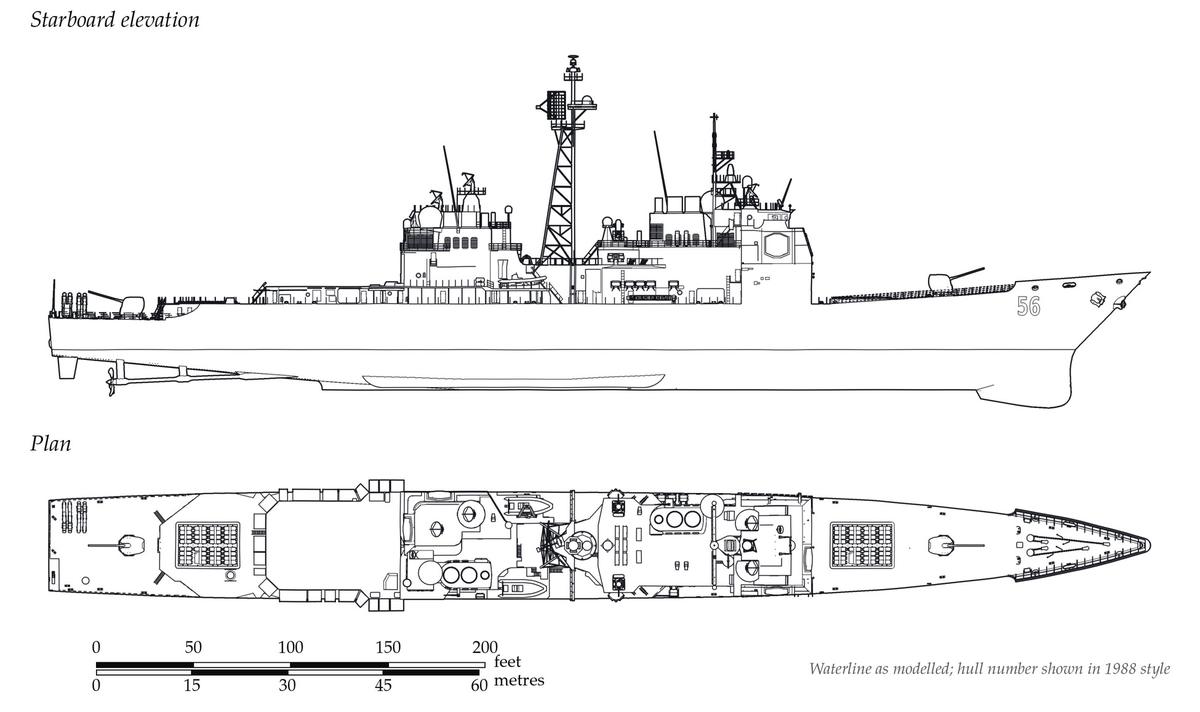
The lead ship, USS Ticonderoga (CG-47), was built at Ingalls Shipbuilding in Pascagoula, Mississippi, and joined the fleet in 1983. The class was about 567 feet long and 55 feet in the beam and displaced about 9,500 tons fully loaded. The references differ by a few feet and a few hundred tons, and by a few dozen in the size of the crew, which the Navy’s historical dictionary gives as 364 and the Navy’s 2023 release on San Jacinto as about 330.9 The Spruance hull beneath her had already gone into thirty-one destroyers, every one built at Ingalls and commissioned between 1975 and 1983, and in 1981 the Congressional Budget Office called that proven hull and machinery a reliable and capable platform for the new combat system.9, 10
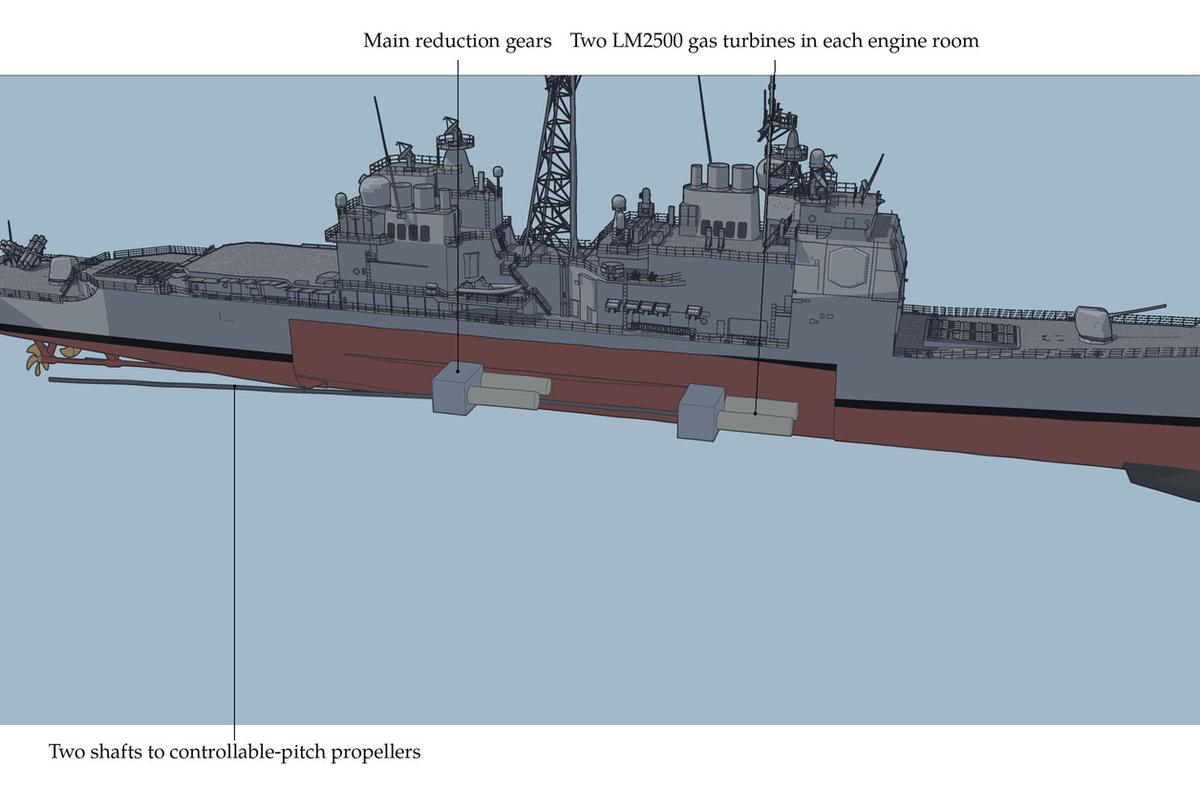
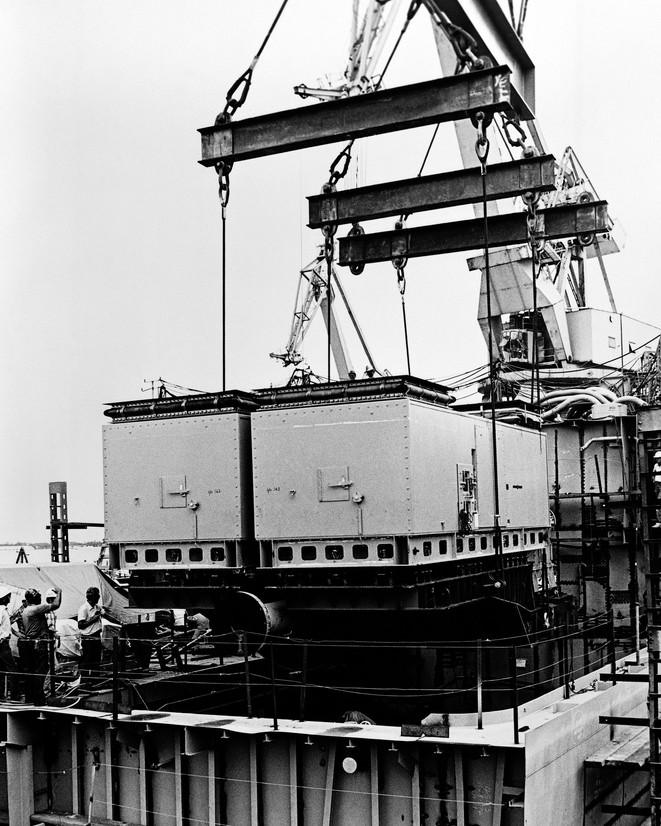
The plant. Four General Electric LM2500 gas turbines, marine cousins of an airliner’s jet engine, drove two shafts through reduction gears that brought their speed down to between 55 and 168 revolutions a minute, and the ship could make more than thirty knots. A gas turbine cannot run backward, so the propellers had blades whose pitch could be reversed, which also let the ship stop quickly in what sailors call a crash stop. With twin rudders the ships could turn very sharply, so sharply that experienced shiphandlers recommended limits on rudder angle, and in a hard turn they heeled outward and came back upright more slowly than ships of other classes.14
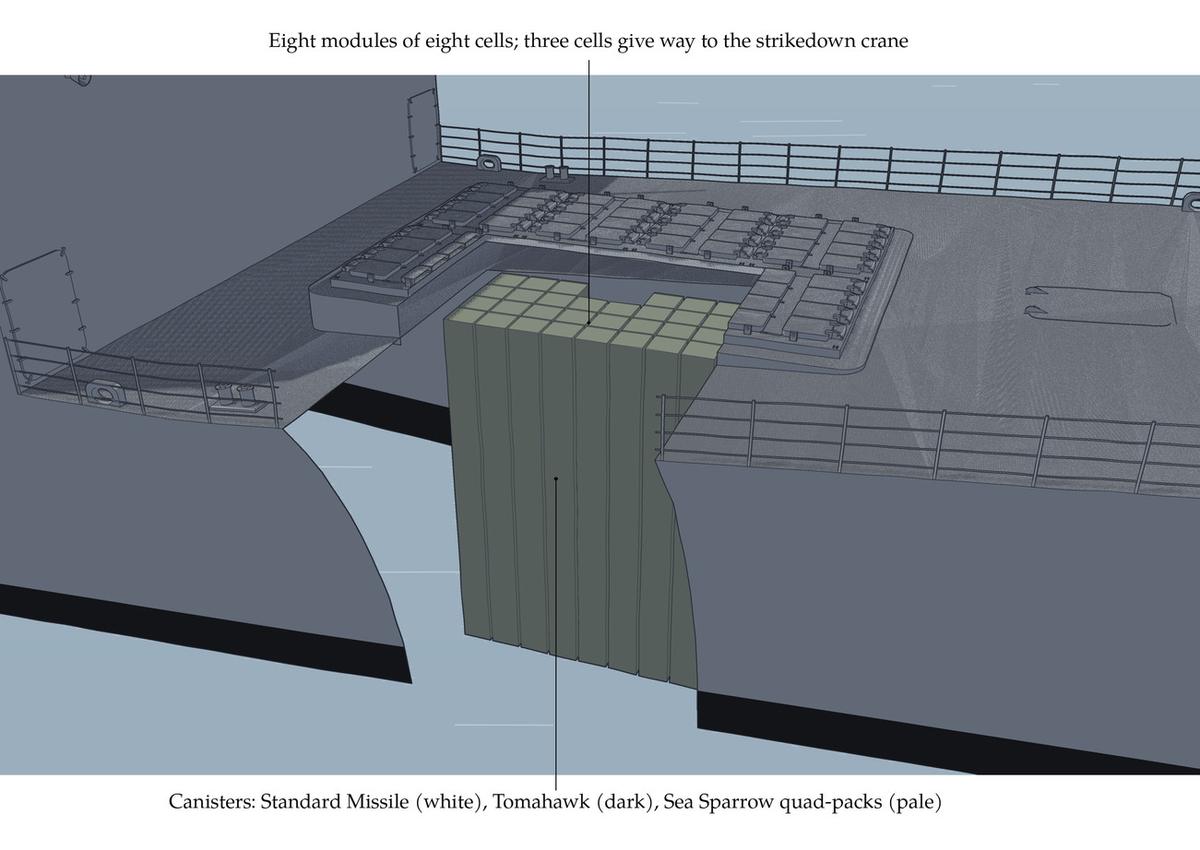
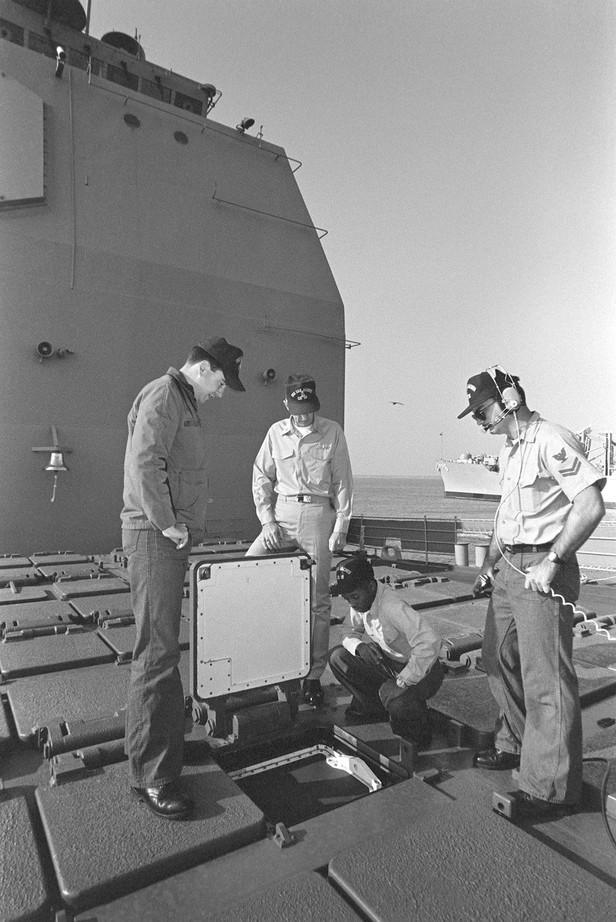
The launchers. The ships were built in groups that the Navy called baselines, each with its own set of equipment. The first five carried two twin-arm Mk 26 launchers, forward and aft, which between them could fire four missiles at a time. From the sixth ship, Bunker Hill (CG-52), the twin arms gave way to the Mk 41 vertical launching system. Each missile sat in its own cell below the deck, and any cell could be opened and its missile fired within a second or so, whatever its type. A twin-arm launcher had to be reloaded from its magazine after every pair of shots, and if the launcher jammed, every missile behind it was useless. In the vertical system each missile was its own launcher. Each of the two launchers had sixty-four cells in an eight-by-eight block, three of them given over to a folding crane for loading, which left sixty-one, or 122 for the ship. The load could be set for the mission: Standard missiles for air defense, Tomahawk cruise missiles for land attack, anti-submarine rockets.9, 13 Bunker Hill fired the first test missiles from the new launchers during her sea trials in May 1986, four of them in one week, four months before she was commissioned.15
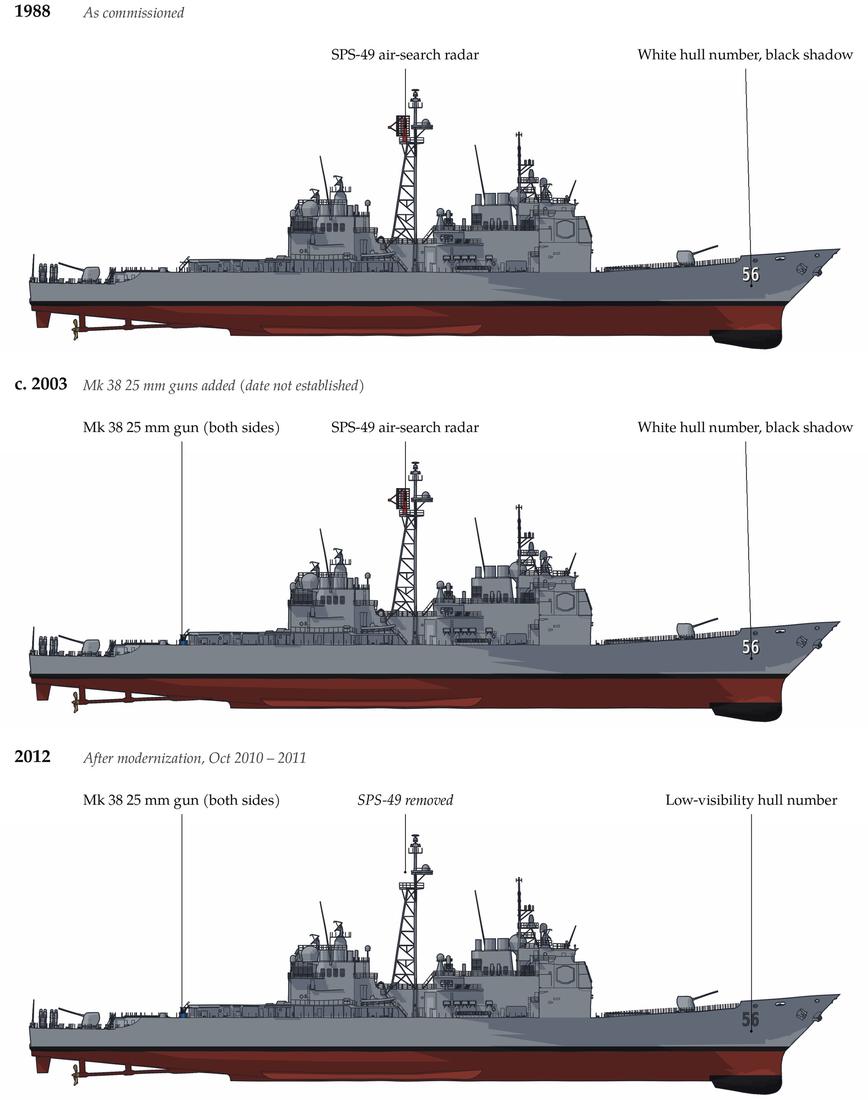
San Jacinto’s baseline. San Jacinto, CG-56, belonged to the second baseline, the seven ships from CG-52 through CG-58. Besides the vertical launchers, which gave them Tomahawk, these ships carried a rigid inflatable boat in place of the old motor whaleboat, a towed sonar array from CG-54 onward, and a hull built partly of HY-80 high-strength steel, with the after Aegis deckhouse lowered by two feet, to save weight. Later baselines brought a lighter radar, the SPY-1B, and then more powerful computers.13
The Tomahawk made the class a different kind of ship. A cruiser that could fire dozens of them could strike targets far inland, and the first time San Jacinto went to war, in 1991, that was the work the Navy remembered her for. A ship designed purely as a shield had become, with one change of launcher, a ship that could start a war from five hundred miles offshore.
The rest of her weapons. Beside the missiles the ships carried two five-inch guns, one forward and one aft; eight Harpoon anti-ship missiles in deck canisters; two Phalanx close-in weapon systems, rapid-fire 20-millimeter guns with their own radars for last-ditch defense against missiles; torpedo tubes; and a hangar and flight deck for two helicopters, which carried the ship’s eyes and anti-submarine weapons far beyond her own horizon. For finding submarines there was a large sonar in a dome beneath the bow and, from Antietam (CG-54), the towed array, a long cable of hydrophones streamed far astern, away from the noise of the ship’s own machinery.9, 13
The room at the center. Her machinery could not be seen from the pier, and neither could the place where she was fought. Inside the hull, below the bridge, lay the combat information center, the CIC, where the system’s picture of the sea and sky came together on consoles and large screens. A newspaper’s description of an Aegis cruiser in 1988 put four large color displays in her darkened control rooms, with some twenty-five officers and technicians on watch.19 The people there did not see the sea. They saw the picture: every aircraft, ship and submarine that the ship’s sensors, or her consorts’, had detected, with its identity and course. Because the system built so complete a picture of the air, an Aegis cruiser was usually named the battle group’s anti-air warfare commander, responsible for the air defense of every ship in it. The Ticonderogas became the carriers’ constant companions, and San Jacinto would spend most of her career in a carrier’s company: John F. Kennedy, George Washington, John C. Stennis, Harry S. Truman, Theodore Roosevelt, Dwight D. Eisenhower.9
What the machine could not do
The same 1988 account recorded what the system could not do. It could not identify an aircraft from its radar image alone; that remained, a senior officer told the paper, a human decision, made by weighing a great deal of information.19 The point had just been made in the hardest way. On 3 July 1988, six months after San Jacinto’s commissioning, her sister ship Vincennes (CG-49) shot down Iran Air Flight 655, an airliner, over the Persian Gulf, having taken it for a hostile aircraft. Iran said 290 people had died.19
The radar had tracked the airliner correctly from the moment it took off. The error was made by people, under pressure, in a dark room, reading a picture and believing what they expected to see. The crews that later stood watch in Aegis combat information centers, San Jacinto’s among them, were trained with that morning as the warning.23
Cost, competition and a long life
The money was argued over from the start. In April 1981, at the request of the House Armed Services Committee, the Congressional Budget Office published a study of the surface warships the Navy would need in the 1990s. It set out the requirement the Navy had given Congress in 1980: at least six carrier battle groups of two carriers each, with three Aegis cruisers and nine other surface warships in every group, seventy-two surface combatants in all, and three surface action groups of four ships, each built around an Aegis cruiser. It priced the cruiser at about $1.02 billion in 1982 dollars, and a nuclear version at about $1.34 billion. Each of its four alternative programs assumed that at least eighteen of the cruisers would be approved through 1985, and three of them assumed twenty-four.10
The study also set down the case against buying only new ships. The cruiser was so expensive that the program would move slowly, it observed, while ten older missile ships could be modernized for about $260 million, a quarter of the price of a single new cruiser. Even its most ambitious option, which wanted the next class to be nuclear-powered, conceded that the cruiser program should go ahead, for the ship’s combat capability and to keep the shipyards working.10
The program went ahead in a climate that for once favored ships. John Lehman, Secretary of the Navy from February 1981 to April 1987, pressed the Reagan administration’s goal of a 600-ship Navy, a Cold War fleet built to fight the Soviet Navy at sea, with fifteen carriers at its center and about a hundred attack submarines.11, 20 The cruisers were built in two yards that the Navy set against each other. In January 1986 it divided contracts worth more than $629 million for three more ships, $386.6 million to Bath Iron Works in Maine for two and $242.6 million to Ingalls for one, the second year running in which Bath had won over Ingalls.16
Competition did not end the trouble. In March 1987 the Navy and Bath were in dispute over delays and overruns on six cruisers worth about $1.2 billion. A three-month strike in 1985 had nearly stopped work, a senior Navy official conceded that the Navy had been late with radar equipment, and internal memos released by a watchdog group alleged that steel meant for the cruisers had been marked as inspected without being inspected.17 In June 1988 federal investigators in the Pentagon procurement scandal were examining whether a former Assistant Secretary of the Navy and a Washington consultant had improperly helped Unisys win electronics work on the Aegis program.18
By then the Navy was already planning what would follow. In 1980 a repeat cruiser of the class was reckoned at about $800 million in 1980 dollars, and the smaller Aegis destroyer meant to replace the older destroyers from fiscal 1985, with a cheaper and less capable version of the SPY-1 radar, had a target cost of $500 million. That design became the Arleigh Burke class.21 The destroyer that the cruiser’s crews would spend three decades being mistaken for was, from the beginning, the cruiser’s cheaper successor.
The class ran to twenty-seven ships, CG-47 through CG-73. The first five, with their twin-arm launchers, were never refitted with vertical launchers; the Navy retired them instead.13 By 2009, the Navy’s historical dictionary records, twenty-two of the twenty-seven were active and five had been retired, and the class had seen action in the Mediterranean in 1986, in the Gulf in 1988 and in Desert Storm in 1991.9 The rest, San Jacinto among them, would be modernized, argued over and kept in service long after the Navy had first expected to replace them. That argument came much later. Her own story began at Ingalls, the yard on the Gulf Coast that had built the lead ship and would build the tenth.
| Hull | Name | Builder | Launchers | Commissioned | Decommissioned | 2014 | Status (15 Nov 2026) |
|---|---|---|---|---|---|---|---|
| CG-47 | Ticonderoga | Ingalls | Mk 26 (BL1) | 22 Jan 1983 | 30 Sep 2004 | — | Scrapped 2022 |
| CG-48 | Yorktown | Ingalls | Mk 26 (BL1) | 4 Jul 1984 | 10 Dec 2004 | — | Scrapped 2024 |
| CG-49 | Vincennes | Ingalls | Mk 26 (BL1) | 6 Jul 1985 | 29 Jun 2005 | — | Scrapped 2011 |
| CG-50 | Valley Forge | Ingalls | Mk 26 (BL1) | 18 Jan 1986 | 30 Aug 2004 | — | Sunk as target 2006 |
| CG-51 | Thomas S. Gates | Bath | Mk 26 (BL1) | 22 Aug 1987 | 16 Dec 2005 | — | Scrapped 2017 |
| CG-52 | Bunker Hill | Ingalls | Mk 41, BL2 | 20 Sep 1986 | 22 Sep 2023 | A | Reserve |
| CG-53 | Mobile Bay | Ingalls | Mk 41, BL2 | 21 Feb 1987 | 10 Aug 2023 | A | Sunk as target 2026 |
| CG-54 | Antietam | Ingalls | Mk 41, BL2 | 6 Jun 1987 | 27 Sep 2024 | A | Reserve |
| CG-55 | Leyte Gulf | Ingalls | Mk 41, BL2 | 26 Sep 1987 | 20 Sep 2024 | A | Reserve |
| CG-56 | San Jacinto | Ingalls | Mk 41, BL2 | 23 Jan 1988 | 29 Sep 2023* | A | Stricken; Philadelphia |
| CG-57 | Lake Champlain | Ingalls | Mk 41, BL2 | 12 Aug 1988 | 1 Sep 2023 | A | Reserve |
| CG-58 | Philippine Sea | Bath | Mk 41, BL2 | 18 Mar 1989 | 25 Sep 2025 | A | Reserve |
| CG-59 | Princeton | Ingalls | Mk 41, later | 11 Feb 1989 | — | A | Active |
| CG-60 | Normandy | Bath | Mk 41, later | 9 Dec 1989 | 25 Sep 2025 | A | Reserve |
| CG-61 | Monterey | Bath | Mk 41, later | 16 Jun 1990 | 16 Sep 2022 | A | Reserve |
| CG-62 | Robert Smalls (ex-Chancellorsville) | Ingalls | Mk 41, later | 4 Nov 1989 | — | A | Active |
| CG-63 | Cowpens | Bath | Mk 41, later | 9 Mar 1991 | 27 Aug 2024 | B | Reserve |
| CG-64 | Gettysburg | Bath | Mk 41, later | 22 Jun 1991 | — | B | Active; life extended |
| CG-65 | Chosin | Ingalls | Mk 41, later | 12 Jan 1991 | — | B | Active; life extended |
| CG-66 | Hué City | Ingalls | Mk 41, later | 14 Sep 1991 | 23 Sep 2022 | B | Reserve |
| CG-67 | Shiloh | Bath | Mk 41, later | 18 Jul 1992 | 30 Sep 2026 | B | Reserve |
| CG-68 | Anzio | Ingalls | Mk 41, later | 2 May 1992 | 22 Sep 2022 | B | Reserve |
| CG-69 | Vicksburg | Ingalls | Mk 41, later | 14 Nov 1992 | 28 Jun 2024 | B | Sold for scrap 2026 |
| CG-70 | Lake Erie | Bath | Mk 41, later | 10 May 1993 | 25 Sep 2026 | B | Reserve |
| CG-71 | Cape St. George | Ingalls | Mk 41, later | 12 Jun 1993 | — | B | Active; life extended |
| CG-72 | Vella Gulf | Ingalls | Mk 41, later | 18 Sep 1993 | 4 Aug 2022 | B | Reserve |
| CG-73 | Port Royal | Ingalls | Mk 41, later | 9 Jul 1994 | 29 Sep 2022 | B | Reserve |
Source: Wikipedia, “Ticonderoga-class cruiser” (accessed 15 Nov 2026) for dates and status, to be checked against the Naval Vessel Register before print; launcher groups from Chapter 10. 2014 column, from the Stackley testimony (Chapter 20): A, modernized ships to deploy until retirement from 2019; B, the phased-modernization group. *San Jacinto: NVR date; ceremony 15 Sep 2023.
Notes
- The loss of HMS Sheffield on 4 May 1982 is covered in Lawrence Freedman, The Official History of the Falklands Campaign, and in every general account of the war. Twenty crew members died. ↩
- The Soviet saturation-attack concept, the Backfire/AS-4 combination and the problem of detecting sea-skimming missiles are described in the standard literature on Cold War naval strategy; the account of the Aegis rationale in Kurt Greiner, Warship Pictorial 35: Ticonderoga Class Cruisers (Classic Warships Publishing, 2010), p. 1, opens with “the threat of Soviet saturation missile attacks.” ↩
- For the first San Jacinto (CVL-30) at Okinawa, including the mass air attack of 5 April 1945, see DANFS, “San Jacinto II (CVL-30),” Naval History and Heritage Command. The Navy’s history dates the heaviest attack to 5 April 1945; the Pacific Wrecks day-by-day chronology for 6 April 1945 dates the first all-out raid to 6 April. ↩
- Norman Friedman, U.S. Cruisers: An Illustrated Design History (Naval Institute Press, 1984), pp. 417–422, for the Typhon program, its cost estimates of October 1961 ($175 million for a Typhon cruiser against $115 million for a nuclear frigate), Secretary McNamara’s decisions of September 1961 and 1963, and the survival of the concept as the Advanced Surface Missile System and then Aegis. Greiner, pp. 1–2, gives the “shield of Zeus” derivation of the name. ↩
- Greiner, pp. 1–4, on the SPY-1 phased-array radar and the design of the weapons system, including the tracking of many targets and the ability of the Standard Missile to be guided without continuous illumination. Congressional Budget Office, Naval Surface Combatants in the 1990s: Prospects and Possibilities (April 1981), pp. 28–29, on the four illuminators of the system as configured for the cruisers and the Standard Missile’s need for illumination only in the final phase of its flight; James M. Morris and Patricia M. Kearns, Historical Dictionary of the United States Navy (2011), entry “AEGIS Missile Weapon System Mk-7,” on the tracking of as many as 100 targets. ↩
- The Norton Sound test ship, RCA’s role at Moorestown, and Wayne E. Meyer’s role are standard Aegis history, taken from general accounts of the program rather than from a cited document. ↩
- Greiner, p. 1, on Zumwalt’s “high-low mix,” the Spruance and Oliver Hazard Perry classes, and Rickover’s push for nuclear-powered escorts; Friedman, pp. 420–421, on the Aegis system’s origin in the Virginia-class nuclear frigates and the compromise Zumwalt forced. Zumwalt’s term as Chief of Naval Operations, 1 July 1970 to 29 June 1974: Historical Dictionary, Appendix B. ↩
- Friedman, pp. 420–422, on the strike cruiser (CSGN), the May 1975 announcement of eight strike cruisers and sixteen Aegis destroyers, the Ford administration’s decision to drop it for a cheaper Aegis ship, and the observation that numbering the ship CG 47 rather than a lower number “shows a belief that some type of true Aegis cruiser will ultimately be built.” The redesignation of the missile frigates as cruisers in 1975 without change of hull numbers, and the unused cruiser numbers 42 through 46, are in Friedman, Appendix B (“Names and Dates List”). The 1979 redesignation of DDG-47 as CG-47, and the reason the Navy gave for it, are in Congressional Budget Office, Naval Surface Combatants in the 1990s (April 1981), p. 4, footnote. ↩
- Greiner, pp. 2–6, on the hull, the stability problems of the first ship, the bulwark added to the bow, the LM2500 propulsion, the Mk 26 and Mk 41 launchers (sixty-four cells less three lost to a crane gives sixty-one; two arrays give 122), the Mk 45 guns, Harpoon, Phalanx, sonar and the towed array fitted from CG-54; the Navy’s historical dictionary, in its entry for the Ticonderoga-class cruisers (CG), is the source for the class’s arrival in the fleet in 1983, its 565-foot-10-inch length, 55-foot beam, displacement of 9,400 to 9,530 tons, complement of 364, total of twenty-seven ships, actions in 1986, 1988 and 1991, and the 2009 count of twenty-two active ships and five retired; its entry for the Spruance class gives thirty-one destroyers completed between 1975 and 1980, 563 feet long, 7,800 tons, all built at Ingalls (Morris and Kearns, Historical Dictionary of the United States Navy, 2011). The 567-foot length and 9,500-ton displacement are in Port of Houston Magazine, November 1987. The crew of about 330 (30 officers and 300 enlisted) is from the Navy’s decommissioning release for the ship, DVIDS 453585, 15 September 2023. The carriers San Jacinto escorted are from the ship’s deployment histories. ↩
- Congressional Budget Office, Naval Surface Combatants in the 1990s: Prospects and Possibilities (Washington, D.C.: U.S. Government Printing Office, April 1981): prepared at the request of the House Committee on Armed Services (Preface); the Aegis cruiser’s hull and machinery, weapons and LAMPS III helicopters, pp. 38 and 58; the Navy’s requirement of six two-carrier battle groups and three surface action groups, p. 9; unit cost of about $1.02 billion in fiscal year 1982 dollars, pp. 28 and 38, and of about $1.34 billion for the nuclear-powered alternative, p. xviii; the four program options, each assuming at least eighteen ships of the class approved through 1985 and three assuming twenty-four, pp. xix and 46; the modernization of ten older missile ships for about $260 million, pp. xvi and 12; the concession in the discussion of the highest-capability option, p. 49. ↩
- John Lehman’s term as Secretary of the Navy, 5 February 1981 to 10 April 1987: James M. Morris and Patricia M. Kearns, Historical Dictionary of the United States Navy (Bloomsbury Publishing USA, 2011), Appendix A. ↩
- Friedman, U.S. Cruisers (note 4): introduction, on the name ship of the class laid down as DDG 47; chapter 13, “Into the Missile Age,” on the separate fire-control channel needed for each engagement by first-generation missile systems (a Talos ship with two sets of guidance radars could engage two targets at a time), the cost of McNamara’s decision as the first-generation ships left the force without successors, Aegis entering service about a decade late because of the controversy over its platform, and the redesignation of DDG 47 as CG 47, which Friedman dates to 1981. The Congressional Budget Office (note 8) dates it to 1979. The difference is unresolved. ↩
- Greiner, Warship Pictorial 35 (note 2): Preble (DDG-46) as the last of the Coontz class; the weight of the Aegis deckhouses, equal to three triple six-inch turrets (the comparison credited to Michael C. Potter, Electronic Greyhounds); the first ship overweight at her inclining, riding lower than the Spruances, and the bow bulwark; the “Ticonderoga Class Variations” section on the baselines, with Baseline 2 (CG-52 through CG-58) introducing vertical launch and Tomahawk, the rigid inflatable boat from CG-53, the towed array from CG-54, HY-80 hull steel and the lowered after deckhouse; and the first five ships, which were retired rather than refitted with vertical launchers. Greiner gives no reason for that decision. ↩
- Greiner, propulsion and handling: shaft speeds of 55 to 168 revolutions a minute, the reversible-pitch propellers and crash stop, Prairie air through the propeller blades, the twin rudders, the recommended limits on rudder angle, and the ships’ tendency to heel out of a hard turn. ↩
- “Navy Begins Testing Multiple Launchers Aboard New Cruiser,” Los Angeles Times, 24 May 1986: four test missiles fired that week from the vertical launching system of Bunker Hill, then in sea trials and due to be commissioned in September. ↩
- “2 Shipyards Win Navy Contracts,” New York Times, 10 January 1986: contracts worth more than $629 million for three Ticonderoga-class cruisers, $386.6 million to Bath Iron Works for two and $242.6 million to the Ingalls division of Litton Systems for one; the second consecutive year in which Bath was chosen over Ingalls. ↩
- “Bath Iron Works, Navy Are in Talks On Cruiser Delays,” Wall Street Journal, 13 March 1987: six cruisers for about $1.2 billion; the 1985 strike; the Navy’s late delivery of radar equipment; quality-assurance memoranda released by the Project on Military Procurement. ↩
- “U.S. Studies if Defense-Scandal Figures Helped Unisys Get Navy Cruiser Work,” Wall Street Journal, 28 June 1988. ↩
- “The Downing of Flight 655; Aegis Cruiser Protected By High-Tech Umbrella,” New York Times, 6 July 1988: Aegis at about half of a cruiser’s $1 billion cost; control of the airspace to more than 200 miles; four color screens in darkened control rooms with 25 officers and technicians; identification by radar image alone “a human decision.” “Navy Missile Downs Iranian Jetliner Over Gulf; Iran Says 290 Dead,” Washington Post, 4 July 1988. ↩
- Ronald O’Rourke, “Navy Force Structure and Shipbuilding Plans: Background and Issues for Congress,” chapter 1 in Naval Issues (Nova Science, 2011; reprint of a Congressional Research Service report): the Reagan-era plan for a 600-ship Navy, designed for Cold War missions against Soviet naval forces at sea, with 15 carriers and about 100 attack submarines. ↩
- Norman Friedman, U.S. Destroyers: An Illustrated Design History (Annapolis: Naval Institute Press, 1982), chapter “The Fast Task Force Escorts,” pp. 320–324, and chapter “The Future,” p. 389, read from an OCR of a scanned copy, with the figures checked by a second OCR at 300 dpi: the conception of the Advanced Surface Missile System in 1963, RCA as prime contractor from 1969, the DXGN of about 10,000 tons, four escorts per carrier and up to 23 nuclear frigates in prospect by 1970; the Center for Naval Analyses estimate of 18 to 35 Aegis ships; Zumwalt’s request of August 1971; the limits of $100 million (FY 1973 dollars) and 5,000 tons; the 139 computer runs; the successive DG/Aegis designs of 6,161 tons and $136.1 million and of 5,884 tons and about $200 million, with procurement planned for FY 1977; Secretary Warner’s study of May 1973; Admiral Hayward’s presentation to Secretary Schlesinger (8 strike cruisers and 16 Aegis ships on the Spruance hull); the congressional deadlock over FY 1977; the contract for DDG 47 awarded to Litton on 22 September 1978 and the keel laid on 21 January 1980; the redesignation as CG 47 in January 1980 and the 1974 congressional action; four illuminators and the split SPY-1A; the enmity of part of the ship-design community; CGN 42 cancelled by the Carter administration (caption, p. 324); the DDGX target cost of $500 million against $800 million for a repeat CG 47 (p. 389). ↩
- Meyer’s method (test each element at sea; one office responsible for the whole system): source needed (NHHC biography of RADM Wayne E. Meyer; the “build a little, test a little, learn a lot” tradition). unconfirmed ↩
- That the radar tracked Flight 655 correctly and the error was human: the Navy’s formal investigation (Fogarty report, 1988). unconfirmed ↩