Part Two: Name, Keel, Commissioning
Chapter 11Pascagoula
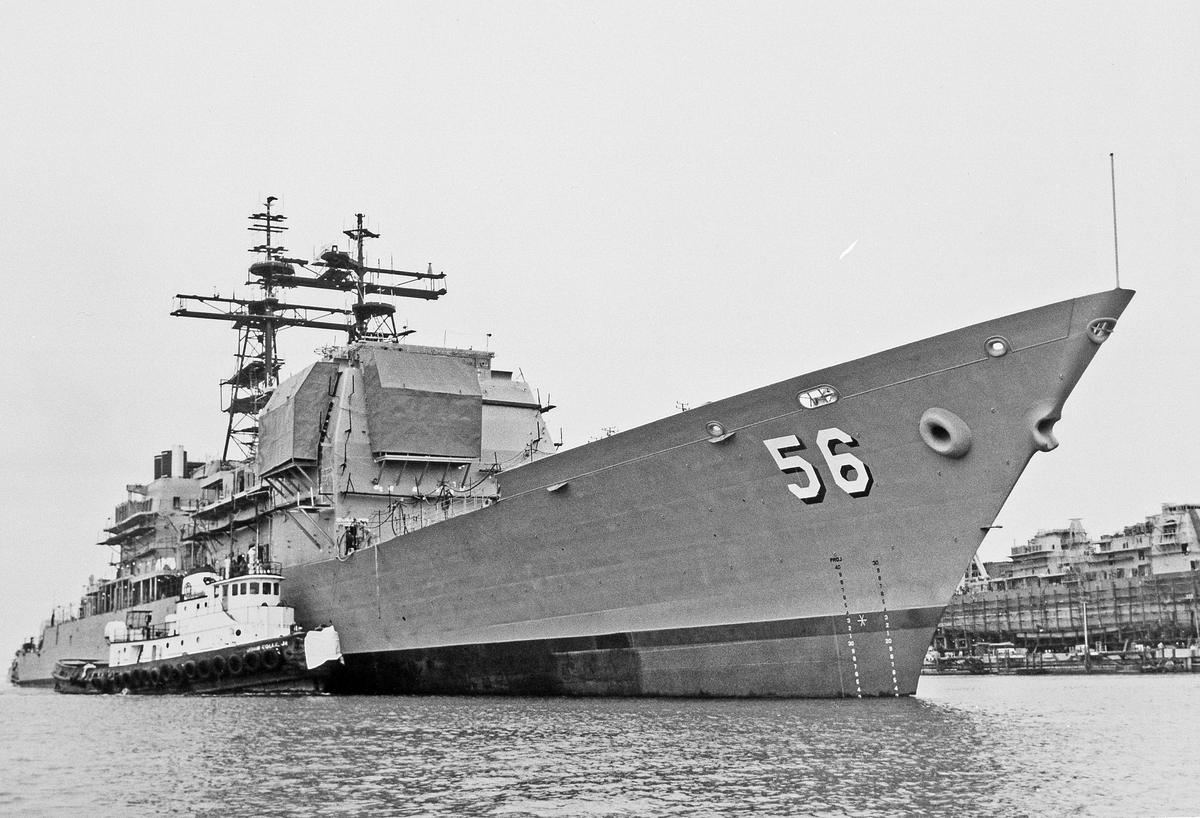
A warship begins as paper. Before any steel is cut, the Navy has to decide what it wants, Congress has to agree to pay for it, and a shipyard has to promise to build it for a price. For the cruiser that would become San Jacinto, the paper stage ended on 20 June 1983, when the Navy awarded the contract for her to Ingalls Shipbuilding of Pascagoula, Mississippi.1
She was to be CG-56, the tenth ship of the Ticonderoga class, numbered on from the lead ship, CG-47. The Navy treated the class as a series, buying the ships in batches and improving the design as it went. More than two years before the award, the Congressional Budget Office had priced the Aegis cruiser at about a billion dollars a ship in 1982 dollars and laid out alternative building programs, every one of which assumed that Congress would approve at least eighteen of the cruisers by 1985. The study was a set of planning assumptions, not a record of what Congress approved, but it shows the Navy planning the class as a numbered series, and San Jacinto, the tenth, fell inside the first eighteen. The officials responsible when her contract was let were John Lehman, Secretary of the Navy from February 1981 to April 1987, and Admiral James D. Watkins, Chief of Naval Operations from June 1982 to June 1986.2
Four and a half years would pass between that contract and the day a crew brought her to life. In that time some thousands of shipyard workers, most of whom would never go to sea in her, cut and welded and wired a ship that three hundred and fifty sailors at a time would then spend thirty-five years living in. Every space in her, the racks, the trunk down to the sonar dome, the closet off the combat information center, was built on the Mississippi coast in the middle of the 1980s by people whose names are in no Navy record.
A yard on the Gulf Coast
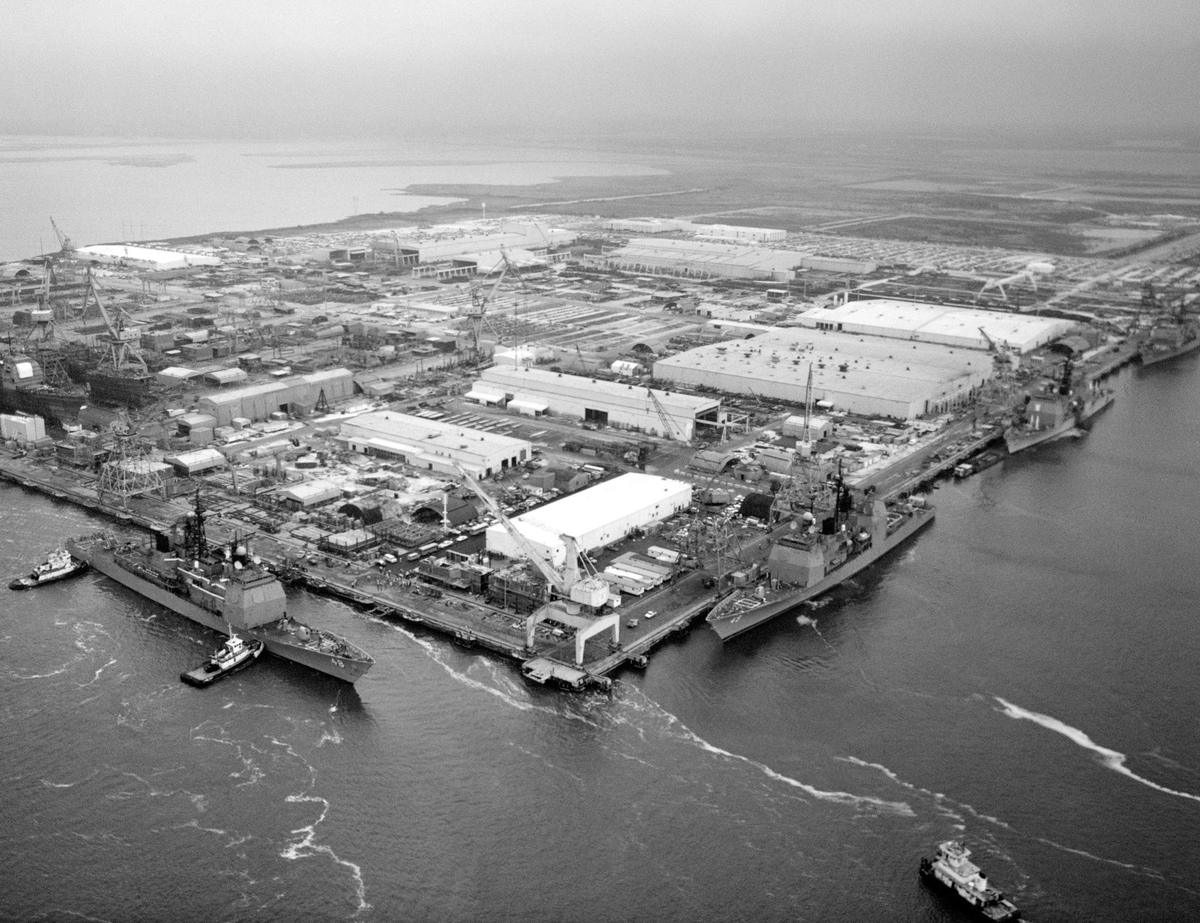
Pascagoula lies on the Mississippi coast a few miles from the Alabama line, where the Pascagoula River runs into the Mississippi Sound and the Gulf of Mexico beyond. Ingalls was founded there in 1938 and in 1961 became a division of Litton Industries, and over the following decades it grew into one of the Navy’s main builders of surface warships. The Navy’s historical dictionary credits it with all thirty-one Spruance-class destroyers, commissioned between 1975 and 1983, and with the five Tarawa-class amphibious assault ships of the late 1970s, flat-topped ships of about 39,400 tons that carry Marines, landing craft and helicopters, roughly five times the displacement of a Spruance.3 The cruiser’s hull was the Spruance’s, so the yard knew it better than any other in the country. By the time Ingalls laid down the tenth cruiser it had built that hull, in one form or another, some forty times.
Ingalls was not the only builder. The Navy had brought in Bath Iron Works in Maine, founded in 1884 and building for the Navy since its first gunboat in 1893, to build cruisers of the class in competition, and it played the two yards against each other.3 In January 1986 it divided the contracts for three more cruisers between them, two to Bath and one to Ingalls, the second year in a row in which Bath had won over the Mississippi yard.8 Ingalls kept the lead all the same. It was the class’s design yard, and from 1981 it held a separate Navy contract for engineering, training, logistics, and data and configuration management for the whole class, including technical support to Bath; by mid-1990 that contract had grown to $203 million. By then, the company said, Ingalls had won contracts for nineteen of the twenty-seven cruisers authorized since 1978 and had delivered twelve of them to the Navy on or ahead of schedule and under budget.9 The claim was the company’s own, and Bath’s troubles at the time, a strike in 1985, late radar equipment and disputes over cost, made it an easy one to make.11
How the yard built
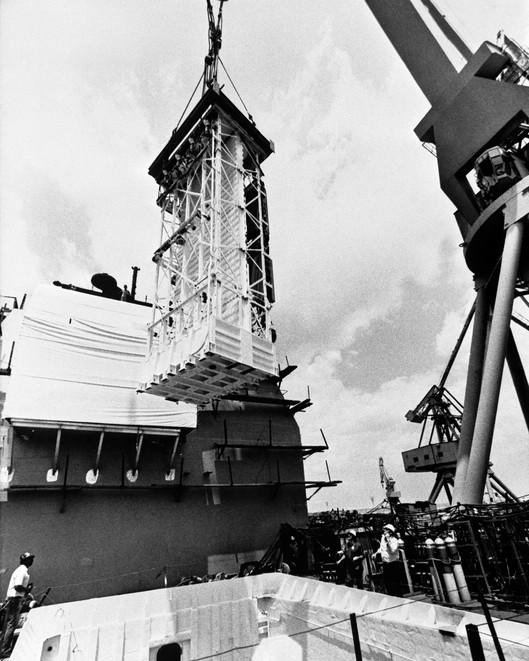
What set a yard like Ingalls apart from the older shipyards was how it put a ship together. For most of the twentieth century a hull was built where it would be launched: workers laid a keel on a sloping slipway and added frames, plates and decks upward and outward until the ship was complete enough to slide into the water, and then most of the machinery, piping and wiring went in at a fitting-out pier over many months. Men carried every pump and every cable down through hatches into a finished hull and installed it by lamplight in whatever room was left.
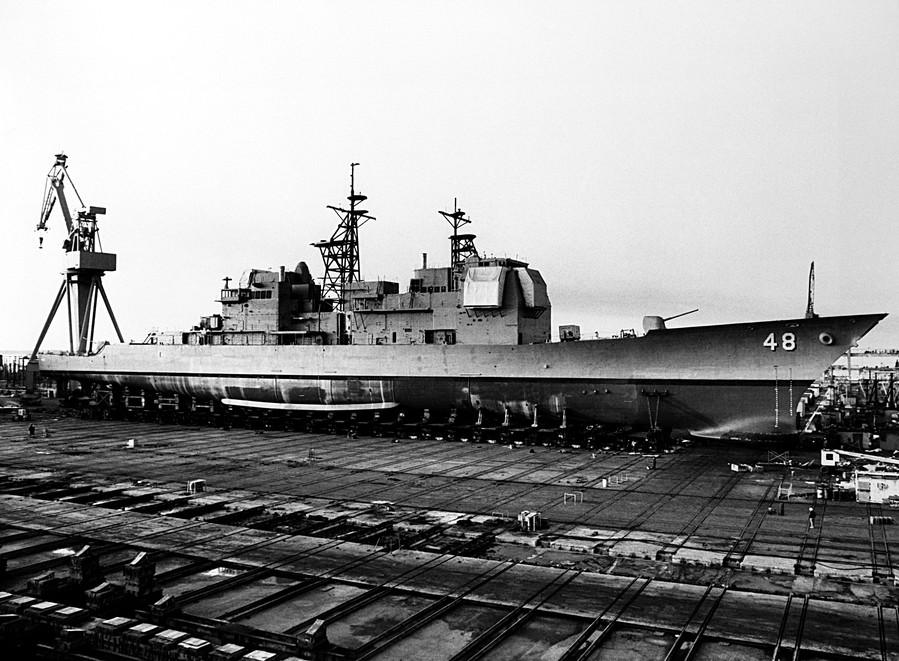
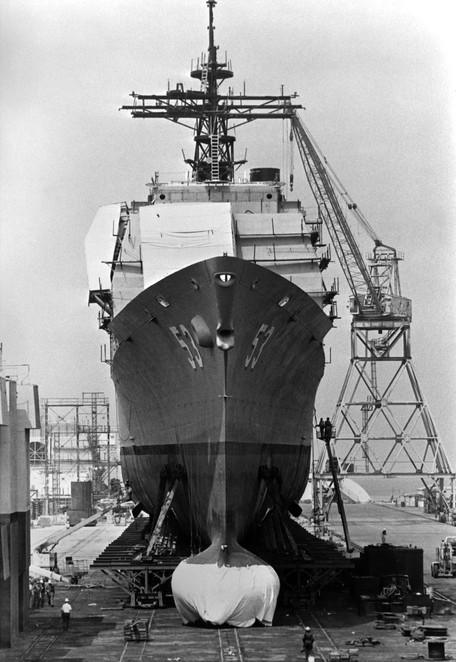
Modular construction reverses much of that. The yard builds the ship in large sections, called modules, usually under cover. Each section is fitted with pipes, cables, ventilation and often machinery while it still sits at a convenient height on a shop floor, where the work is easier and the weather cannot interfere. The finished sections are moved to the building position and joined. It is far easier to install a pump in a section lying open in a workshop than in a finished hull with its decks closed over it.
Ingalls had invested heavily in this way of working, and the yard and its parent company promoted it as the Shipyard of the Future.3 Its ships were built on level ground and moved, when they were ready, onto a floating dry dock that was then flooded to put them afloat. A sailor of the cruiser’s first crew who was at the yard in the late 1980s remembers watching the big amphibious assault ship Wasp, building at Ingalls at the same time, being moved across the yard day by day on wheeled carriers toward the dry dock, and hearing that it was a record weight to be moved over land.10 For a cruiser packed with equipment, with a phased-array radar fixed to her deckhouse, two launchers sunk in her decks, gas turbines, sonar, helicopter facilities and the computers that tied them together, the method was one way of keeping the work on schedule.
Steel to ship
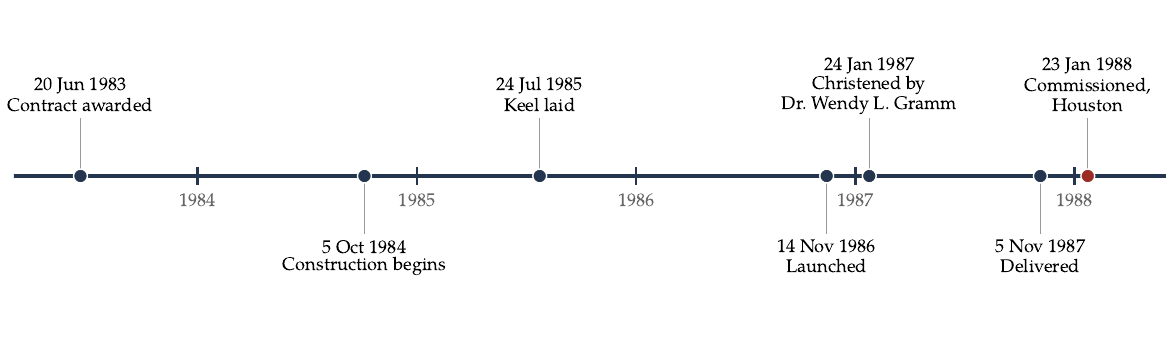
The Navy’s records mark the main stages of the ship’s construction with exact dates, and together they show how long it took to produce a cruiser in the 1980s.1
The Navy’s 2023 account of the ship gives 5 October 1984 as the day construction began. No contemporary document in the surviving record confirms it, and the Navy’s older official history of the ship begins with the keel laying instead. In a modular yard a start of construction usually means that steel is being cut and the first sections are being assembled in the shops, not that a hull has appeared on the building ways.
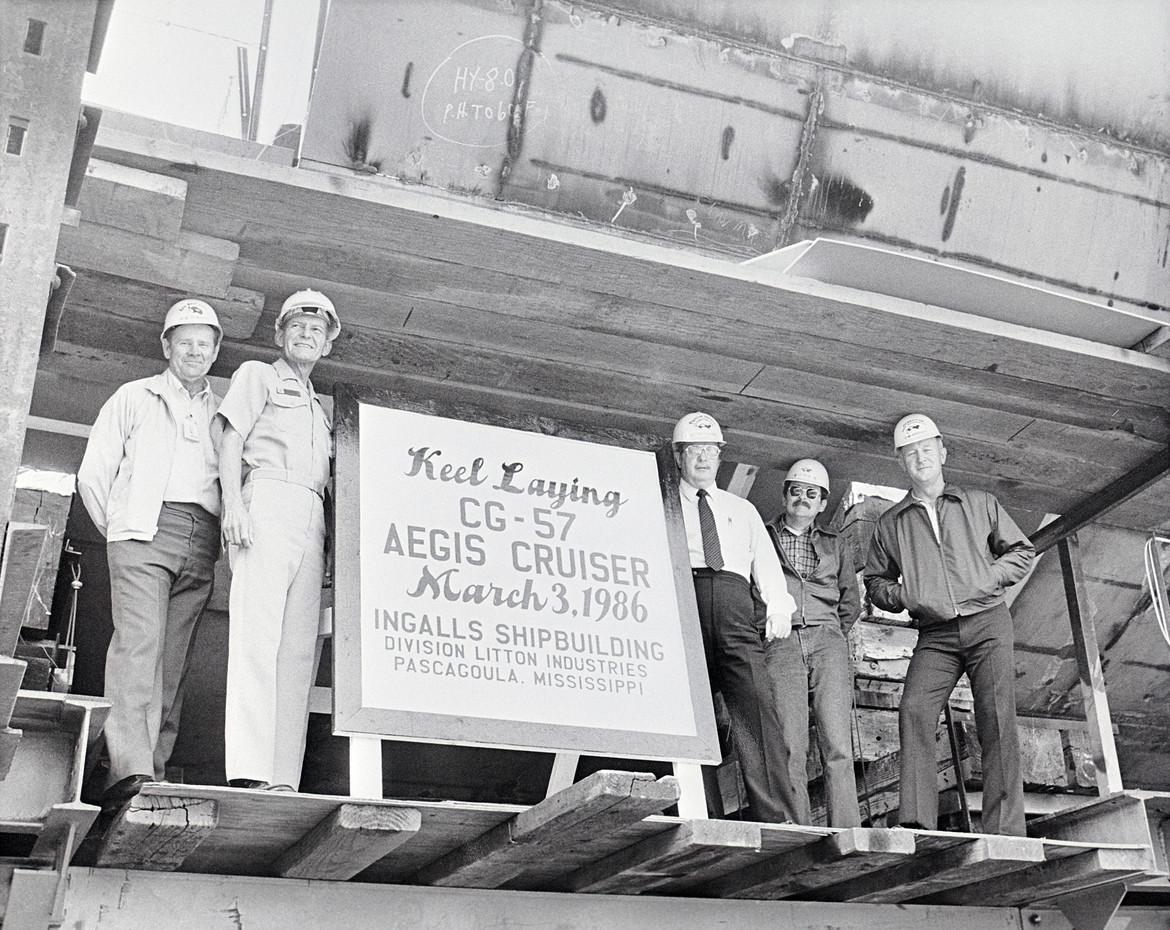
Nearly ten months later, on 24 July 1985, came the keel laying. The ceremony goes back to wooden shipbuilding, when the keel, the long timber along the bottom, was the first piece set in place and was treated as the ship’s backbone. In a modern yard it marks the moment when the first major sections are placed on the building position and the ship begins to take shape as a whole, and sailors still count it as her beginning.1
On 14 November 1986, by the Navy’s account, the ship was launched, floated clear of the building position for the first time.1 One photograph-and-data site records the launch as 11 November; the Navy’s official ship history, its 2023 account and several other compilations give the 14th.4 At Ingalls a launching was a matter of moving the hull onto the floating dry dock and flooding it down, less dramatic than a slide down the ways but no less carefully engineered.
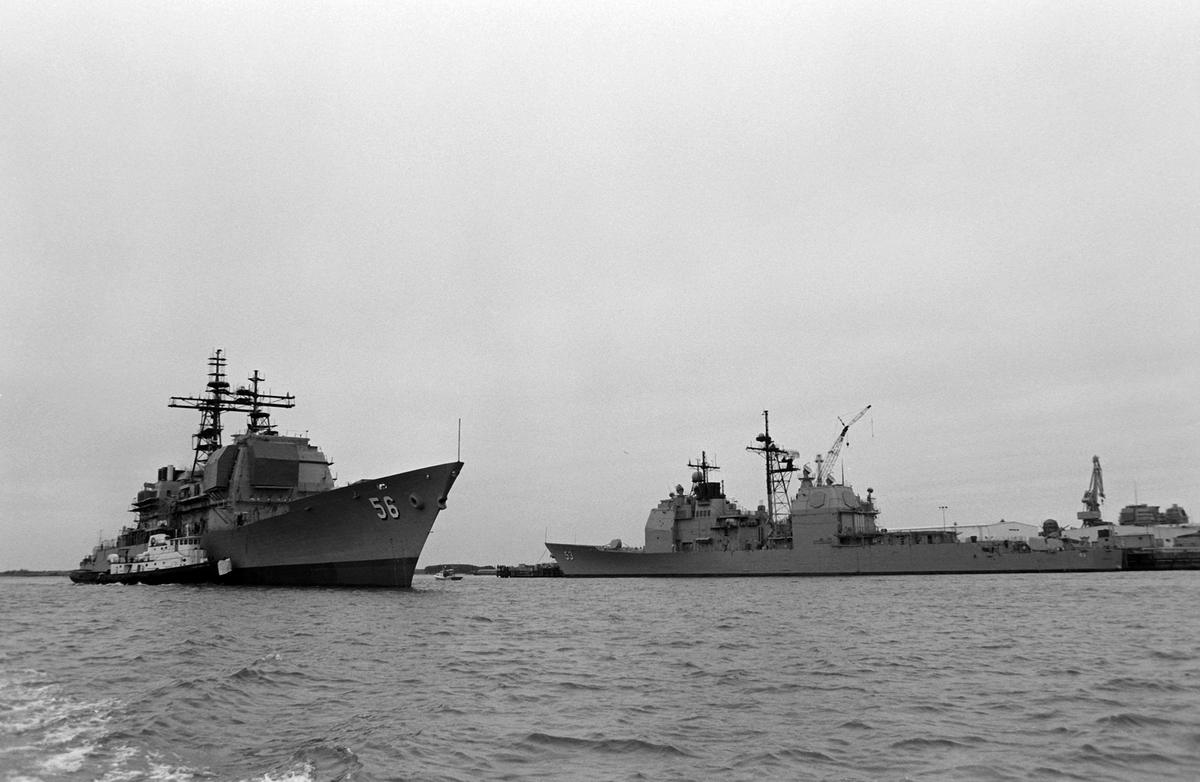
The christening followed on 24 January 1987. The ship’s sponsor was Dr. Wendy L. Gramm, an economist and the wife of Phil Gramm, then a United States senator from Texas.4 A sponsor, by Navy tradition, breaks a bottle against the bow and speaks the ship’s name, and remains part of the ship’s story long afterward, invited to her ceremonies and reunions. Sailors hold that a sponsor’s spirit goes into the ship with the name, and that a bottle which fails to break is bad luck.
The people at the top of the Navy changed while the ship was being finished. John Lehman was still Secretary of the Navy at the christening and left office in April 1987. James H. Webb Jr. held the post from May 1987 to February 1988, a span that takes in both the delivery in November 1987 and the commissioning in January 1988. Admiral Carlisle A. H. Trost was Chief of Naval Operations from July 1986 to June 1990, and so held that office throughout.4
More than three and a half years separated the contract from the christening, and the ship was still not finished. The work that followed her launch was the work of making her a ship that could go to sea: installing and testing the radar and computers, the weapons and sonar, the communications gear, the galleys and the living spaces. A hull can be welded in months. What takes years is the miles of cable inside it, and proving that every one of them carries what it should to where it should.
Lights on her masts
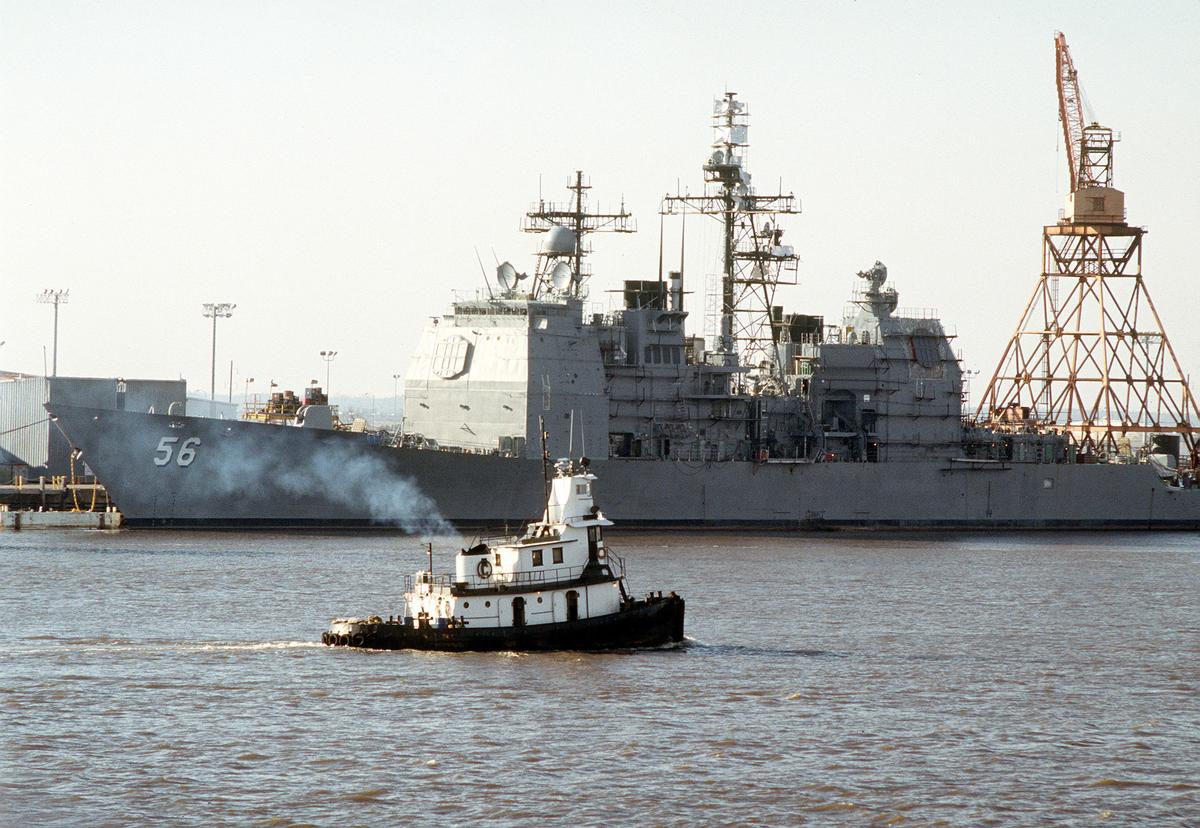
One small piece of paperwork from those months shows how unlike an ordinary ship she was. Every vessel at sea is bound by the International Regulations for Preventing Collisions at Sea of 1972, the rules of the road, which among other things fix where a ship must carry her navigation lights so that other ships can tell at night how big she is, which way she is heading and whether she is under way. A large ship must show two white masthead lights, one forward and one higher aft, set a prescribed distance apart, so that a watchkeeper on another bridge can read her heading from the way the two lights line up. The cruiser’s masts and deckhouses had been laid out around her radar faces, her antennas and her launchers, and the lights could not be placed where the rules required.
On 10 June 1987 Secretary Webb certified that San Jacinto, because of her special construction and purpose, could not comply fully with the rules without interfering with her function as a naval cruiser. Her forward masthead light stood lower above the hull than the rules required and was not in the forward quarter of the ship, and her after masthead light and the distance between the two did not meet the standard either. The Secretary certified that the lights were placed in the closest possible compliance with the rules. The notice was published in the Federal Register on 23 June, effective from 11 June, and its stated purpose was to warn mariners in the waters where the rules applied.7 The same issue carried a similar certification for the command ship La Salle. A sailor on another ship’s bridge, seeing the cruiser’s lights at night, might misjudge her, and the Navy was bound to say so.
It is a small thing, and it is worth remembering. A warship is built to fight first and to be an ordinary ship second, and wherever the two purposes collide, the fighting wins. This book has a good deal to say later about a night when another vessel misjudged where San Jacinto was and where she was going.
The people who came first
The Navy begins to assemble the people for a new ship well before she is ready for them. Months before delivery a small group reports to the shipyard as what the Navy calls a pre-commissioning unit, and until she is commissioned the ship is known as PCU, for pre-commissioning unit, followed by her name. The first to arrive are the commanding officer and a few key officers and senior enlisted sailors, who follow the construction, inspect the work, learn the systems from the builders and the equipment makers, and prepare to receive the rest of the crew. As the ship nears completion the unit grows to her full complement, which for a cruiser of this class was several hundred officers and sailors.5
It is strange duty. A pre-commissioning sailor has a ship he cannot yet live in, in a town that is not a Navy town, and his days are spent in classrooms, in borrowed offices and in a hull full of welders. He learns his equipment while it is still being installed, sometimes from the engineers who designed it. Nobody aboard has done the job on this ship before, because nobody has done anything on this ship before. Every procedure, every watch bill and every locker assignment has to be written by somebody for the first time.
The sailors aboard when a ship is commissioned are her plank owners. The term goes back to wooden ships: by the usual explanation, when an old ship was broken up her planks were sold off, and sailors who had been aboard from the beginning could claim to own a piece of her. A plank owner has a place in a ship’s history that no later sailor can have, and San Jacinto’s kept the tokens of it for decades: a plank owner’s certificate, a belt buckle, a coffee cup that came with the job. One of them stood the watch as messenger from 2000 to midnight on New Year’s Eve 1987, with the ship in port at Pascagoula, three weeks before her commissioning, and years later set down every New Year’s watch stood aboard her after that. Others remember the first crew’s pride in passing its tests and inspections and in setting the standard on the waterfront.10
The commanding officer chosen to take San Jacinto from construction into commission was Captain H. Ward Clark Jr.4 A first commanding officer does not inherit a ship with her traditions and routines and a crew who already know how to run her. He builds them, and the decisions of the first crew, from how the watch bill is organized to how the ship greets visitors, become the habits that later crews take for granted.
Trials and delivery
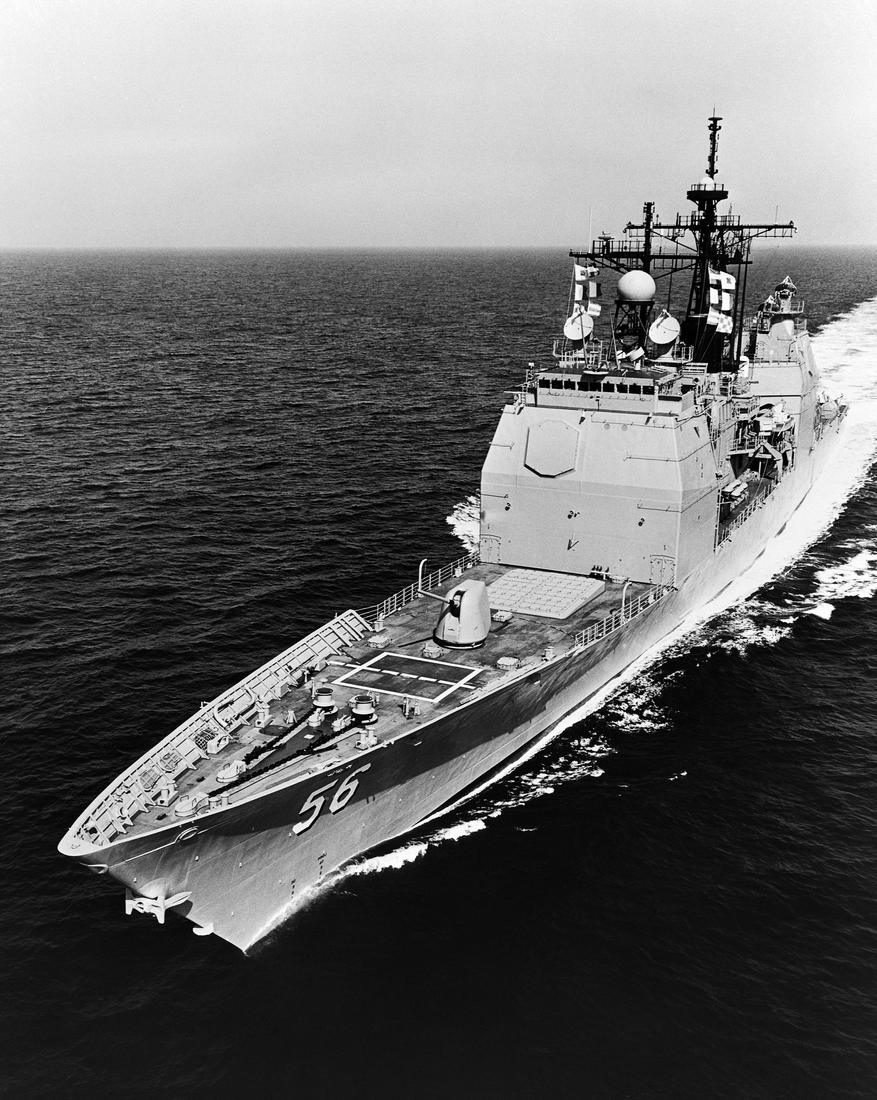
The last months of building follow a standard pattern. Once the ship is afloat and her machinery installed, the builder tests her systems, first at the pier and then at sea, running the engines at full power, testing the steering and the ship’s ability to stop quickly and turn sharply, and checking the systems that keep her afloat and fighting if she is damaged. Before the Navy accepts her, its Board of Inspection and Survey tests her against the contract and the Navy’s standards, and the builder must correct what it finds or the Navy accepts her with a list of items to be fixed later. No account of San Jacinto’s own builder’s trials or acceptance trials survives in the record; a crew member remembers a yard photograph of the ship that appears to have been taken on builder’s trials in the Gulf.10
When the Navy accepts a ship, the builder delivers her. Delivery is a legal and financial event, the point at which the Navy takes possession and most of the builder’s responsibility ends. For San Jacinto it came on 5 November 1987.1 A delivered ship belongs to the Navy but is not yet a warship of the fleet. Commissioning is the ceremony that places her in service, and in her case seventy-nine days separated the two.
The Navy decided to commission her not at the Mississippi yard that had built her but in Texas. The Port of Houston Magazine of November 1987 announced that she would come to the port and be commissioned there.6 She had been named for a battle fought beside the Houston Ship Channel, and she would be put in service within a few miles of the battlefield.
Notes
- Contract award (20 June 1983), start of construction (5 October 1984), keel laying (24 July 1985), launch (14 November 1986), christening (24 January 1987) and delivery (5 November 1987): Naval Sea Systems Command (NAVSEA), historical evaluation of USS San Jacinto (CG 56) at decommissioning; Navy ship-history release, DVIDS item 453585. The NAVSEA document lists the ship’s length as 529 feet, which conflicts with the 567 feet given by other sources and appears to be an error. The 5 October 1984 start of construction appears in the NAVSEA evaluation and the Navy’s 2023 release, and is repeated by uscarriers.net and the Seaforces data sheet; the Dictionary of American Naval Fighting Ships, NavSource, hullnumber.com and Los Barcos de Eugenio give the keel date of 24 July 1985 or no start date, and no contemporary document confirming the earlier date has been found. ↩
- The Ticonderoga class on the Spruance hull, gas-turbine propulsion and the vertical launching system from CG-52: Norman Friedman, U.S. Cruisers: An Illustrated Design History (Naval Institute Press, 1984), pp. 417–422; Greiner, Ticonderoga-class history, pp. 1–6. On the hull numbers, Friedman, Appendix B (“Names and Dates List”), covers the 1975 redesignation of missile frigates as cruisers and the unused numbers CG 42 through 46. The cost of about $1.02 billion and the assumption that at least eighteen ships would be approved through 1985 are in Congressional Budget Office, Naval Surface Combatants in the 1990s (April 1981), pp. xix, 28 and 46, and the 1979 redesignation on p. 4, footnote. The terms of John Lehman (5 February 1981 to 10 April 1987) and Admiral James D. Watkins (30 June 1982 to 30 June 1986): Morris and Kearns, Historical Dictionary of the United States Navy (2011), Appendices A and B. ↩
- Ingalls Shipbuilding (founded 1938; division of Litton Industries from 1961; modular “Shipyard of the Future”; Spruance, Tarawa and Ticonderoga work): the 1938 founding and the 1961 Litton date are from company and Navy shipbuilding histories. The Spruance-class destroyers built at Ingalls, the Tarawa-class ships completed at Litton/Ingalls, and the history of Bath Iron Works are from Morris and Kearns, Historical Dictionary of the United States Navy (2011), entries “Spruance-Class Destroyers (DD),” “Tarawa-Class Amphibious Assault Ships (LHA)” and “Bath Iron Works (BIW).” ↩
- Sponsor (Dr. Wendy L. Gramm, wife of Senator William P. Gramm of Texas), commanding officer at commissioning (Capt. H. Ward Clark Jr.) and the Navy’s launch date: Dictionary of American Naval Fighting Ships, vol. III, entry for San Jacinto (CG-56). NavSource gives the launch as 11 November 1986. uscarriers.net records the christening on 24 January 1987. The launch date of 14 November 1986 is also given by DANFS, the Seaforces data sheet, uscarriers.net, hullnumber.com and Los Barcos de Eugenio; only NavSource gives 11 November. The terms of the Secretaries of the Navy (Lehman, 5 February 1981 to 10 April 1987; Webb, 1 May 1987 to 23 February 1988) and of Admiral Trost as Chief of Naval Operations (1 July 1986 to 29 June 1990): Morris and Kearns, Historical Dictionary of the United States Navy (2011), Appendices A and B. ↩
- The pre-commissioning unit, the “PCU” style and the plank-owner tradition describe general Navy custom, not a source specific to this ship. The size of the ship’s company at commissioning is given only as “several hundred,” because no crew list for that date was found. ↩
- Plans to commission the ship at Houston: Port of Houston Magazine, November 1987. ↩
- Department of the Navy, “Certifications and Exemptions Under the International Regulations for Preventing Collisions at Sea, 1972; USS San Jacinto,” final rule, 32 CFR Part 706, Federal Register 52, no. 120 (23 June 1987): 23546; signed by Secretary of the Navy James H. Webb Jr. on 10 June 1987, effective 11 June 1987. The certification covers Annex I, section 2(a)(i) (height of the forward masthead light) and section 3(a) (forward masthead light not in the forward quarter, placement of the after masthead light and the horizontal separation of the two). The same issue (p. 23545) carries the certification for USS La Salle (AGF-3). ↩
- “2 Shipyards Win Navy Contracts,” New York Times, 10 January 1986 (Chapter 10, note 16). ↩
- John A. Georg, “Navy Awards Litton $26.4 Million to Continue Engineering and Support Class Services for the Ticonderoga (CG-47) Aegis Shipbuilding Program,” Business Wire, 26 June 1990: the 1981 support contract, $203 million in all; Ingalls’s 19 of the 27 ships authorized since 1978 and 12 delivered “on or ahead of schedule and under budget,” a company statement. ↩
- Crew recollection: the move of Wasp (LHD-1) across the Ingalls yard to the dry dock; plank owners’ certificates, belt buckles and coffee cups; a sailor’s list of New Year’s Eve watches aboard, beginning in port at Pascagoula in 1987; the first crew’s inspections; a yard photograph taken apparently on builder’s trials. The claim that Wasp’s move set a record for weight moved over land is recollection and has not been checked. ↩
- “Bath Iron Works, Navy Are in Talks On Cruiser Delays,” Wall Street Journal, 13 March 1987 (Chapter 10, note 17). ↩