Part Two: Name, Keel, Commissioning
Chapter 12Houston, January 1988
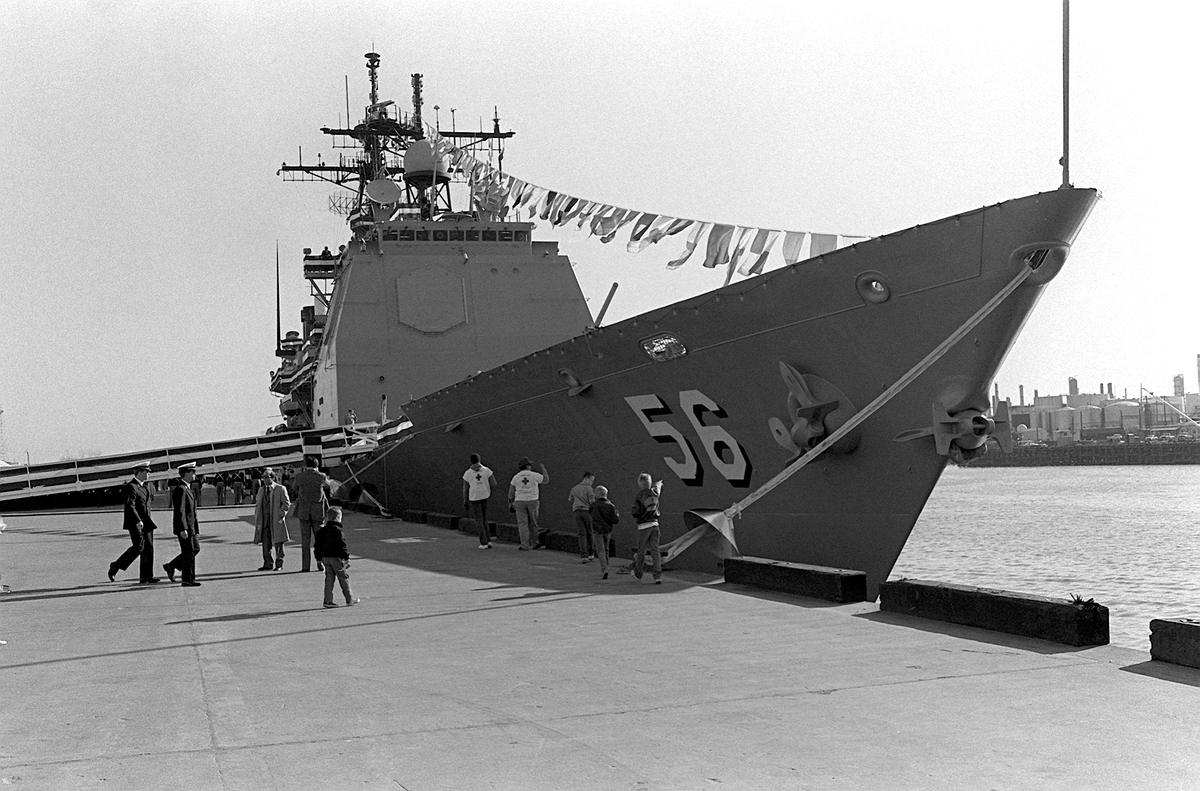
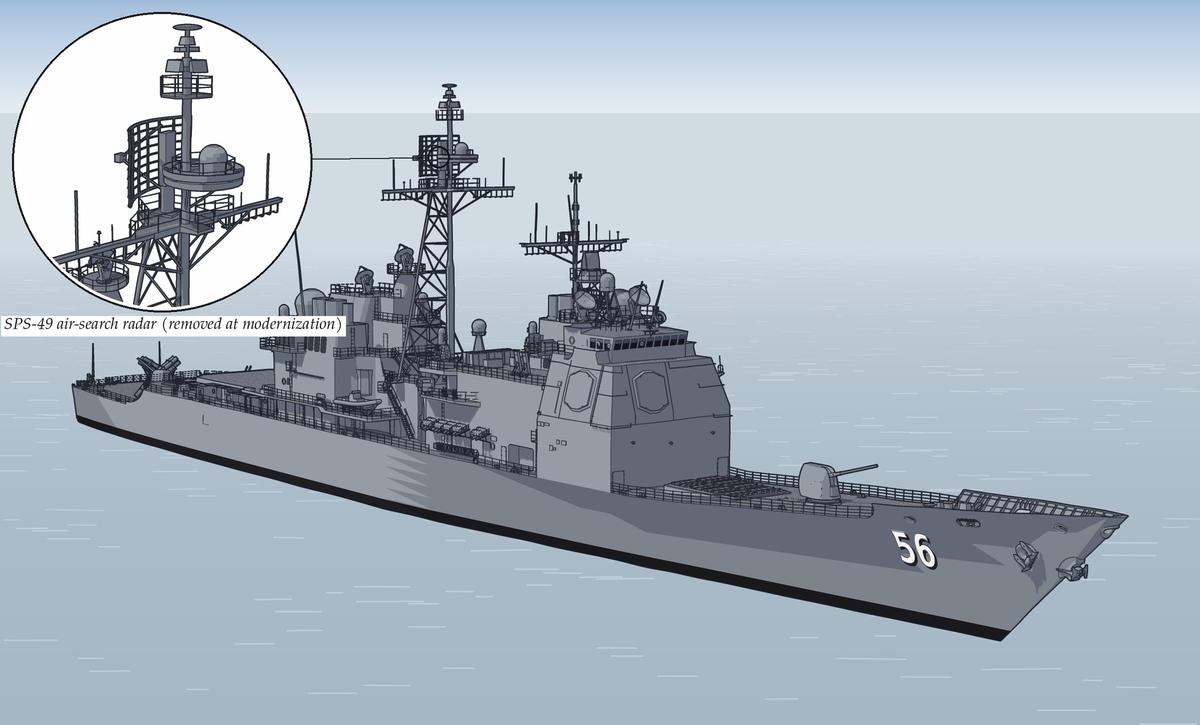
In its November 1987 issue the Port of Houston Magazine, the journal of the public authority that ran the city’s docks, gave a page to a warship. A Navy cruiser named for a Texas battle, it told its readers, would be commissioned on 23 January at Wharf 32 of the authority’s Turning Basin Complex and would then join the Atlantic Fleet. She had been built by Ingalls Shipbuilding, a division of Litton, and christened the previous January. She was 567 feet long, displaced 9,500 tons and could make more than thirty knots. The magazine listed her weapons as two Mk 41 vertical launching systems, two rapid-fire five-inch guns, two sets of triple torpedo tubes for use against submarines, two Phalanx close-in guns, a Harpoon missile system and several kinds of electronic warfare equipment. The battle that gave her the name, it added, had been fought beside the San Jacinto River, near Houston.8 The Houston press followed her approach through the winter, and by January the wire services were calling her the Navy’s newest and most advanced Aegis cruiser. The Associated Press put her cost at roughly a billion dollars.1
A warship in an oil port
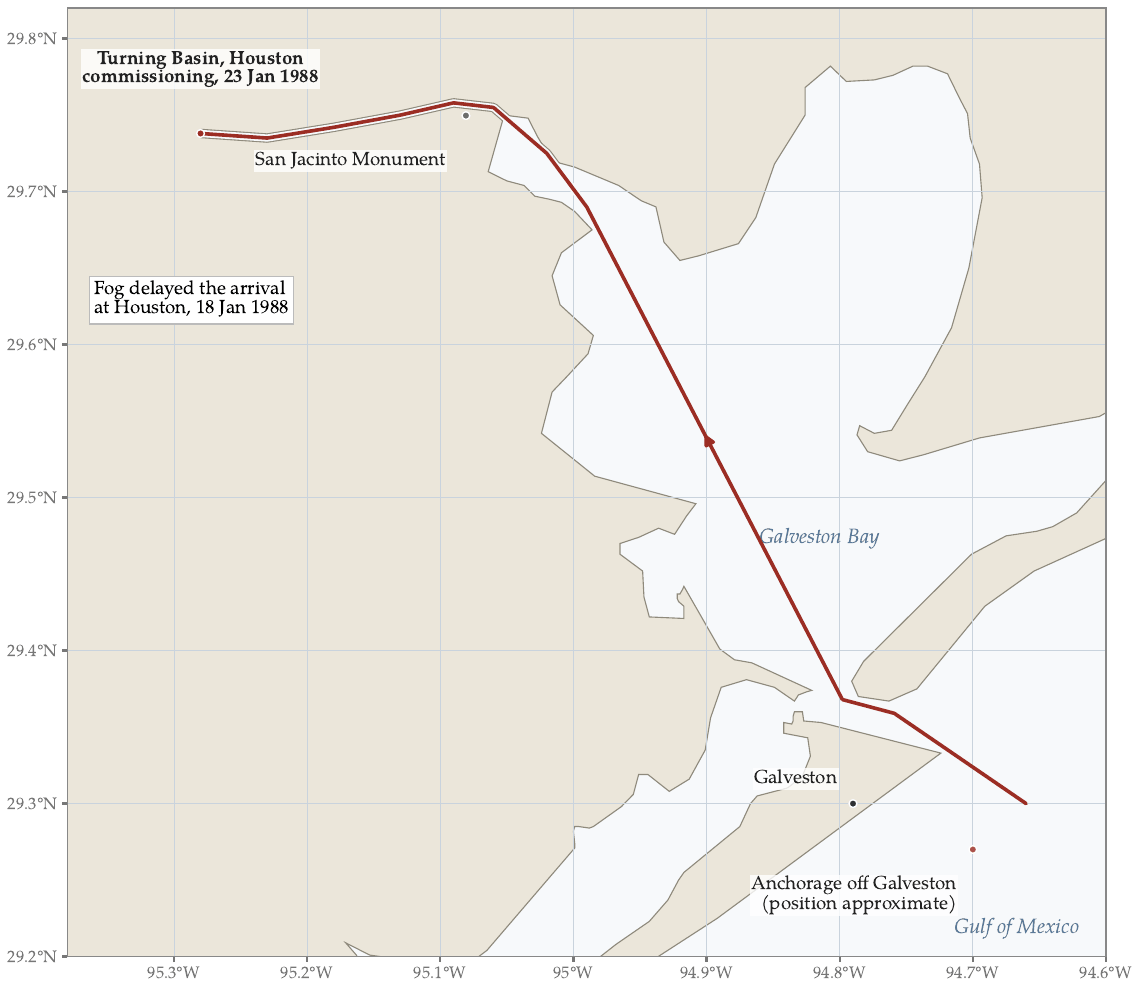
Houston was an unusual place to bring a warship. The city sits some fifty miles from the Gulf of Mexico, and what made it a port was a channel, dredged from the Gulf across Galveston Bay and up the old course of Buffalo Bayou, deep enough for ocean-going ships. By the late twentieth century the port at its head was among the busiest in the United States by tonnage, and the channel was lined for miles with refineries, chemical plants, grain elevators and docks.2
The same channel runs past the ground where, on 21 April 1836, Sam Houston’s army defeated Santa Anna’s and won Texas its independence. The battleground lies on its bank, marked by a tall monument and, since 1948, by the battleship Texas, kept there as a museum. A cruiser called San Jacinto was coming to be commissioned up the same waterway that passes the field her name came from. Santa Anna had marched down one bank of Buffalo Bayou and Houston down the other. A hundred and fifty-two years later a ship named for what happened when they met would steam between them.
The Navy liked to commission a ship in a place tied to her name, and a city with such a tie usually took a proprietary interest in the event. The ceremony let the Navy show taxpayers what they had paid for and gave the city something to show off. Sixteen months earlier the sixth ship of the class, Bunker Hill, the first with vertical launchers, had been commissioned in Boston at the foot of the monument to the 1775 battle. United Press International counted a crowd of about 10,000 in Charlestown and quoted the main speaker, Senator Edward M. Kennedy, on the new cruiser’s ability to direct more missiles at more targets than any Soviet ship. About a hundred anti-nuclear protesters handed out leaflets ashore, and others in small boats were held outside a hundred-yard safety zone kept by twenty-two Coast Guard vessels. The Navy would neither confirm nor deny whether the cruiser carried nuclear weapons. She had 22 officers and 388 enlisted men and was bound for San Diego and the Western Pacific.9 For a Texas port and a ship carrying the name of a Texas battle, the arrangement was an easy one to make.
The Gulf and the fleet
The fleet she was about to join was busy, and the work was dangerous in a way the Cold War plans had not foreseen. In early 1988 the Navy’s attention was on the Persian Gulf. Iran and Iraq had been at war for more than seven years, and since the summer of 1987 American warships had been escorting Kuwaiti oil tankers, sailing under the American flag, through its waters.
In May 1987 an Iraqi pilot had fired two Exocet missiles, apparently by mistake, into the frigate Stark, killing thirty-seven sailors. Less than a month after San Jacinto’s commissioning, the Washington Post reported that an Iraqi Badger bomber had fired two long-range cruise missiles within eight miles of the destroyer Chandler as she escorted tankers, and that American commanders in the Gulf feared accidental attacks by Iraqi pilots more than deliberate ones by Iran. Commanders had reported many occasions on which they had warned Iraqi aircraft away from their ships, some of them with the ship’s captain close to opening fire. The same report said the Navy was cutting three ships from its Gulf force, among them the battleship Iowa and the Aegis cruiser Ticonderoga, one of her two escorts. It also noted that two American warships bumped by Soviet ships off the Crimean coast the week before had left the Black Sea for the Mediterranean.10
So the cruiser was commissioned into a Navy that was being shot at by accident in one sea and shouldered aside on purpose in another. The Aegis ships had been designed for a great battle in the open ocean. What they were getting instead was crowded water, unclear intentions and very little time to decide, and it was in exactly those conditions that her sister Vincennes would make her mistake six months later.
Orders for the class kept coming. On 25 February 1988, a month after the commissioning, the Navy gave Ingalls a $769.1 million contract for four more Aegis cruisers and Bath Iron Works $226.1 million for one. The Wall Street Journal, reporting the awards, called the Aegis cruisers among the Navy’s most sophisticated ships and noted that for two years the Litton yard had won most of the orders.11
Up the channel
At the turn of the year the new cruiser was still at Pascagoula. One of her sailors, who stood the evening watch as messenger on 31 December 1987, later remembered seeing the year out in port there.12 Some time in January she sailed west along the Gulf Coast for Texas.
To reach Houston, a deep-draft ship comes in from the Gulf through Galveston Bay and then up the channel, past the refineries and plants, to the turning basin at the head of the port. The passage takes several hours. In January, when cold air settles over the warmer water of the Gulf and the bay, it is liable to fog.2 Press reports and crew recollection place the cruiser at anchor near Galveston on 18 January 1988, waiting for the fog to lift.3 Years later one of her first crew, shown a photograph of the ship at anchor, said he believed it had been taken while they waited for the fog to clear so that they could go up the channel to be commissioned.12
A ship of her size does not go up a narrow industrial waterway in poor visibility, and the pilots who take deep-draft ships to Houston decide when conditions allow it. A new billion-dollar cruiser with a new crew, due in front of the Vice President in five days, sat at anchor and waited on the weather like any tanker. When it cleared she made the passage and tied up at the Turning Basin. No document gives the day she arrived.3
For the crew the weekend had been planned for months. Captain Clark wrote to his sailors and their families inviting them to the ceremony, and men who were there kept the paperwork for decades afterward, among it the letter, a reception pass, a parking pass and an information card. Those aboard on commissioning day received a plank-owner certificate and plaque. Coffee mugs, a belt buckle and drinking glasses marked with the ship’s name and the year are still in the hands of former crew, along with ball caps handed out at the party after the ceremony, which the sailors remember as the gift of a brewery.12
23 January 1988
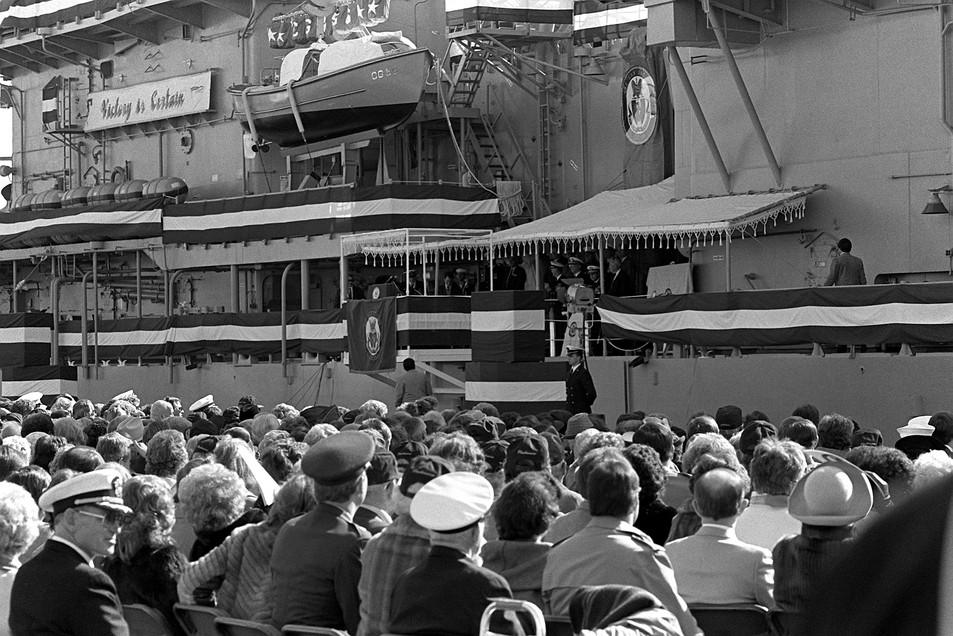
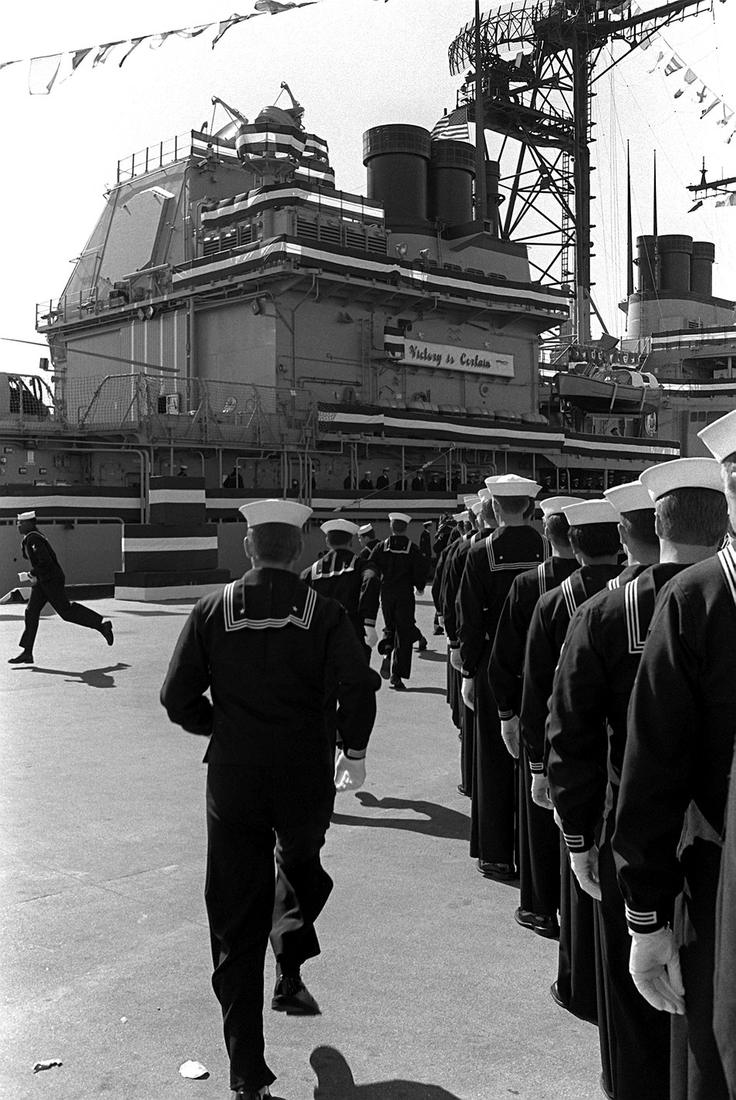
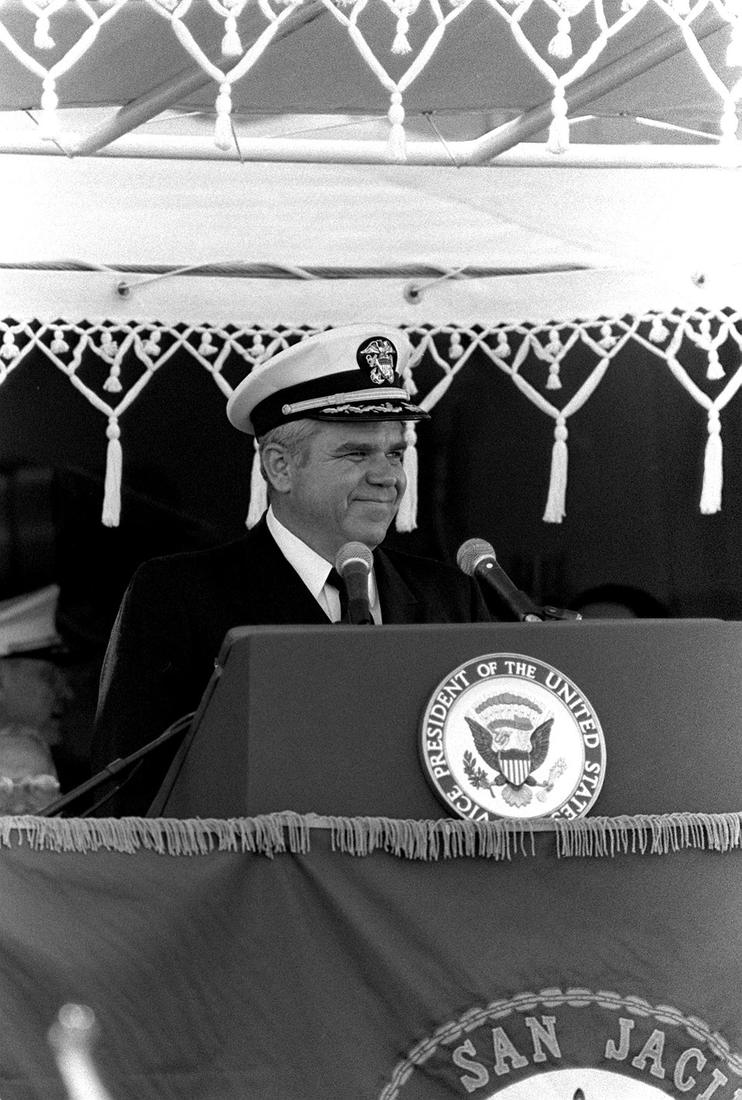
The Vice President of the United States, George H. W. Bush, came to commission her. He was campaigning for the presidency, which he would win that November. On 22 January the Los Angeles Times carried a report from Washington that the Navy would commission its newest cruiser in Houston the next day with the Vice President delivering the main address.4 His office kept a file on a captain’s reception for the ship on 22 January and another on the ceremony itself, both among the papers of his national security adviser, Donald P. Gregg, which are now held at the George Bush Presidential Library. The library’s inventory lists the two folders; what they contain is not known.13
Bush’s presence tied the new ship to an old one. On 2 September 1944, as a twenty-year-old Navy pilot flying from the light carrier San Jacinto (CVL-30), he had been shot down over the Japanese-held island of Chichi Jima and rescued from the sea by a submarine. His two crewmen did not survive. Forty-three years later he came back, as Vice President, to commission the third ship to carry the name.4 Houston was also his adopted home, the city he had represented in Congress. Whatever the politics of an election year, there was no one else alive who could have stood on that wharf with the same claim to the name.
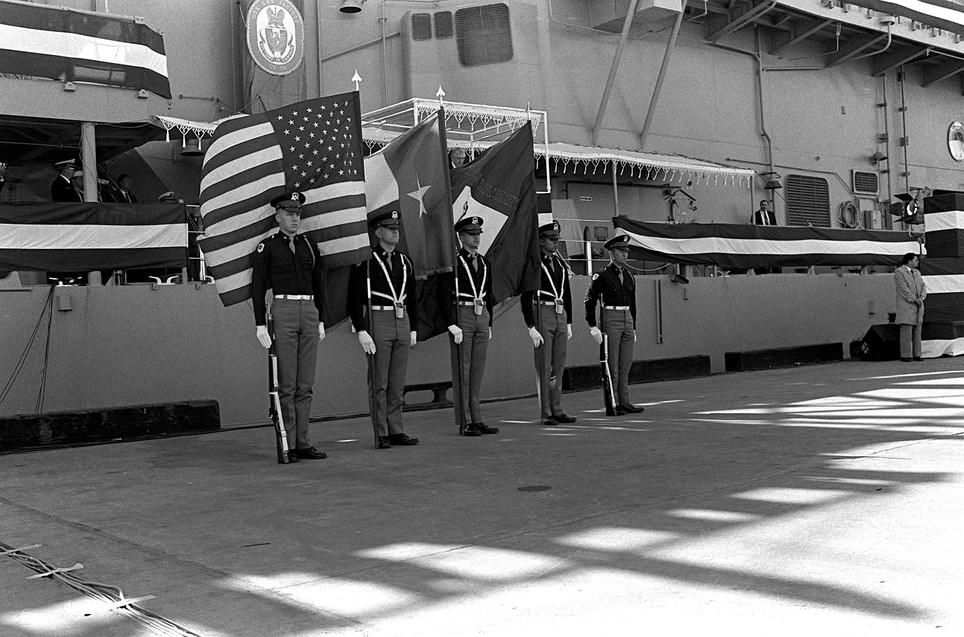
The ceremony took place on Saturday, 23 January 1988, at Wharf 32 of the Turning Basin Complex.1 A commissioning follows a form that goes back to the age of sail. Until the ceremony the ship belongs to the Navy but is not a warship of the fleet. The commanding officer reads his orders, the Navy’s representative directs him to place the ship in commission, and the national ensign and the long, narrow commissioning pennant are hoisted. Then the sponsor, or the senior officer present, gives the traditional order, “Man our ship and bring her to life,” and the crew run aboard and take their stations.5 The radars begin to turn, the guns train, the whistle sounds, and a hull that was a shipyard’s product an hour earlier is a ship of the line with a watch set.
The order of events at this ship’s own ceremony is not documented. One moment of it survives in a photograph that former crew still pass among themselves, captioned as Captain H. Ward Clark Jr. reading his orders as he assumed command at the Port of Houston.12
The first captain
Clark had reported to the ship as her prospective commanding officer in October 1986, a month before she was launched. A native of Takoma Park, Maryland, he had entered the Naval Academy in 1960 and graduated in 1964, served in destroyers, taken a master’s degree in electrical engineering at the Naval Postgraduate School and commanded the guided-missile destroyer King from 1979 to 1981. He had spent the three years before joining the ship as assistant chief of staff for combat systems to the commander of the Atlantic Fleet’s surface force, and the two years before that teaching anti-air and electronic warfare at the Tactical Training Group, Atlantic.
It was the record of a man chosen for the combat system. An engineer by training who had commanded a missile ship and then taught air defense was what the Navy wanted in the captain of a new Aegis cruiser. His executive officer, the second in command, had reported the same October after serving as combat systems officer of Ticonderoga, the first ship of the class. The command master chief, the senior enlisted sailor and the captain’s principal adviser on the crew, had come aboard in January 1987.14 His first crew remembered him as a captain who, in one sailor’s words, didn’t fool around.
The day left a paper trail of another kind. The Postal Service ran a temporary station for the ceremony, the “U.S.S. San Jacinto (CG-56) Station” of Houston, with its own pictorial postmark, and collectors of naval covers, envelopes stamped and cancelled to mark a ship’s important dates, prepared designs for the occasion. One came from the Stephen Decatur Chapter No. 4 of the Universal Ship Cancellation Society and another from a private cachet maker. The society’s journal ran a notice of the commissioning and a background article on the ship in the same period.15
The date went into the Navy’s official history as the day she entered service, and her crews kept it afterward as the ship’s birthday. The sailors aboard on 23 January 1988 became her plank owners.6
The first year
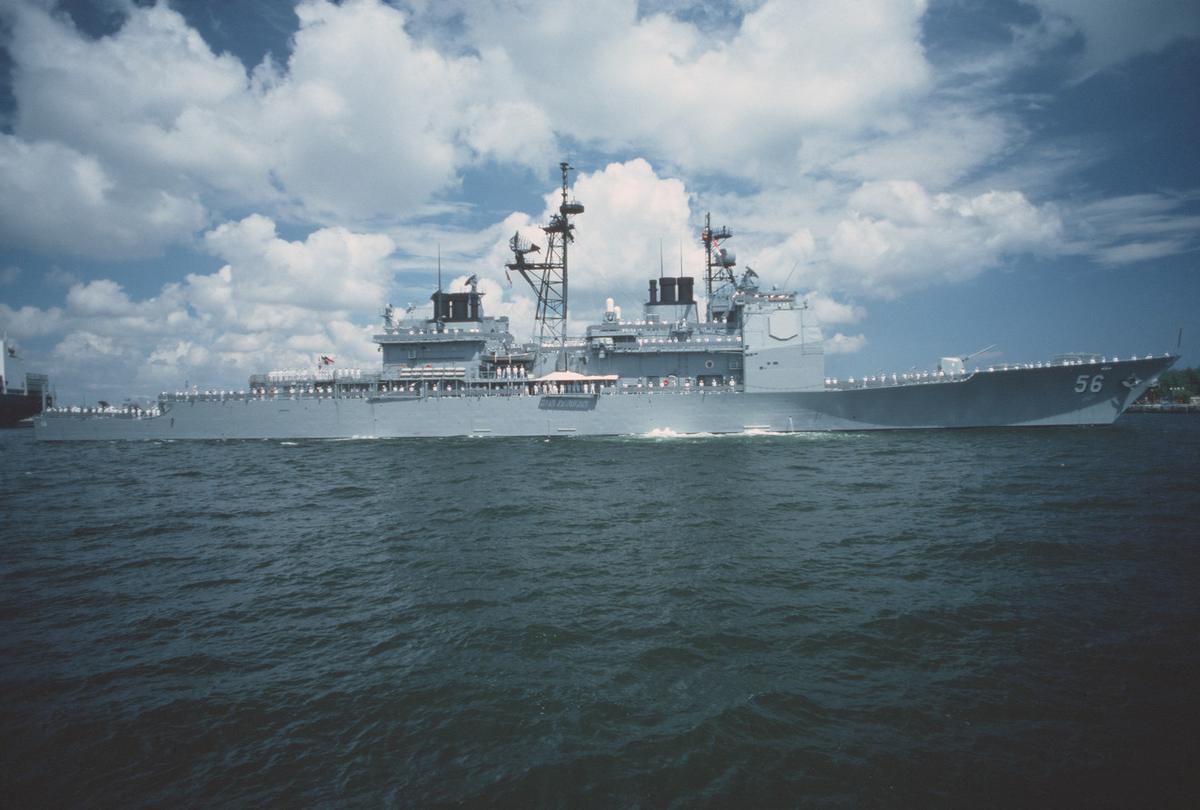
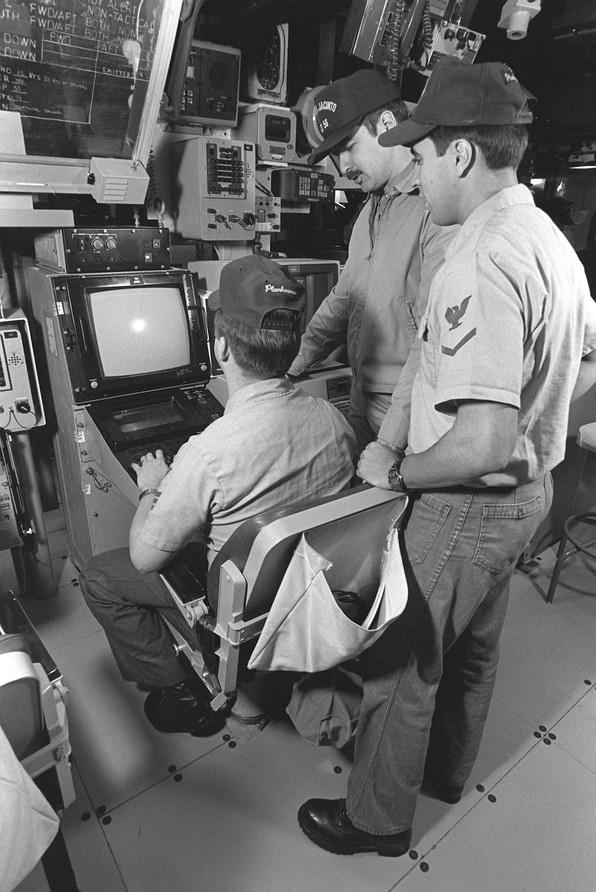
From Houston she went to Norfolk, Virginia, the main base of the Atlantic Fleet and her home port. The Navy’s history has her sailing on 25 January and arriving on the 30th.6 For the rest of her service she was based on its waterfront. Clark would command her for the next two or three years. One published list of her captains ends his command on 12 January 1990, and the Navy’s own history ends it on 12 January 1991.16 One sailor who had received orders to her in August 1987 remembered reporting aboard a few days after the commissioning, when she put in at Roosevelt Roads, the naval station on the eastern tip of Puerto Rico. Since the Navy’s history takes her straight from Houston to Norfolk, the call he remembers probably came some weeks later, and no document dates it.17
A new ship is not finished when she is commissioned. She has to be shaken down, which means tested, trained, certified and corrected, and the first months of any new warship are a mixture of systems that do not yet work as intended, sailors who have not yet learned the ship, and a long list of items that the builder and the Navy have agreed to fix. Most of her officers’ attention went to the combat system. San Jacinto was among the first cruisers to carry her missiles in vertical launch cells, 122 of them in two groups forward and aft, and her people had to learn, as a crew and alongside the engineers who had designed the system, how it behaved in everyday use and what to do when part of it failed.
Crew recollection places her shakedown in the Caribbean that spring, with training on the ranges at Guantánamo Bay, Cuba.7 Guantánamo was where the Atlantic Fleet sent its ships to be tested by instructors whose job was to find every weakness in a crew: fires, flooding and battle damage staged at all hours until the ship could handle them. Generations of sailors remembered it as the hardest weeks of a ship’s life short of war.
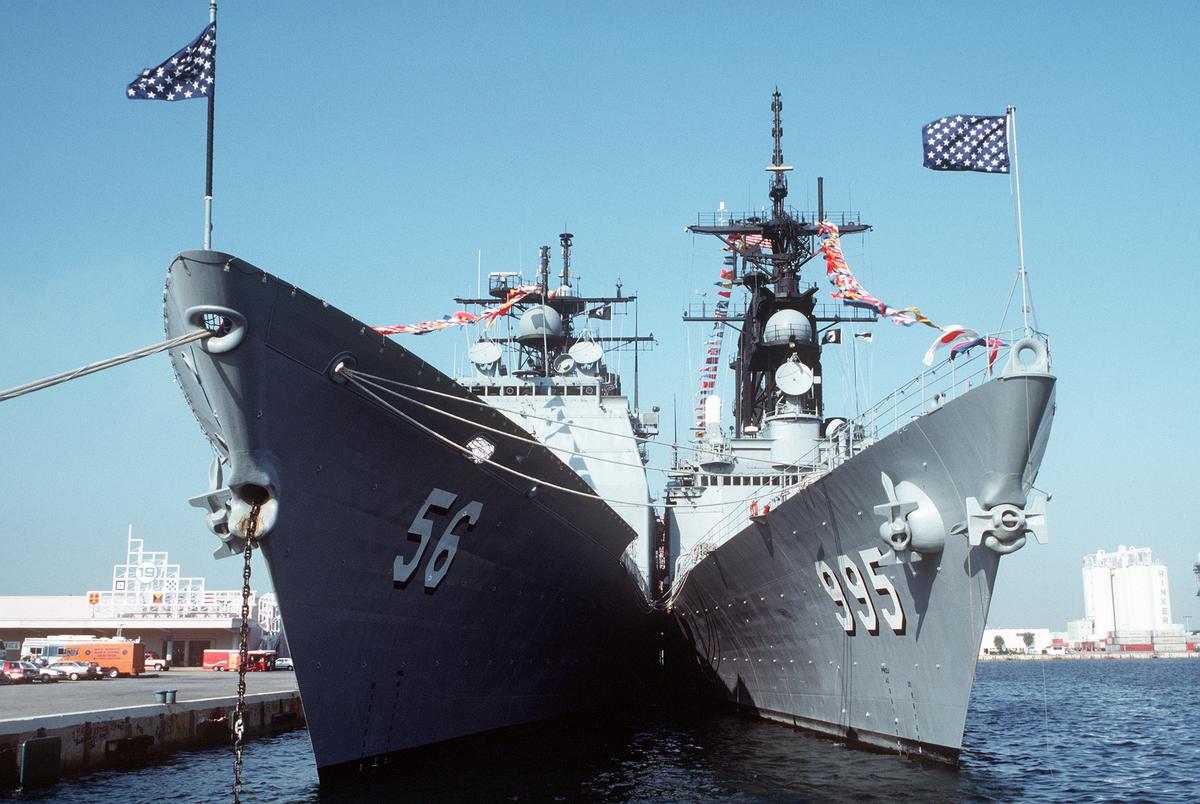
At the end of April she came into Port Everglades, Florida, and a sailor’s photograph shows her preparing to dock there.17 The Fort Lauderdale Sun-Sentinel had announced her on 28 April as the newest guided-missile cruiser in the fleet, due on Saturday the 30th, the same weekend as the carrier John F. Kennedy, with a destroyer and a guided-missile frigate arriving the day before and two British submarines already in port. A Navy League official said the port had never before held a carrier, a guided-missile cruiser, a destroyer and a frigate at the same time. The paper repeated what Sea Power magazine had written about her class. Congress had criticized the ships at first, but opinion had changed after Aegis cruisers supported United Nations forces off Lebanon in 1983 and 1984, helped intercept the aircraft carrying the Achille Lauro hijackers in 1985 and supported the air strikes on Libya in 1986, and the magazine rated the air-defense system unusually capable.7
That summer the Gulf drew the fleet’s attention again. On 3 July the Aegis cruiser Vincennes shot down an Iranian airliner with 290 people aboard. In August, with a cease-fire between Iran and Iraq due on the 20th, the Navy decided not to send another Aegis cruiser, Mobile Bay, to replace her. At the end of September the Reagan administration ended the close escort of tankers that had begun fourteen months before, and officials likened the looser watch that replaced it to zone coverage in football, as against man-to-man.18 None of this involved San Jacinto directly. The trade press reported that she returned to her builder at Ingalls that summer for a post-shakedown availability, a yard period in which the faults found in a ship’s first months are put right. No cost figure for the work is in the record.7
She was back at Port Everglades in October for the port’s Navy Appreciation Week. On the evening of Thursday, 13 October 1988, the week closed beside her with a nineteen-gun salute for the Navy’s 213th birthday, fired from a small saluting gun on her deck. About three thousand sailors had visited the port during the week, and between 35,000 and 40,000 members of the public were expected to tour the ships before it ended. Rear Admiral Edward Clexton, the Atlantic Fleet’s director of operations, called the week a success, and port and Navy officials said they hoped to make it an annual event.7
In November came her first large exercise with the fleet. FleetEx 1-89 ran for seventeen days, from 4 to 20 November 1988, in the waters off Puerto Rico.7 She saw the year out in Norfolk, where the sailor who had stood the New Year’s watch at Pascagoula a year before stood it again.17 Early in 1989 she was on the Texas coast once more. Two men who later served in her remember seeing the ship at Galveston while they were still high-school seniors, enlisted but not yet called to training. One of them toured her and places the visit around Mardi Gras in 1989, though he was not certain of the year.17 The record does not say why she went there or how long she stayed.
By then she had been in commission a year. She had a home port, a crew that had learned her, and a combat system that worked. What she had not yet done was deploy.
Notes
- Commissioning site and plans: Port of Houston Magazine, November 1987 (Turning Basin Complex, Wharf 32); Associated Press, January 1988 (“newest and most advanced Aegis cruiser”; cost of about a billion dollars). ↩
- The Houston Ship Channel, its length and the passage from Galveston Bay to the Turning Basin: Port of Houston Authority descriptions of the channel. ↩
- The anchorage near Galveston on 18 January 1988 and the fog: press reports and crew recollection, not confirmed by a document. The date on which the ship reached the Turning Basin is likewise unconfirmed. ↩
- Vice President Bush as principal speaker at the commissioning: George Bush Presidential Library, speeches and schedule records for January 1988. The Navy’s announcement of the ceremony and of the Vice President’s role: Los Angeles Times, 22 January 1988, “Bush to Commission Ship” (Southland edition, p. 29, datelined Washington). Bush’s loss of his aircraft on 2 September 1944 and his rescue: see the notes to Chapter 9 (DANFS, vol. II, entry for CVL-30, and Bush Library records). ↩
- The commissioning ritual is described in its customary form; the order of events at this ship’s own ceremony is not documented in the sources consulted. ↩
- Commissioning on 23 January 1988 and Norfolk as home port: DANFS, vol. III, entry for San Jacinto (CG-56); NavSource. ↩
- Shakedown, the Port Everglades visit and the post-shakedown availability: Maritime Reporter, July 1988, and crew recollection. The Port Everglades visit at the end of April 1988: Stephen Wissink, “Port Fills Up With U.S., British Ships,” Sun-Sentinel (Fort Lauderdale), 28 April 1988, p. 2B, which also carries the passage from Sea Power magazine on the class. The October 1988 Navy Appreciation Week and the 19-gun salute of 13 October: Andrew Martin, “Navy Week Visit Ends With a Bang,” Sun-Sentinel, 14 October 1988, p. 3B; the admiral’s name is spelled as in the report. No cost figure for the availability could be confirmed, and none is given. FleetEx 1-89 (4–20 November 1988, off Puerto Rico): ship history in DANFS, vol. III. ↩
- The magazine’s notice: “U.S.S. San Jacinto to Be Commissioned in Houston,” Port of Houston Magazine, vol. 31, no. 11 (November 1987), p. 17 (Port of Houston Authority), the source of the length, displacement, speed and armament as given here. ↩
- Bunker Hill’s commissioning: United Press International, “Navy Commissions Newest Warship,” Sun-Sentinel (Fort Lauderdale), 21 September 1986, p. 3A. ↩
- The Gulf and the Black Sea in February 1988: Molly Moore, “U.S. Team to Visit Iraq for Talks on Gulf Incidents,” Washington Post, 17 February 1988, section A (final edition). ↩
- The contracts of 25 February 1988: “Litton Unit Gets $769.1 Million Job for Aegis Cruisers,” Wall Street Journal (Eastern edition), 26 February 1988. The article gives no price per ship, and none is given here. ↩
- Crew recollection: a sailor of the first crew on his New Year’s watch at Pascagoula on 31 December 1987; a first-crew sailor on a photograph taken at anchor while the ship waited for the fog; first-crew sailors on the captain’s letter of invitation, the reception and parking passes and information card, the plank-owner certificate and plaque, mugs, belt buckle and glasses, and the ball caps given out at the commissioning party; and a photograph of Captain Clark reading his orders, passed among former crew with its caption. The originals are in private hands and were not examined. ↩
- The Vice President’s files: George Bush Presidential Library, Inventory for FOIA Request 2013-1212-S, Records on Donald P. Gregg Files (Vice President Bush Meetings with Americans), Bush Vice Presidential Records, Staff and Office Files, folders “Meetings with Americans, January–June 1988: U.S.S. San Jacinto Captain’s Reception, January 22, 1988” and “Meetings with Americans, January–June 1988: Commissioning Ceremony for the U.S.S. San Jacinto, January 23, 1988” [OA/ID 19867]. The library’s log of FOIA cases received in fiscal year 2013 records a request for records on the commissioning ceremony. The folders themselves were not consulted. ↩
- Captain Clark’s career, the executive officer’s previous post and the reporting dates of all three: USS San Jacinto, Mediterranean cruise book, 1989, pp. 2–4 (PDF pp. 6–10), biographies of the commanding officer, executive officer and command master chief, read from page images. ↩
- The commissioning covers: Naval Cover Museum, USS San Jacinto (CG-56) covers, page 1 (two covers postmarked 23 January 1988 with the USPS pictorial postmark “U.S.S. San Jacinto / (CG-56) / Station,” Houston, Texas; cachets by the Stephen Decatur Chapter No. 4, USCS, and by a private maker). USCS Log, combined index to vols. 53–55 (1987–1989), entries “San Jacinto (CG-56) Commissioned” and “San Jacinto (CG-56), Some Background & Color on.” The articles themselves have not been seen. ↩
- Commanding officers and their dates: NavSource Online, cruiser photo index for CG-56 (archived 23 May 2025), list of commanding officers, which gives 12 January 1990 for the end of Clark’s command. The Navy’s history (Dictionary of American Naval Fighting Ships, entry for San Jacinto (CG-56)) gives 12 January 1991, and also dates the passage from Houston to Norfolk 25–30 January 1988. The conflict is discussed in the notes to Chapter 14. ↩
- Crew recollection: a sailor who reported aboard at Roosevelt Roads a few days after the commissioning; a sailor’s photograph of the ship preparing to dock at Port Everglades in April 1988; the New Year’s watch of 31 December 1988 at Norfolk, from the same sailor as note 12; two later crew members who saw the ship at Galveston while in the Navy’s delayed entry program, one of whom toured her around Mardi Gras, probably in 1989. No document confirms the Roosevelt Roads call or the Galveston visit. ↩
- The Gulf in the summer of 1988: “Navy Won’t Replace Vincennes in Gulf With Another of Its Aegis Cruisers,” Los Angeles Times, 13 August 1988, part 1, p. 10 (datelined Manama, Bahrain); Associated Press, “U.S. Ends ‘Close-Quarter’ Navy Convoys in Gulf,” Sun-Sentinel, 27 September 1988. On Vincennes and Iran Air Flight 655 see also the notes to Chapter 10. ↩