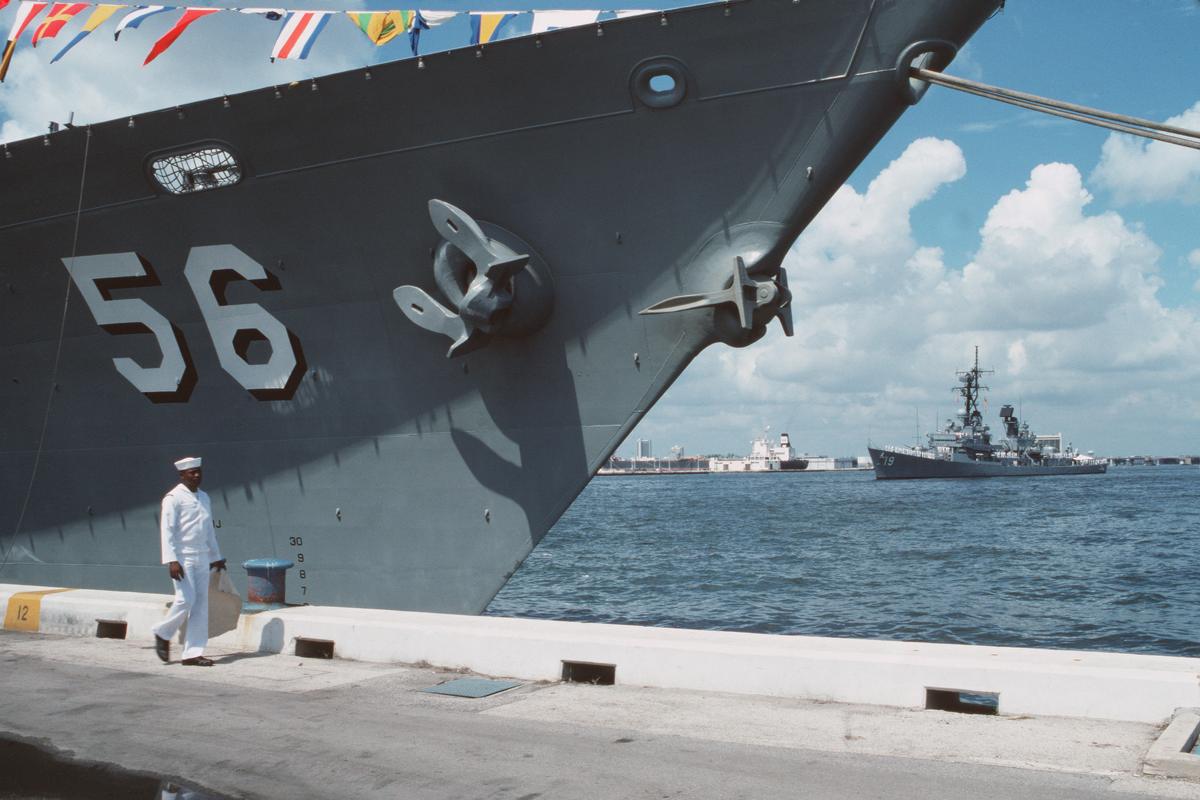
Part Three: The Maiden Mediterranean and Desert Storm
Chapter 13The Maiden Mediterranean
At the end of May 1989 a battle group of twelve ships, carrying more than 14,000 sailors and Marines, left its home ports on the East Coast for the Mediterranean. Its carrier was Coral Sea, on what her own cruise book records as her final deployment, and its commander was Rear Admiral Richard C. Macke. The Navy called the group MED 3-89.11 San Jacinto sailed in it. She had finished her fitting out and work-ups, the Navy’s term for the training and certification a ship must complete before she is judged ready for operations, and this was her first deployment, sixteen months after her commissioning. She would not be home until November.1 A sailor’s photograph from the crossing shows her alongside a supply ship, taking on stores or fuel on the way over.16
The pairing said something about the Navy of 1989. Coral Sea had been laid down during the Second World War and was making her last cruise. The cruiser beside her was a year old and carried a combat system the carrier’s builders could not have imagined. And the world both ships had been built for was six months from coming apart, though nobody in the battle group knew it when they sailed.
The Sixth Fleet
The Mediterranean was the Navy’s oldest overseas station. American warships had cruised there since the early years of the republic, and after the Second World War the Navy kept a standing force in its waters, built around one or two carriers, with cruisers and destroyers, amphibious ships carrying Marines, and the oilers, supply ships and tenders that kept them at sea. The Navy’s historical dictionary dates the command to 1 October 1946, when the Navy created U.S. Naval Forces, Mediterranean. It became the Sixth Task Fleet in 1948 and the Sixth Fleet in 1950.
Its work was part diplomacy and part deterrence: it showed the flag in friendly ports, supported NATO’s southern flank and stood ready for the crises the region produced with some regularity. In the Suez crisis of 1956, when Israel invaded Egypt’s Sinai Peninsula, its ships took 2,213 American citizens out of Egypt and Israel. In the decade before San Jacinto arrived, the same waters saw clashes with Libya in the Gulf of Sidra in August 1981 and March 1986, the bombing of the Marine barracks in Beirut in October 1983, the withdrawal of the Marines from Lebanon in February 1984 and, in April 1986, the air strikes on Tripoli and Benghazi.3 A Mediterranean deployment in the 1980s was liberty in Naples and Palma with the understanding that it could be cancelled, any afternoon, by something that had happened in Beirut or Tripoli.
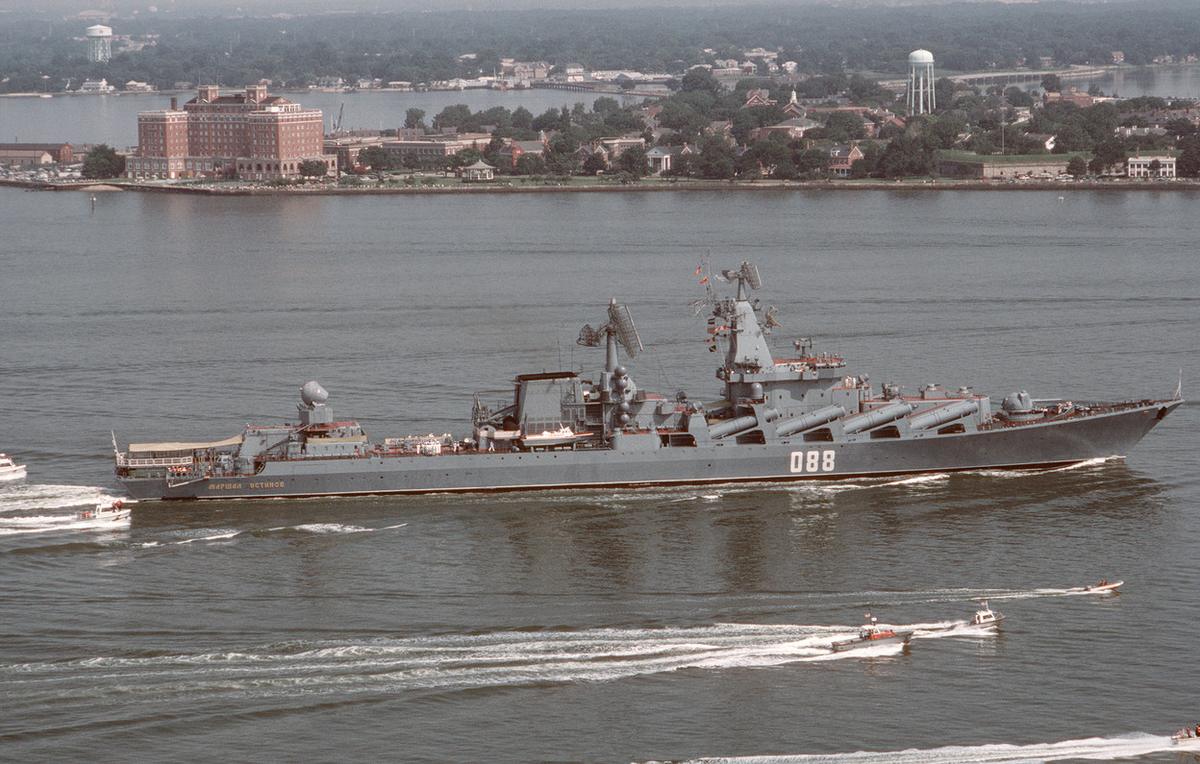
The Soviet Navy was there too. Since 1967 Moscow had kept a permanent squadron in the Mediterranean, known in the West by its Russian name, the Fifth Eskadra, made up of cruisers, destroyers, submarines, intelligence-gathering trawlers and supply ships. Much of its purpose was to shadow the Sixth Fleet and to be ready, if war came, to strike at American carriers, and the Sixth Fleet in turn watched the Eskadra. Over two decades the two navies had settled into close and wary contact. In 1972 the United States and the Soviet Union signed an agreement on the prevention of incidents on and over the high seas, which set rules for ships and aircraft that met: how close was too close, what signals to use, what maneuvers to avoid and how to give notice of exercises.3 It did not remove the tension, but it gave the officers who drove ships on both sides a common set of expectations.
The crew of the new Aegis cruiser had trained to fight that fleet. Everything in Chapter 10, the radar, the computers, the missiles in their cells, had been built to stop the Eskadra’s missiles and the bombers behind them. Now they would see it at close quarters.
Into the Black Sea
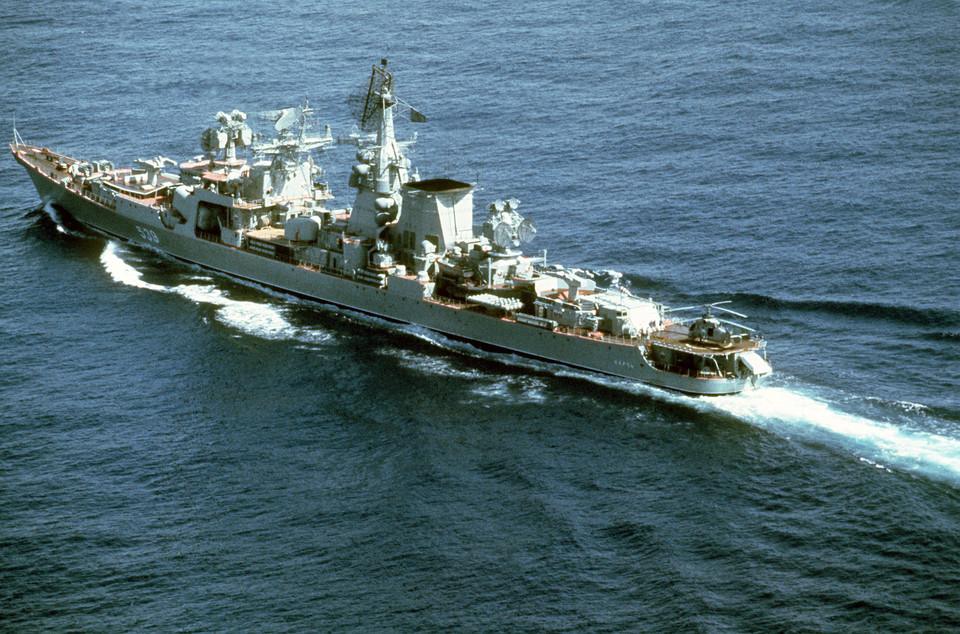
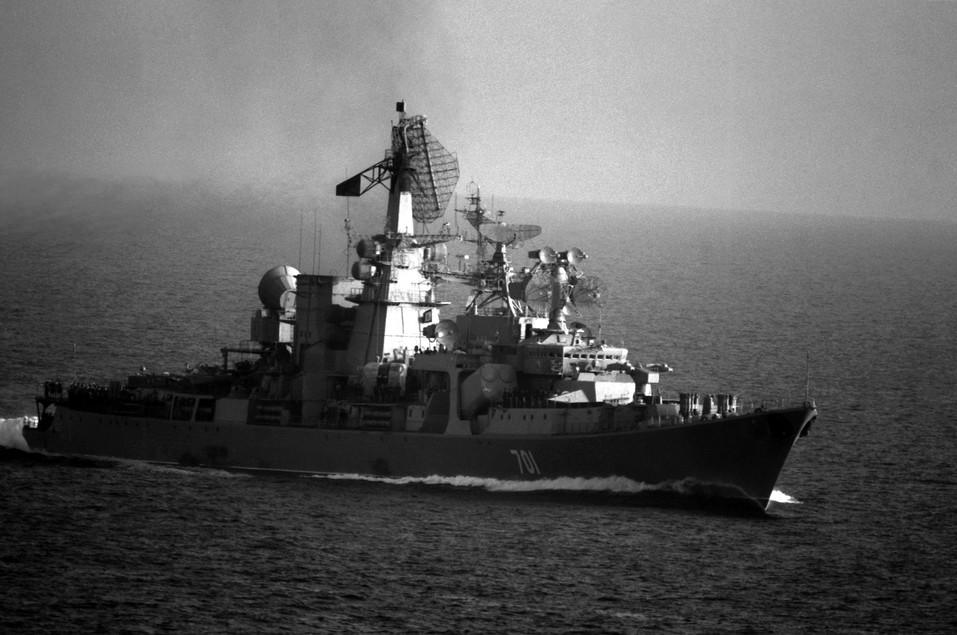
Her first assignment took her out of the Mediterranean altogether. The messages of congratulation that her cruise book later reproduced describe her as the Sixth Fleet’s representative in Romania, and Rear Admiral Macke’s lists the visit to Constanta as the first of her successes.12 Romania was a member of the Warsaw Pact, ruled by Nicolae Ceauşescu, and to reach it the cruiser had to pass through the Turkish Straits, the Dardanelles, the Sea of Marmara and the Bosphorus, into the Black Sea. The Black Sea was as close to a Soviet lake as any water in the world, and American warships had a recent history there. In February 1988, the Washington Post had reported, Soviet ships bumped two of them off the Crimean coast, after which both left the Black Sea for the Mediterranean.13 One of the two had been a sister of San Jacinto’s, the Aegis cruiser Yorktown.18
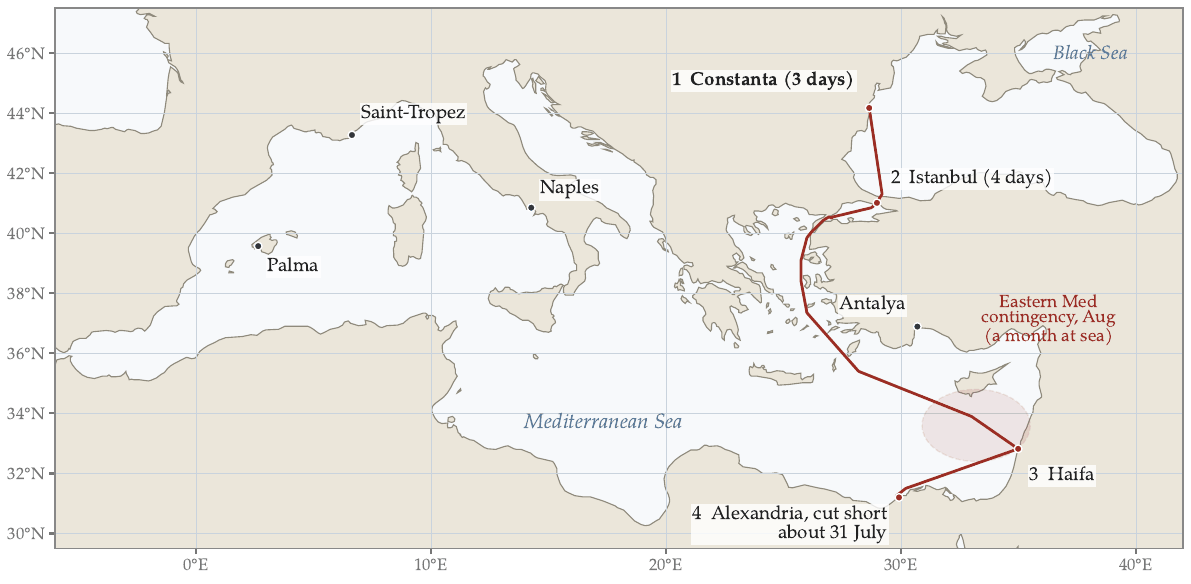
So the Navy’s newest cruiser, sixteen months in commission, was sent through the straits to tie up in a communist port as an invited guest. The visit lasted three days. The cruise book’s account calls Constanta Romania’s principal seaport, 170 miles from Bucharest and the center of the country’s Black Sea resort area, and describes sailors on the beaches of Mamaia, a resort a little to the north, eating a Romanian meal of lamb, french fries, tomato salad and bread, and touring a folklore program that included a traditional Romanian wedding. The official rate was nine lei to the dollar, but the sailors soon found that Kent cigarettes worked better than money as a means of trade. The writer described the call as a look at what life was like on the other side.5 Crew members remembered it as unlike the other ports of the deployment, a city with little in its shops, long queues and a population that was curious and cautious at once.5
None of them could have known how little time that Romania had left. Six months after the cruiser sailed from Constanta, the regime that had hosted her was gone and its ruler was dead.
Istanbul followed, four days at anchor off the city that straddles the Bosphorus, where the sailors toured Topkapi Palace, the Blue Mosque and Hagia Sophia and bargained for carpets, onyx, gold and leather in the Grand Bazaar. At Haifa, in Israel, she went alongside a pier for the first time since Romania. Sailors took tours to Jerusalem and to the fortress of Masada and swam in the Dead Sea.5
Alexandria
In Lebanon that summer, groups backed by Iran held a number of Western hostages. One was Lieutenant Colonel William R. Higgins of the Marine Corps, chief of a United Nations observer group in southern Lebanon, who had been kidnapped on 17 February 1988. The President’s published papers record that he was executed by his captors on 31 July 1989, and that afternoon President Bush met his senior advisers in the Cabinet Room on the hostage situation.14 The man in the Cabinet Room was the same man who had commissioned the cruiser eighteen months before.
San Jacinto was then at Alexandria, Egypt’s largest port, where sailors had gone on tours to Cairo, the Pyramids and the Egyptian Museum. The visit was cut short. By the cruise book’s account some of the crew came back to the ship by helicopter, and Alexandria was the last port she would see for nearly a month.5 Coral Sea’s cruise book tells the same story for the whole battle group: its visit to Alexandria was cut short so that it could operate in the eastern Mediterranean in support of the Beirut hostage situation, and the carrier’s air wing later flew cover for the evacuation of the American embassy in Beirut.11 An official Navy photograph dated 16 August 1989 shows Coral Sea, the battleship Iowa, the cruiser Belknap and the amphibious assault ship Nassau steaming in formation off the Lebanese coast.15
The record does not say where San Jacinto was in those weeks or what she did, beyond the Sixth Fleet commander’s reference, in a message her cruise book reprints, to contingency operations in the eastern Mediterranean.12 For her crew it was their first experience of the thing that would define the ship’s whole career: a recall from liberty, a month at sea off a coast, and nothing said afterward about what the ship had been ready to do.
The gap
In September the battle group started home. Coral Sea reached Norfolk on 30 September 1989.15 San Jacinto stayed. Rear Admiral Macke’s farewell message, as her cruise book prints it, noted that MED 3-89 was beginning its transit home without her, and with Coral Sea gone the Sixth Fleet had no aircraft carrier in the Mediterranean at all. Another message in the same pages calls it the “first ever period with no CV in the MED,” CV being the Navy’s designation for an aircraft carrier.12 The Navy’s own account of the ship, issued when she was decommissioned in 2023, says that she provided strike warfare capability during a rare carrier gap. An older compilation of her history calls it the first such gap in recent history, and no document in the record gives the gap’s exact dates.2
The reasoning was new, and it mattered for everything that came after. A carrier strikes with aircraft flown from her deck. A cruiser armed with Tomahawk cruise missiles can strike targets ashore with missiles launched from cells beneath her own deck, and San Jacinto’s vertical launchers could hold Tomahawks alongside the air-defense missiles for which the class was designed. She could not do a carrier’s work, which included fighting for control of the air, but she gave the Sixth Fleet a means of striking that did not depend on one. For the first time since 1946 an American admiral in the Mediterranean was counting on a cruiser’s missiles to do what he had always counted on a carrier’s aircraft to do.
The messages in her cruise book say that because she could do more in every warfare area than other ships she was the clear choice to strengthen the battleship battle group during the interval, and the battleship in the Mediterranean that summer was Iowa.12, 15 Her deployment was extended, and the Sixth Fleet commander credited her with providing offensive punch until the carrier Forrestal could arrive.4 Sixteen months later a Tomahawk from the same launchers would open a war.
The extension brought its own tests. She went through an Operational Propulsion Plant Examination, the Navy’s inspection of a ship’s engineering plant and of the sailors who run it, and Rear Admiral Macke’s message called the result outstanding. The cruise book also records a NATO exercise, Display Determination 89, and a ten-day maintenance period at Naples, during which the crew climbed Vesuvius, walked through Pompeii and took the day tour to Rome. They left Naples expecting to start for home. Their next port turned out to be Palma de Mallorca, which most of the crew, by the cruise book’s account, rated the best liberty port of the deployment.6, 12 A quarter of a century later a sailor of the 2013 crew would remember Palma for the best food of his deployment.
The other ports appear in the cruise book without dates. Antalya, on Turkey’s southern coast, is described as a week-long visit, and much needed, and Saint-Tropez, on the French Riviera, as the ship’s first western Mediterranean port after what the writer called a grueling month at sea in the eastern Mediterranean.5, 6 Former crew remember a bar at Antalya that they called the Camel Bar and keep photographs taken there. One remembers meeting a man at a beach bar in Saint-Tropez and inviting him to tour the ship.5, 16
Life aboard in 1989
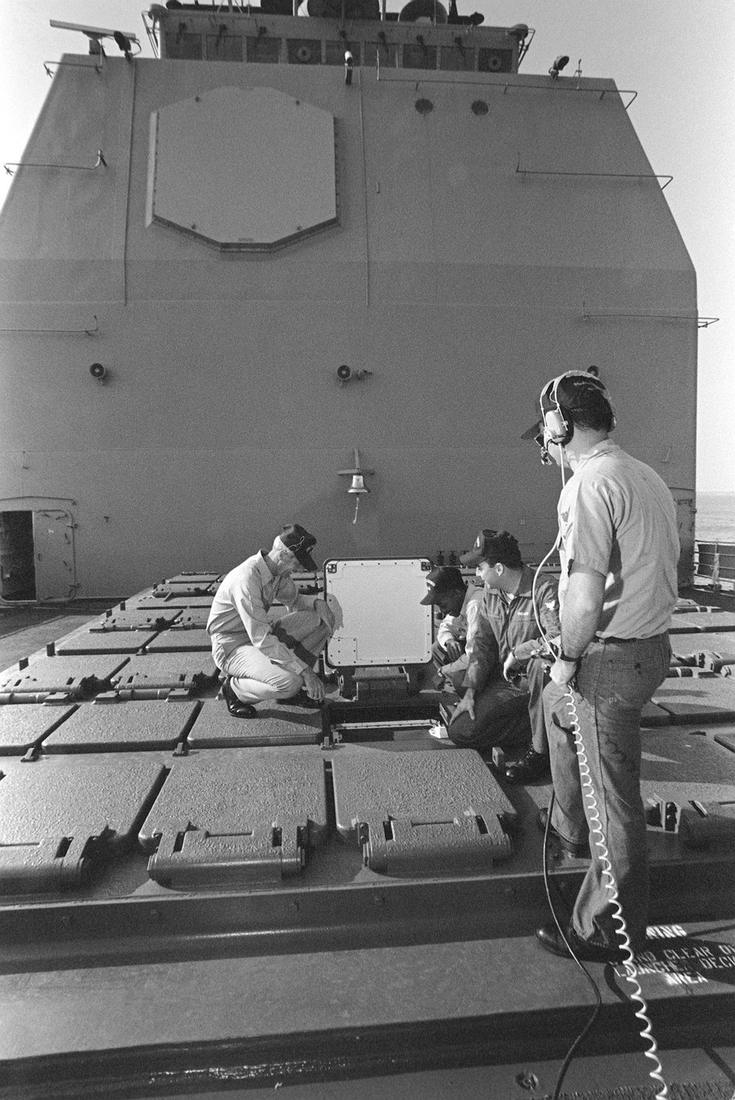
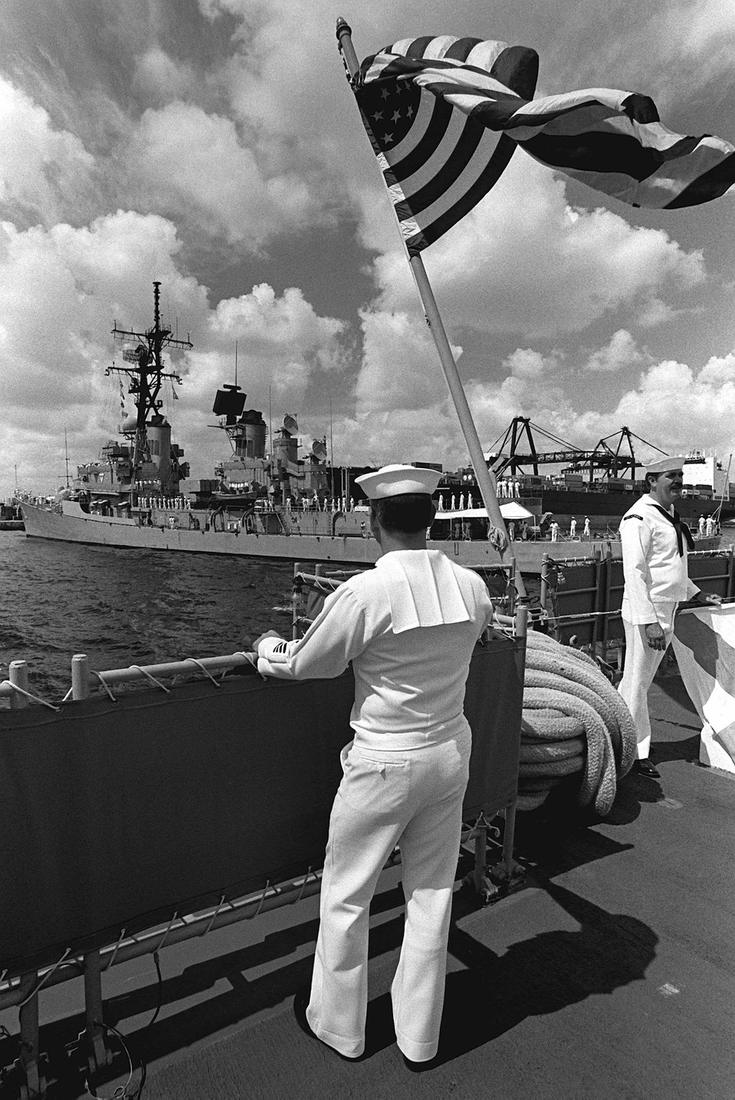
The cruise book of 1989 shows the ship when everything in her was new. Set beside the ship of her later years, the differences are mostly in the names.
The ship carried two SH-60B Seahawk helicopters, part of what the Navy called the Light Airborne Multi-Purpose System, or LAMPS.7 Her cruise book describes their work: they carried sonar processing equipment and torpedoes to find and, if necessary, attack submarines, searched for surface ships with radar and other sensors well beyond the ship’s own horizon, flew medical evacuations and carried the mail, which the writer called the morale-boosting letter from home.12 She took her fuel and stores at sea from the oilers and supply ships that accompanied the fleet, the two ships steaming side by side at a steady speed, often less than two hundred feet apart, while lines and hoses were passed across. A deployed cruiser did it every few days in 1989, as she would in 2013.
The cruise book’s pages also show how the crew was organized. The sonar technicians and torpedomen of CA division searched for submarines with the hull-mounted sonar and the towed array and kept the torpedoes for both the ship and her helicopters. The torpedoman’s mates were a rating of their own then; by the 2010s they were gone and the torpedoes belonged to the sonar technicians. The operations specialists of OI division manned the combat information center, the space where the ship’s sensors and radio reports came together, and built from them the picture of the surrounding sea and air on which the commanding officer based his orders, filling posts with titles such as engagement planner and air intercept controller. The cryptologic technicians, electronic warfare technicians and intelligence specialists of OT division gave early warning of the radars and transmissions around the ship and located and identified the other units operating near her. The boatswain’s mates and seamen of the deck division ran the ship’s boats, handled the anchors and lines and worked the flight deck. The supply department fed the crew, paid them twice a month, ran the barber shop, the laundry and the ship’s store, and kept the spare parts coming.12
The men of the first crew remember Captain Clark as a commanding officer who did not waste time, and they tell of drills that came without warning. In one, the crew of the after five-inch gun mount, relaxing on the fantail during a lunch break, were ordered to bring the gun to bear and prepare to fire, to see how quickly they could do it. In another, during a steel-beach picnic, the Navy’s name for a cookout held on deck while the ship is at sea, the forward machine guns were ordered into action against a target towed astern.8 These are the recollections of men who were young at the time, and the details may have shifted over thirty-five years. The year is most likely 1989, and neither drill appears in a document.
In mid-July, while she was deployed, her executive officer, the second in command, who had been with her since October 1986, was relieved by a lieutenant commander who had been chief engineer of Ticonderoga.12 A junior hospital corpsman who had served aboard since the commissioning stayed with her to the end of the deployment.10
Home
She came back to Norfolk in November 1989.1 That month, on the 9th, the Berlin Wall was opened, and in December the Romanians overthrew Ceauşescu, whose principal port she had visited at the start of her deployment.9 Within two years the Soviet Union was gone, and in 1992 the Fifth Eskadra was disbanded.3
She had made exactly one deployment against the enemy she was built to fight. The sailors who took her to Constanta in June came home in November to a world in which the Warsaw Pact was dissolving on television. The ship was not yet two years old, and the war she had been designed for had been called off.
A sailor who had stood the New Year’s watch at Pascagoula and at Norfolk stood it at Norfolk again at the end of 1989, this time as petty officer of the watch.16 One list of her commanding officers has Captain Clark turning the ship over to Captain Paul W. Ecker on 12 January 1990. The Navy’s own history puts the change a year later, in the Red Sea.17 Whichever date is right, her next deployment would not be to a cold war.
Notes
- Fitting out and work-ups, deployment to the Mediterranean in late May 1989 and return in November: NAVSEA historical evaluation of USS San Jacinto (CG 56); hullnumber.com deployment table (May–November 1989). The exact departure and return dates are not confirmed by a command history or a contemporary newspaper. ↩
- The first Mediterranean carrier gap “in recent history” and the ship’s strike capability: uscarriers.net, USS San Jacinto (CG 56) chronology. The Navy’s decommissioning release (DVIDS 453585, 15 September 2023, as reproduced on the Seaforces data sheet) says that on her 1989 maiden deployment she provided strike warfare capability during a rare aircraft carrier gap in the Mediterranean; the Dictionary of American Naval Fighting Ships entry says nothing about the 1989 deployment. The wording “first ... in recent history” is that of uscarriers.net alone. No document in the surviving record gives the dates or length of the gap. ↩
- The Soviet Fifth Eskadra (formed 1967, disbanded 1992) and the 1972 Incidents at Sea Agreement between the United States and the Soviet Union (signed 25 May 1972): general Cold War naval history; the text of the agreement is published by the State Department. The establishment of the Sixth Fleet (1 October 1946; Sixth Task Fleet 1948; Sixth Fleet 1950) and the evacuation of 2,213 American citizens in the Suez crisis of 1956: James M. Morris and Patricia M. Kearns, Historical Dictionary of the United States Navy (2011), entries “Sixth Fleet” and “Suez Crisis.” The events of 1981 to 1986 (Gulf of Sidra, August 1981 and March 1986; Beirut barracks bombing, October 1983; withdrawal of the Marines from Lebanon, February 1984; Operation Eldorado Canyon, April 1986): the same work, Chronology. ↩
- USS Forrestal’s relief of the gap and the extension of the cruiser’s deployment: ship’s 1989 cruise book and crew recollection. The carrier is named in the Sixth Fleet commander’s message as the cruise book reprints it (note 12); the dates of the gap and of Forrestal’s arrival are not confirmed by any other document. ↩
- The Black Sea visit to Constanta, the Istanbul, Haifa and Alexandria calls, and the circumstances of the early departure from Alexandria: ship’s 1989 cruise book (a 136-page volume carrying a letter from Capt. H. W. Clark Jr.) and crew recollection. No press account of an American warship visit to Romania in 1989 was found to confirm the call, and the nature of the Lebanon tasking is not established. The Camel Bar at Antalya: crew recollection and photographs. The port pages are printed pp. 100–112 of the cruise book (PDF pp. 104–116), read from page images; they take the calls in the order Constanta, Istanbul, Haifa, Alexandria, Antalya and give no dates. ↩
- Saint-Tropez, Palma de Mallorca, the ten-day maintenance period at Naples and the NATO exercise Display Determination 89: cruise book, printed pp. 115–120 (PDF pp. 119–124). The exercise is also named in the Sixth Fleet commander’s message (note 12). The exercise name and dates are not confirmed by an outside record. ↩
- Two SH-60B LAMPS Mk III Seahawks as the ship’s air detachment: DANFS, vol. III, entry for San Jacinto (CG-56), characteristics. ↩
- The quick-draw and machine-gun incidents: plank-owner recollection; the year is likely 1989. ↩
- The fall of the Berlin Wall (9 November 1989) and the overthrow of the Ceauşescu government (December 1989): general history. ↩
- A junior hospital corpsman’s account of serving from commissioning to the end of the 1989 deployment: crew recollection. The cruise book also lists the ship’s wardroom and chief’s mess; those names and ranks could not be verified and are not reproduced. ↩
- MED 3-89: USS Coral Sea (CV-43), cruise book of the 1989 Mediterranean deployment (published 1990), pp. 40–41, as reproduced by e-yearbook.com, consulted 14 November 2026. The scanned text is imperfect; the figures (twelve ships, more than 14,000 sailors and Marines), the departure at the end of May, Rear Admiral Macke’s command, the shortened Alexandria visit and the air cover for the Beirut embassy evacuation are taken from its legible passages. The page does not name San Jacinto; her place in MED 3-89 rests on Macke’s message in her own cruise book (note 12). ↩
- The messages of congratulation, the executive officer’s relief and the air detachment’s work: USS San Jacinto, Mediterranean cruise book, 1989, pp. 2–3 (PDF pp. 6–7: Captain Clark’s letter to the crew and messages from Rear Admiral R. C. Macke, Commander Battle Force Sixth Fleet, Vice Admiral J. D. Williams, Commander Sixth Fleet, and Admiral J. T. Howe, Commander in Chief U.S. Naval Forces Europe), pp. 4–5 (PDF pp. 8–9, executive officers) the division pages (PDF pp. 12, 56, 66, 73 and 78) and the Air Department page (PDF p. 98), all read from page images. The quoted phrase comes from a message whose signature the scan does not show clearly. ↩
- The Black Sea incident of February 1988: Molly Moore, “U.S. Team to Visit Iraq for Talks on Gulf Incidents,” Washington Post, 17 February 1988, section A. ↩
- Higgins: George Bush Presidential Library and Museum, Public Papers of the President, item 775, editorial note (kidnapped 17 February 1988, executed 31 July 1989); “Statement by Press Secretary Fitzwater on the Hostage Situation in Lebanon,” 31 July 1989, The American Presidency Project, University of California, Santa Barbara. Both consulted online 14 November 2026. ↩
- Official photographs: usscoralsea.net, “Pictures, 1980’s,” pp. 11–12, U.S. Navy photographs credited to the National Naval Aviation Museum, captions of 16 August 1989 (formation off Lebanon) and 30 September 1989 (return to Norfolk), consulted 14 November 2026. ↩
- Crew recollection: a sailor’s photographs of an underway replenishment on the 1989 crossing and of Antalya; a sailor who met a man at a beach bar in Saint-Tropez and invited him to tour the ship; the New Year’s watch of 31 December 1989 at Norfolk, from the sailor whose earlier New Year’s watches are noted in the notes to Chapter 12. ↩
- Commanding officers and their dates: NavSource Online, cruiser photo index for CG-56 (archived 23 May 2025), list of commanding officers (Clark, 23 January 1988 to 12 January 1990; Ecker, 12 January 1990 to 8 February 1992). The Dictionary of American Naval Fighting Ships gives 12 January 1991 for the change of command; see the notes to Chapter 14. ↩
- The ships bumped off Crimea on 12 February 1988 were the cruiser Yorktown (CG-48) and the destroyer Caron: source needed (NHHC, or the Washington Post report already cited if it names them). unconfirmed ↩