Part Three: The Maiden Mediterranean and Desert Storm
Chapter 14Five Days' Notice
Five days
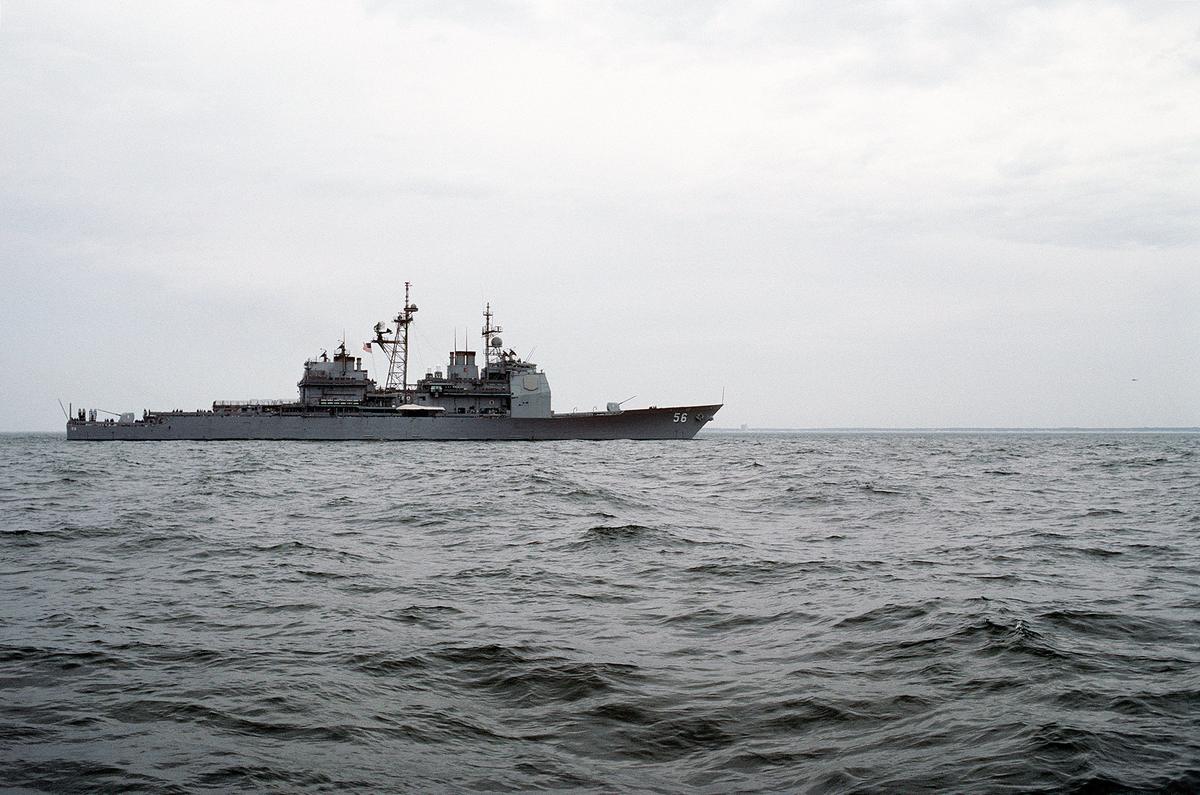
When Iraqi armored divisions crossed into Kuwait on 2 August 1990, San Jacinto was at sea off the Virginia coast with her sister ship Leyte Gulf (CG-55). The two cruisers were testing a way of passing radar information from one ship to another, an early step toward what the Navy later fielded as the Cooperative Engagement Capability, in which a ship can use another ship’s radar picture as if it were her own.1, 20 It was the kind of work a new ship did in a quiet year: an experiment, a few days out, home by the weekend.
Within two days the Iraqi army had overrun the emirate, and Saddam Hussein, Iraq’s president, declared Kuwait a province of Iraq. On 6 August the United Nations Security Council, which had already condemned the invasion, placed a trade embargo on Iraq.5 President George H. W. Bush, who had spoken at the cruiser’s commissioning in Houston two and a half years before, began sending American forces to defend Saudi Arabia. The operation was called Desert Shield.
The ship’s own movements in those first days survive in outline. The day after the invasion, Leyte Gulf broke away and steamed south for her home port of Mayport, Florida. The day after that, San Jacinto came back into Norfolk.20 The aircraft carrier John F. Kennedy (CV-67) and the ships assigned to her had been told to be ready to deploy on about five days’ notice, and the cruiser was to go with them.2
A carrier battle group, as the Navy called it then, was a carrier and her air wing surrounded by escorts. Cruisers and destroyers defended the force against aircraft, missiles and submarines, frigates hunted submarines, and supply ships carried the fuel, ammunition and food that kept everyone at sea. In that company an Aegis cruiser had one job above the others. Her radar and combat system had been built to watch every aircraft and missile for hundreds of miles around and to decide, faster than any earlier ship could, which of them to engage. She was the group’s air defense.
Five days is very little time in which to take a warship to war. San Jacinto had come home from her first deployment, to the Mediterranean, in November 1989, and was nine months into the ordinary round of maintenance and training that follows one. Some of the sailors who had commissioned her were already gone. An engineer from the commissioning crew remembers that he left her in 1990 and went on to sweep mines in the Arabian Gulf.28 The rest now had to take aboard ammunition, food and spare parts for a deployment of unknown length, and to say their goodbyes on a few days’ warning. A sailor with a lease, a car payment, a wife or a child had less than a week to arrange for all of it to go on without him, for how long nobody could say.
A reporter from the Washington Post who stood on the Norfolk piers that week opened his story with a sentence that caught the mood: “No war has been declared, but on Pier 7 you’d never know it.” His dispatch, dated 15 August, said that Kennedy, the cruiser Thomas S. Gates (CG-51) and two amphibious ships had sailed that morning, and that nineteen ships would have left Norfolk in under a week before the mobilization was done. Navy officials told him that the base, the largest naval station in the world, had never sent out so many ships so fast, not even in the Vietnam years, when the buildup had been spread over far more time. In the five days before the carrier sailed, the paper reported, some 500 tons of weapons and equipment had gone aboard the warships and 5,000 crane-loads of food and supplies had been swung aboard Kennedy alone, while shore crews worked sixteen-hour days.17
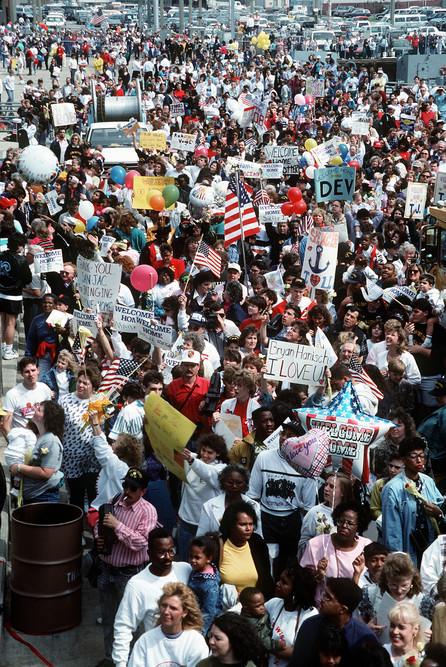
The article described the carrier’s group as three cruisers, Gates, Mississippi (CGN-40) and San Jacinto, with the combat stores ship Sylvania (AFS-2). It said the group would meet three more ships from other ports and then either relieve the Dwight D. Eisenhower group, already in the Red Sea, or add to the fleet gathering around the Arabian Peninsula. The reporter also noticed how few relatives stood on the pier for ships with such large crews, and he was told by people who often watched ships leave that a thin crowd was a sign of how hard sudden departures were on families.17
The newspaper did not list San Jacinto among the ships that left on the 15th. The Navy’s history gives her departure as 16 August and says that she joined the Kennedy group at sea, on the way.1, 2 The two accounts fit together: the carrier went first, and the cruiser followed a day behind and caught up. Neither says why. She would not see Norfolk again until 28 March 1991.1
The Red Sea
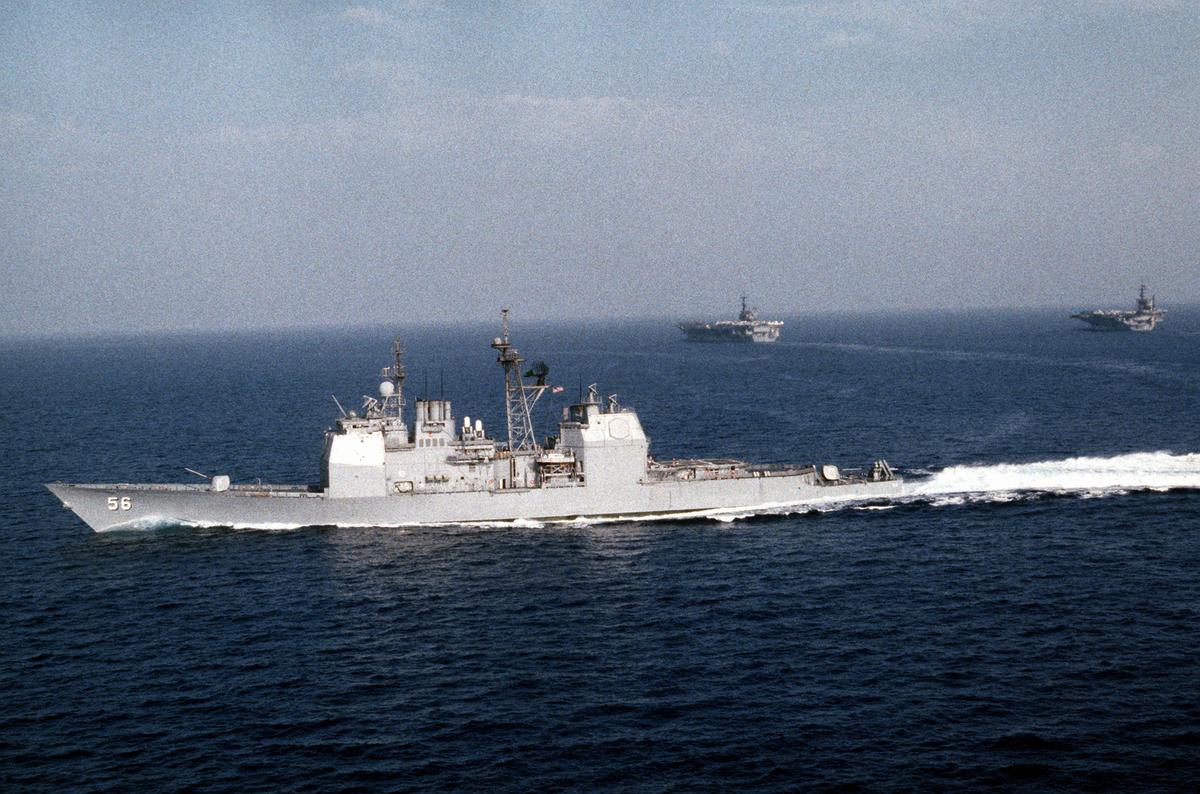
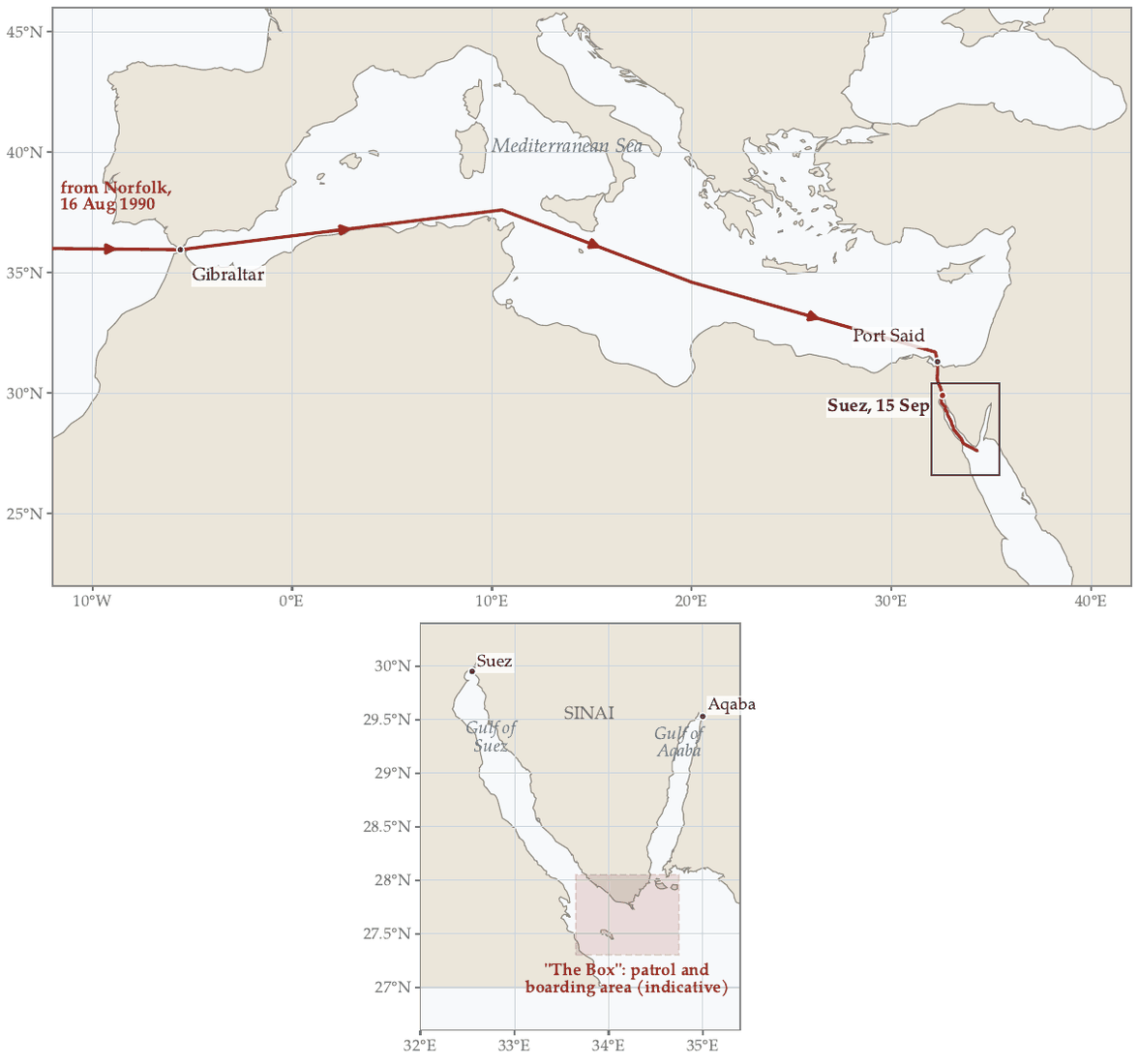
The group crossed the Atlantic and the Mediterranean and entered the Suez Canal. A Navy photograph dated 15 September 1990 shows San Jacinto in the canal, southbound; some accounts give the 14th.3 The canal runs about a hundred miles across the Egyptian desert, from Port Said on the Mediterranean to Suez at the head of the Red Sea. Ships go through in convoys, one direction at a time, each with an Egyptian pilot on the bridge. Photographs kept by a shipmate show a reenlistment ceremony held on deck during one of the cruiser’s transits, with Kennedy in the background.28
Beyond Suez lies the Red Sea, some twelve hundred miles of water between Egypt, Sudan and Ethiopia on the African shore and Saudi Arabia and Yemen on the Arabian. For the next six months it was the ship’s world, and within it she had a small, particular patch. The Navy’s evaluation of the ship places her search area at the southern tip of the Sinai Peninsula, where the Gulf of Suez and the Gulf of Aqaba open into the Red Sea.20 Ships bound for the Jordanian port of Aqaba, at the head of the second gulf, had to pass that way, and Aqaba was the back door through which cargo could reach Iraq overland. The crew had their own name for the patrol area. They called it the San Jac in the Box, and years later veterans still described their war as the one they had done in the Box.4, 11
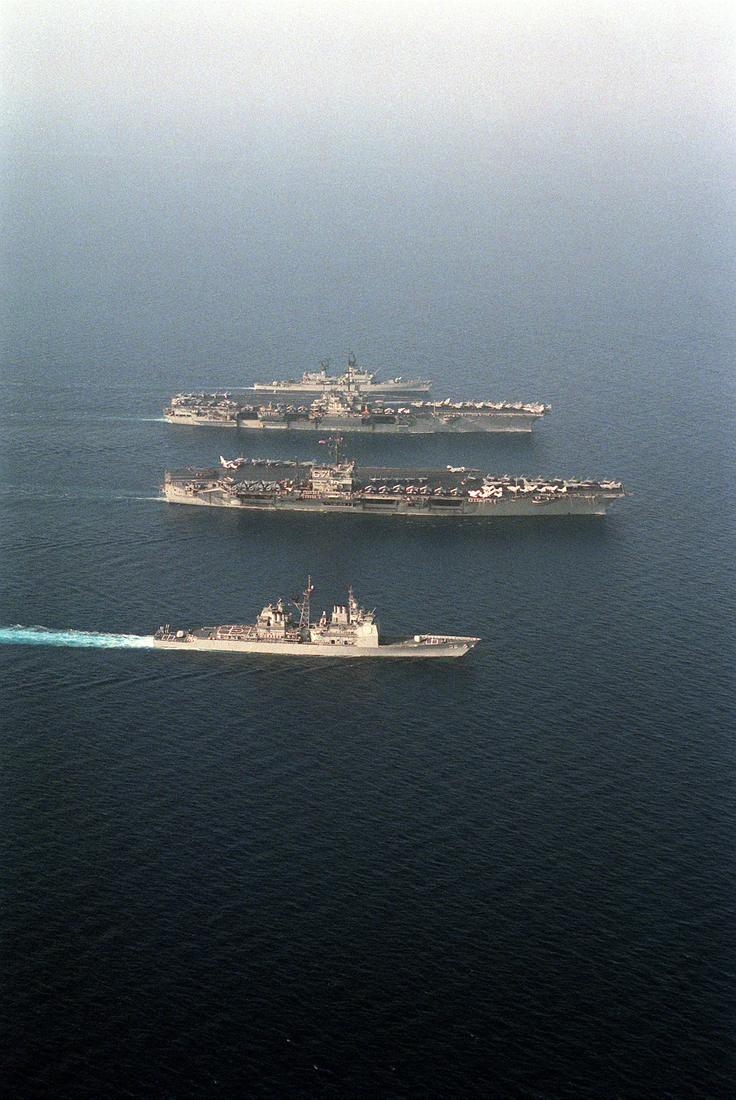
A photograph taken in the Red Sea that September by one of Kennedy’s photographer’s mates shows four ships together: the cruiser Biddle (CG-34), the carriers Saratoga (CV-60) and John F. Kennedy, and San Jacinto.22
The embargo
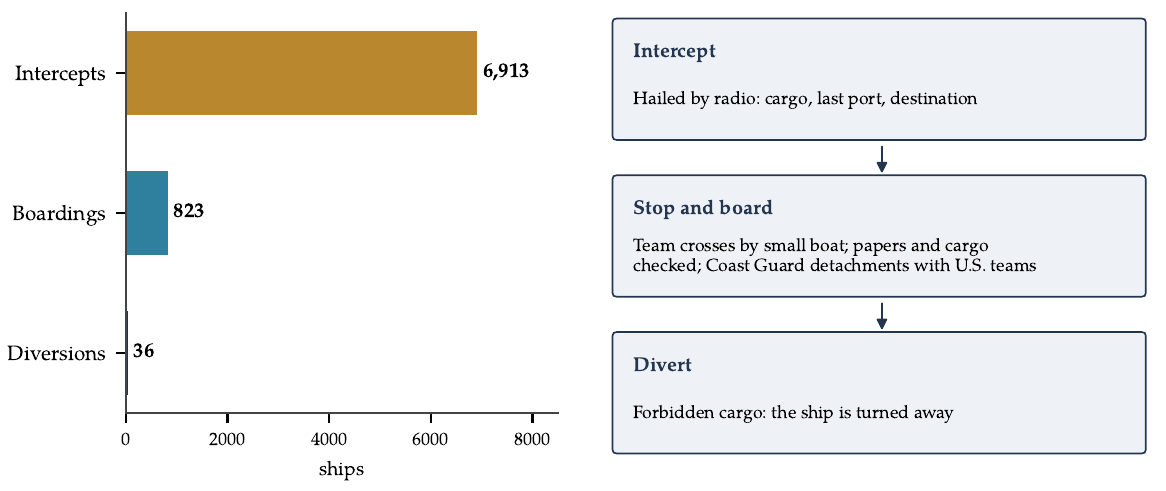
The embargo came first. The Security Council had banned trade with Iraq on 6 August and on 25 August authorized navies to enforce the ban at sea.5 The work was called maritime interception, and it went in stages. A merchant ship was first hailed by radio and questioned about her cargo, her last port and her destination; that was an intercept. If the answers did not satisfy, she was ordered to stop, and a boarding team crossed to her in a small boat and climbed aboard to check her papers and inspect what she carried. In the American ships, Coast Guard law-enforcement detachments went with the boarding teams. A ship found carrying forbidden cargo was turned away, which the coalition counted as a diversion. By the time the war began in January the interception force, commanded by Rear Admiral William M. Fogarty, had made 6,913 intercepts and 823 boardings and had ordered 36 diversions.21
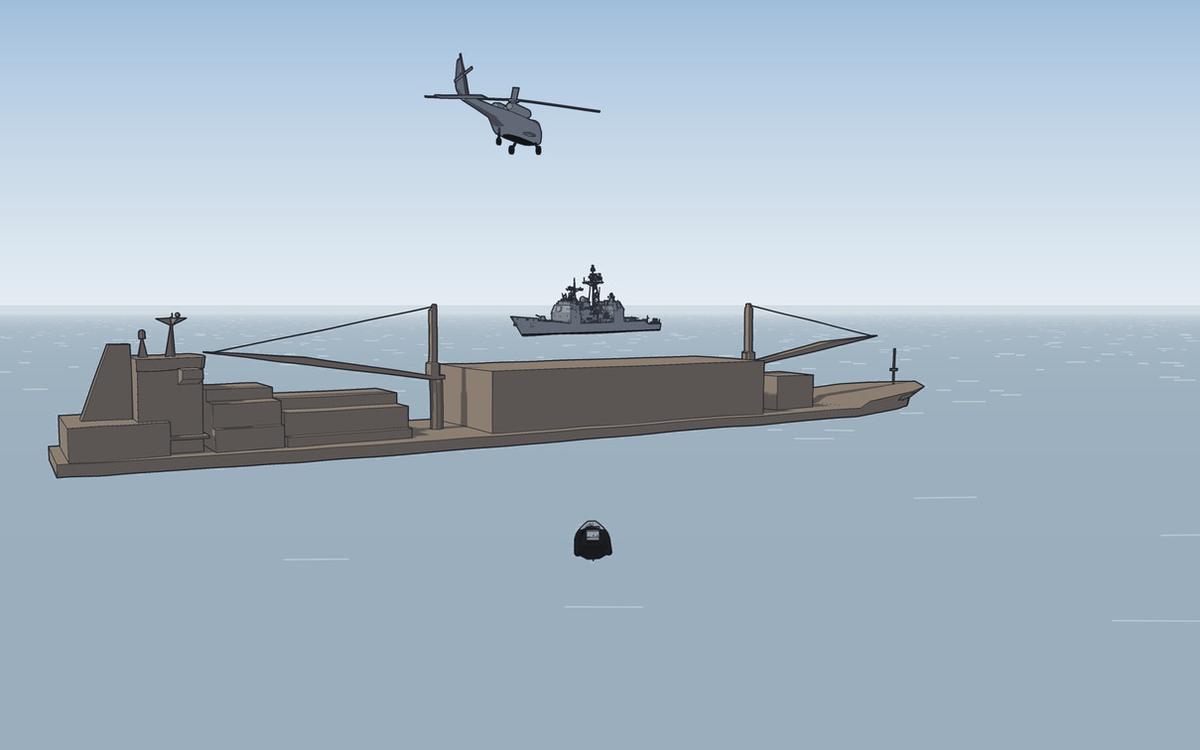
The Navy’s evaluation says only that San Jacinto’s boarding teams inspected several dozen ships for contraband in her search area.20 The crew remembered more. Shipmates recall the boardings as hot, hard work and a job they were proud of, and one kept photographs of the team being launched in the ship’s boat with a helicopter overhead, of the team at work on a merchant deck, and of the cruiser standing by. A boarding on 23 December 1990 was filmed by a member of the crew, and the tape survives.5, 28
It was not work the ship had been designed for. A billion-dollar air-defense cruiser was stopping freighters one at a time and sending cooks and technicians up their sides on a rope ladder to read cargo manifests. But it was the work the next thirty years would ask of her more often than any other. The boarding teams of 1990 were the first of a line that ran through the sanctions patrols of the 1990s to the pirate skiffs of 2010.
Red Crown
The task the Navy cared most about was air defense. In its later account the cruiser served as the anti-air warfare commander of the Red Sea battle force, responsible for guarding it against a surprise attack by Iraqi or terrorist aircraft and missiles.7 The anti-air warfare commander is a post within a task force rather than a rank. It goes to the ship best equipped to watch the air over the whole formation. From that ship’s combat information center, the windowless room where her radar picture is assembled and her weapons are directed, the watch officers coordinate the air defense of every ship in the group: which aircraft are friendly and which unknown, which ship will engage which threat, and when. Aegis had been built for exactly that work.
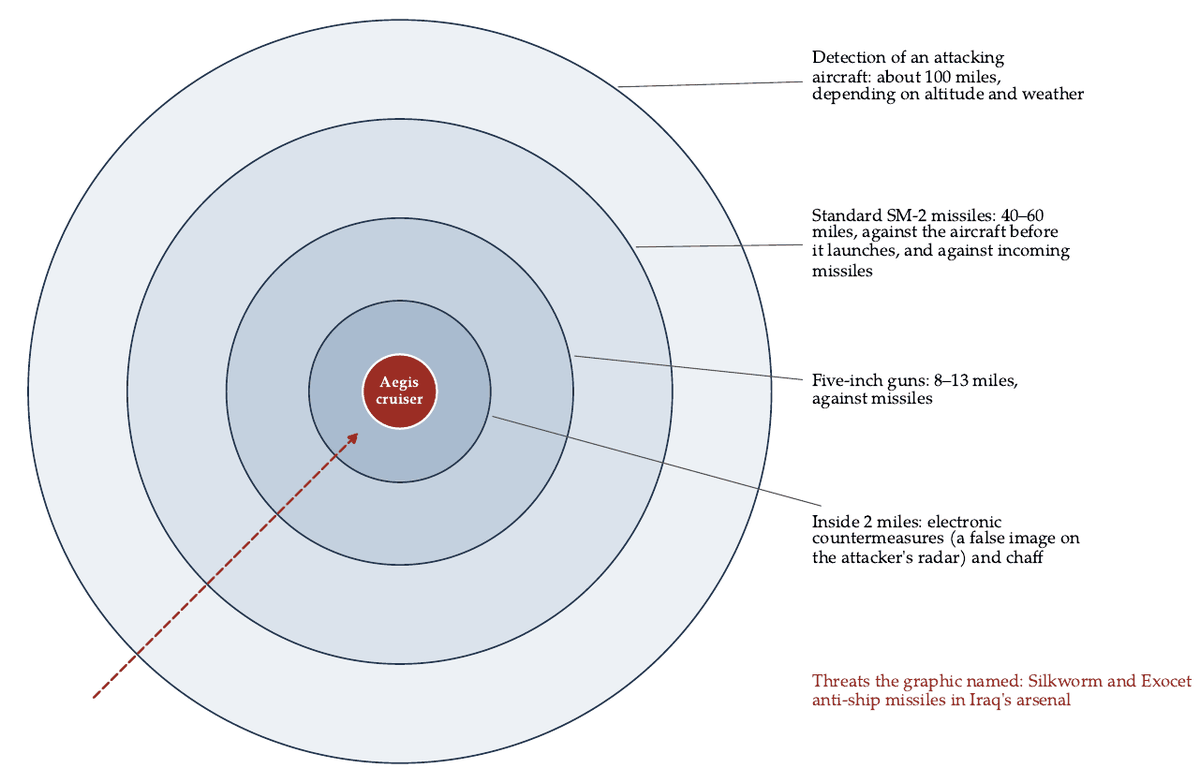
Newspapers at the time explained a warship’s defenses to their readers in plain distances. A Los Angeles Times graphic published during the war put the detection of an attacking aircraft at about 100 miles, depending on its altitude and the weather. At 40 to 60 miles the ship’s Standard SM-2 missiles would try to destroy the aircraft before it launched its own weapons, and they could be turned on incoming missiles as well. At 8 to 13 miles the five-inch guns could fire on missiles. Inside two miles the ship relied on electronic countermeasures, which could plant a false image of her on an attacker’s radar, and on chaff, clouds of aluminum strips fired off to confuse it. The paper’s list of the threats began with the Silkworm and Exocet anti-ship missiles in Iraq’s arsenal.24
The Exocet was the missile that had sunk Sheffield and crippled Stark, and Iraq’s pilots were the ones who had fired it at Stark. Nobody in the cruiser’s combat information center needed that explained. Many years later a veteran of her air-defense watches wrote that sitting Red Crown in Desert Storm, the call sign of the watch that kept the air picture over the force, was something never to be forgotten.11 Hundreds of aircraft a day would fly out from three carriers and come back the same way, and the watch had to be sure, every time, that everything coming back was one of theirs.
The Red Sea force grew through the autumn. By January it was Battle Force Yankee, Task Force 155, under Rear Admiral Riley D. Mixson, with three carriers: Saratoga, Kennedy and America (CV-66), which arrived just before the war.13, 25 Of the 108 American ships under Vice Admiral Stanley R. Arthur’s Naval Forces Central Command when the fighting began, 26 were in the Red Sea.21 The escorts changed as the months went by. The sources name the cruisers Mississippi, Thomas S. Gates and Philippine Sea (CG-58), the fast combat support ship Seattle (AOE-3), and Sylvania, which brought stores.7
Waiting
Five months passed between the canal and the war, and most of what filled them left no official record. The ship’s post office kept the crew’s mail moving through the fleet post office in New York that served her, FPO New York 09587. There was no email. A letter home took weeks each way, and the mail bag was the only news of home a sailor had. For collectors of naval postal covers the post office also applied special postmarks and printed designs, which collectors call cachets. One such cover, postmarked aboard on 24 October 1990, carries a cachet for the John F. Kennedy Battle Group.23
The crew made their own diversions. A video from the autumn of 1990 records a boxing smoker, an evening of organized bouts staged on board, during the Red Sea patrol. At Christmas, as crew members remember it, a sandstorm blew off the desert and left the ship, usually gray, coated in fine pale dust from the masthead to the waterline. They called it their white Christmas in the Red Sea, and the dust came off in a freshwater wash-down before the holiday.6, 28 On New Year’s Eve a sailor who had seen in every New Year aboard since 1987, as messenger of the watch at Pascagoula and at Norfolk and as petty officer of the watch in 1989, stood a twelve-hour watch from 1800 to 0600 in the ship’s signals exploitation space, the compartment where specialists intercept and analyze the radio and radar signals of other ships and aircraft.28
Captain H. Ward Clark Jr. had commanded the ship since her commissioning. The Navy’s history records that Captain Paul W. Ecker relieved him on 12 January 1991, five days before the war began.8 A change of command in the middle of a deployment is not unusual, since officers’ tours run on schedules of their own. Not every source agrees on the year. The roster of commanding officers kept by NavSource gives 12 January 1990 for the same ceremony, which would mean that Ecker, and not Clark, took the ship to the Red Sea. That roster shows the captains of the early 1990s serving tours of about two years and puts Ecker’s successor in command in February 1992, which fits its own date at least as well as the Navy’s. No record from the ship herself that fixes the date has been published. Sailors who served in the war remember serving under Ecker, which fits either date.8
17 January 1991
In November the Security Council had authorized the use of force if Iraq was not out of Kuwait by 15 January 1991.18 The deadline passed.
The weapon chosen to open the war from the sea was the Tomahawk land-attack missile, a small pilotless jet that a ship could launch from hundreds of miles away. It had been in the fleet for most of a decade and had never been fired in combat. Nobody knew for certain how it would do against a real air defense, and the men who had planned the first night had put it against some of the best-defended targets in Iraq so that pilots would not have to go there.
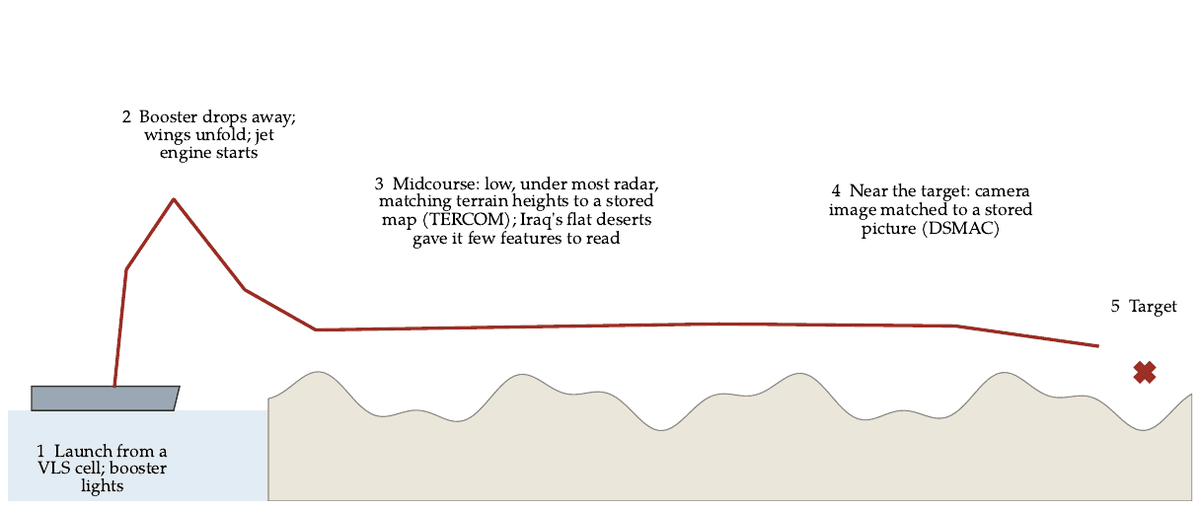
The Tomahawk flew low, under most radar coverage, and found its way in two stages. Over the long middle of the flight it measured the height of the ground beneath it and compared the readings with a terrain map stored in its computer, a method called terrain contour matching. Near the target it switched to a camera and matched what it saw against a stored picture of the target area, using a system called the Digital Scene Matching Area Correlator. Iraq’s flat deserts gave the terrain-matching system few features to read, which made the first method harder there than it was over hills.25
None of the planning happened on the ship. Each missile’s route, the points it would turn at, the ground it would cross and the image of its target were prepared beforehand by planning staffs ashore and loaded into the missile through the ship’s weapon system.10 The cruiser’s part was to be in position, to have the missiles ready in their cells, and to fire on time.
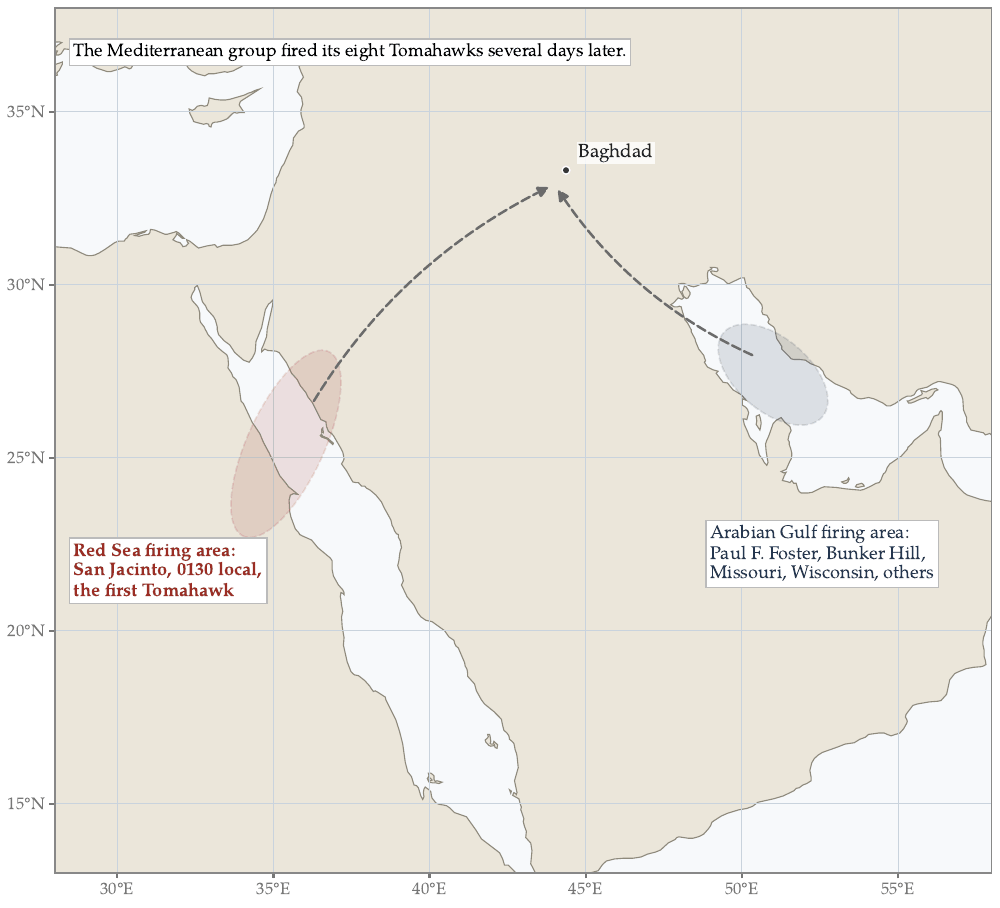
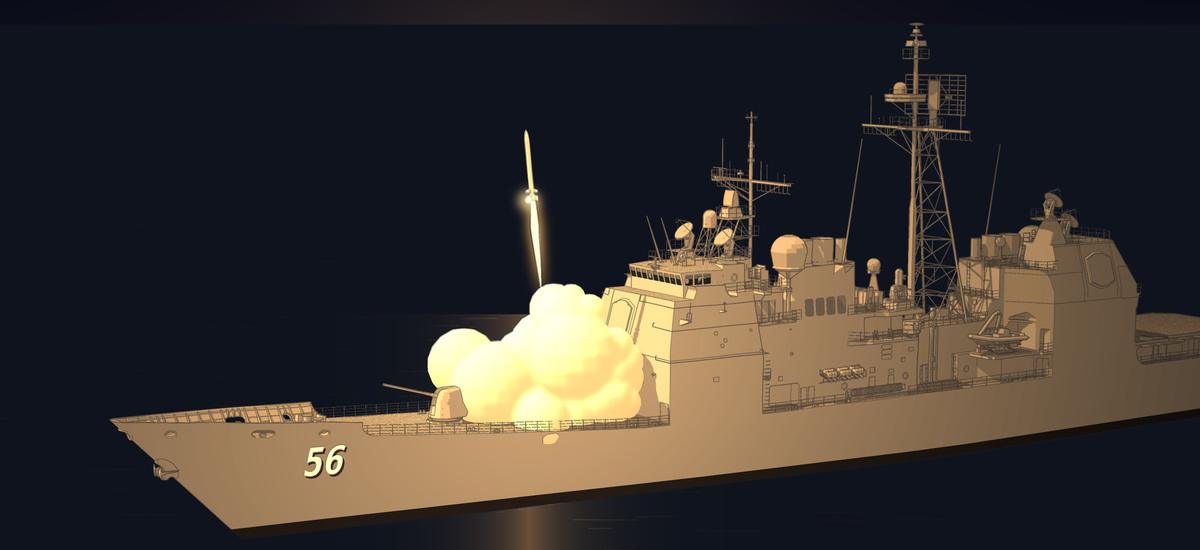
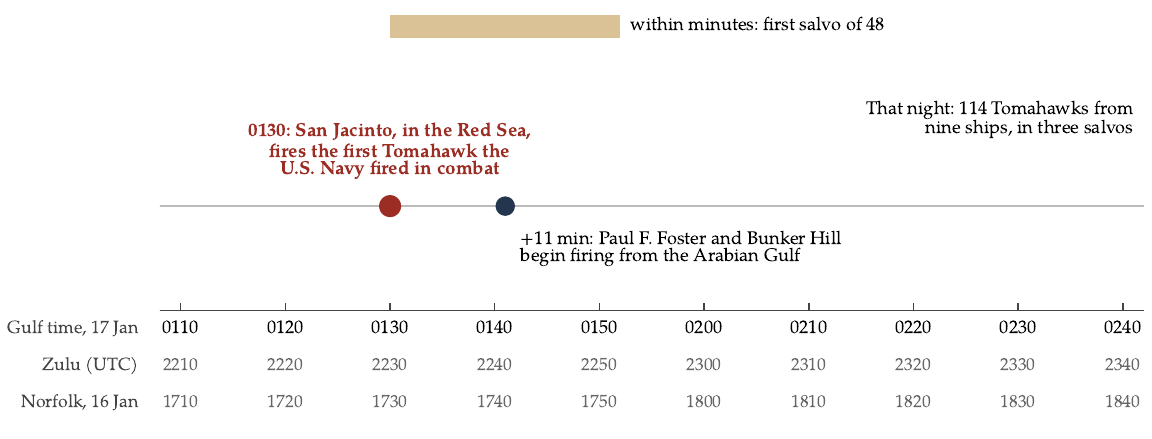
At 0130 on 17 January, Persian Gulf time, San Jacinto, operating in the Red Sea, launched the first Tomahawk the United States Navy fired in combat.9 Eleven minutes later the destroyer Paul F. Foster (DD-964) and the cruiser Bunker Hill (CG-52) began firing from the Arabian Gulf; the Navy’s historian notes that accounts differ over which of the two fired first.25 The Navy League’s yearly reference, the Almanac of Seapower, gives the same order in brief: the first missile from the Red Sea, fired by San Jacinto, and Bunker Hill following moments later from the Gulf.19
Within minutes a first salvo of 48 missiles was on its way to targets in Iraq. Nine ships fired 114 in three salvos that night, among them the battleships Missouri (BB-63) and Wisconsin (BB-64).9, 25 The Navy’s ship history gives 122 for the first wave and counts ships in the Mediterranean among the nine. The account written for the war’s thirtieth anniversary by the Director of Naval History says instead that the Mediterranean strike group, which Admiral Mixson also commanded, fired its eight Tomahawks into Iraq several days later.9, 25
In Norfolk it was 1730 on 16 January, which is why some American accounts give that date for the same launch. That evening the White House announced that the liberation of Kuwait had begun.9
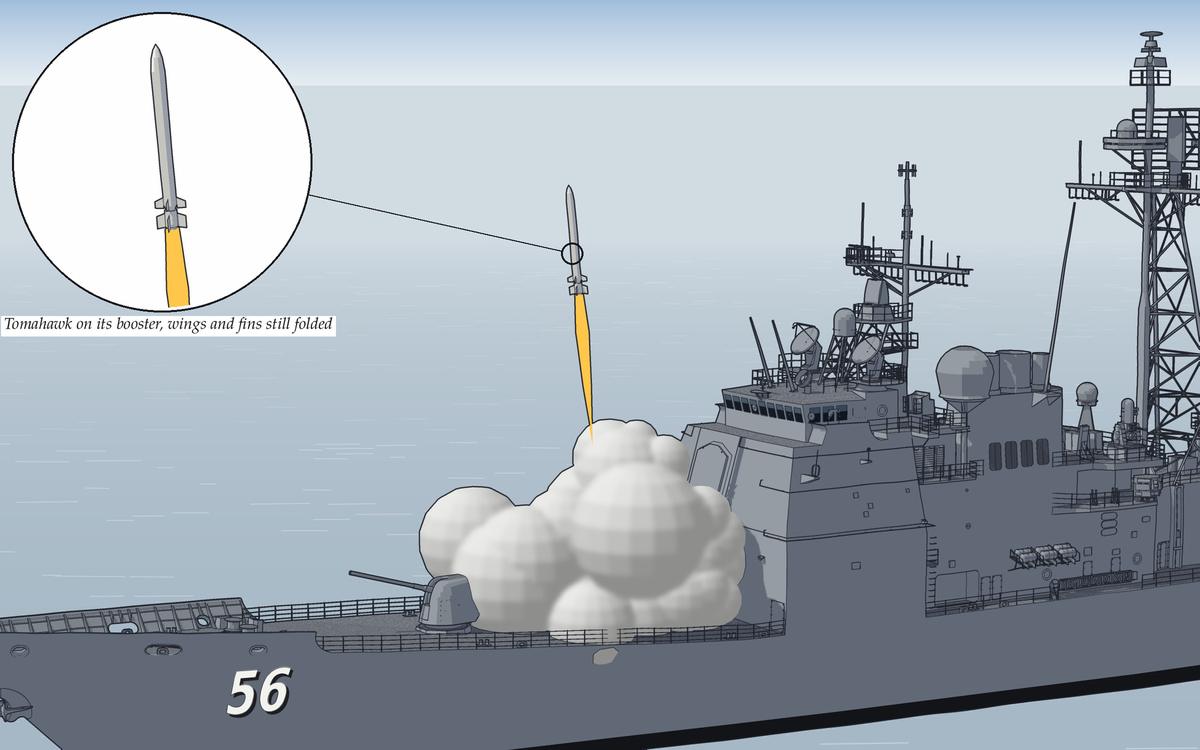
No published document describes the scene aboard the cruiser that night: who was on watch, who gave the order, what was said. What can be described is the machinery. Below the cruiser’s forward and after decks stood two launchers of 61 cells each, 122 in all, and each cell held one missile in its own sealed canister.12 The countdown ran in the combat information center. At the firing time the combat system opened the hatch of the chosen cell, the missile’s rocket booster lit, and the Tomahawk climbed out of the deck on a column of flame. When the booster burned out and fell away, the missile’s wings and fins unfolded, its small jet engine started, and it turned onto the first leg of its route.10 From the deck it was over in seconds. The missile itself had more than an hour to fly.
The crew afterward marked the spot. The ship’s company knew which cell the first missile had left, and two decades later its hatch cover still set it apart: a sailor who joined the ship in 2011 remembers that the cover was painted with the image of a tomahawk hatchet. Earlier shipmates remember a plaque on the missile deck recording the first launch, which visitors photographed.11, 29 The wording of the plaque, and the date the hatch was first painted, are not recorded in any published document.
The sources do not agree on how many Tomahawks the ship fired in the whole war. The Navy’s ship history says she fired 15 at Iraqi military targets during 44 days of combat. The Navy’s 2023 historical evaluation says she fired two to open the war and 16 in all, and adds that she was the first ship of her class to deploy with a full load of 122 missiles.12 Either figure is a small share of the 297 Tomahawks the Navy fired before the war ended. Roughly four in five of them reached their targets, and two, possibly as many as six, were shot down by Iraqi air defenses. Of the three waves fired on the first night, the third had the largest share fail to arrive.9, 25
| Measure | Figure | Source |
|---|---|---|
| Tomahawks fired by San Jacinto in the war | 15 | DANFS (Navy ship history) |
| 16, two of them in the opening salvo | NAVSEA historical evaluation, 2023 | |
| Days of combat (DANFS wording) | 44 | DANFS |
| First-night total, all ships | 114, in three salvos, from nine ships | H-Gram 058 (NHHC, 2021) |
| 122 in the first wave | DANFS | |
| First salvo | 48 | H-Gram 058 |
| U.S. Navy total, whole war | 297 | H-Gram 058 |
| Shot down by Iraqi air defenses | 2, possibly as many as 6 | H-Gram 058 |
| Share reaching their targets | roughly four in five | H-Gram 058 |
Source: Chapter 14, notes 9, 12 and 25; Appendix G. The book gives both of the ship’s own counts without choosing between them.
Fifteen or sixteen missiles out of 297 is not why the ship is remembered. She is remembered for the first one. A weapon the Navy had bought, argued over and never used was fired in anger for the first time from her deck, and it worked, and from that night the cruise missile was a weapon American presidents reached for first.
The war and the way home
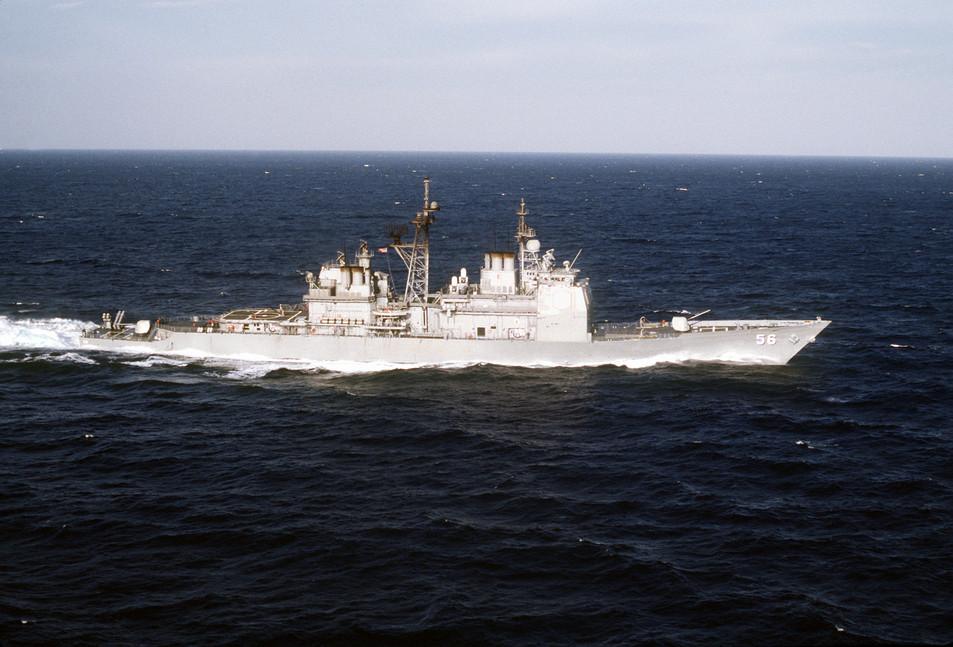
On the first day of the war the Navy flew 228 combat sorties from six carriers, three of them in the Red Sea.27 The Red Sea carriers had the long way to Iraq, across Saudi Arabia, and their strike aircraft needed Air Force tankers to make the trip. There were not enough tankers to go around, and for the first days America took no part in the strikes.25 The losses fell early. On the first night the Hornet flown by Lieutenant Commander Michael Scott Speicher from Saratoga was shot down, the first American aircraft lost in the war. Saratoga lost an A-6E Intruder over western Iraq the next night and an F-14 Tomcat on 21 January.26 Under the surface of the same sea the submarine Louisville (SSN-724) fired the first Tomahawks ever launched in combat from a submarine. By 19 January the Navy had fired 216.25
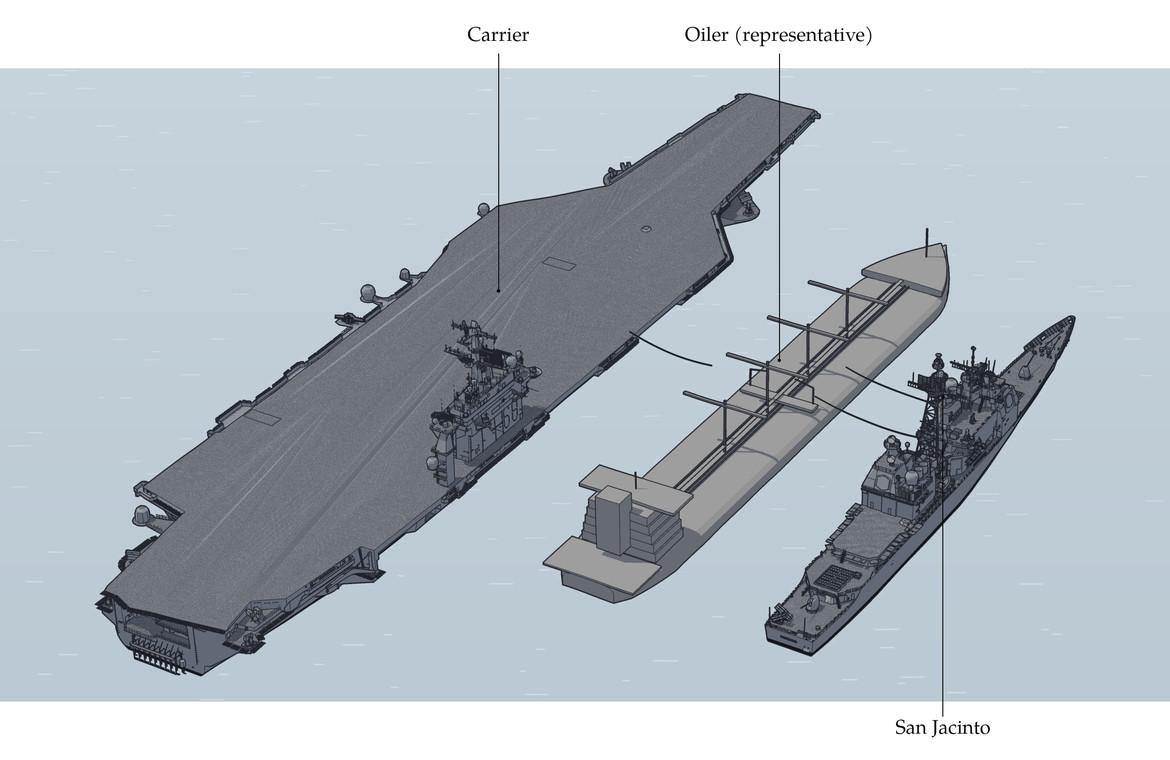
For the cruiser the weeks that followed were watches more than events. The air picture had to be kept around the clock, and the ships of the force had to be fed, fueled and armed at sea. On 21 January, four days into the war, she was in the northern Red Sea with Kennedy and Sylvania for a vertical replenishment, in which helicopters carry loads of stores slung beneath them from the supply ship to the warships. A Navy photographer recorded it, and so did a sailor on the cruiser’s port bridge wing with a home video camera; the radar left streaks of static across his tape.7, 28
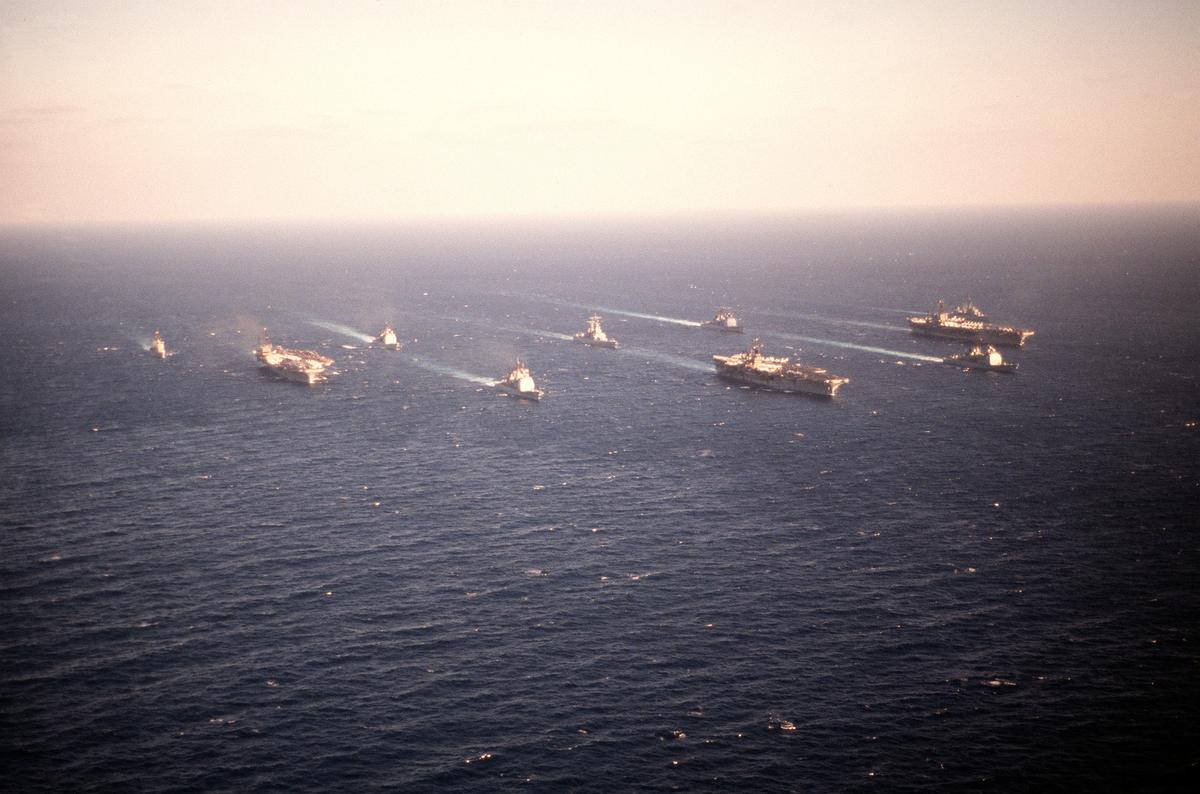
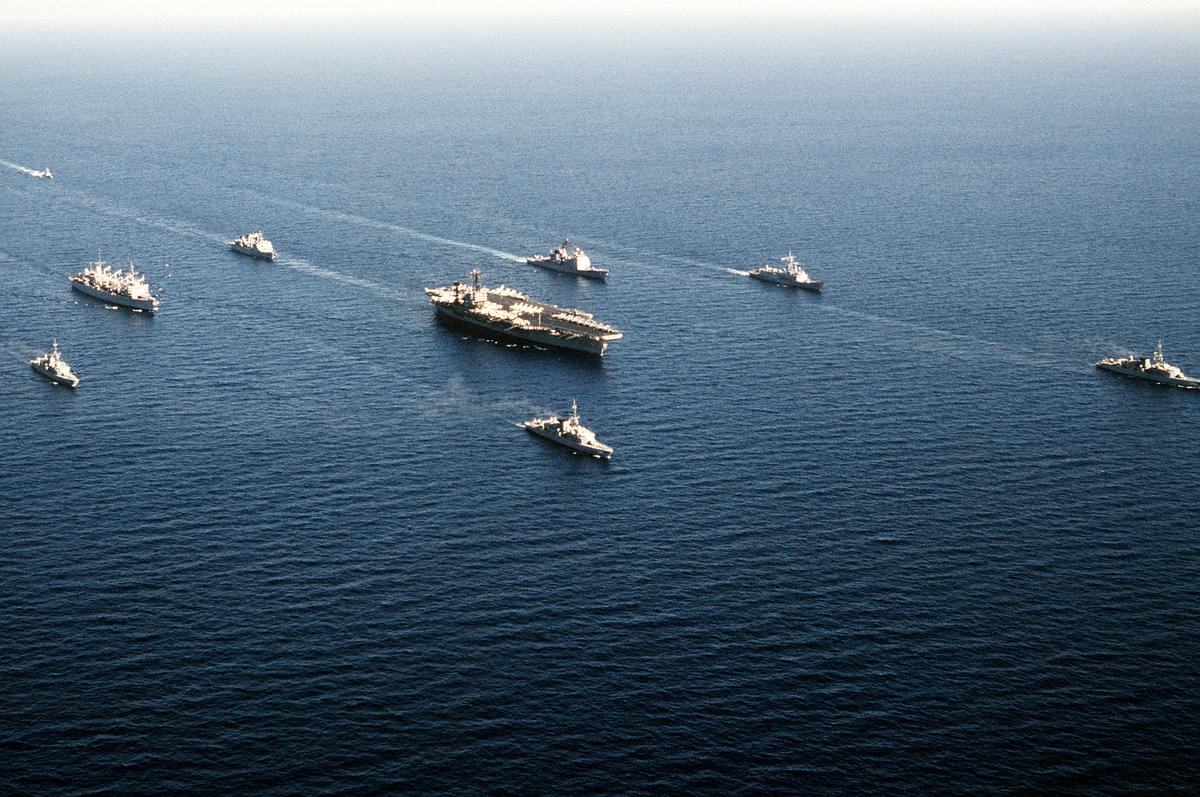
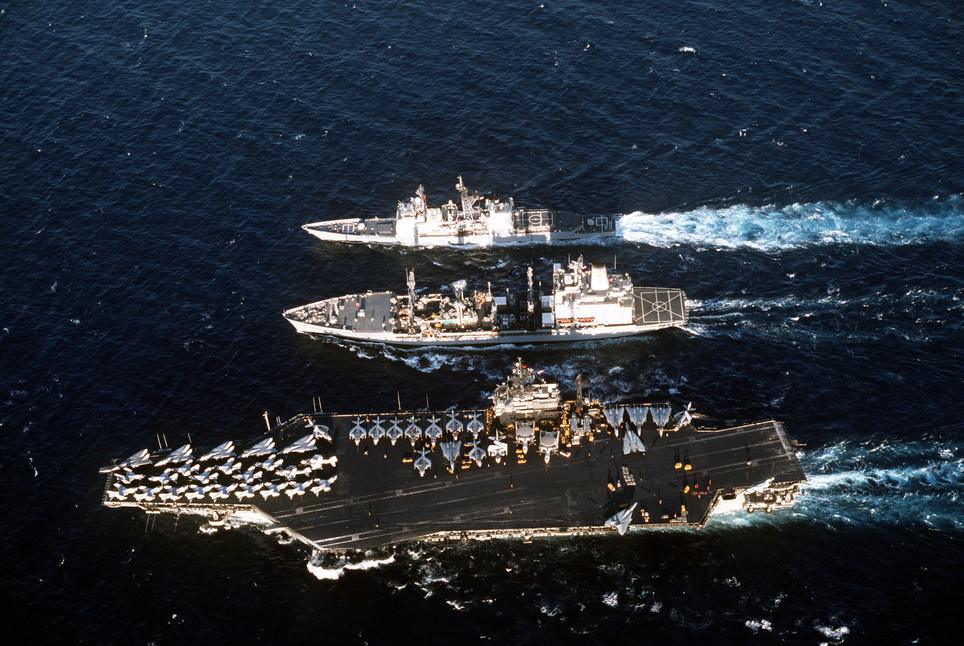
On 9 February the fast combat support ship Detroit (AOE-4) replenished Kennedy and San Jacinto in a single evolution, the three ships steaming side by side with the oiler in the middle.22 The same day a Navy photographer caught ten ships of Task Force 155 in formation: San Jacinto, Saratoga and Thomas S. Gates on one side; America, Mississippi and Kennedy in the center; and Preble (DDG-46), Philippine Sea, Normandy (CG-60) and William V. Pratt (DDG-44) on the other.13, 22 A sailor who served as an electronic warfare operator remembered, years later, trading light messages with a supply ship in the Red Sea, and the odd neighborliness that grows among the ships of a formation over four months.14
Later in the air campaign Vice Admiral Arthur sent America around the Arabian Peninsula to join the carriers in the Gulf, where her aircraft were only half as far from Kuwait as the nearest Air Force bases.26 The Gulf had its own danger. On 18 February the cruiser Princeton (CG-59), a ship of San Jacinto’s own class, was damaged by a mine there, and a newspaper explainer that week called mines an even bigger threat to the fleet than Iraq’s missiles.24 The most advanced air-defense ship in the world had been put out of the war by a weapon that had changed little since 1914. The ground campaign began on 24 February. It lasted a hundred hours, and on 28 February, forty-two days after San Jacinto’s first Tomahawk, the fighting stopped.
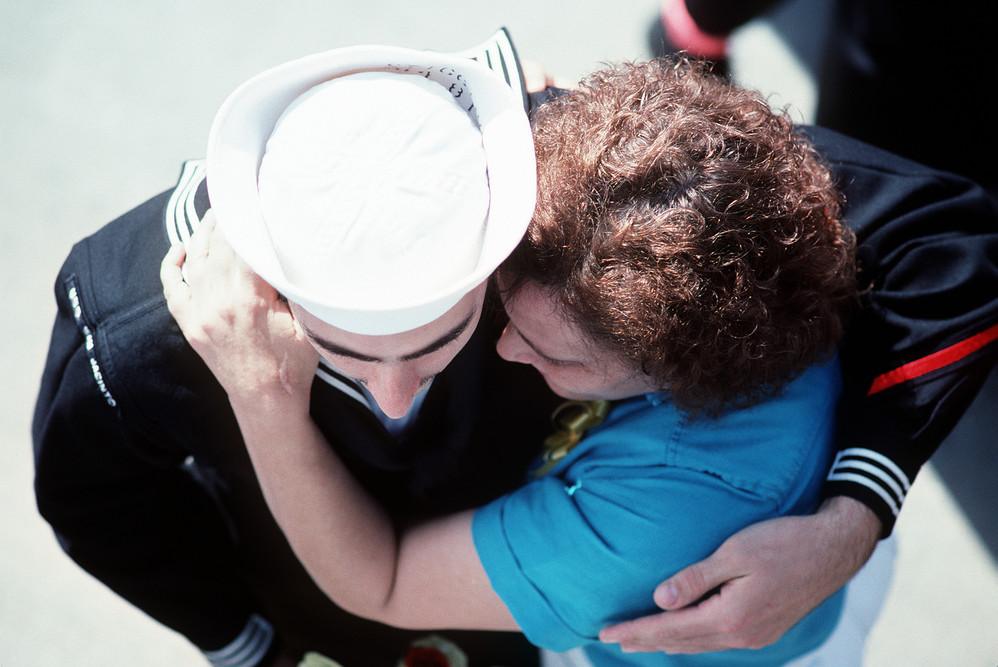
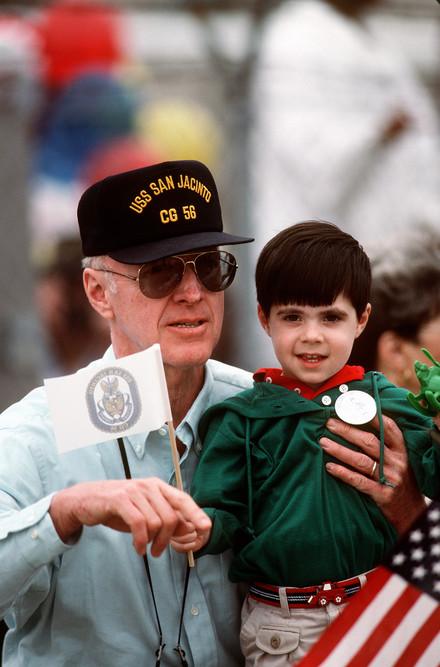
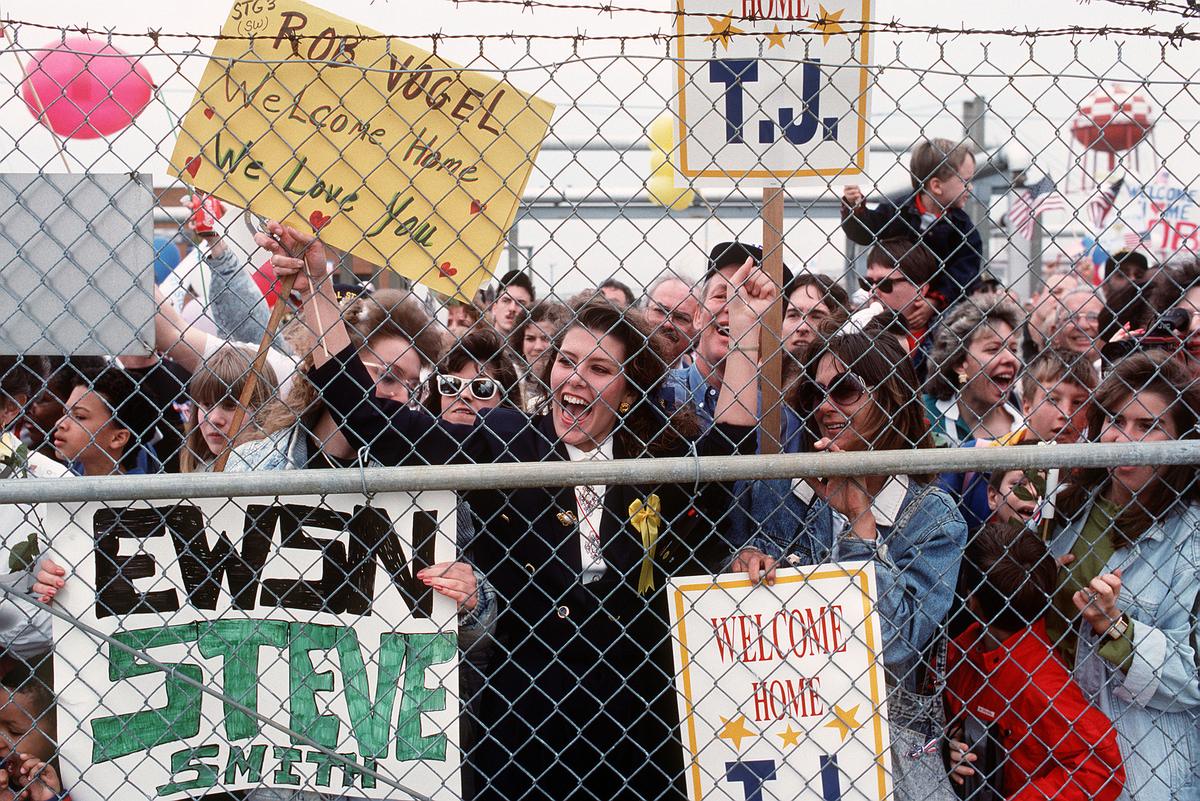
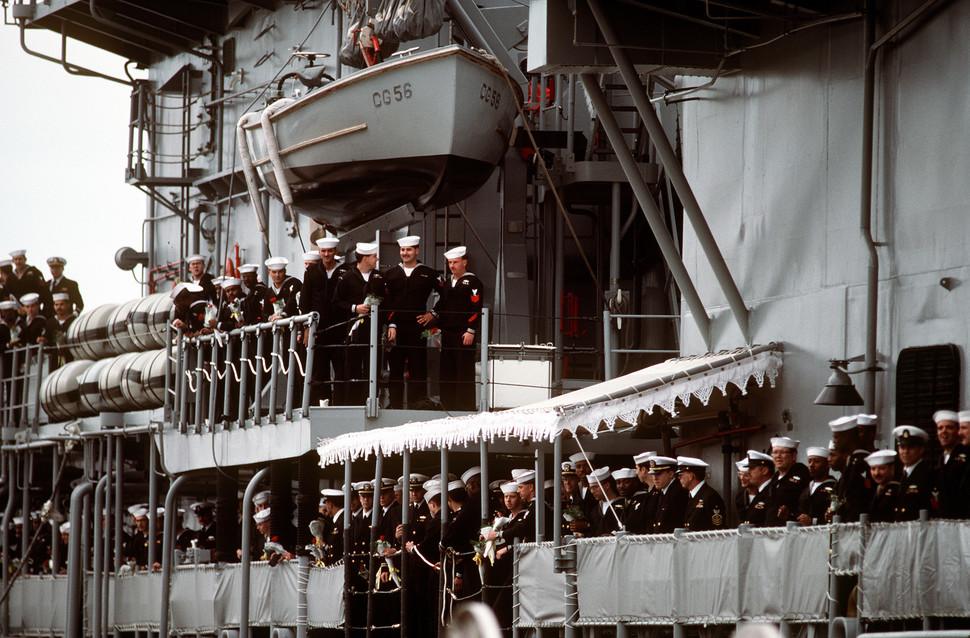
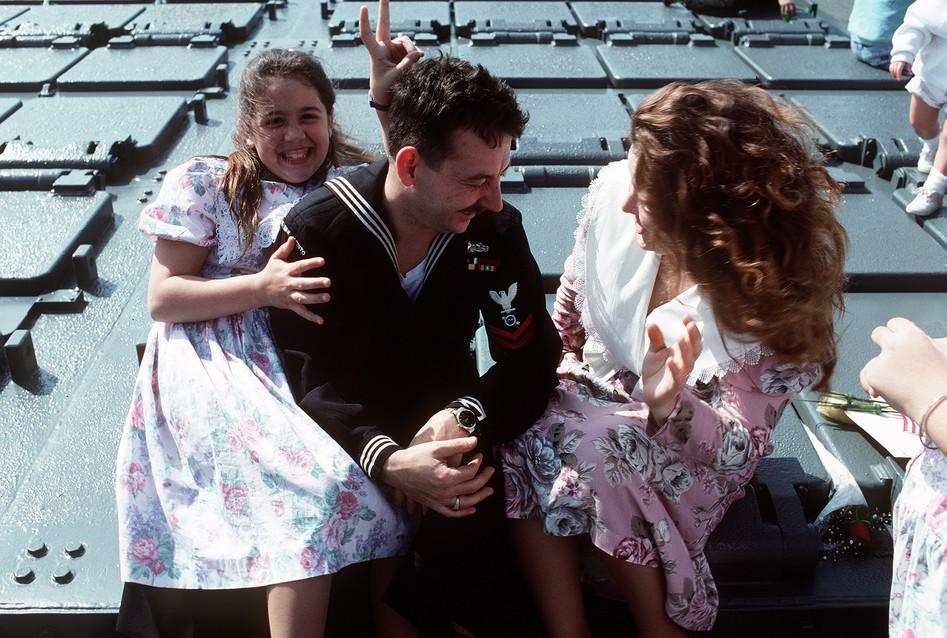
She came home through the Suez Canal, and a shipmate’s photographs record the northbound transit.28 San Jacinto tied up at Norfolk on 28 March 1991, 224 days after she had sailed on five days’ notice.1
She had been in commission for three years and two months, and the first Tomahawk became the fact by which the Navy introduced her for the rest of her life. It is in the Navy’s history of the ship and in the remarks at her decommissioning in 2023, and sailors who joined her long after 1991 learned it as part of the ship.16 In June 1991, crew members remember, she was among the ships that steamed up the Hudson River in New York’s parade of ships for the returning forces.15
She had sailed as the newest ship in a fleet built to fight the Soviet Union. She came home a veteran of a different kind of war, fought with a weapon nobody had designed her around, and that was the kind of war she would be sent to for the rest of her life.
Notes
- Deployment dates (16 August 1990 to 28 March 1991) and the ship’s work off Virginia in early August 1990 with Leyte Gulf (CG-55): DANFS, vol. III, entry for San Jacinto (CG-56); NAVSEA historical evaluation (2023). The description of the work as Cooperative Engagement tests comes from the ship’s own history and is not confirmed by a command history. ↩
- Orders to deploy on about five days’ notice and the rendezvous with the John F. Kennedy (CV-67) contingency battle group: uscarriers.net chronology; DANFS, vol. III. ↩
- Transit of the Suez Canal on 15 September 1990: Naval History and Heritage Command photograph NH 106526-KN. Some accounts give 14 September; the photograph caption is preferred. ↩
- “San Jac in the Box”: crew usage. ↩
- Maritime interception and the 23 December 1990 boarding: crew recollection. The embargo: UN Security Council Resolution 661 (6 August 1990); Resolution 665 (25 August 1990) authorized its enforcement at sea. ↩
- The sandstorm “white Christmas”: crew recollection; the year is probably 1990. ↩
- The ship’s role as anti-air warfare commander of the Red Sea battle force: Navy release USS San Jacinto (CG-56) Decommissions, Honoring 35 Years of Service (DVIDS 453585, 15 September 2023). Composition of the task group: NHHC, “H-Gram 058” (Naval Historical Foundation), Desert Storm section; Meisner, Desert Storm: Sea War (Motorbooks, 1991); Navy photograph of 21 January 1991. The 2023 NAVSEA evaluation names the cruiser Philippine Sea; other accounts name Mississippi and Thomas S. Gates; the group changed over four months, and the ship’s command operations report was not available to settle which ships were present. ↩
- Change of command, Capt. Paul W. Ecker relieving Capt. H. Ward Clark Jr. on 12 January 1991: DANFS, vol. III. NavSource’s list of commanding officers gives 12 January 1990 for the same change of command. The two dates are a year apart and the record available does not settle the difference; DANFS is followed in the text. NavSource’s roster ends Ecker’s tour on 8 February 1992, begins his successor’s on 9 February 1992, and shows tours of about two years for the captains of the period. Clark’s commissioning command in January 1988 is in the commissioning accounts cited for Chapter 12. Crew recollection of Ecker. ↩
- H-Gram 058: “At 0130 17 January 1991 Persian Gulf time” the cruiser, operating in the Red Sea, launched the first U.S. Navy Tomahawk Land-Attack Missile fired in anger. The figures (114 missiles in three salvos from nine ships; 297 over the campaign; about 80 percent reaching their targets) are as given there; DANFS gives 122 for the first wave. The two counts have not been reconciled. ↩
- The description of a vertical-launch Tomahawk firing is general and not specific to this night; no deck log or command history for 17 January 1991 was available. ↩
- Crew recollection, including the plaque on the missile deck; its wording and location are not confirmed by a document. ↩
- DANFS, vol. III (15 Tomahawks, 44 days of combat); NAVSEA historical evaluation (2023) (two to open the war, 16 in all, first of her class to deploy with a full load of 122 missiles). ↩
- Navy photograph, 9 February 1991; H-Gram 058 on Task Force 155 and its commander. ↩
- Crew recollection. ↩
- Crew recollection; press accounts of the June 1991 New York parade; the ship’s own participation rests on crew recollection. ↩
- Navy accounts of the ship (DANFS; the 2023 decommissioning release) and crew recollection. ↩
- Peter Baker, “From Norfolk, Nervous Goodbyes; Quick Mobilization Sends Sailors Off to Middle East as if to War,” Washington Post, 16 August 1990, p. A1 (dateline Norfolk, 15 August). The article names San Jacinto in the Kennedy battle group but lists only the Kennedy, Thomas S. Gates and two amphibious ships as sailing on 15 August; DANFS gives 16 August as the date San Jacinto deployed. ↩
- Morris and Kearns, Historical Dictionary of the United States Navy (2011), Chronology: United Nations authorization of force against Iraq in November 1990, with a withdrawal deadline of 15 January 1991. ↩
- “Weapons / Navy: R/UGM-109 Tomahawk,” in Almanac of Seapower 2002 (Navy League of the United States, 2002), Weapons/Navy section, Tomahawk entry (briefing text on Desert Storm firings; the first Tomahawk was fired from the Red Sea by San Jacinto, followed moments later by Bunker Hill from the Persian Gulf). ↩
- Naval Sea Systems Command, Naval Vessel Historical Evaluation: San Jacinto CG 56, initial determination, 21 September 2023, “Vessel History”: the Cooperative Engagement Capability tests with Leyte Gulf off Virginia when Iraq invaded Kuwait; Leyte Gulf detaching for Mayport the next day; San Jacinto’s return to Norfolk the day after; her sailing “barely five days later”; and her boarding teams’ inspection of several dozen ships in a search area at the southern tip of the Sinai Peninsula. The evaluation lists Wikipedia, NavSource and HullNumber among its sources, so its narrative is not independent of them. ↩
- Samuel J. Cox, “H-Gram 058: Operation Desert Storm, January 1991,” Naval History and Heritage Command, 15 January 2021: Naval Forces Central Command under Vice Admiral Stanley R. Arthur with 108 U.S. ships at the start of hostilities, 26 of them in the Red Sea; the Maritime Interception Force under Rear Admiral William M. Fogarty (CTF 152), with 6,913 intercepts, 823 boardings and 36 diversions since late August 1990. ↩
- NavSource Naval History, photo index for USS San Jacinto (CG-56), archived 23 May 2025: photograph of Biddle, Saratoga, John F. Kennedy and San Jacinto in the Red Sea in September 1990, taken by a photographer’s mate of Kennedy; Department of Defense photograph DN-SC-91-05321, 9 February 1991, Detroit (AOE-4) replenishing Kennedy and San Jacinto; the 9 February 1991 photograph of Task Force 155, with the ships named in their positions. ↩
- Naval Cover Museum, “San Jacinto CG 56 Covers,” page 1 (captured 12 November 2026): cover postmarked aboard on 24 October 1990, FPO New York 09587, with a privately made cachet for the John F. Kennedy Battle Group. ↩
- “Shielding U.S. Warships,” Los Angeles Times, 21 February 1991, home edition (graphic; sources given as the Department of Defense and Jane’s Fighting Ships): detection and engagement ranges, electronic countermeasures and chaff, the Silkworm and Exocet threat, the mine threat, and the damage to Princeton that week. The date of the mine strike, 18 February 1991, is from general histories of the war. ↩
- H-Gram 058 (note 21): Battle Force Yankee (CTF 155) under Rear Admiral Riley D. Mixson in the northern Red Sea with Saratoga, Kennedy and America, and America’s absence from the first days’ strikes for want of Air Force tankers; Mixson’s Mediterranean Strike Group (CTG 150.9), which fired eight Tomahawks into Iraq several days after the opening night; Paul F. Foster and Bunker Hill beginning to launch eleven minutes after San Jacinto (accounts vary as to which was first); the first salvo of 48; terrain contour matching, the Digital Scene Matching Area Correlator and the difficulty of Iraq’s flat terrain; two to six missiles shot down, the third wave faring worst; Louisville’s submerged launches from the Red Sea; 216 Tomahawks fired by 19 January. DANFS counts Mediterranean ships among the nine that fired on the first night; H-Gram 058 is followed. ↩
- H-Gram 058 (note 21): the loss of Lieutenant Commander Michael Scott Speicher’s F/A-18 from Saratoga on the first night; an A-6E of Attack Squadron 35 from Saratoga lost over western Iraq on the night of 17–18 January; an F-14 from Saratoga shot down on 21 January; Vice Admiral Arthur’s later order sending America from the Red Sea to the Gulf, where carrier aircraft had half the distance to Kuwait of the nearest Air Force bases. The date of America’s move is not given. ↩
- DANFS, vol. III, entry for San Jacinto (CG-56): 228 combat sorties on the first day from America, John F. Kennedy and Saratoga in the Red Sea, Midway and Ranger in the Persian Gulf, and Theodore Roosevelt en route. ↩
- Crew recollection: an engineer of the commissioning crew who left the ship in 1990; photographs of a reenlistment on deck in the Suez Canal with Kennedy in the background, of the boarding team at work, and of the homeward canal transit; a video of a boxing smoker in the Red Sea in 1990; the freshwater wash-down after the sandstorm; a sailor’s account of New Year’s Eve watches aboard from 1987 to 1990; a home video of the 21 January 1991 vertical replenishment, shot from the port bridge wing. ↩
- Crew recollection of a sailor who served aboard from 2011 to 2015: the hatch cover of the vertical-launch cell that fired the first Tomahawk of 17 January 1991, painted with the image of a tomahawk hatchet. No document seen records the cell’s number or when the cover was first painted. ↩