Part Four: The Long Peace That Wasn't (1991–2006)
Chapter 15The Jac in the Nineties
On 26 June 1992 San Jacinto left Norfolk for South America with six target drones in her care. They belonged to a small detachment of Fleet Composite Squadron Six, known as VC-6, which had come aboard with its launching gear for the summer, and they were meant to be shot at. A target drone is a small unmanned jet, launched from the ship with the help of a rocket booster and flown along a course set by controllers, so that gunners and missile crews have something real to aim at. One that survives is brought down by parachute and used again.2, 3
Eighteen months earlier the same ship had opened a war. Now she was carrying targets around a continent for other navies to practice on. That was the 1990s. The world the cruiser sailed into had changed since her last deployment. The Soviet Union had dissolved at the end of 1991, its fleet was laid up at its piers, and for the first time in two generations no navy could contest the American Navy for control of the sea. What remained was demand. Governments in Washington and abroad wanted American warships off every coast where trouble might start, and the fleet answered with a steady round of deployments, exercises, port visits and small operations that the Navy described as presence. A ship built to fight one enormous battle spent the decade doing a hundred small jobs instead. Her commanding officer since 9 February 1992 had been Captain Sherman E. Wright Jr., the third man to hold the post.25
Around a continent
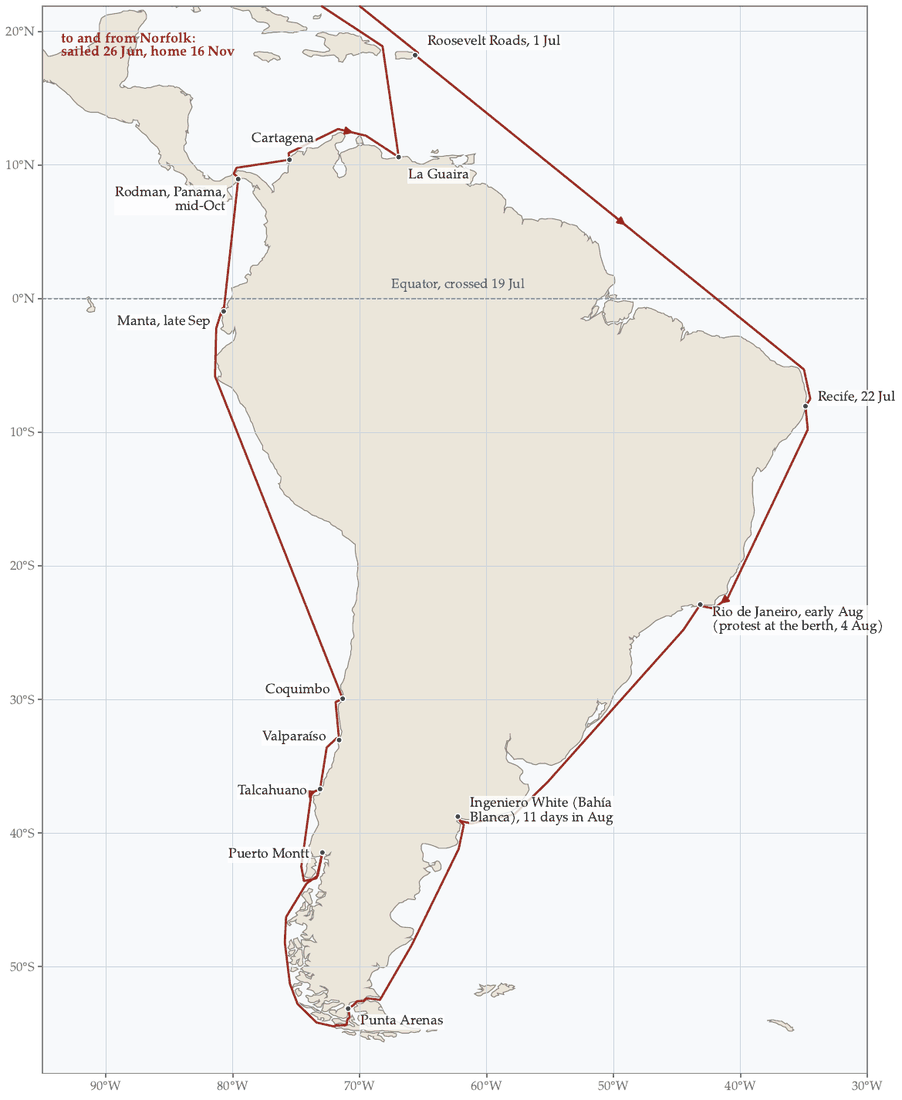
UNITAS is the Navy’s annual exercise with the navies of Latin America. It has run since 1960, and its summer cruise has always been a kind of floating diplomacy: a small American task group sails along the coast of South America, calling at a port in each participating country and exercising with each navy in turn. In 1992 the thirty-third UNITAS took its group all the way around the continent. With San Jacinto sailed the attack submarine Whale (SSN-638), the destroyer Cushing (DD-985) and amphibious ships carrying Marines, among them Portland (LSD-37) and Manitowoc (LST-1180).1
The group gathered at Roosevelt Roads, Puerto Rico, on 1 July. On 19 July, in the Atlantic, the cruiser crossed the equator and held a shellback initiation, the old Navy rite in which those who have never crossed the line, called pollywogs, are put through a day of ordeals by those who have, the shellbacks.3, 4 She reached Recife, Brazil, on 22 July and Rio de Janeiro at the start of August. On Tuesday, 4 August, environmentalists slipped through security at her berth in Rio, and an Associated Press photograph printed two days later in the Chicago Tribune shows sailors on deck spraying them with water. The caption says the protest followed a report that a nuclear submarine was accompanying the cruiser. It names neither the protesters’ organization nor the submarine, though Whale, the group’s attack submarine, was nuclear-powered.17
Farther south she spent eleven days in the second half of August at Ingeniero White, the port of Bahía Blanca in Argentina. It was the southern winter. Sailors remember passing an iceberg off the Argentine coast, and seas heavy enough that men wedged their boots under their mattresses and buckled the safety straps on their racks. She rounded the bottom of the continent and worked up the Pacific coast through the channels of Chile, calling at Punta Arenas on the Strait of Magellan, Puerto Montt, Talcahuano, Valparaíso and Coquimbo, and some of the crew took a tour into the Andes. One sailor later recalled that she reached thirty-seven knots off Chile on that cruise, a speed no document records.3, 26 A column of service news in the Baltimore Sun of 27 September listed two local sailors as aboard her, deployed in the Caribbean and South America.18 In late September she was at Manta, Ecuador, and in mid-October at Rodman, Panama, at the Pacific end of the canal. She finished in the Caribbean at Cartagena, Colombia, and La Guaira, Venezuela, and brought her crew home to Norfolk on 16 November.3
| Measure | Figure |
|---|---|
| Drones embarked | 6 |
| Operating days | 17 |
| Flights scheduled | 18 |
| Flights flown | 23, five more than scheduled |
| Drones lost | 5 of 6 |
| Lost to parachutes that failed to open | 4 |
| Squadron’s verdict | An excellent platform for drone work; berthing for the detachment judged exceptional |
Source: Chapter 15; Fleet Composite Squadron Six command history for 1992, Enclosure (5), UNITAS 33-92 detachment report.
The list runs to some fourteen ports in nine countries, the most this history records for any one deployment.
The drones had a hard summer. Every navy in UNITAS wanted a target for its gunners, and over seventeen operating days the detachment flew twenty-three flights, five more than the schedule called for, but it lost five of its six drones, four of them to parachutes that failed to open. VC-6 judged the cruiser an excellent platform for drone work all the same, and its report noted with some satisfaction that the detachment’s officer had been given a two-man stateroom, its chief a berth, and its sailors the use of the chiefs’ overflow compartment, accommodations the squadron thought exceptional.2
Sailors of that era remember Captain Wright as an officer of strong opinions, with a taste for anti-submarine warfare in coastal waters, which gave the ship’s sonar technicians their chance to shine, and a love of fishing. One of those sonar technicians remembered being reenlisted by him at the San Jacinto Monument outside Houston.4, 26 Another recollection from roughly these years concerns a drill in the Caribbean near St. John in the U.S. Virgin Islands, in which an exercise torpedo fired at the ship to test her countermeasures turned and homed on her, passing beneath the hull several times before it was recovered. The year is uncertain.5
The Baltic
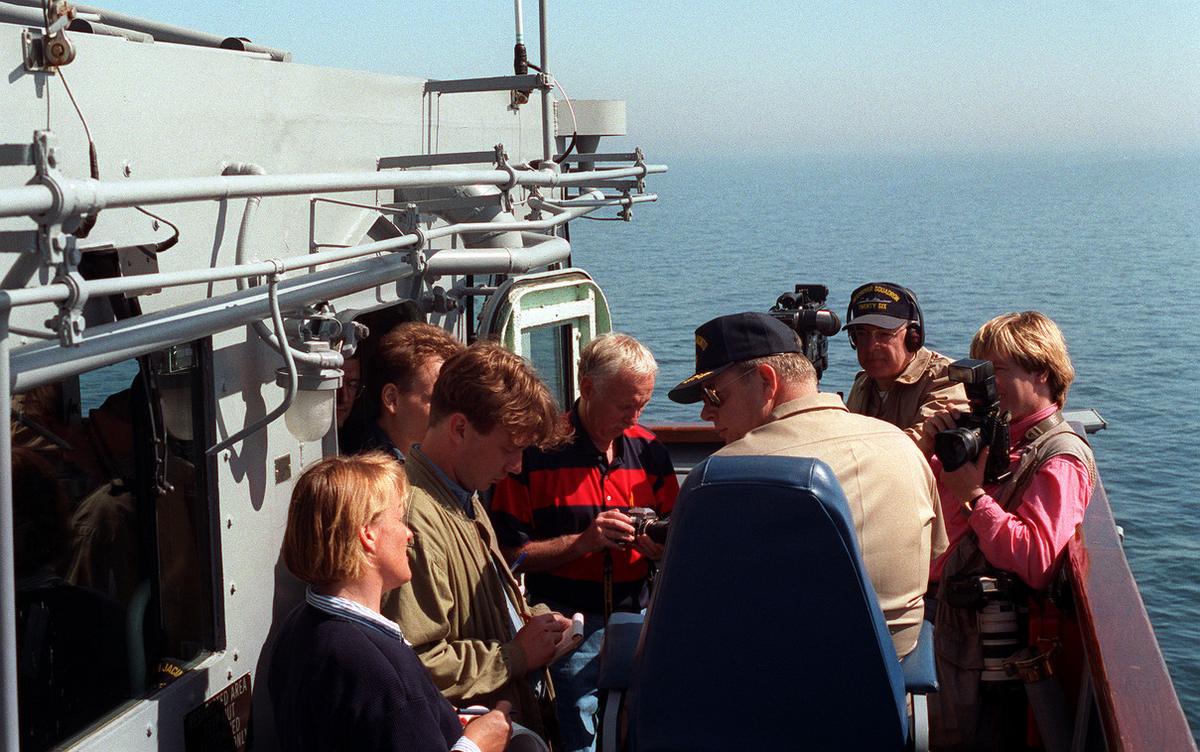
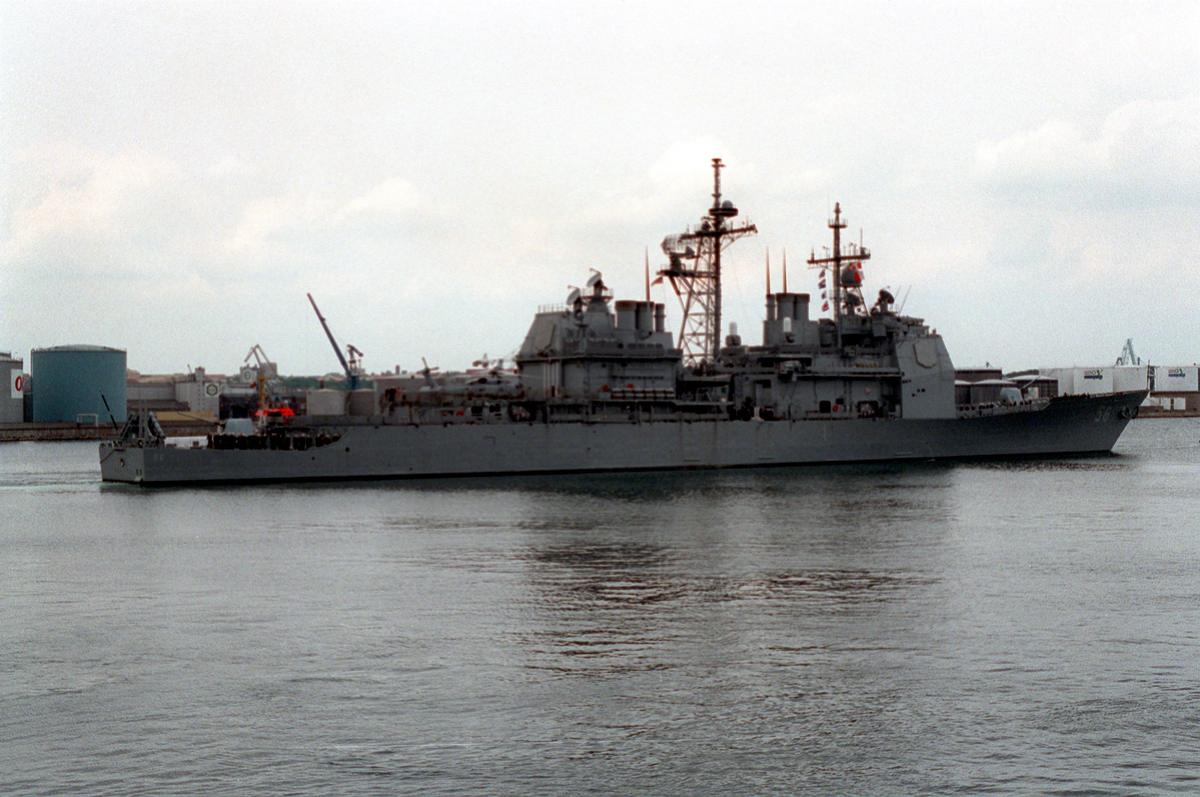
The summer of 1993 took her to northern Europe for BALTOPS ’93, NATO’s yearly exercise in the Baltic. It came in the first summers after the Soviet collapse, when the navies of former Warsaw Pact adversaries were beginning to exercise alongside NATO’s.6 Four years after her visit to Ceauşescu’s Romania, she was in a sea that had been the Soviet Baltic Fleet’s front yard, training with the people she had been built to fight. A photograph taken that July shows her bow at Wilhelmshaven, the German naval port on the North Sea, and crew recollection adds a visit to Stockholm.6, 27
For the exercise she embarked a combined helicopter detachment of a kind no cruiser had carried before: the SH-60B Seahawk, the Navy’s ship-based helicopter for anti-submarine and surface warfare, together with the SH-60F, the carrier-based anti-submarine version, which the Navy called the Oceanhawk. The ship’s histories record it as the first such combined detachment.6 On 21 August 1993 Captain Clifford C. Covington relieved Captain Wright.25 A sailor of the period remembered the ship going up the Houston Ship Channel, past the battleship Texas, more than once for changes of command, and another remembered sailing with her from Charleston to the Port of Houston in 1993. No document confirms where those ceremonies were held.26
With George Washington, 1994
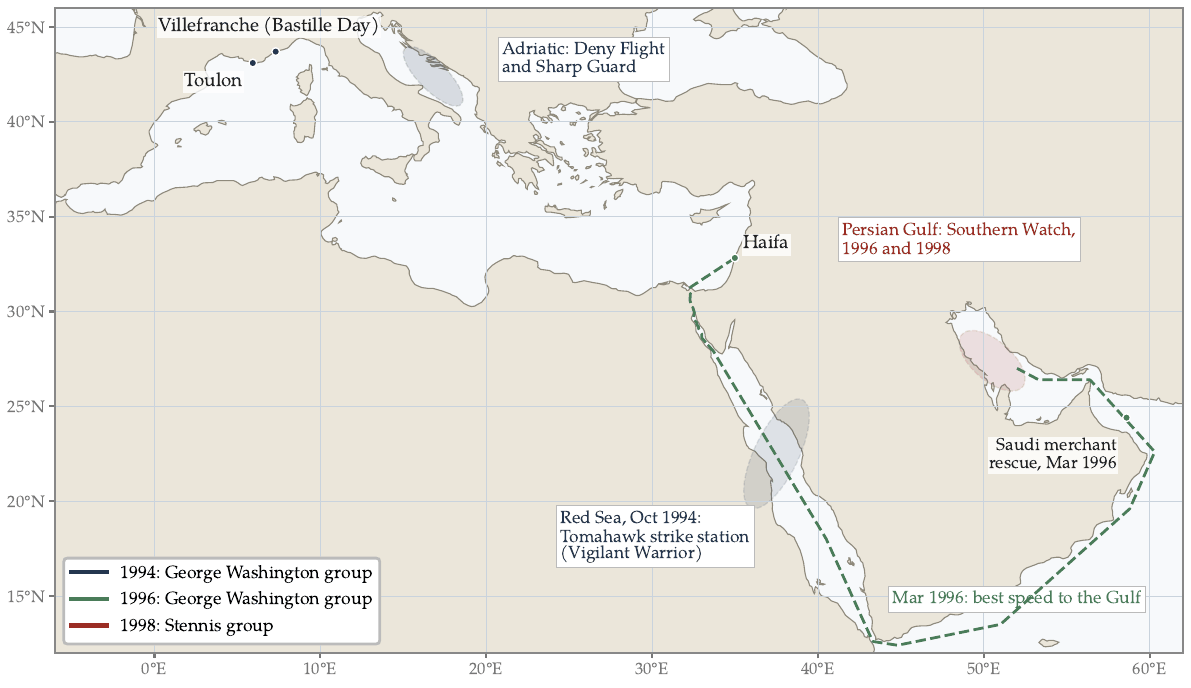
In May 1994 she deployed to the Mediterranean and the Red Sea in the battle group of the nuclear carrier George Washington (CVN-73), then new to the fleet. The cruise began, as many did in that decade, in the Adriatic, where the breakup of Yugoslavia had become a war, and for sixty-nine days she supported the United Nations and NATO effort there.7
That meant two kinds of work. One was the enforcement of a no-fly zone over Bosnia and Herzegovina, the operation known as Deny Flight. The other was the naval embargo on weapons and other goods bound for the warring parties, Sharp Guard. Ships stood off the coasts of Montenegro and Croatia, hailing and boarding merchant vessels, watching their radars for aircraft that were not supposed to be flying, and threading a crowded traffic of ferries and fishing boats in the narrow water between Italy and the Balkan coast.7 It was the Red Sea work of 1990 over again, embargo and air picture, in a sea a tenth the size.
Crew recollection records two moments of public history on the way. On 6 June 1994, the fiftieth anniversary of the Normandy landings, the battle group took part in the commemorations, and a sailor remembered manning the rails.8 Later, after a stop at Toulon, the cruiser anchored at Villefranche-sur-Mer on the French Riviera for Bastille Day, and several shipmates recalled that a small motorboat came alongside carrying the actor Jack Nicholson, who asked for a tour and was given one. Sailors’ accounts have placed the visit in 1989 as well as 1994; three shipmates who were on the later cruise were firm that it was 1994.8
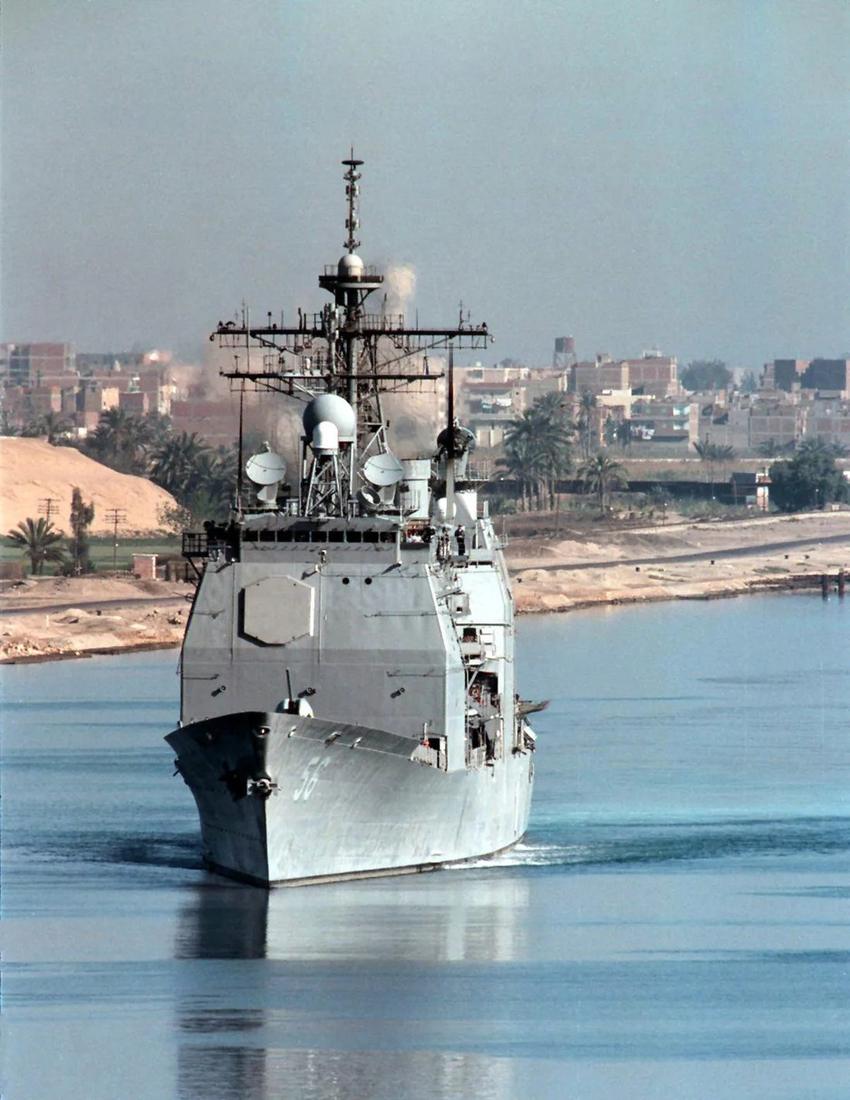
In October Saddam Hussein again moved troops toward the Kuwaiti border, and the United States answered with a rapid reinforcement of the Gulf called Operation Vigilant Warrior. San Jacinto, by then in the Red Sea, took up a Tomahawk strike station, as she had almost four years before. Iraq pulled its forces back and no missiles were fired.9 A photograph published three years later shows her in the Suez Canal late in 1994, in the foreground, with the new destroyer John Barry behind her.28
That winter she was back in Norfolk. In January 1995 the Navy gave the city’s repair yards a set of contracts to carry them through the slow months, among them $5.48 million to Metro Machine, a yard of about seven hundred workers, to berth and repair San Jacinto.29 On 25 August Captain Raymond C. Pilcher Jr. relieved Captain Covington.25
In the same summer the ship took part in a test that had nothing to do with Iraq or the Balkans. According to the Fort Lauderdale Sun-Sentinel of 18 August 1995, the Navy fired an unarmed Tomahawk from San Jacinto in the Atlantic, on Wednesday, which would make it 16 August, and the missile flew across North Florida at about 550 miles an hour to a military range in the Panhandle, coming down by parachute at Eglin Air Force Base, near Fort Walton Beach. The paper called it the first Tomahawk fired across North Florida, priced the missile at $1.2 million and said the success opened the way to more tests along what it called a cost-cutting route, without saying where the saving lay.19 The record does not say what the test was meant to measure. The ship that had fired the first Tomahawk in combat had now also fired one across her own country.
A month later, on 15 September 1995, the ship’s chief petty officers’ mess initiated its new chiefs aboard, and one of them came back twenty-eight years later, for her decommissioning, to stand in that mess again.30
With George Washington, 1996
She deployed with the George Washington group again on 26 January 1996.10 Two photographs record her refueling from the fleet oiler Big Horn (T-AO-198) in the Mediterranean that winter. The caption to one, published in Sea Power in December 1997, dates it 2 February 1996. The other, a Navy photograph, is dated 24 February and shows her making a high-speed breakaway from the oiler in the central Mediterranean at the end of the replenishment. Whether these were two refuelings or one with two dates the record does not settle.10, 31
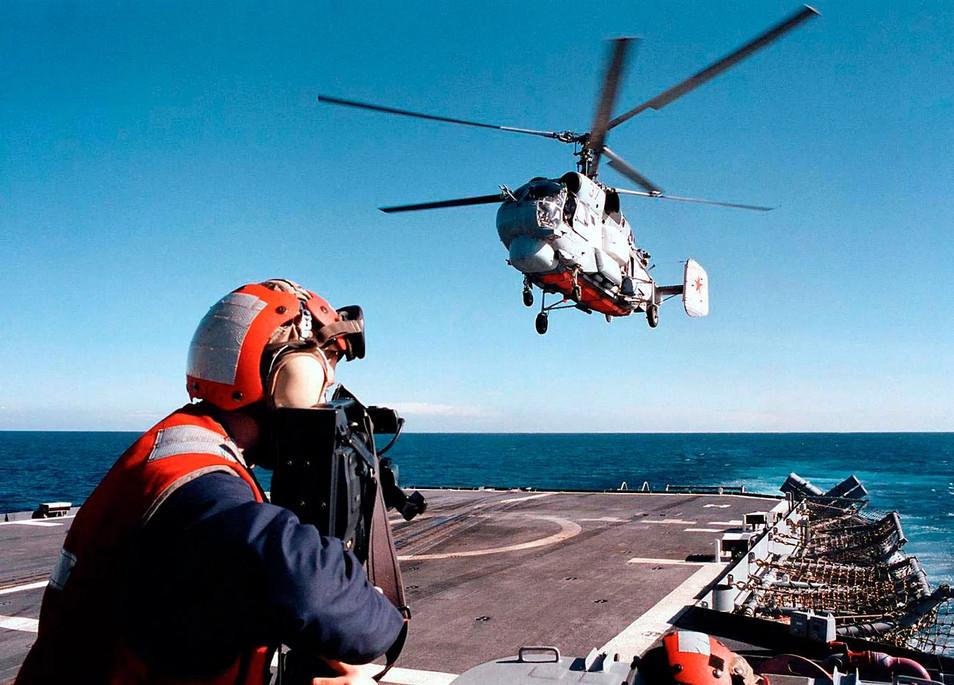
That deployment included something that would have been out of the question a few years before: exercises with the Russian Navy. A Russian carrier group led by the aircraft-carrying cruiser Admiral Kuznetsov was in the Mediterranean that winter, and American and Russian ships worked together at sea. A Russian frigate of the Krivak class came alongside the cruiser, and a Russian helicopter landed on her deck. A sailor who worked in the ship’s public affairs office kept photographs of the Russian ships, though the year of some of the prints is disputed between 1996 and 1999.10 This appears to be the visit the older crews still tell about, with the Russian officers videotaping everything in sight and paying for ship’s-store souvenirs in hundred-dollar bills.
In March the cruise took a sudden turn. Crew recollection holds that after leaving Haifa the ship was ordered at her best speed to the Persian Gulf, to cover for a carrier group that had been sent east toward Taiwan, where China was firing missiles into the waters near the island’s main ports. That fits the Taiwan Strait crisis of March 1996, when the United States sent two carrier groups toward the area. The sailors remember six days at full power, a refueling from George Washington and the passage of the Strait of Hormuz, the narrow entrance to the Gulf.11 A crisis off China had emptied the Gulf of a carrier, and a cruiser in the Mediterranean was sent at full power to help fill the hole. The Navy of the 1990s had the whole ocean to itself and still not enough ships to be everywhere it was wanted.
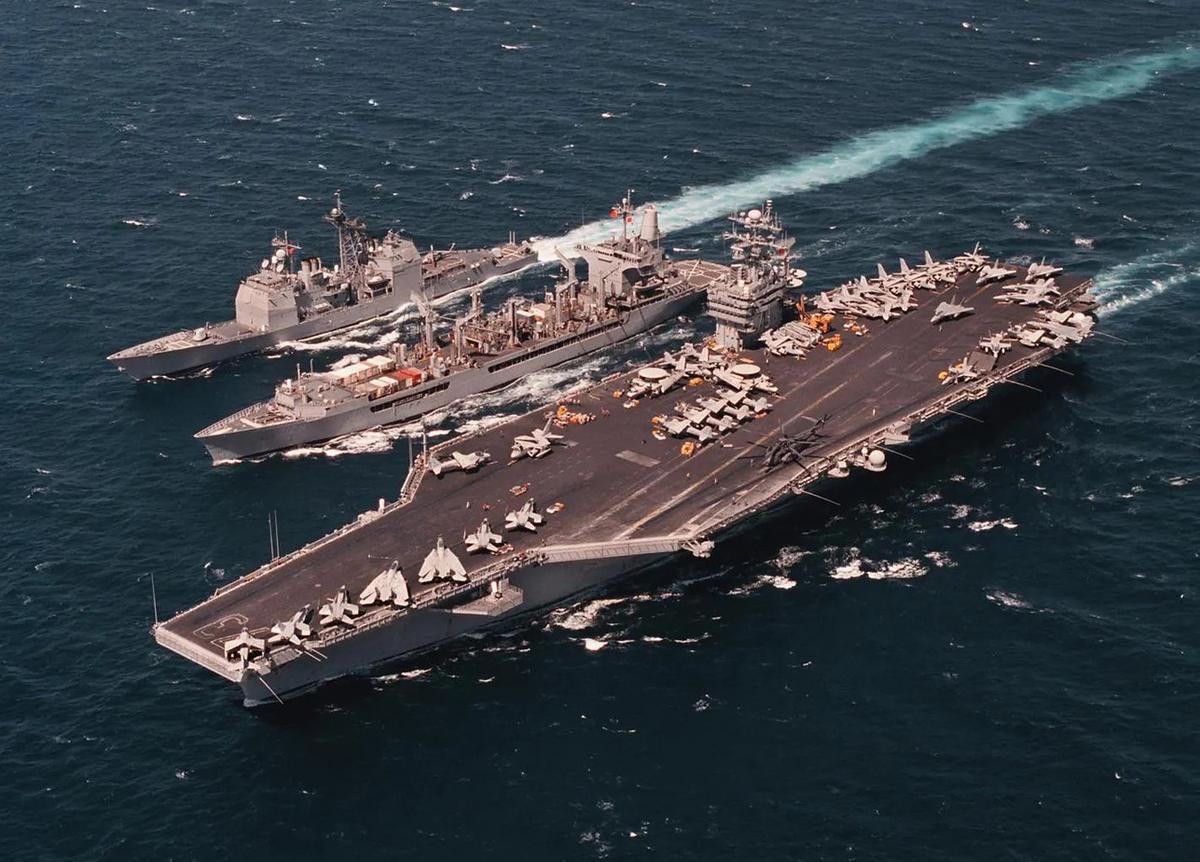
One printed source puts the ship in the Gulf by the end of March. Helicopter News, a trade newsletter, reported on 12 April 1996 that the Navy’s helicopters were taking over more of the work of hunting submarines as its P-3 Orion patrol aircraft were turned to other missions. Its dateline was the Persian Gulf, and one of the men it quoted, speaking on 29 March, was the air operations officer of Helicopter Anti-Submarine Squadron (Light) 48, HSL-48, a Mayport squadron that flew the SH-60B. He was deployed on San Jacinto, which the newsletter described as helping to enforce the United Nations embargo against Iraq, and he said much of his time went to maritime surveillance around the George Washington group and to using the helicopter’s dipping sonar, lowered on a cable from a hovering helicopter, to listen for submarines.20 Two photographs published in Sea Power in the summer of 1997 show her in the Gulf the year before with the carrier: in one she is alongside the oiler Merrimack with George Washington during an underway replenishment, and in the other she lies astern of the carrier while helicopters ferry stores to the flight deck, the method the Navy calls vertical replenishment.24, 32
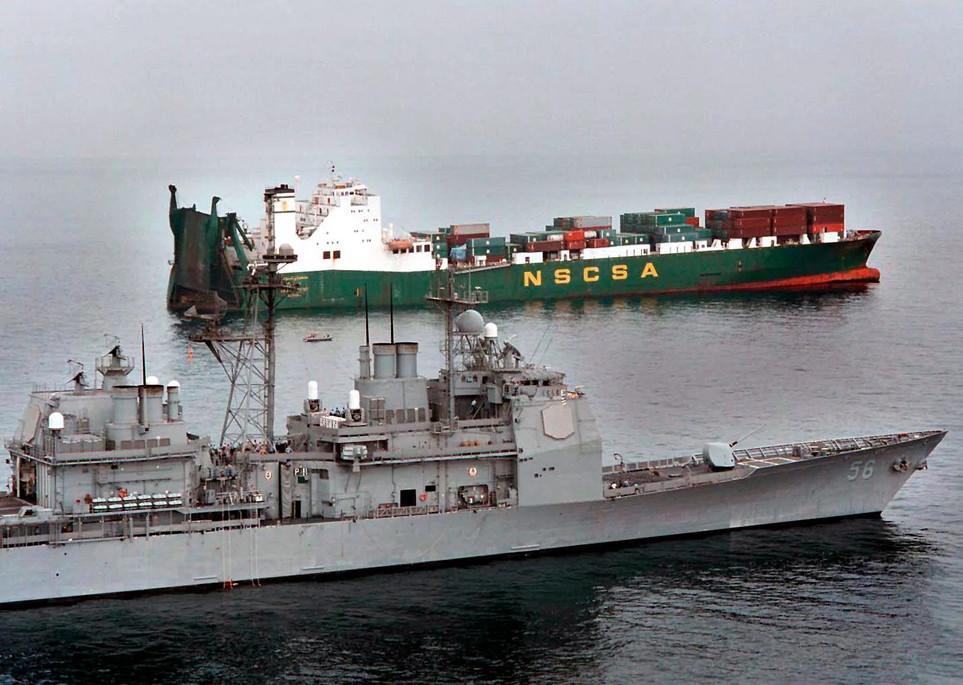
In March she also went to the help of a merchant ship. The ship-history compilation at uscarriers.net records that she rescued the crew of the Saudi Hoffur, and the Virginian-Pilot of Norfolk reported a rescue by the cruiser on 22 and 23 March 1996. Crew recollection places it in the Gulf of Oman, where the Saudi ship was flooding and a boarding party from the cruiser went aboard with pumps and damage-control gear. Crew accounts spell the ship’s name Hofuf, and the spelling has not been settled.12
The rescue was the damage-control drills put to use on somebody else’s ship. The cruiser’s crew trained for fire and flooding most weeks of the year, and the Navy had spent the years since 1987 re-equipping its ships for the work. When the frigate Stark was hit by two Iraqi missiles in May 1987, fire spread through seven decks, and one of the Navy’s survivability experts told the Chicago Tribune in 1992 that it had taken twenty-two hours of firefighting to save her.34
The deployment also contributed to Operation Southern Watch, the American, British and French enforcement of a no-fly zone over southern Iraq. When it was over the ship entered the first of her extended shipyard overhauls.13 She was not yet out of circulation in the late summer of 1996. The Sun-Sentinel of 31 August announced that the 567-foot cruiser was due that day at Port Everglades and would be open to the public at Berth 22 from one to five on Sunday and Monday, 1 and 2 September, the Labor Day weekend, before sailing on Tuesday.21 She would return to Port Everglades in later years, among them 2007 and 2012. On 24 February 1997 Captain James A. Woods Jr. relieved Captain Pilcher.25
The Jac as a place
The days between deployments are the part of a ship’s history that her crew recall first and the hardest to reconstruct from documents. Sailors of the 1990s called the ship the Jac and themselves Gunslingers, a name that survived into the reunions of later decades. They remember the smell of the bridge on watch, which they describe as a mixture of fuel, paint, coffee and sea air, and what they called the San Jacinto rain cloud, the tendency of rain to fall on the ship in foreign ports where it had not rained in months. They remember the evaporators, the machines in the engineering spaces that make fresh water from sea water, which one chief engineer recalled as rated at about twelve thousand gallons a day each, and they knew that the engineers’ mood followed how those machines were running. They remember an emergency breakaway from an oiler, when the ship had to pull clear fast in the middle of a replenishment.14, 30 A fire controlman remembered the radar watches and the midwatches in the combat information center in the middle of the decade, and the Main 1 crew, the engineers who stood watch in the forward engine room between 1996 and 1999, formed a loose society that was still trading memories a quarter of a century later.14
The ship of those years was between six and twelve years old, in the middle of her designed life. The sailors who trained the crews of the 2010s had been junior sailors then.
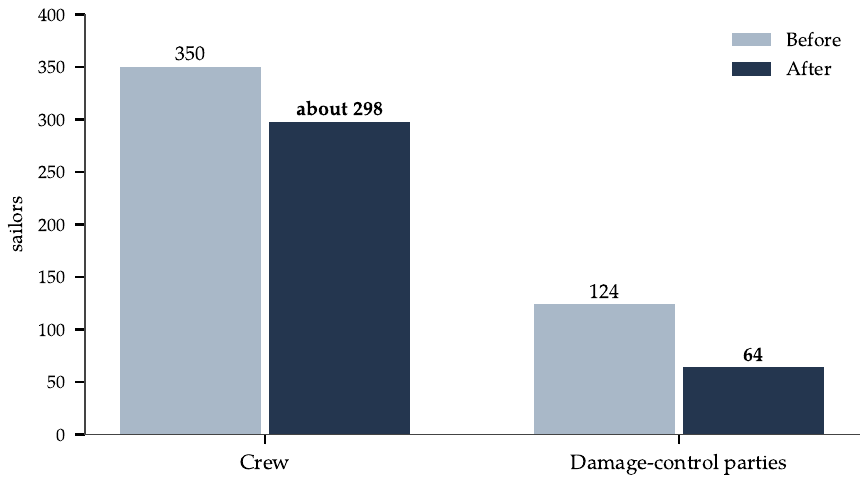
The Navy those sailors served in was shrinking. To find money for new ships it was cutting its ranks, and one of its answers was to replace sailors with computers. In November 1997 the Los Angeles Times described the work of the cruiser Yorktown, one of San Jacinto’s sisters, which the Navy had made its test ship for what it called the Smart Ship program. Her captain had cut her crew of 350 by fifteen percent, and improved computers controlling everything from guns and radars to firefighting systems had displaced fifty-two jobs. Her damage-control parties, the sailors who fight fires and flooding, had been cut from 124 to 64, with sensors in every compartment and radios meant to make up the difference. A retired vice admiral quoted in the same article argued that the cuts were driven by budgets and went too far.33
The argument he was making in 1997 is the one this history returns to in its later chapters. A warship’s crew is sized for the worst day she can have. Cut it to fit the ordinary days, and the ordinary days go well for years, until the one that does not.
The Stennis deployment, 1998
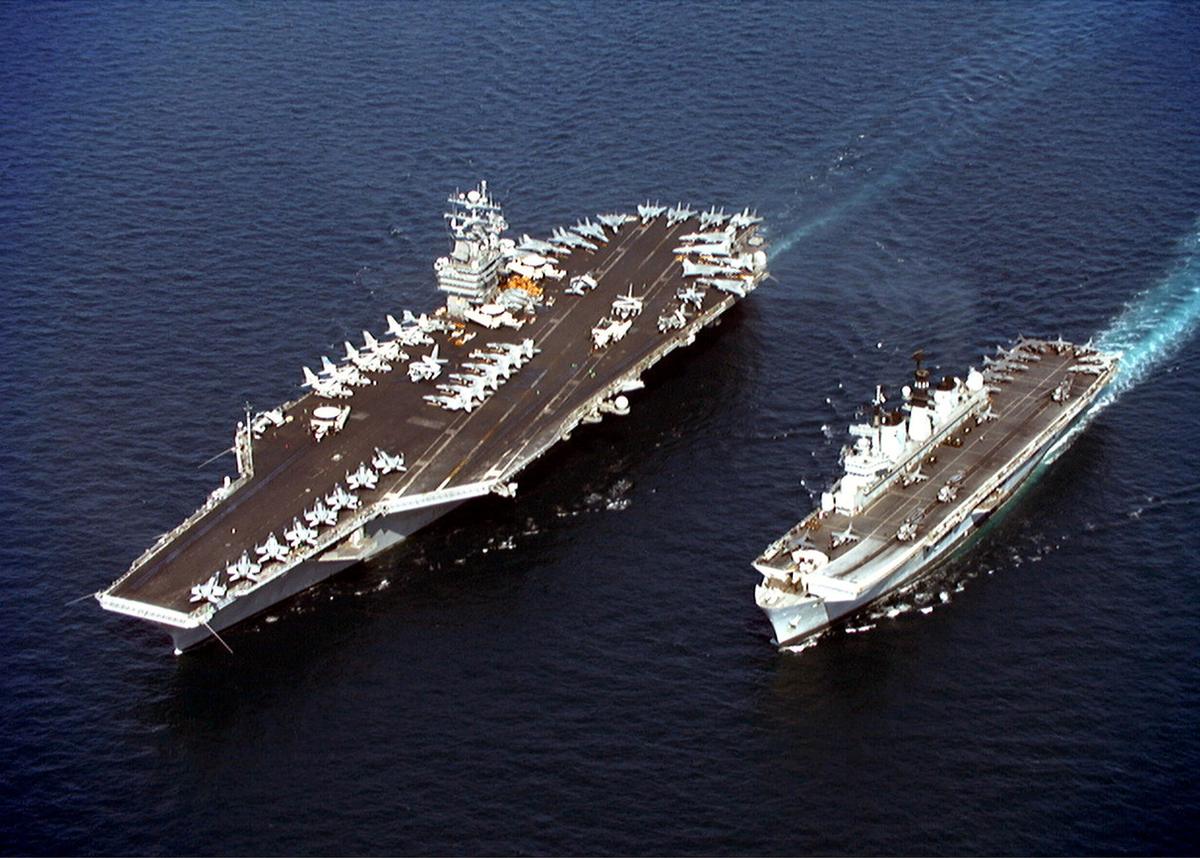
On 26 February 1998 San Jacinto deployed with the carrier John C. Stennis (CVN-74) to the Persian Gulf, after a sixteen-day transit. It came in the middle of a winter crisis in which Iraq had obstructed the United Nations weapons inspectors and the United States was massing forces in the Gulf. The cruiser served as air warfare commander for the Stennis group and as regional air warfare commander, the officer responsible for the air defense of the whole area, and took part in Southern Watch and in the interception of shipping. During the cruise she also rescued the crew of a Turkish merchant ship in distress.15
The carrier’s side of the cruise is told in a report by the public affairs officer of an electronic-attack squadron in her air wing, printed in the winter 1998 issue of the naval aviation magazine Wings of Gold. Stennis had left Norfolk on the first around-the-world cruise of her career, bound in the end for her new home port of San Diego, and because of the crisis she raced across the Atlantic, covering the 3,442 miles from the Chesapeake Light Tower to the Strait of Gibraltar in seven days, a record by the report’s account, and canceling seven planned port visits in the Mediterranean. A carrier that crosses an ocean at that speed takes her escorts with her, and the cancelled port visits were presumably cancelled for the cruiser’s crew as well.
On 10 March the carrier passed through the Strait of Hormuz and began sharing the duties of Task Force 50, the Gulf carrier force, with the carrier Independence, and the British carrier Illustrious joined them. Their daily work was Southern Watch, the patrols that enforced the no-fly zone over southern Iraq. In May Independence and Illustrious left, and Stennis remained as the only carrier in the Gulf. Her air wing flew its last Southern Watch missions on 15 July, after 1,744 of them and what the report calls a carrier-record 131 days in the Gulf, and she went on toward Australia, reaching San Diego on 26 August.22
In June, the same report says, the carrier’s SH-60F squadron, Helicopter Anti-Submarine Squadron 5, the Night Dippers, recorded the thousandth deck landing qualification for the cruiser, a deck landing qualification being one of the takeoffs and landings a pilot must make to be certified on a given ship. By the end of the cruise each of the squadron’s pilots had logged more than a hundred, and in the Gulf the squadron had supported more boardings in four months than the Navy had conducted in the whole of 1997. The report does not say whether the thousand landings were counted for the cruise or for the ship’s career, but it shows the carrier’s helicopters working from the cruiser’s deck that June.22
The Navy’s senior enlisted sailor came out to the Gulf that spring. A release of 4 June 1998 said that the Master Chief Petty Officer of the Navy, Jim Herdt, had recently talked with sailors aboard Stennis, San Jacinto, the destroyer O’Brien (DD-975) and Independence while they were taking part in Southern Watch, and that getting out to forward-deployed units was one of his first priorities in the job. Much of the release dealt with uniforms. The Navy was giving up its denim working dungarees, he said, to get out of the all-cotton business; the new materials would last longer and hold their color, and names, ratings and warfare insignia would be embroidered or sewn on as nametapes, which cost more, so clothing allowances had been raised and embroidery would be required by 1 October. The release does not say on which ships he spoke about uniforms, and it lists Independence as taking part although the Wings of Gold report has her leaving the Gulf in May, so the visit may have come before she left.23
The dungarees he was retiring were the uniform the plank owners had worn. The move away from all-cotton working clothes that he announced that spring ended, fourteen years later, with a Navy laboratory setting fire to a strip of blue camouflage. On 9 July 1998 Captain Paul E. Stanton relieved Captain Woods.25
A Truman cruiser
When she came home, Stennis moved to the Pacific Fleet, and San Jacinto was reassigned to the battle group of the carrier Harry S. Truman (CVN-75), the ship with which she would be linked for much of the next quarter-century.16
In the last week of May 1999 she was one of thirteen ships that came up New York harbor on a Wednesday for Fleet Week. The New York Amsterdam News listed them as the amphibious assault ship Wasp, the destroyers Briscoe and Cole, the frigates Simpson and Samuel Eliot Morison, San Jacinto, a group of Coast Guard cutters and the Canadian frigate Montreal, with two more ships berthed at Staten Island, and it followed sailors into the boroughs over the Memorial Day weekend.35 The destroyer Cole, moored in the same harbor that week, had seventeen months left before the morning in Aden that changed how every ship in the Navy stood watch in port.
Crew photographs place some of her sailors in the audience of David Letterman’s television show that week and her wardroom at Halifax, Nova Scotia, later that year.30 Crew recollection adds a period in the spring of 2000 at Newport, Rhode Island, as a school ship for the Surface Warfare Officers School.16 On 28 April 2000 Captain Craig E. Langman took command.25 Her next deployment began in November.
Notes
- Fleet Composite Squadron Six (VC-6), Command History for 1992, Enclosure (5), UNITAS 33-92 detachment report; the composition of the group is as stated there. Sources differ on whether Manitowoc was an oiler or an amphibious ship; she is carried here as an amphibious ship. uscarriers.net records the circumnavigation of South America during UNITAS XXXIII in 1992. ↩
- VC-6 1992 history: drone numbers, flight counts and the assessment of the ship’s suitability, from Enclosure (5) and its lessons-learned section. The detachment is variously described as six or eight men. ↩
- VC-6 1992 history, long-range schedule and port list. ↩
- Shellback initiation, 19 July 1992, Atlantic: hullnumber.com deployment table. Captain Sherman E. Wright Jr. as commanding officer in 1992: crew recollection, confirmed by the NavSource list of commanding officers (note 25), which dates his command 9 February 1992 to 21 August 1993. The account of his interests is crew recollection. ↩
- Crew recollection; year uncertain. ↩
- BALTOPS ’93 and the first combined SH-60B/SH-60F detachment: uscarriers.net chronology; naval aviation year-in-review for 1993. The Stockholm port call is crew recollection alone. ↩
- May 1994 deployment with George Washington (CVN-73) and 69 days in the Adriatic supporting the Bosnia no-fly zone and arms embargo: uscarriers.net chronology; ship’s deployment history (Appendix C). The operation names Deny Flight and Sharp Guard are supplied from general history of the period and are not confirmed by a Navy summary. ↩
- Crew recollection. The Jack Nicholson visit was long placed in 1989 in shipmate accounts, but three later witnesses dated it to the 1994 Mediterranean cruise; the text follows them. The Normandy anniversary participation is crew recollection alone. ↩
- Operation Vigilant Warrior, October 1994, Tomahawk strike station in the Red Sea: uscarriers.net chronology (“responded to Iraqi forces moving toward Kuwait by taking Tomahawk strike station”). ↩
- Deployment beginning 26 January 1996: uscarriers.net chronology. Navy photograph caption, as reproduced among former crew (24 February 1996, high-speed breakaway after replenishment from USNS Big Horn); crew recollection and prints of the Russian ships (the year of some prints is disputed between 1996 and 1999). Russian carrier group operating in the Mediterranean in early 1996: general history, not confirmed by a specific source. ↩
- Crew recollection, consistent with the March 1996 Taiwan Strait crisis; deck logs were not available to confirm it. ↩
- uscarriers.net (“rescued the merchant ship Saudi Hoffur”); Virginian-Pilot, 22–23 March 1996; crew recollection. The ship’s official biography, as reproduced on the Seaforces data sheet, spells it Saudi Hoffuf. The spelling of the ship’s name (Hoffur, Hofuf) is unresolved; the statement that a boarding party went aboard with pumps is crew recollection alone. ↩
- uscarriers.net: the 1996 cruise ended with the ship’s first extended shipyard overhaul. Southern Watch: general history of the period. ↩
- Crew recollection. ↩
- 26 February 1998 deployment with John C. Stennis, 16-day transit, air warfare commander and regional air warfare commander, Southern Watch and the rescue of a Turkish merchant crew: uscarriers.net chronology. The Iraqi inspection crisis of early 1998: general history. A claim of five Battle Efficiency awards in this period is not carried; see Appendix D. ↩
- Reassignment to the Truman group and Fleet Week New York 1999: uscarriers.net. The spring 2000 school-ship period at Newport: crew recollection. A wardroom photograph dated by former crew to 1999 places the ship at Halifax that year; uscarriers.net places a Newport school-ship period in 2012, and the year is not settled. ↩
- Photograph caption, “U.S. ship douses environmentalist protest in Rio,” Associated Press, Chicago Tribune, 6 August 1992, p. 3. The caption gives “Tuesday” without a date; 4 August 1992 was a Tuesday. VC-6’s 1992 history places the ship at Rio de Janeiro in early August. ↩
- “Service Notes,” The Sun (Baltimore), 27 September 1992, p. 17. ↩
- “Tomahawk Is Fired Across N. Florida,” Sun-Sentinel (Fort Lauderdale), 18 August 1995, p. 16A (wire services, Jacksonville dateline). The article gives “Wednesday” without a date; 16 August 1995 was a Wednesday. ↩
- “U.S. Navy Helos Get Increased Role in Hunting Subs,” Helicopter News (Potomac, Md.), 12 April 1996, p. 1; the interview with the HSL-48 officer is dated 29 March in the text. ↩
- “Vessel Open for Tours,” Sun-Sentinel (Fort Lauderdale), 31 August 1996, p. 3B. Later Port Everglades visits (30 April 2007; 25 April 2012): uscarriers.net chronology. ↩
- LTJG C. J. Casad, “Team 7/74 Cruise Report,” Wings of Gold, winter 1998, pp. 42–44 (the first page is unnumbered in the copy consulted). The report is written from the carrier air wing’s point of view and names San Jacinto once, in the paragraph on the squadron HS-5. ↩
- “US Navy: MCPON Visits Ships in Gulf,” M2 Presswire, 4 June 1998. ↩
- Sea Power, June 1997, p. 66, in an article on the F/A-18E/F production decision and forward-deployed forces; photograph caption naming San Jacinto, Merrimack and George Washington during replenishment “last year” in the Arabian Gulf. ↩
- Commanding officers and their dates: NavSource Online, cruiser photo index for CG-56 (archived 23 May 2025), list of commanding officers: Sherman E. Wright Jr., 9 February 1992 to 21 August 1993; Clifford C. Covington, 21 August 1993 to 25 August 1995; Raymond C. Pilcher Jr., 25 August 1995 to 24 February 1997; James A. Woods Jr., 24 February 1997 to 9 July 1998; Paul E. Stanton, 9 July 1998 to 28 April 2000; Craig E. Langman, from 28 April 2000. ↩
- Crew recollection: sailors of the UNITAS cruise on the iceberg off Argentina, the heavy seas, the Andes tour and a speed of thirty-seven knots off Chile (the speed is not confirmed by any document); a sonar technician reenlisted by Captain Wright at the San Jacinto Monument; a sailor who remembered more than one change of command in Houston; and a sailor who sailed with the ship from Charleston to the Port of Houston in 1993. ↩
- Wilhelmshaven, July 1993: photograph caption in Kurt Greiner, Ticonderoga Class Cruisers, Warship Pictorial 35 (Classic Warships Publishing, 2010), PDF p. 8 (SeaPhoto collection). ↩
- Suez Canal, late 1994: photograph caption in Scott C. Truver, “The Fleet of the Future: An Eclectic Preview,” Sea Power, October 1997, read by OCR from the page image. ↩
- “3 Shipyards in Va. Win Navy Contracts,” Associated Press, Washington Post, 9 January 1995, p. F11. ↩
- Crew recollection: a chief petty officer initiated aboard on 15 September 1995 who returned for the decommissioning in 2023; a sailor’s memory of an emergency breakaway, about 1997; crew photographs of the 1999 Fleet Week in New York, including sailors at the David Letterman show; a wardroom photograph at Halifax dated 1999. ↩
- Big Horn, 2 February 1996: photograph caption in Glenn W. Walman and Scott C. Truver, “Coming: An International Aegis Armada,” Sea Power, December 1997, read by OCR from the page image. The Navy photograph of 24 February 1996 (note 10) shows a second replenishment from the same oiler, or the same one under a different date; the record available does not settle which. ↩
- Vertical replenishment in the Gulf, 1996: photograph caption in “Douglass Cites Concerns About U.S. Shipbuilding Base,” Sea Power, July 1997, p. 15 (“last year” relative to the issue), read by OCR from the page image. ↩
- Smart Ship: Patrick J. Sloyan, “Fewer Sailors, More Sensors for Navy Ships,” Los Angeles Times, 23 November 1997. ↩
- Stark and the Navy’s firefighting improvements: David Evans, “A New Arsenal to Fight an Old Foe: Ship Fires,” Chicago Tribune, 29 May 1992. ↩
- Fleet Week 1999: “Fleet Week Styles Another Memorable May,” New York Amsterdam News, 10 June 1999. ↩