Part Four: The Long Peace That Wasn't (1991–2006)
Chapter 17Commodore on the Bridge
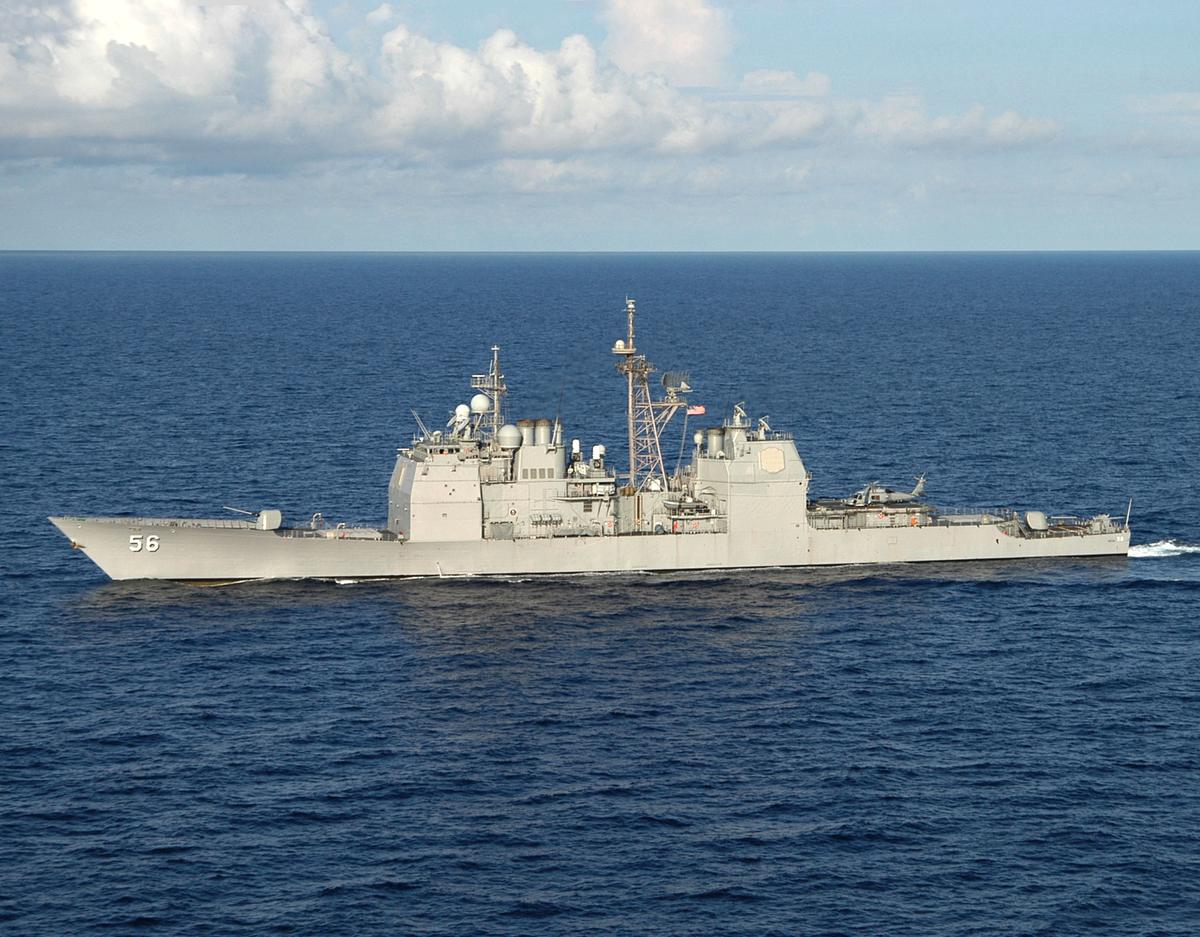
On 18 November 2005, in the northern Persian Gulf, a Royal Navy officer, Commodore Bruce Williams, took command of the coalition task force that guarded Iraq’s offshore oil terminals and made San Jacinto his flagship. In the Navy’s words, it was the first time since the end of the First World War that a Royal Navy commodore had flown his flag in an American warship.8, 16
The admiral’s berthing, the flag spaces that sat ready for a guest who was usually not aboard and were inspected anyway, had been built into the class for exactly this. For about two months in the winter of 2005 they were used.
The cruise that brought her there had begun in the summer, after more than two years without a deployment. The Navy had renamed its carrier battle groups carrier strike groups, and San Jacinto, paired with Harry S. Truman since 1998, had been reassigned to the nuclear carrier Theodore Roosevelt (CVN-71), whose group was next in line for the Middle East. On 15 July 2005 Captain Charles J. Neary relieved Captain Eschbach in command.14, 15
The Roosevelt strike group
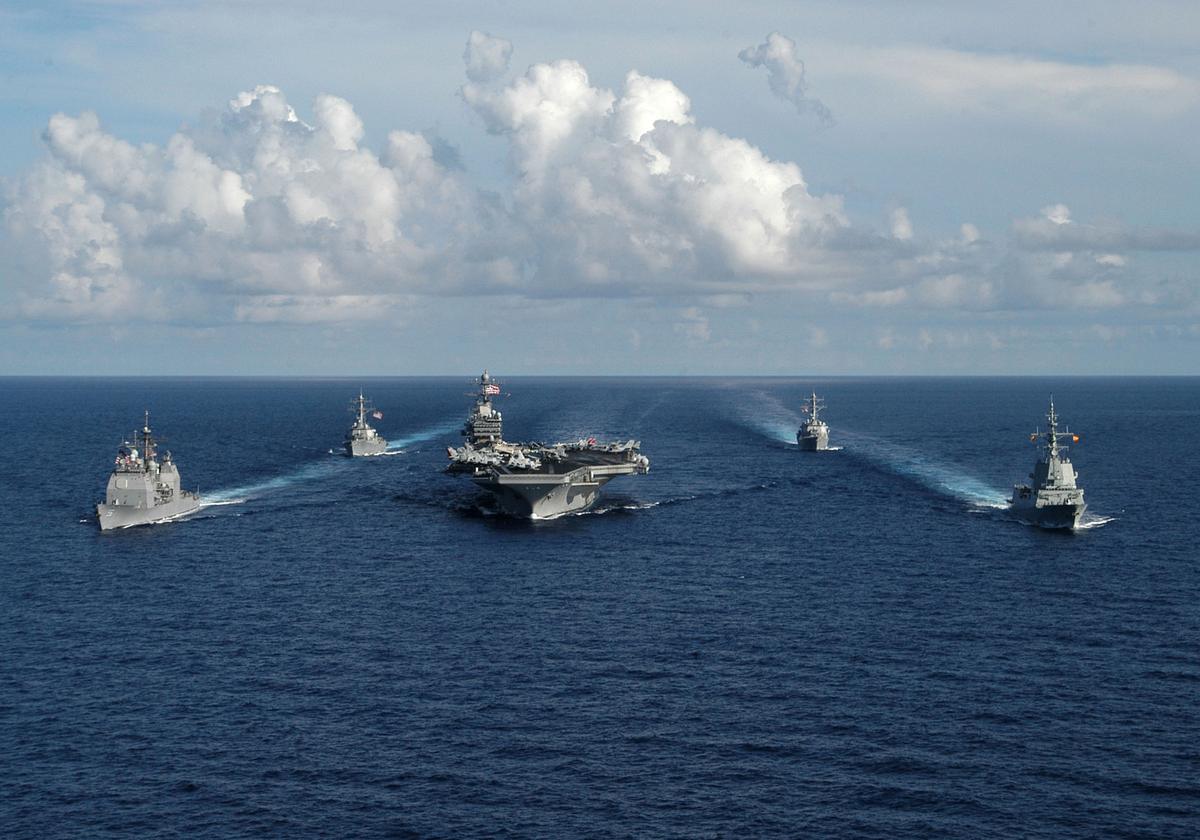
A carrier strike group is the Navy’s basic fighting formation: an aircraft carrier with her air wing, a cruiser, two or three destroyers or frigates, usually an attack submarine, and supply ships. The group that left Norfolk on 1 September 2005 numbered more than 7,500 sailors under Rear Admiral James A. Winnefeld Jr. Besides Theodore Roosevelt and San Jacinto it included the destroyers Donald Cook (DDG-75) and Oscar Austin (DDG-79), a submarine of the Los Angeles class, the oiler Kanawha (T-AO-196), the ammunition ship Mount Baker (T-AE-34) and a ship of another navy, the Spanish frigate Álvaro de Bazán (F-101).1
The Spanish frigate was one of Spain’s new F100 class, built around the Aegis combat system, the same system that gave San Jacinto her radar and fire control. The system that had been an American secret when the cruiser was laid down was now at sea under a Spanish flag, in a ship newer than she was. A ceremony aboard Theodore Roosevelt on 4 May 2005 had formally attached the frigate to the group, and she trained with it as a full member in a joint task force exercise in July.2 The group was to relieve the carrier Nimitz in the Mediterranean and the Middle East. It spent a few days at Naples in the third week of September and on 27 September passed through the Suez Canal, the Spanish frigate and the oiler in company, at an average of about nine knots, into the Red Sea.3
The next day the Spanish frigate asked for help with a member of her crew who was seriously ill. Theodore Roosevelt sent her senior medical officer across, and he judged that the man had to be evacuated at once. San Jacinto, steaming in the carrier’s screen, launched her Seahawk, a helicopter of Helicopter Anti-Submarine Squadron (Light) 44, Detachment 8, call sign Magnum 446, and its pilot, a lieutenant, flew the patient more than 140 nautical miles to a hospital ashore.4
The northern Gulf
The strike group reached the Persian Gulf in October. By the account of its first two months that it gave the magazine Sea Classics, published in February 2006, its air wing, Carrier Air Wing 8, had flown its first combat sorties on 24 September, before the carrier reached the Gulf, led by its electronic-attack squadron, whose aircraft jam enemy radars. From then to 1 November the wing flew 2,070 sorties, 624 of them in support of the war in Iraq and 557 for maritime security operations, the patrolling of the sea lanes against terrorism and smuggling. Its two fighter squadrons still flew the F-14 Tomcat, which the account described as soon to be phased out of front-line service.5, 13 The Tomcat had been designed to shoot down the Soviet bombers that the cruiser had been designed to shoot down. Both were ending their careers dropping bombs on, or standing guard over, a country with no navy and no air force.
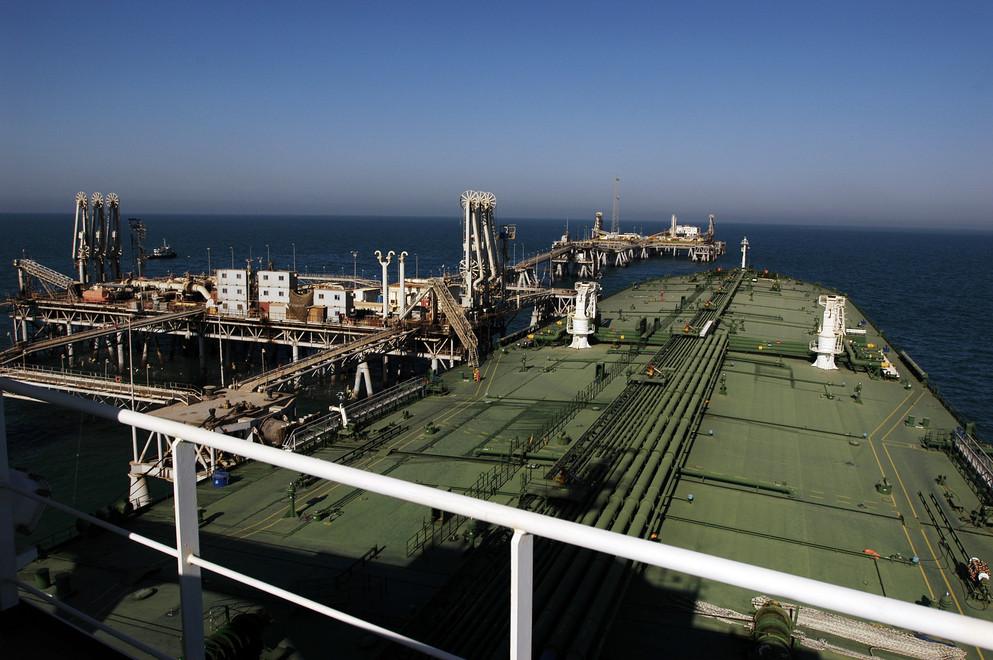
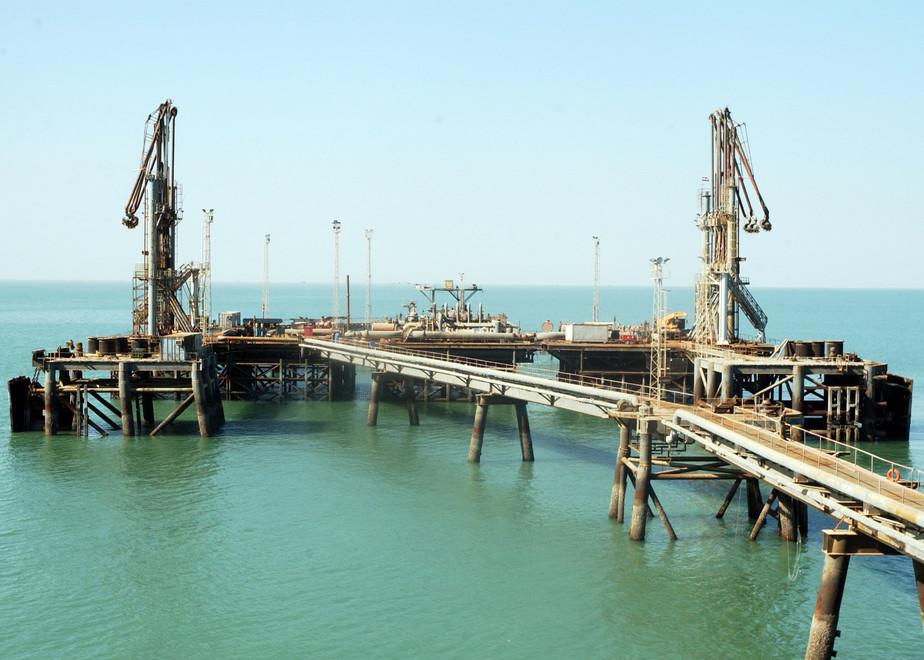
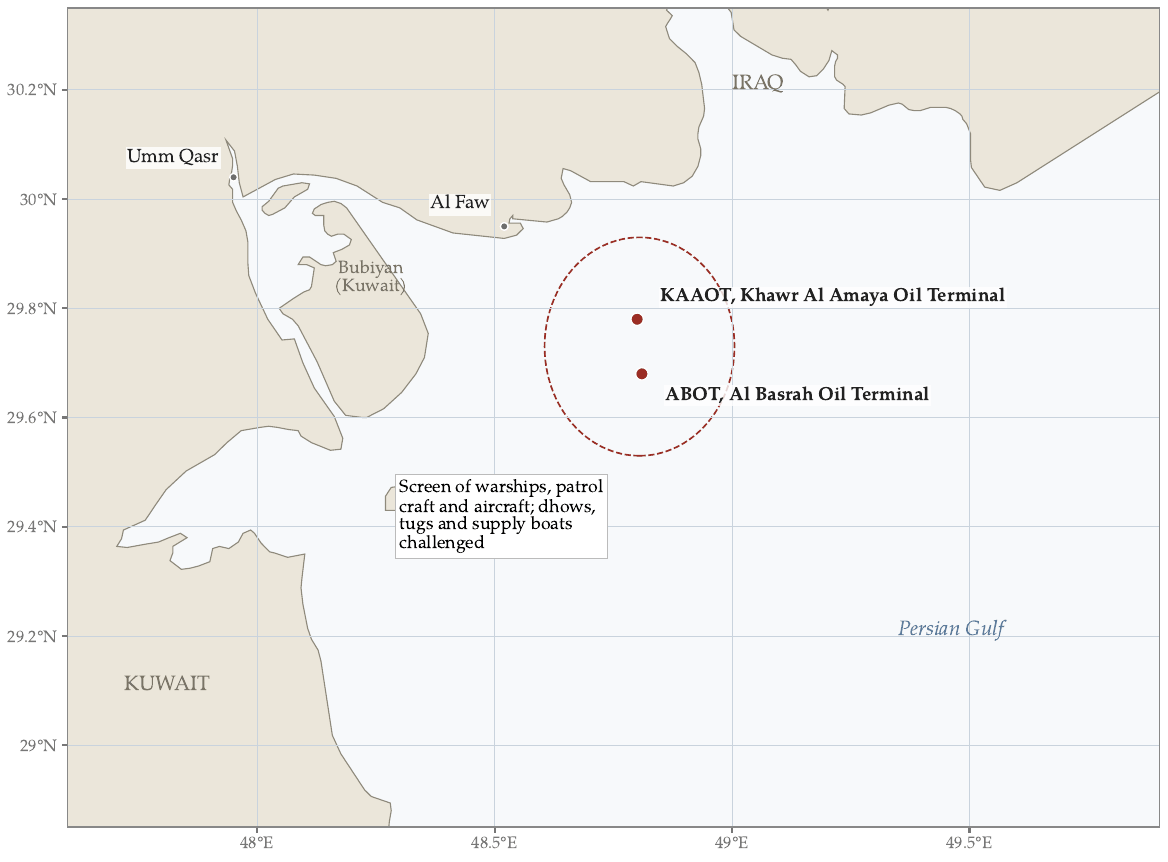
The escorts had work of a different kind. Iraq’s oil exports went out through two terminals in the northern Gulf, the Al Basrah Oil Terminal and the Khawr Al Amaya Oil Terminal, platforms standing in open water. A Navy release of the time said they accounted for a significant share of the revenue of the Iraqi government, which was then trying to rebuild, and a later release put it more strongly, crediting them with eighty-five percent of the country’s gross national product.5 They were also a target. In April 2004 suicide boats had attacked them, and two American sailors and a Coast Guardsman, members of a boarding team from the patrol craft Firebolt, were killed.6 They died doing what the cruiser’s boarding teams were about to do several dozen times: pulling alongside a dhow to see who was in it.
The force charged with the terminals’ defense was Combined Task Force 58, a coalition of Australian, British, American and Iraqi personnel, and in 2005 it was in the middle of handing responsibility for the terminals to Iraqi forces it was training to defend them.5 Its work was patient and repetitive. Warships, patrol craft and aircraft kept a screen around the terminals and challenged every dhow, tug and supply boat that came near, trying to separate the traffic that kept the terminals running from the very few boats that meant harm.
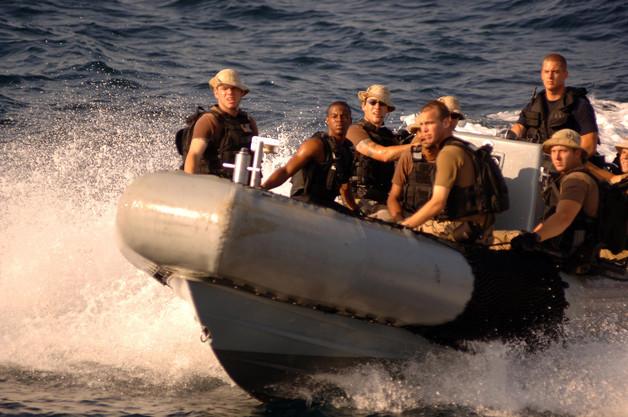
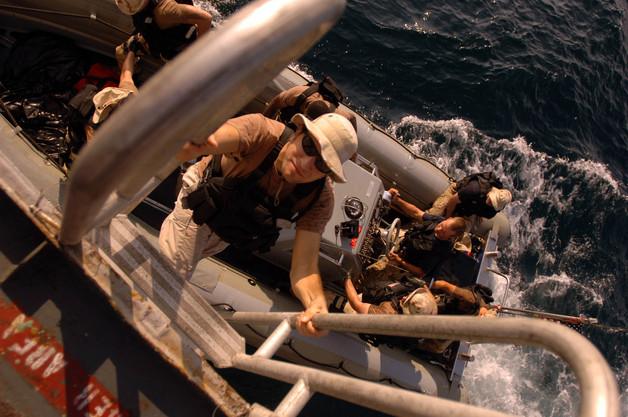
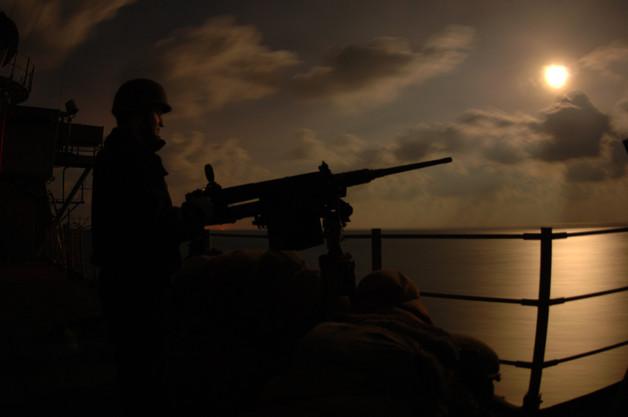
Oscar Austin and Donald Cook guarded Iraqi territorial waters and the terminals themselves, and cooks from Oscar Austin were sent out to a terminal platform to make hot meals for the people stationed there. San Jacinto’s visit, board, search and seizure teams, the boarding parties that stop and inspect suspect vessels, worked the dhow traffic. Such boardings were meant to keep terrorist organizations from using the sea to move people, weapons or drugs, and by early November her teams had inspected more than fifty local fishing dhows, handing goodwill packages to the fishermen as they went. The strike group’s account called the cruiser a key factor in its success; it does not say how many boardings she made in all or what, if anything, her teams found.7, 13
Fifty boardings in a few weeks is fifty times that a boat crew drawn from every rating on the ship went down the side and across open water to a vessel they knew nothing about. Nearly every one of those dhows was what it looked like, a fishing boat. The teams could not know which one would not be.
A British commodore
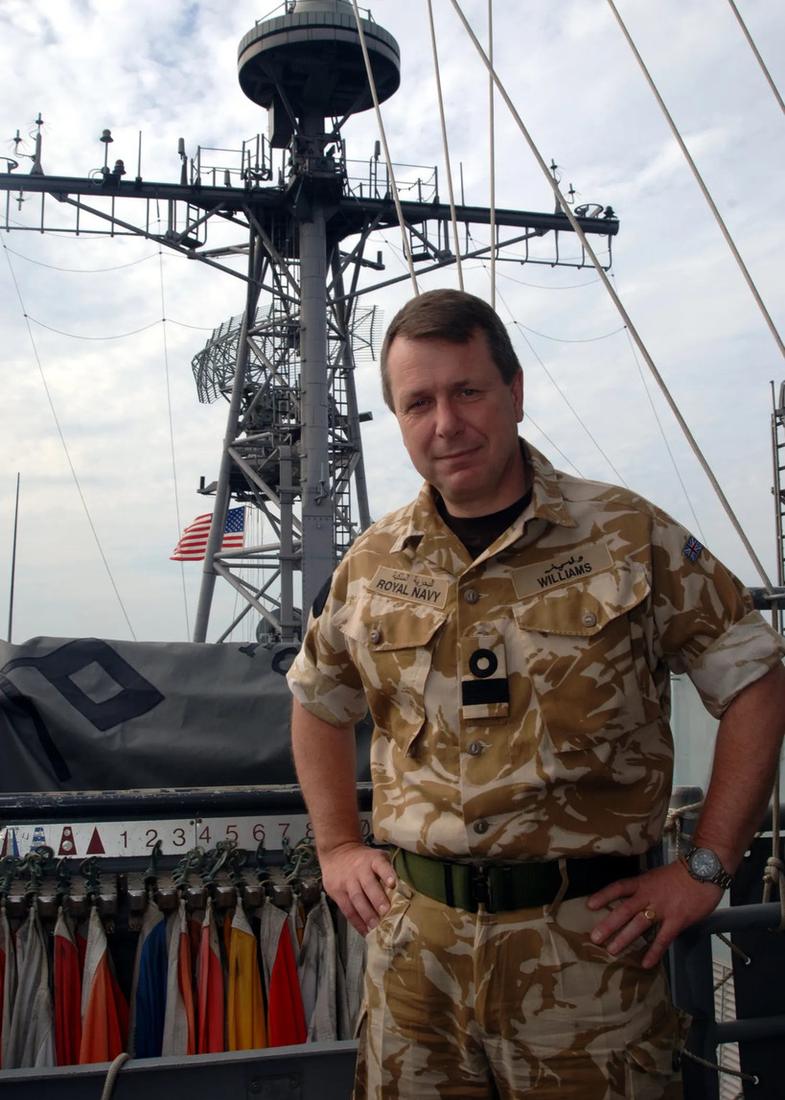
The ceremony of 18 November handed Combined Task Force 58 from Captain Hank Miranda of the U.S. Navy, who had led the maritime security effort in the Gulf for the previous three months, to Commodore Williams.8 Williams said why he wanted a cruiser. A flagship, he told the Navy’s reporter, had to be able to command forces close by and at a distance, and it took a ship of the cruiser’s scale and capacity to command the mixed force in the northern Gulf. As a British one-star officer, he added, he was leading Australian, American, British and Iraqi units that could operate together, and the coalition’s work was shifting from guarding Iraq’s terminals for the Iraqis to helping them guard their own.8 A commodore, in the Royal Navy, is an officer between a captain and a rear admiral who commands a group of ships. A flagship is the ship from which such an officer exercises command, and his presence changes her. Her own captain remains responsible for the ship, her safety and her crew, while the commodore and his staff direct the task force from her. The staff takes over spaces aboard, and the ship’s operations department, whose usual work is to support the captain’s decisions, finds itself supporting the staff’s as well.
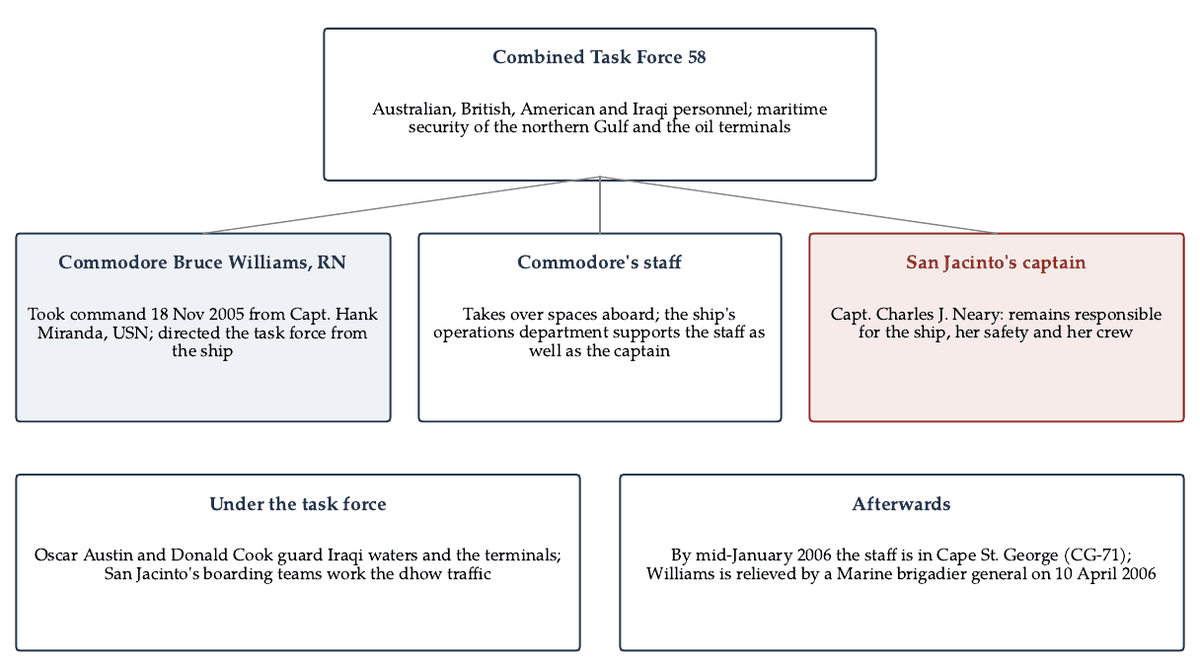
For the crew it meant more khaki in the passageways, more people in the combat information center, more traffic on the radios and one more senior officer whose eye could fall on anything. A cruiser lived under more scrutiny than a destroyer, and a cruiser with a foreign commodore embarked lived under more still. For a time a ship built to be one escort among several became the headquarters of a coalition. Her official biography describes her in those weeks as the flagship of the multinational force responsible for maritime security operations in the North Arabian Gulf.16
Two days after Williams took command, her sailors mounted two solar-powered strobe lights on the wreck of a sunken oil tanker and on its marker buoy in the northern Gulf, so that merchant ships and patrol boats could avoid the hazard at night, an improvement to navigational safety that the Navy recorded in a release of its own.9 It was a small job, done by a few sailors in a boat.
Her time as flagship was short. By the middle of January 2006 Navy releases place the task force’s staff in another cruiser, Cape St. George (CG-71). Williams stayed in command of Combined Task Force 58 until 10 April 2006, when a brigadier general of the Marine Corps relieved him.10 San Jacinto had carried the commodore’s flag for about two months.
Home
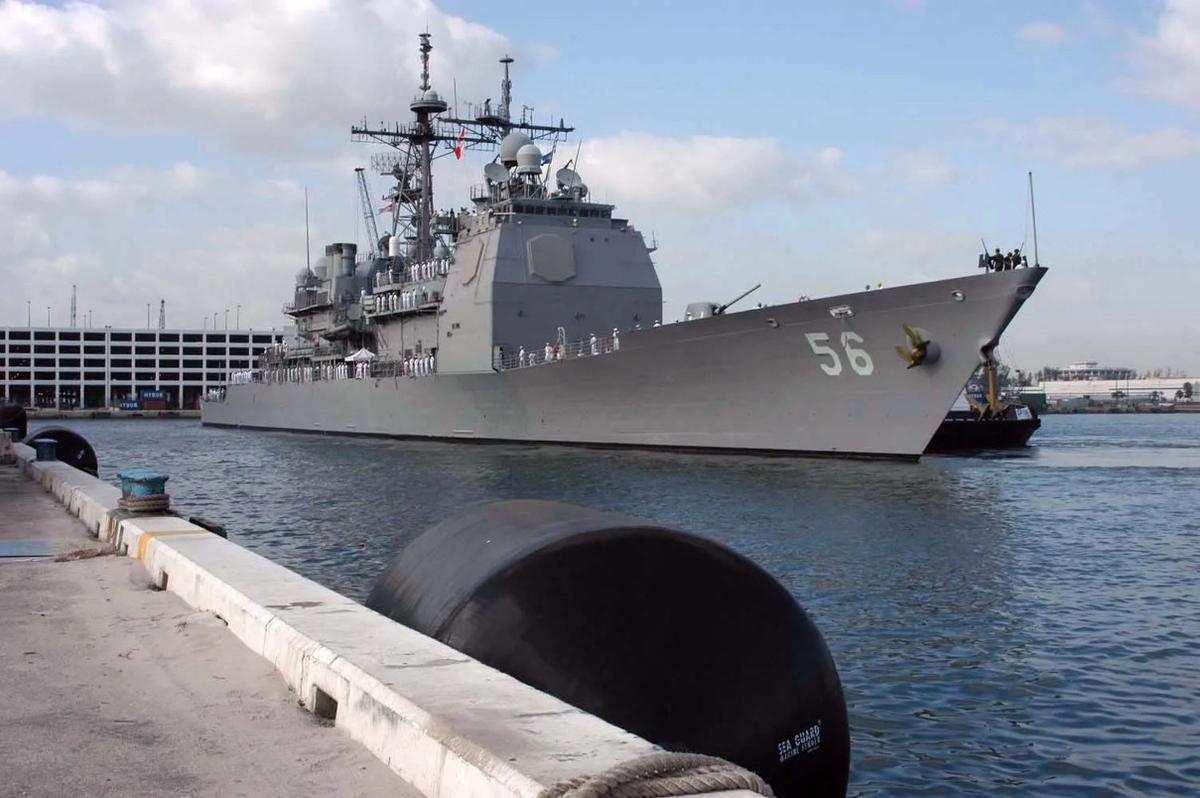
On 15 February 2006 Theodore Roosevelt and San Jacinto passed north through the Suez Canal, their part in maritime security operations and in the war in Iraq done, with the Ronald Reagan group coming to relieve them.11 The cruiser called at Marmaris, Turkey, on 16 February, and the strike group was home in Norfolk on 11 March 2006, about six months after it sailed.12 On 1 May she was at Port Everglades for South Florida’s Fleet Week, one of the ships whose nearly three thousand sailors took part.17 Her next deployment began in November 2007.
She was eighteen years old, past the midpoint of the life the Navy had planned for her. She had been a strike ship in two wars against Iraq and a guard ship over its oil in the peace that followed, and the second half of her life would be harder on her than the first.
Notes
- Departure from Norfolk on 1 September 2005 with more than 7,500 sailors under Rear Adm. James A. Winnefeld Jr., and the composition of the strike group: Navy NewsStand, 1–2 September 2005 and 7 November 2005; uscarriers.net chronology (departure 1 September 2005; sources vary between 1 and 3 September). The Los Angeles-class submarine is not named in the releases consulted. The ammunition ship USNS Mount Baker (T-AE-34), from Naval Weapons Station Earle, New Jersey, is named in the Sea Classics article cited in note 13, which names Kanawha and Mount Baker as the group’s combat logistics ships. ↩
- Joining of the Spanish frigate Álvaro de Bazán (F-101) to Carrier Strike Group 2, 4 May 2005, and the July 2005 joint task force exercise: globalsecurity.org, Theodore Roosevelt Strike Group MED 05 Deployment, compiled from Navy releases. The F100 class as the Spanish Navy’s Aegis frigate: general knowledge. That San Jacinto was reassigned to the Roosevelt group in 2005 is inferred from the group composition in these releases and is not confirmed by a command history. ↩
- Naples port visit, 19–23 September 2005, and the Suez transit on 27 September 2005 at an average of nine knots: Navy NewsStand, 6 October 2005; globalsecurity.org chronology. ↩
- The 28 September 2005 medical evacuation (Magnum 446, the pilot, a lieutenant, HSL-44 Detachment 8, more than 140 nautical miles): DANFS, vol. III. ↩
- The oil terminals, Combined Task Force 58 and its multinational makeup, and the handover to Iraqi forces: Navy NewsStand, 23 November 2005; American Forces Press Service, February 2006; Navy NewsStand, 15 July 2005 (Task Force 58 then under a Royal Australian Navy commodore); DVIDS item 5395 (the 85 percent figure, as given there). ↩
- The April 2004 attack on the terminals, in which two U.S. Navy sailors and a U.S. Coast Guardsman from USS Firebolt’s boarding team died: public record. Firebolt was a coastal patrol craft, not a destroyer. ↩
- Boarding of more than 50 dhows by the ship’s visit, board, search and seizure teams: Navy NewsStand, 7 November 2005. ↩
- Commodore Bruce Williams, RN, assuming command of Combined Task Force 58 on 18 November 2005 from Capt. Hank Miranda, and the “first since the end of World War I” claim as made by the Navy: Navy NewsStand, 23 November 2005; uscarriers.net chronology; DANFS, vol. III. The claim has not been checked against Royal Navy records. ↩
- Strobe lights on a sunken tanker and marker buoy, 20 November 2005: Navy NewsStand, 28 November 2005. ↩
- The task force staff aboard USS Cape St. George (CG-71) in January 2006: Navy NewsStand, 20 January 2006. Williams relieved by Brig. Gen. Carl Jensen, USMC, 10 April 2006: Navy NewsStand, 13 April 2006. ↩
- Suez transit of 15 February 2006 and relief by the Ronald Reagan group: Navy NewsStand and American Forces Press Service, 15 February 2006. ↩
- Return to Norfolk on 11 March 2006: Navy releases of 11–14 March 2006; uscarriers.net. The Marmaris visit on 16 February 2006: ship’s deployment history, not confirmed elsewhere. ↩
- Susan Duprey, “Carrier Roosevelt Support Group Continues to Have Impact in Gulf,” Sea Classics 39, no. 2 (February 2006): 9. The article is a one-page summary of the first two months of the deployment (the figures run to 1 November 2005). It gives the group’s composition, the 24 September start of combat flights, the 2,070 sorties (624 in support of Operation Iraqi Freedom and 557 in support of maritime security operations), the role of the visit, board, search and seizure teams of San Jacinto and the “more than 50” dhows inspected, and the tasks of Oscar Austin and Donald Cook at the oil terminals. The article does not say where the carrier was on 24 September. ↩
- NavSource, list of commanding officers of USS San Jacinto (CG-56): Capt. Neary, 15 July 2005 to 10 May 2007 (his predecessor’s tour ending 15 July 2005). The list gives his full name as Charles James Neary and his predecessor as Alan Eugene Eschbach. It was consulted online and has not been checked against a ship’s plaque or the Navy’s own list. ↩
- The reassignment to the Theodore Roosevelt group: uscarriers.net chronology, entry for 1 September 2005; the releases cited in note 1. The renaming of carrier battle groups as carrier strike groups: general naval history of the period. ↩
- The ship’s official biography, as reproduced on the Seaforces data sheet for USS San Jacinto (CG-56): “flagship for Combined Task Force 58, leader of the multinational coalition forces responsible for conducting maritime security operations in the North Arabian Gulf” (paraphrased in the text). The figures in the Sea Classics article (note 13) agree with an OCR reading of the page image: 2,070 sorties from 24 September to 1 November, 624 for Iraqi Freedom, 557 for maritime security, more than 50 dhows. ↩
- Fleet Week at Port Everglades, 1 May 2006, with nearly 3,000 sailors taking part: uscarriers.net chronology. ↩