Part Five: The Middle Years (2007–2012)
Chapter 18Dakar to Fujairah
In the spring of 2007 San Jacinto was nineteen years old. Eleven captains had commanded her since she came up the Houston Ship Channel in 1988. On 10 May Captain Matthew M. Sharpe relieved Captain Neary in command.26 The wars in Iraq and Afghanistan had made heavy demands on a fleet smaller than it had been in 1991, the Aegis cruisers were wanted everywhere, and the Navy had begun a modernization program to upgrade their hulls and combat systems so that they could serve out their planned lives and perhaps longer.
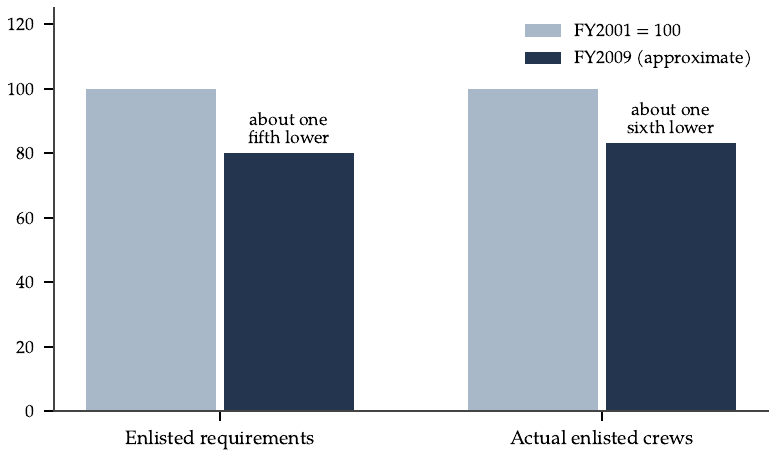
The ships were also being asked to do the work with fewer people. Between fiscal 2001 and 2009, under an initiative the Navy called optimal manning, enlisted requirements on its cruisers and destroyers fell by about a fifth and actual crews by about a sixth. When the Government Accountability Office reviewed the policy for Congress in 2010, San Jacinto was one of the eleven ships its investigators visited, interviewing her commanding officer, executive officer and department heads, and the office reported that personnel on the ships it visited said their work in port had been growing.27
An older ship needs more maintenance, not less, and the Navy had taken away a sixth of the people who did it. The retired admiral who warned in 1997 that the cuts on Yorktown went too far had lost the argument. What he had warned about arrived in the years this chapter covers, as divisions short of people, sailors doing other ratings’ work, and watches stood by whoever was left.
A year of showcases (2007)
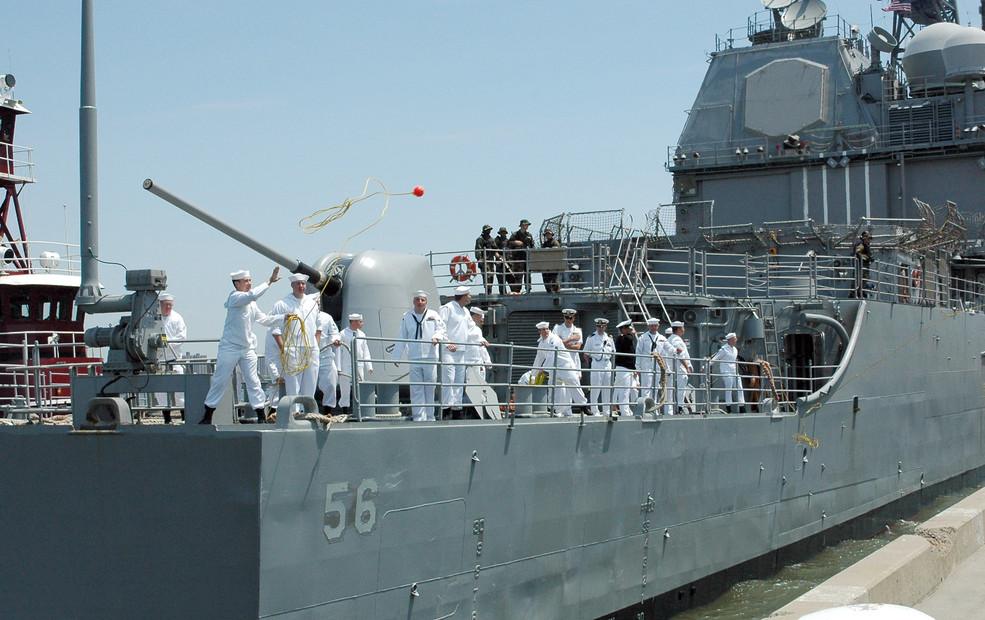
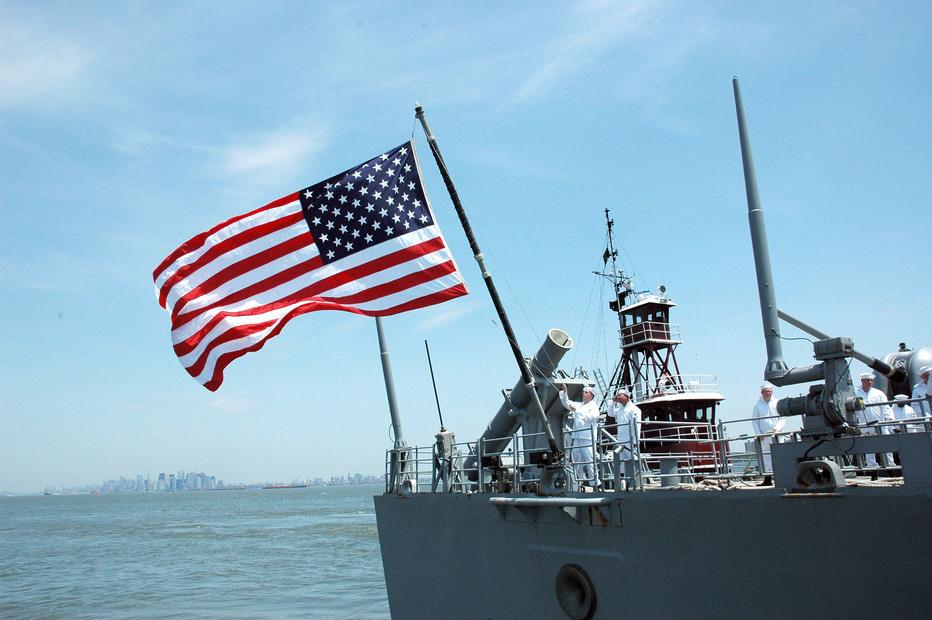
The year began with the exercises that came before every deployment. On 3 April 2007 the ship was in the Atlantic conducting a Tailored Ship’s Training Availability with the Truman strike group, a block of training and certification in which a ship’s crew is put through drills in damage control, navigation, weapons handling and other skills by an outside team of evaluators.1 On 30 April she moored at Port Everglades, Florida, for Fleet Week South, and on 23 May she was in New York for the city’s Navy Fleet Week.1
A Fleet Week is the Navy’s way of bringing a warship to a city so that people can walk her decks and her sailors can have a few days of liberty ashore. For the crew it is the best duty a ship in home waters gets, and it is paid for beforehand in paint.
Dakar and the Black Sea (November 2007 – June 2008)
On 5 November 2007 the ship left Norfolk with the Truman strike group on a deployment that would last seven months.2 The cruise took the group through the Mediterranean and down the Atlantic coast of Africa. It was, by the Navy’s standards of the time, an unusually varied deployment, a carrier group working with partner navies on maritime security and training in places where an American carrier group did not often go.
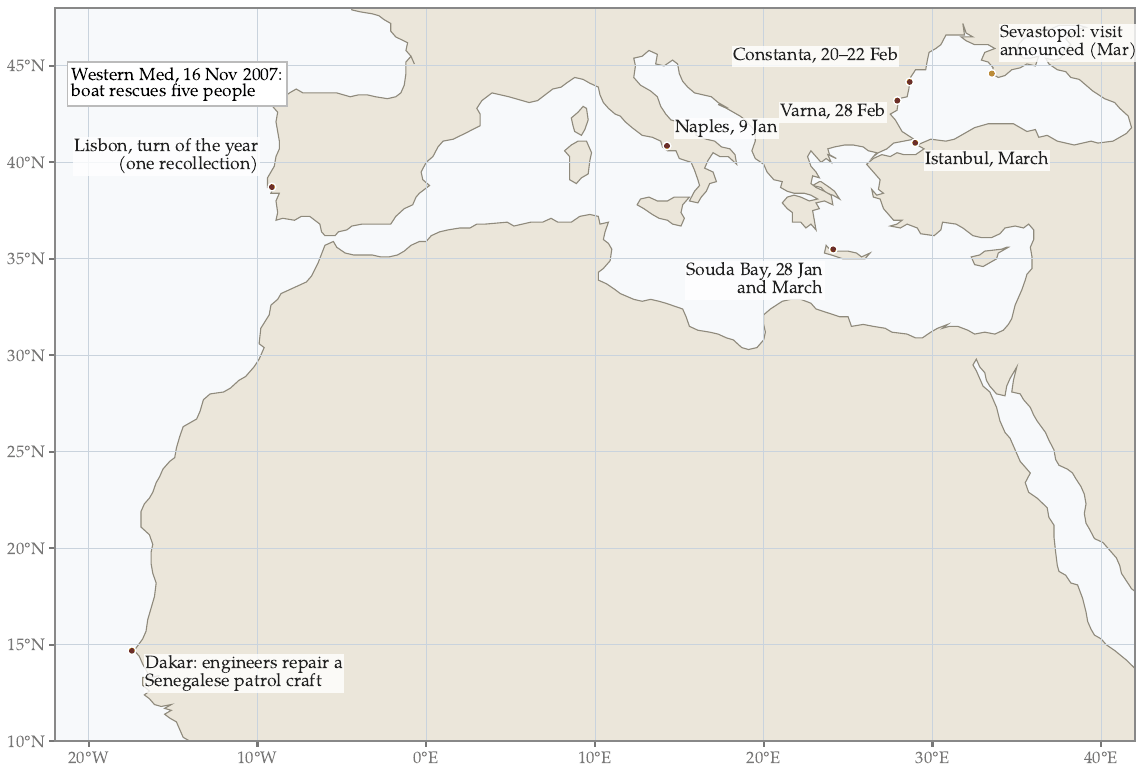
On 16 November, in the western Mediterranean, the ship’s rigid-hull inflatable boat went to the aid of five stranded people and gave them food and water.2 At Dakar, Senegal, her engineers helped repair a Senegalese Navy patrol craft, the Matelot Oumar Ndoye, that had stopped working.3 The snipes who kept a nineteen-year-old cruiser running were lent out to fix someone else’s ship, and did. By one sailor’s recollection she was at Lisbon at the turn of the year.29
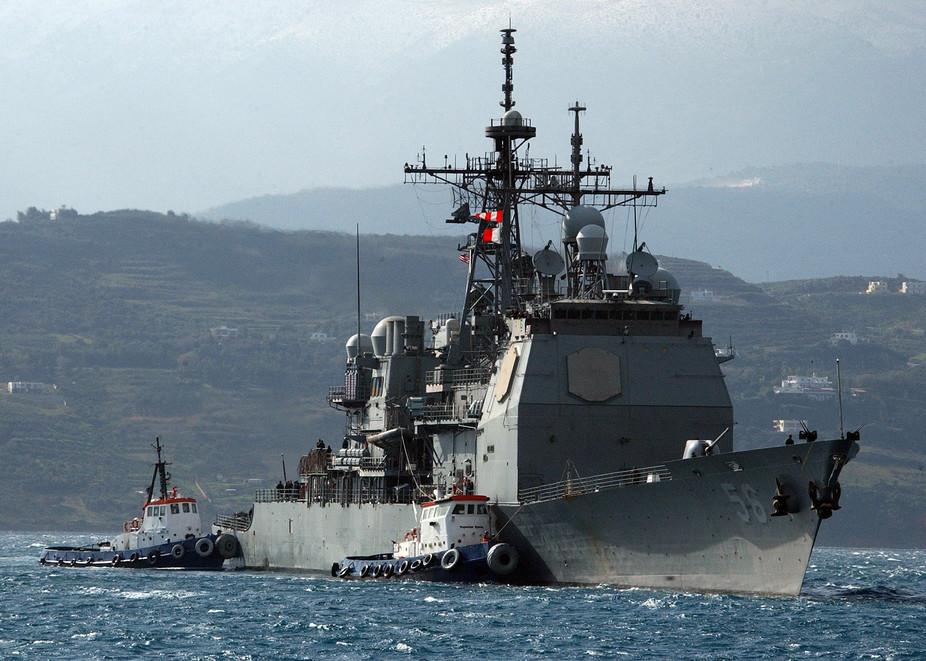
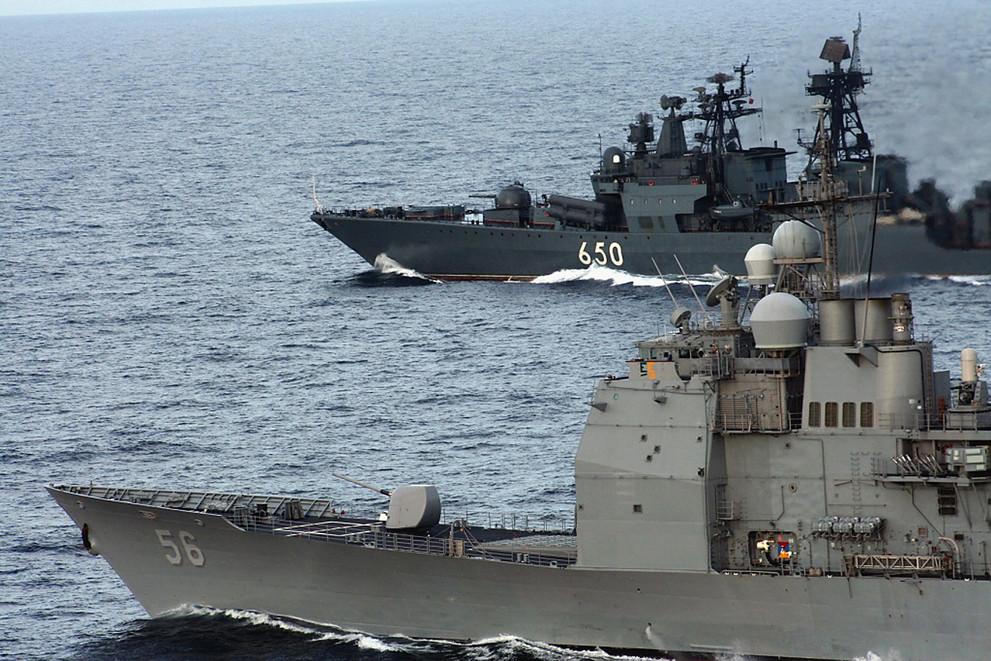
On 9 January 2008 the ship called at Naples, Italy, and on 28 January at Souda Bay on the island of Crete, where the Navy keeps a base. On 20 February she moored at Constanta, Romania, and on 28 February she visited Varna, Bulgaria. Stops at Istanbul and again at Souda Bay followed in March.4 A call at Sevastopol, Ukraine, was announced for the first week of the month.19 Her official biography sums up the deployment as operations throughout the Mediterranean and the Black Sea.28
She had been to Constanta once before, in 1989, when Romania was a Warsaw Pact state ruled by Nicolae Ceauşescu and her sailors had traded Kent cigarettes for what the shops did not have. Romania and Bulgaria had joined NATO in 2004, and this time she came as the guest of an allied navy.
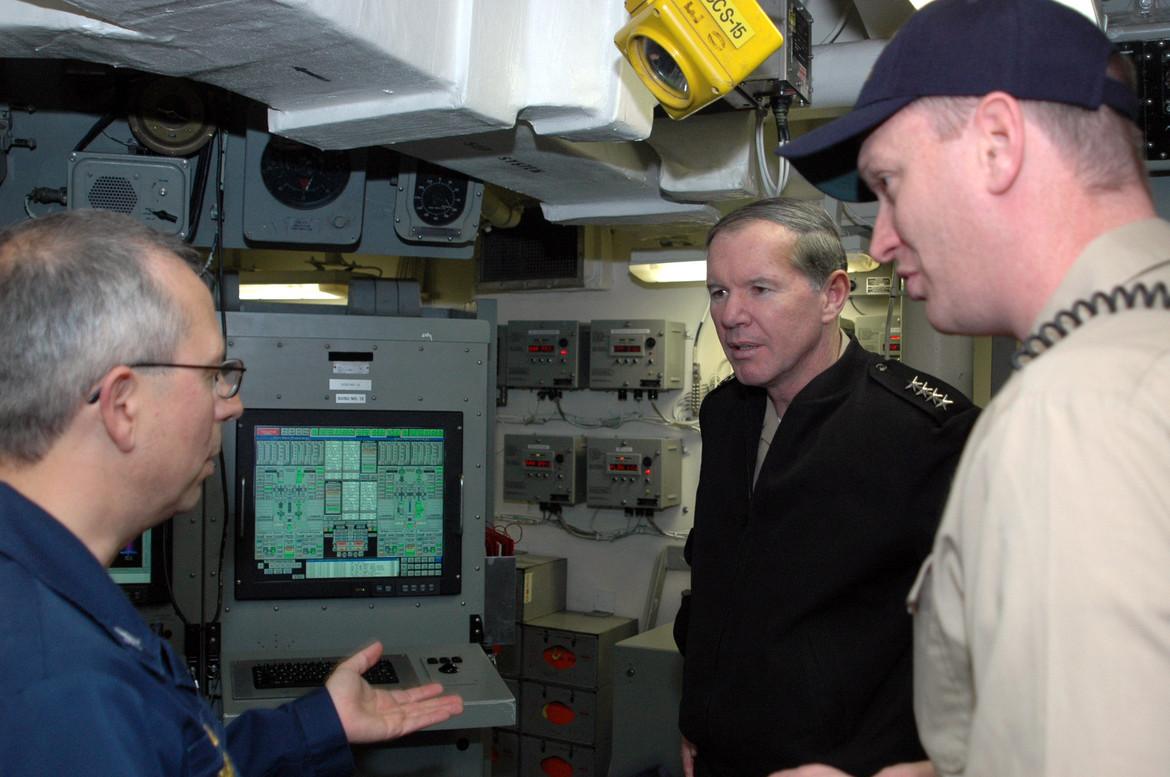
At Constanta on 22 February, sailors and aviation personnel from the ship trained Romanian Navy helicopter pilots in shipboard helicopter operations: search and rescue, salvage and recovery, and fighting an aircraft fire aboard a ship. The ship’s sailors gave classroom instruction on U.S. Navy firefighting and damage-control equipment, and the crash and salvage team performed a simulated aircraft fire drill on the flight deck. The Navy’s account described the Romanian Navy’s helicopter aviation program as just beginning, and presented the training as part of a wider effort to improve maritime safety and security in Europe and Africa.18
The visit announced for Sevastopol was also built around training. The notice from the U.S. Embassy in Kyiv said the ship would exercise with the Ukrainian Navy in boarding and search procedures of the kind used in the NATO maritime patrol known as Operation Active Endeavor, and in combined flight operations. It also listed the ship’s particulars for local readers: commissioned on 23 January 1988, 568 feet long, about 9,600 tons fully loaded, two SH-60B helicopters, and a crew of 35 officers, 27 chief petty officers and about 340 other enlisted sailors.19 The notice was written before the visit, and the record does not describe how it went. Sevastopol was the home of the Russian Black Sea Fleet as well as the Ukrainian Navy. Six years later Russia seized it, and no American warship has called there since.33
She returned to Norfolk on 4 June 2008.5
A rescue in the Bay (2009)
On 27 March 2009 Captain John P. Cordle relieved Captain Sharpe.26 A month later, on 27 April, a fishing boat capsized in Chesapeake Bay. San Jacinto, which was in the Bay at the time, went to help, and her boat crews joined the effort to reach the people in the water. One of them drowned despite it.6
In June 2009, by crew recollection, a chief culinary specialist reported aboard as the first enlisted woman assigned to the ship. Women officers had joined her wardroom earlier in the decade, and by the time one sailor left the ship in August 2010 her enlisted crew was integrated.6, 29 The ship had been all male for twenty-one years, fifteen of them after the law that kept women out of combatants was repealed. On older ships the delay was usually a matter of berthing, since compartments have to be rebuilt before a ship can house both sexes; the record does not say what held up this one.
The pirate coast (2010)
On 21 January 2010, the ship, under the command of Captain John P. Cordle, left Norfolk on a deployment to the Middle East.7 Her task was counter-piracy. She joined Combined Task Force 151, a multinational force that patrolled the Gulf of Aden and the waters off Somalia to protect merchant shipping from pirates.
The piracy problem was then at its height. In the previous two years Somali pirates, in fast skiffs often launched from larger ships that served as bases, had seized dozens of merchant vessels, taken hundreds of hostages and extracted tens of millions of dollars in ransom. The area to be patrolled was vast, and there were never enough warships. A cruiser’s job was to be in the right place, to use her helicopter and her boats to challenge suspicious vessels, and, when she found a pirate boat, to board it, disarm it and, within the legal arrangements of the time, either release the crew or hand them over for prosecution. Coast Guard law-enforcement detachments, which traveled in Navy ships for the purpose, took care of the legal side of such boardings.
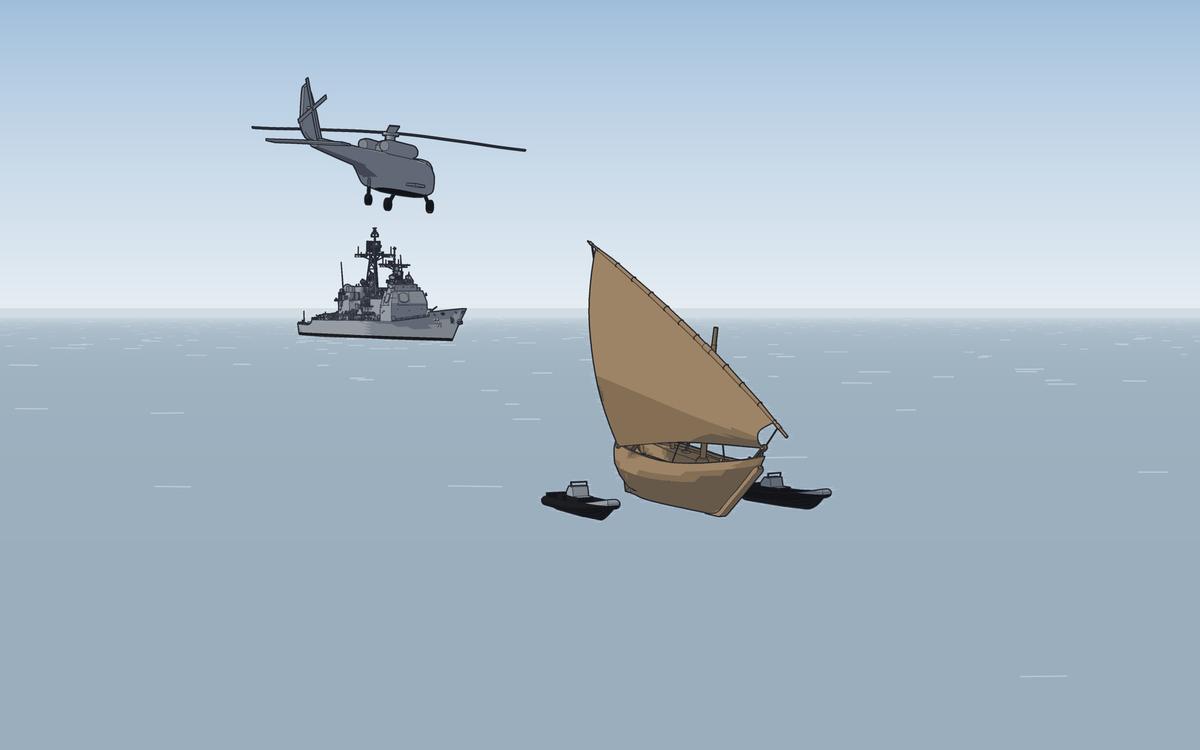
A Navy magazine article on the first five months of the cruise observed that Aegis cruisers were typically thought of as air-defense ships supporting amphibious or expeditionary groups, and said that this ship’s primary duties had changed to support the counter-piracy task force. She carried two rigid-hull inflatable boats, two SH-60B Seahawk helicopters and a trained visit, board, search and seizure team. Her commanding officer described her as a multi-mission ship and an independent deployer, one able to plug into any strike group or task force.20
It was the one deployment of her later life on which she was not tied to a carrier. For seven months the ship that called herself the missile sponge was on her own, hunting men in open boats, and the most important things aboard were not the missiles but two helicopters, two small boats and the couple of dozen sailors trained to go down the side.
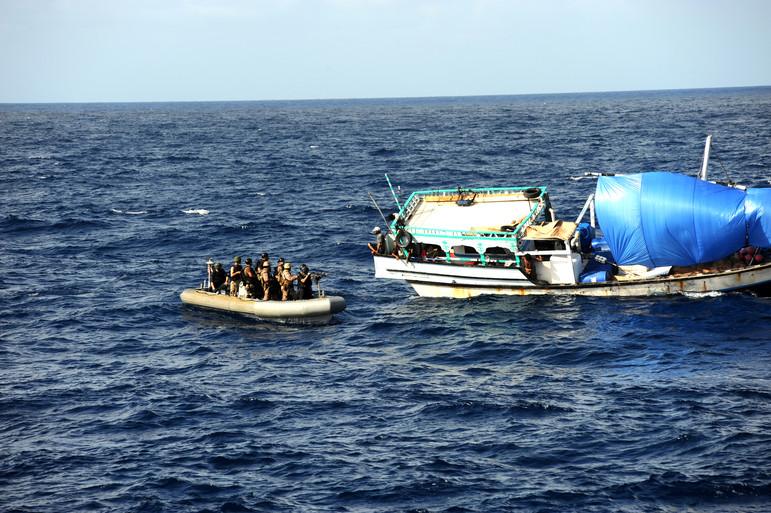
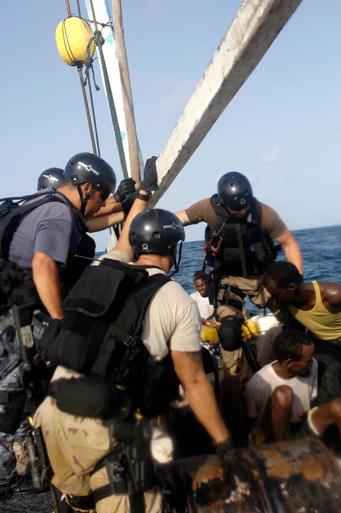
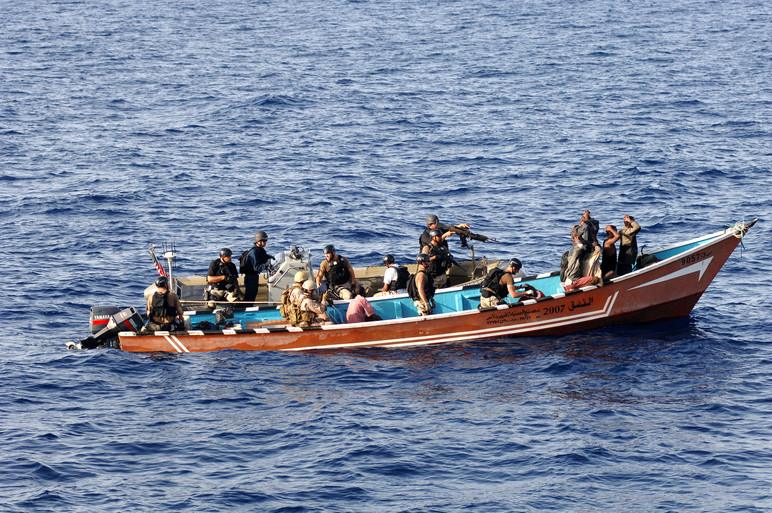
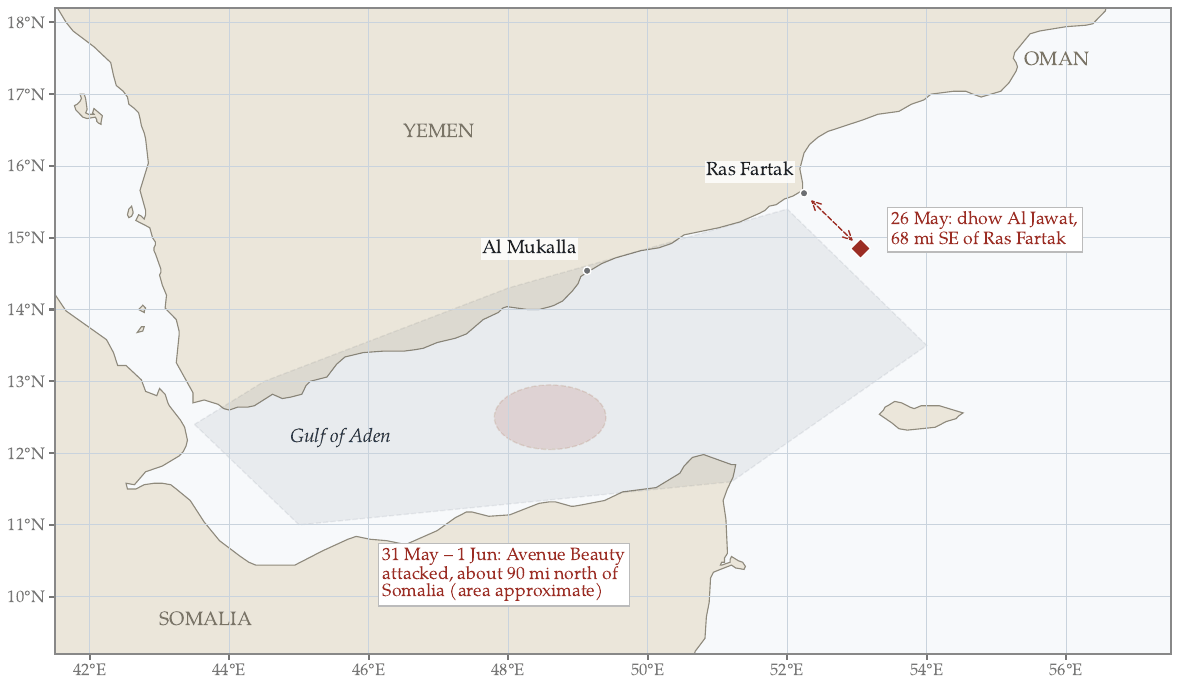
On 26 May 2010 the ship’s boarding team, supported by a Seahawk helicopter with the call sign Proud Warrior 433 and by a Coast Guard detachment, inspected a suspicious dhow, the Al Jawat, 68 miles southeast of Ras Fartak, Yemen, in the Arabian Sea. They found a man hidden aboard, four AK-47 rifles and four rocket-propelled grenades. The dhow’s master told the boarding team that pirates had held his vessel for one day, and he pointed out the men he said were pirates trying to blend in with the crew. They were detained on the dhow without a struggle, and the Yemeni Navy sent a patrol boat from Al Mukalla to take custody of them and to question the crew.8
The Navy’s accounts do not agree on the numbers. The release of 30 May says the master identified thirteen suspected pirates and describes the rescue as one of five Yemeni mariners; a release of 1 June calls the thirteen Somali pirates; the ship’s entry in the Dictionary of American Naval Fighting Ships has the master identifying eight of the thirteen men aboard as pirates.8 The record does not settle whether thirteen men or eight were taken for pirates, or how many of those aboard were the dhow’s own crew. The 30 May release describes the stop as a routine inspection during a counter-narcotics patrol and does not say what the Yemeni investigation found.
A few days later, on 31 May, the ship answered a distress call from the Maltese-flagged merchant ship Avenue Beauty. The merchant vessel, then about ninety miles north of Somalia, had reported an attack by pirates. After hearing gunfire her master sounded the general alarm and ordered counter-piracy measures, and the pirates’ skiff broke off and ran. The cruiser’s Seahawk followed it as it sped south toward the Somali coast, an aircrewman tracked it on radar, and when it would not stop another fired warning shots across its bow and stern. The nine men aboard had thrown their weapons, ammunition and other gear overboard by the time a boarding team, with a Coast Guard law-enforcement detachment, reached the skiff early on 1 June. The team confiscated an engine and several gallons of fuel and released the men in the boat, which left them able to reach shore and limited their ability to attack again.9 The Navy counted twenty-two pirates interdicted by the ship in that week, the nine of the skiff and the thirteen of the dhow. The account of the skiff does not say why the men were released rather than held for prosecution.
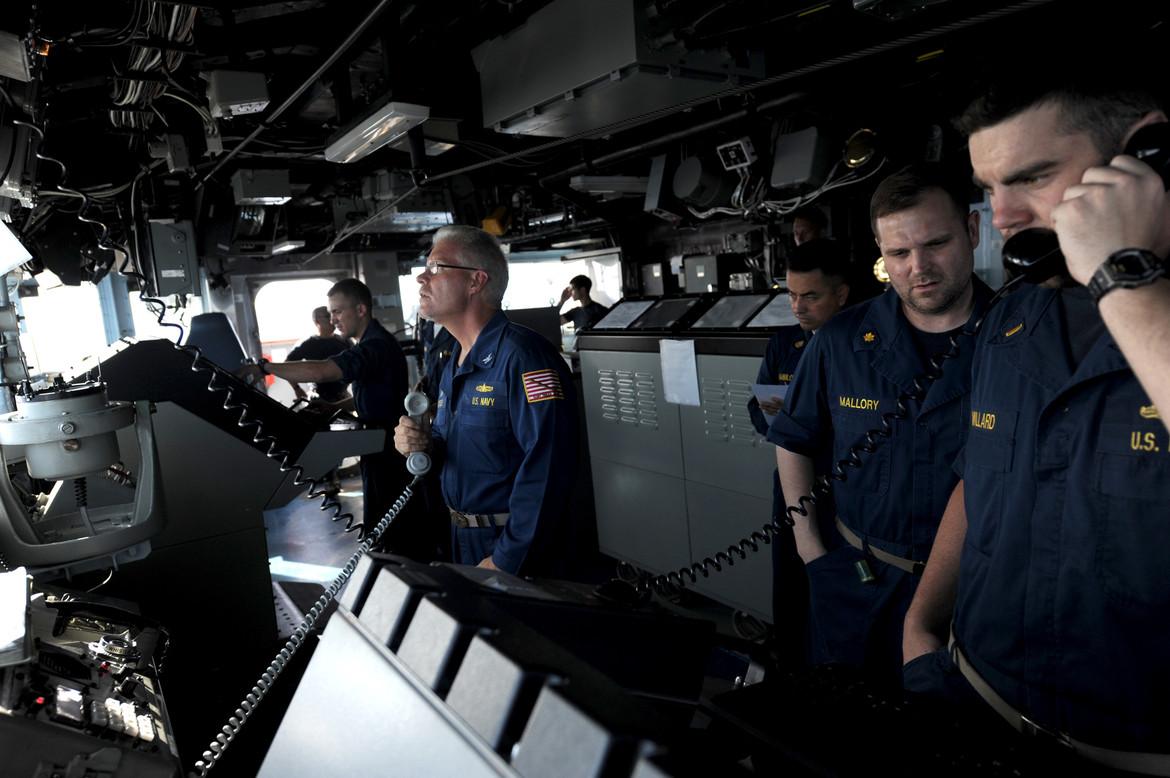
The usual reason, in those years, was that there was nowhere to send them. With the weapons at the bottom of the sea there was little evidence, few countries would take pirates for trial, and a warship could not sail around the Indian Ocean with nine prisoners in her hangar. So the Navy took the engine and let the men go, and both sides understood the arrangement.34
In the photographs that survive, the ship’s visit, board, search and seizure team works alongside foreign sailors, and by one shipmate’s account Jordanians were among them. The team was a small group of sailors, trained apart from the rest of the crew, who went down the ship’s side in boats at all hours with their gear and weapons. An Australian sailor on exchange from the Royal Australian Navy served aboard from February to May.10 A photograph published that July in Proceedings shows the team examining a suspected pirate craft in the Gulf of Aden, in an article that noted that pirate attacks in the region had risen while successful hijackings had fallen.30 Her official biography credits her on the cruise with the apprehension of thirteen pirates and with disrupting attempted boardings of merchant ships.28
Sailors remember other things: the Suez transit in late February, a shellback initiation when she crossed the equator, the 105 sailors who earned their enlisted surface warfare qualification during the deployment, the Battle Efficiency award she won again that year, and a video, shown on the ship’s television at dinner, in which a group of them held the command master chief’s coffee mug for ransom.29 The accounts that survive describe a good cruise, the last deployment before the hard years.
The cruise took the ship to Victoria in the Seychelles, which she left on 14 June, then through the Suez Canal on 18 July with the amphibious ships of the Nassau group, to Alicante, Spain, on 28 July for a five-day visit. Earlier stops included Haifa, Souda Bay, Aqaba, Bahrain, Fujairah in the United Arab Emirates, and Larnaca, Cyprus. She returned to Norfolk on 11 August 2010 after a deployment of nearly seven months.11
A different watch
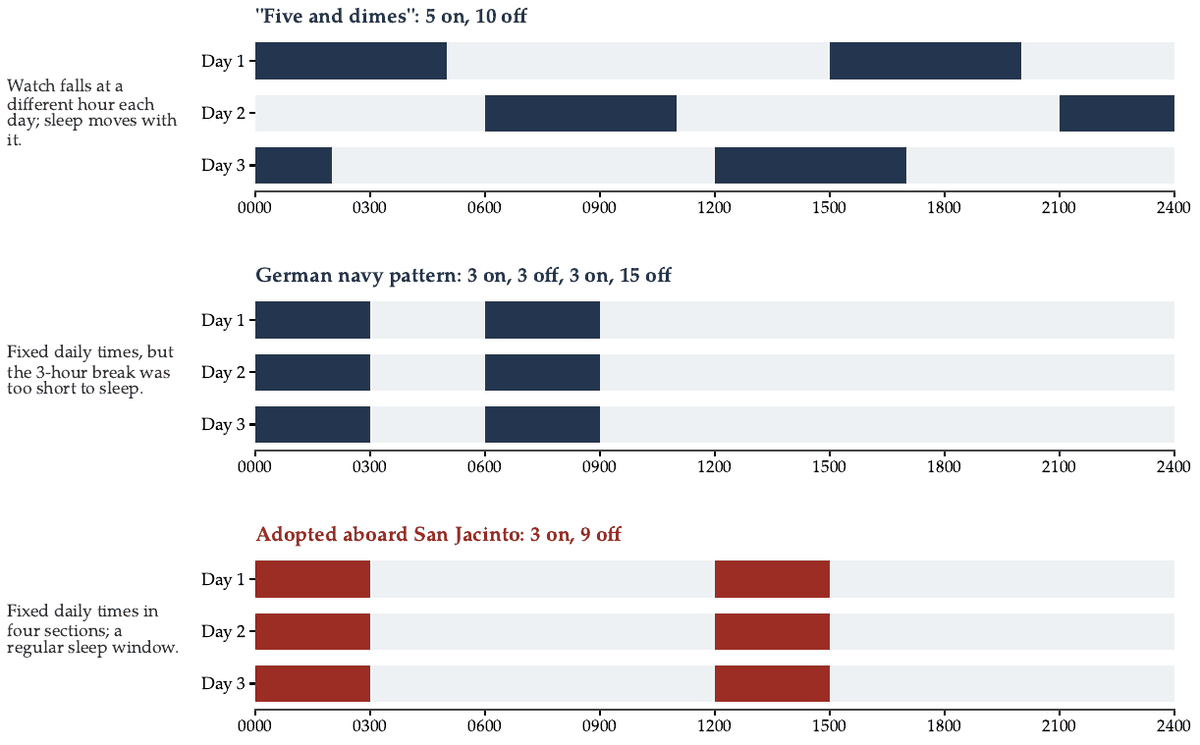
Part of what the crew did on this deployment was unusual for the surface Navy, and it began with the commanding officer. The Navy’s most common watch rotation is known as “five and dimes”: five hours on watch and ten off, a pattern that falls at a different hour each day. A sailor on it is never on the same schedule two days running, and his body never learns when it is supposed to sleep.
Captain Cordle later wrote that he had spent much of his career tired, that long days and three-section watch rotations often left deployed sailors with eighteen-hour days and four hours or less of sleep, and that he had tried and failed to run a “blue and gold” rotation, which splits a crew into two twelve-hour halves, on his earlier command, the destroyer Oscar Austin. With San Jacinto he had more than a year to prepare. The ship’s navigator proposed a rotation used by the German navy, three hours on, three off, three on and fifteen off, which gives each sailor a regular twenty-four-hour day, and it was tried during a month at sea for integrated training before deployment. The crew liked the fifteen hours off, but the three-hour break between watches was too short for real sleep, and the turnovers between watch teams wasted time. At a meeting of the wardroom and the chief petty officers a chief suggested three hours on and nine off, and the ship adopted it.21 The idea that made the watchbill work came out of the chiefs’ mess.
On deployment most of the crew stood watch in four sections on the three-on, nine-off pattern. Divisions that could not support it, the deck department among them, were split into watchstanders on six hours on and six off and day workers, who swapped places every week so that no one kept the worse arrangement. The ship’s routine was bent to fit. By Cordle’s account, sailors with the midnight-to-six watches could sleep in, with the berthing spaces kept dark from 1800 to 0900; quarters, the daily muster, was delayed until 1100; breakfast was early and supper late to fit the watch changes; meetings were held only between 0900 and 1500; and the chaplain offered an afternoon prayer in place of the evening one so as not to wake the watch at taps. He recalled that reveille and taps were no longer passed.21
Cordle’s judgment was that it worked, though not for everyone. He wrote that the watchstanders he observed on the bridge and in the combat information center were alert even long after taps, that stable teams made it easier to train junior sailors, and that engineers, standing short watches in hot spaces, no longer ran up against the heat-stress limits that governed longer watches. The commanding officer of the Surface Warfare Officers School, he reported, wrote that the ship had disproved a teaching that enough rest and recovery from heat could not be had aboard a warship. Not every division could keep the rotation, and acceptance among the crew, he said, was not unanimous.21
Outside the ship the watchbill drew notice. According to Cordle, the ship’s safety officer entered it in the annual shipboard safety award competition, and the ship was selected for the Secretary of the Navy’s award for her class; the account does not give the year. The Naval Safety Center sent the fleet a message recommending that ships consider the rotation, because early indications were that fatigue was much lower than under other watch rotations. The Naval Postgraduate School studied it under Dr. Nita Shattuck, surveying the crew and analyzing the schedule with the Navy’s fatigue-prediction software, and a postgraduate study by a lieutenant produced a guide for commanders who wished to adopt it.21 Cordle received the Navy League’s 2010 John Paul Jones Award for Innovative Leadership and the Navy Bureau of Medicine’s 2010 Epictetus Award for his work on shipboard fatigue, and the article he wrote with Shattuck won the Surface Navy Association’s 2013 literary award at its symposium of January 2014.21, 22
In 2016 the Postgraduate School reported that the vice admiral then commanding the surface force had urged the community to look at the watchbill, that dozens of ships had contacted Shattuck’s team, and that the destroyer Stockdale had begun using a version of it. Cordle told the school that the ship had run the watchbill through a seven-month deployment, which matches the cruise of 2010, and that it rested on three pieces: the circadian watchbill itself, protected sleep time and changed daily routines. His 2016 account puts the hour after which meetings were not held at 1600, where the 2013 article says 1500; in substance the two agree.22
The watchbill outlived its time on the ship that invented it. It left with the captain who believed in it. A year later two destroyers collided with merchant ships in the western Pacific, seventeen sailors died, and the Navy’s own investigations named fatigue among the causes. The surface force then ordered every ship to do what one cruiser had shown could be done in 2010.35
The yard and the new captain (2010)
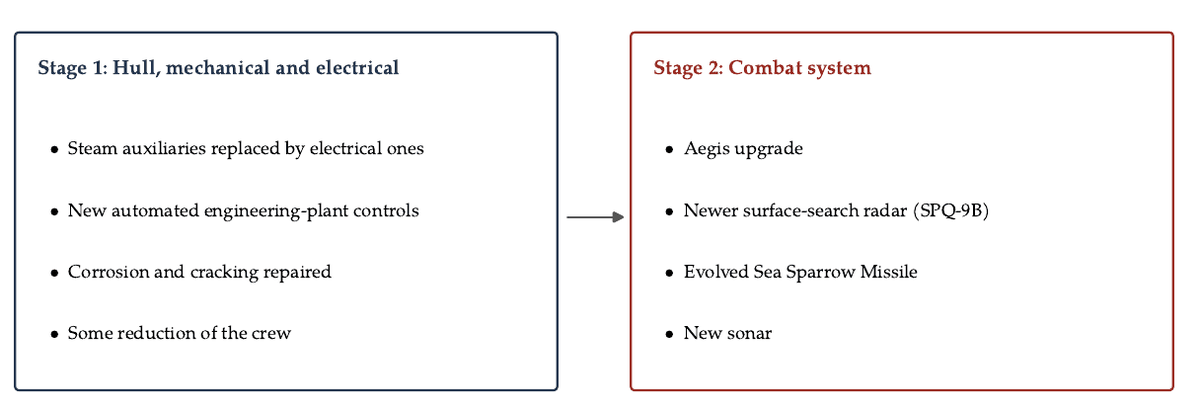
Behind the yard period lay a program that had been running since the middle of the decade. The Navy’s twenty-two remaining Ticonderoga-class cruisers, which were to be kept in service to the age of thirty-five, were to be upgraded in two stages. The first, called hull, mechanical and electrical modernization, dealt with everything except the weapons and sensors: it replaced steam-driven auxiliary machinery with electrical equipment, installed new automated controls for the engineering plant, repaired corrosion and cracking in bulkheads and superstructure, and allowed some reduction of the crew. The second was a combat-system period, with upgrades to the Aegis system, a newer surface-search radar, the Evolved Sea Sparrow Missile, a short-range defensive weapon, and a new sonar. Each stage was a shipyard period of about six months, and the Navy planned to have all twenty-two cruisers through by about 2017 at a cost of roughly $220 million to $225 million apiece.23, 25
A defense magazine’s survey of the program in December 2008 listed San Jacinto, with Leyte Gulf, Philippine Sea and Lake Champlain, as the first four cruisers to have gone through the hull, mechanical and electrical stage since fiscal 2006, and it described Bunker Hill as having done both stages in one period. It gives no dates for San Jacinto’s work.23 A Navy ship-repair solicitation issued in Washington in August 2005 gives a few clues without settling the matter. Among its line items were a dry-docking availability for the ship, scheduled by the Chief of Naval Operations for fiscal 2006, an option for planning work the next year, and an option for a period without dry-docking in fiscal 2008, together with a reference to the ship’s Extended Docking Selected Restricted Availability work package. The dates for each were left blank, and the offer on file was signed by BAE Systems Norfolk Ship Repair; the record does not show which awards followed.24 Neither document says when the ship was in the yard, and the dates and contents of her hull, mechanical and electrical period are not established.
On 13 October 2010 the ship entered dry dock at BAE Systems in Norfolk for a modernization period under the Navy’s cruiser modernization program.12 Whether it was the combat-system stage, a further part of the hull, mechanical and electrical stage or something else is not stated in the record. The Navy’s budget request for fiscal 2011, which began on 1 October 2010, sought money for one cruiser modernization availability, an availability being a period during which a ship is in a shipyard for work; the congressional summary of the request does not name the ship.25 Crew recollection holds that the work included removing the long, slow-rotating SPS-49 air-search radar from the mainmast, which had been the cruisers’ secondary air-search sensor since the 1980s, and replacing the SPQ-9A surface-search and gunfire-control radar with the newer SPQ-9B.12
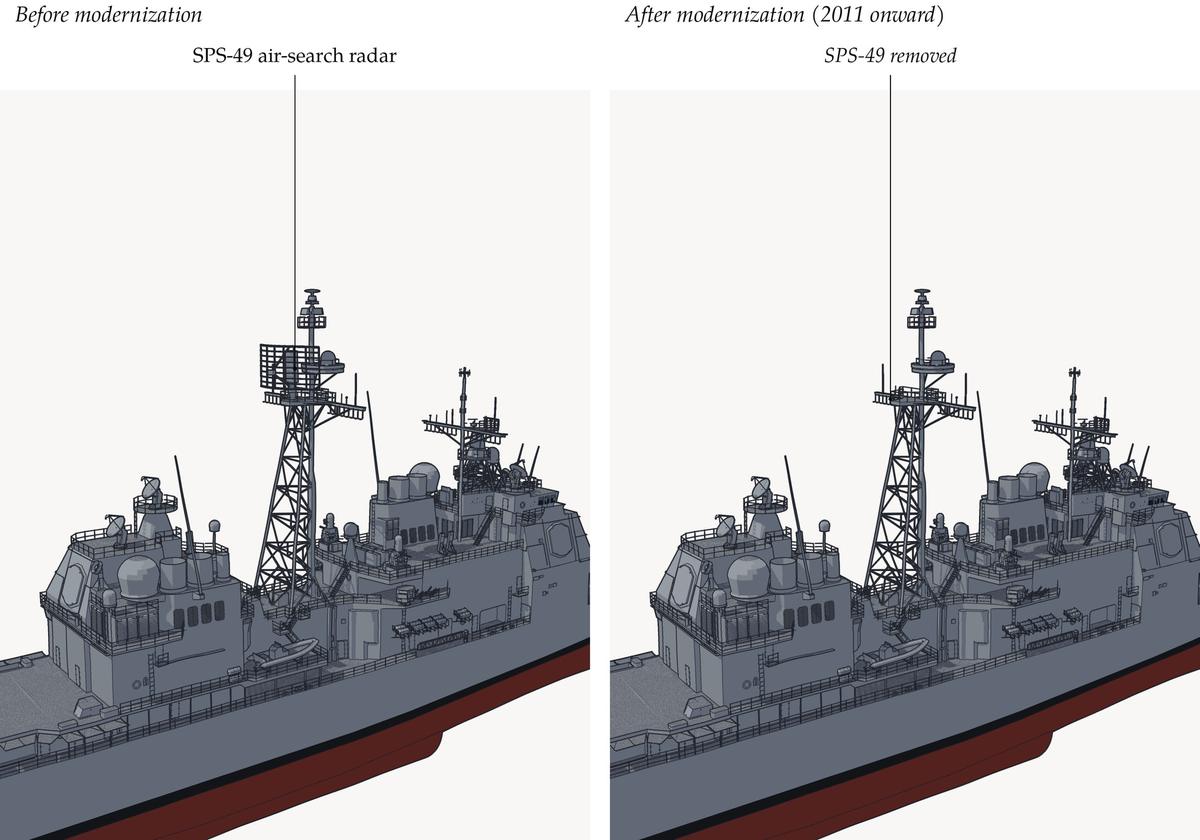
Whatever was done in the yard that winter, the sonar technicians who served in her afterward are clear about one thing that was not. The new sonar the program promised did not reach her, and the hull sonar her crew of 2013 took to sea was the one she had been built with.
On 19 November 2010 Captain Marshall D. Nashold relieved Captain Cordle as the ship’s fourteenth commanding officer.13
Irene (2011)
In late August 2011, with Hurricane Irene approaching the Mid-Atlantic coast, the Navy did what it does in such situations and sent its ships out of Norfolk to ride out the storm at sea. A ship is safer at sea in a hurricane than at a pier, where the storm surge and wind can smash her against the pier or the ships beside her, provided the captain has room to maneuver and the engineers have fuel. San Jacinto left on 25 August and returned on 31 August.14 A sailor from the ship’s forward sonar space, recalling heavy weather at sea in these years, described the ship’s motion as like “an elevator jumping up and dropping down three or four floors at a time.”15
By 2011, a sailor whose job it was to polish the ship’s bell each morning explained to his shipmates, the names of about a dozen children christened aboard had been engraved on it.29 A baby baptized aboard a Navy ship is christened from the upturned bell, and the name is cut inside it afterward. The bell stays with the ship for her whole life.
The last quiet year (2012)
The ship did not deploy in 2011 or 2012, and she was not left at the pier either.
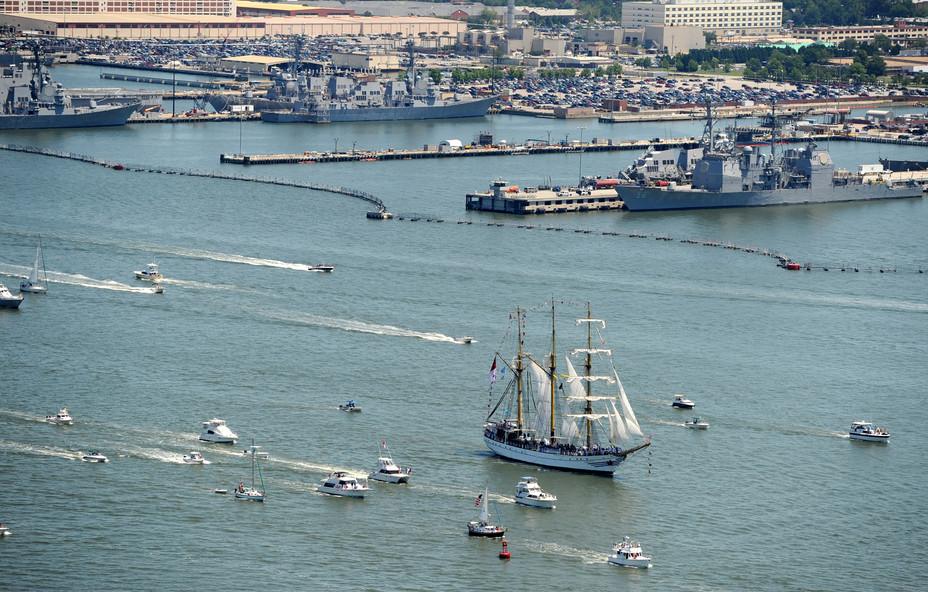
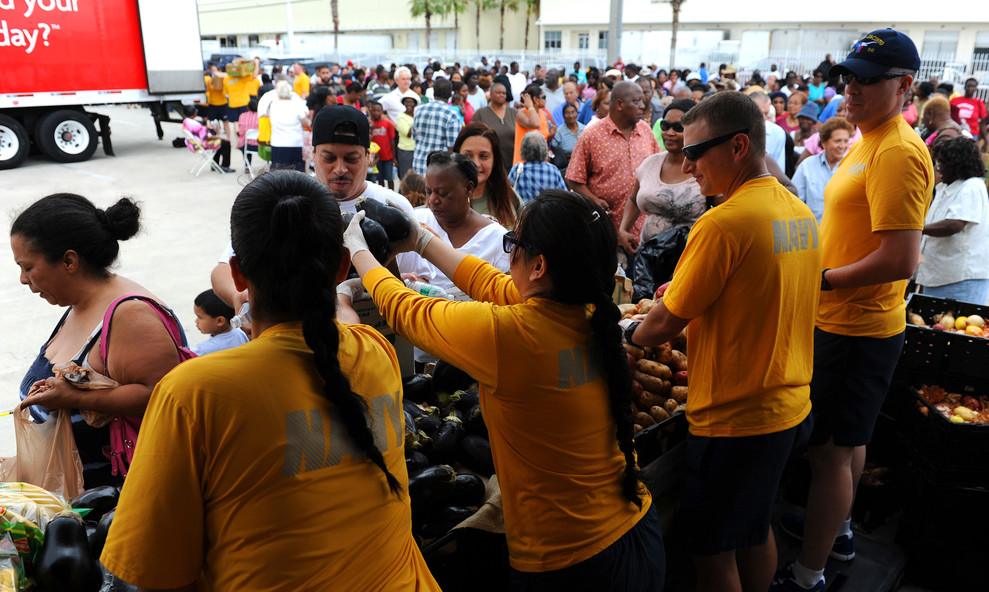
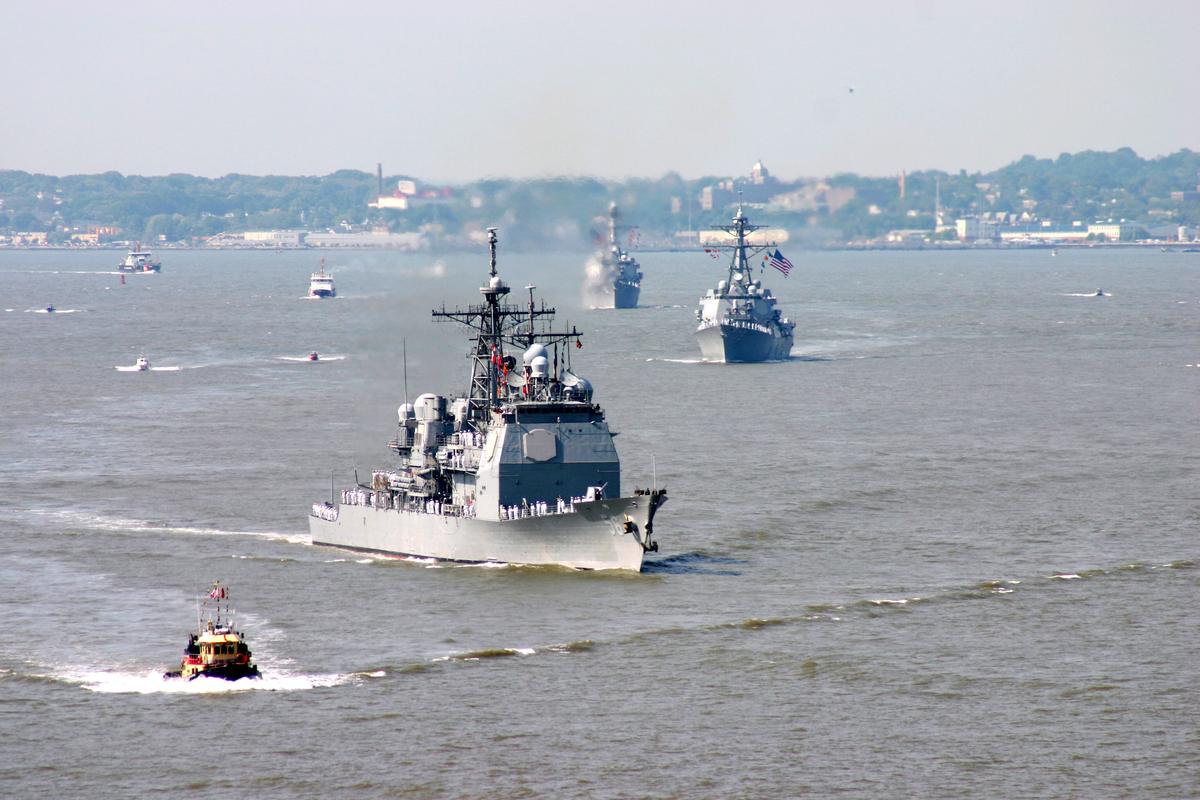
The ship’s 2012 began with the public side of her work. In April she spent five days at Port Everglades for the twenty-second Broward Navy Days Fleet Week. On 23 May she moored at Staten Island for the twenty-fifth Fleet Week New York, which that year marked the bicentennial of the War of 1812, and took part in the Parade of Sail that opened OpSail 2012, the procession of ships up the Hudson River.16 On 27 May, at the pier named for the five Sullivan brothers, she received the last known Pearl Harbor survivor living on Staten Island, a ninety-one-year-old former chief boatswain’s mate who had been in the cruiser St. Louis on 7 December 1941; her executive officer gave him a ship’s ball cap and challenge coin and had him rung aboard with the bell, the honor due a chief boatswain’s mate.31 Navy photographs of May and June show her on the Hudson and then taking on fuel at sea from the amphibious assault ship Kearsarge (LHD-3).16 In July she was at Eastport, Maine, for the Fourth of July.
On 13 August she arrived at Pier 2 at Naval Station Newport, Rhode Island, for a week as school ship for the Surface Warfare Officers School, which sends junior officers to sea in a ship of the fleet to learn the job of running her, and gave tours to its students and staff. On 16 August ten of her sailors, five of them chief petty officers selected that summer, volunteered at an assisted-living home near the base.32 In September, by crew recollection, the new chiefs were pinned.16 On 28 September Captain William McKinley relieved Captain Nashold. On 7 October the ship sailed with the Truman strike group for a group sail, the first of the exercises in which a carrier and her escorts train together before deploying.17
She had a captain nine days in command, a crew short of people in the ratings that kept her picture of the sea, and a combat system older than most of the sailors operating it. Six days later, off the coast of Florida, she collided with a submarine.
Notes
- Chronology of USS San Jacinto (CG-56), uscarriers.net, for the Tailored Ship’s Training Availability of 3 April 2007, Port Everglades on 30 April and New York on 23 May 2007. Fleet Week is described from the general practice of the Navy. ↩
- uscarriers.net chronology for the departure of 5 November 2007; Dictionary of American Naval Fighting Ships (DANFS), vol. III, “San Jacinto”; the 16 November boat assistance is from the uscarriers.net chronology and is not confirmed by the ship’s log. ↩
- uscarriers.net chronology. The Senegalese craft is given there as Matelot Ourmar Ndoye; “Oumar” is the more usual spelling of the name. ↩
- uscarriers.net chronology for the port calls of January to March 2008 and for Captain Sharpe at Constanta on 20 February 2008. The accession of Romania and Bulgaria to NATO in 2004 is general history. The ship’s 1989 visit to Constanta is treated in Chapter 13, where it rests on the cruise book, the Sixth Fleet messages it reprints and crew recollection. ↩
- uscarriers.net chronology, return to Norfolk on 4 June 2008. ↩
- DANFS, vol. III, for 27 April 2009; the circumstances of the capsizing are not given in the sources consulted. The June 2009 arrival of the first enlisted woman is crew recollection, not confirmed by crew lists. ↩
- uscarriers.net chronology for the departure of 21 January 2010 under Captain Cordle. The description of Combined Task Force 151 and of the piracy problem of 2009–2010 is general history. ↩
- DANFS, vol. III, for 26 May 2010. The Navy’s aviation chronology gives the numbers differently (five Yemeni mariners and thirteen pirates); the Navy news releases of 30 May 2010 (Commander, U.S. Naval Forces Central Command Public Affairs; ProQuest document ID 356753292) and 1 June 2010 (Lt. j.g. Kyra D. Lassiter, USS San Jacinto Public Affairs; ProQuest document ID 356790526) give thirteen suspected pirates and five Yemeni mariners, and the figure of eight of thirteen is DANFS’s alone. The text does not reconcile them. The detail of the Avenue Beauty incident (note 9) is from the 1 June release. ↩
- DANFS, vol. III, for 31 May–1 June 2010, including the names and ratings of the two sailors, which were not confirmed against a Navy release. ↩
- Crew recollection and photographs of the 2010 deployment, including the Australian exchange sailor. ↩
- uscarriers.net chronology for Victoria (14 June), the Suez transit (18 July), Alicante (28 July) and the return of 11 August 2010. The earlier ports are from crew recollection and the ship’s deployment history. ↩
- uscarriers.net chronology for the entry into drydock at BAE Systems on 13 October 2010. The radar changes are crew recollection, not confirmed by hull, mechanical and electrical records or combat-system records. ↩
- uscarriers.net chronology for 19 November 2010; the numbering of Captain Nashold as fourteenth commanding officer is from the ship’s command list. ↩
- uscarriers.net chronology, sortie of 25–31 August 2011. ↩
- Crew recollection (an online post by a former sonar technician, describing a heavy-weather passage; the date is not established). ↩
- uscarriers.net chronology for Port Everglades (April 2012) and New York (23 May 2012); Navy photograph captions of May and June 2012 for the Hudson River and the refueling from USS Kearsarge; the chiefs’ pinning of September 2012 is crew recollection. ↩
- uscarriers.net chronology for the change of command of 28 September 2012 and the group sail of 7 October 2012. The ship’s August 2012 service as a training ship at Newport is confirmed by the Navy release cited in note 32. ↩
- Navy news release, “U.S., Romanian Navies Train Together,” by Mass Communication Specialist 2nd Class Chris Henry, 6th Fleet Public Affairs, story NNS080305-01, 5 March 2008 (U.S. Department of Defense Information/FIND, ProQuest document ID 190389198). The training is dated 22 February 2008 in the release. ↩
- “Visit of U.S. Navy Ship,” U.S. Embassy Kyiv release on the call at Sevastopol, Ukraine, carried by US Fed News Service, 3 March 2008 (ProQuest document ID 469509196). It announces a visit for the first week of March; it is a notice written before the event, and no account of the visit itself has been found. The commissioning date and ship’s particulars are as the notice gives them; the notice’s other construction dates are not used. ↩
- MC2 Ja’lon A. Rhinehart, “USS San Jacinto Excels at Counter-Piracy Mission,” Navy magazine, June 2010 (Commander, U.S. Naval Forces Central Command/U.S. 5th Fleet; reprint read from a scanned copy). It dates the deployment to the beginning of 2010 and calls it seven months in length. ↩
- Capt. John Cordle, U.S. Navy, with Dr. Nita Shattuck, “A Sea Change in Standing Watch,” U.S. Naval Institute Proceedings 139, no. 1 (January 2013): 34–39 (ProQuest document ID 1283349256). The account of the watchbill, the routine changes, the results, the safety award, the Naval Safety Center message and the Naval Postgraduate School study is Cordle’s own, as a participant; the article does not date the month of integrated training, and does not name the year of the Secretary of the Navy safety award. The awards of 2010 are from the author note. The article’s remark about crew size is garbled in the copy read and is not used. ↩
- Naval Postgraduate School news release, “NPS Professor Dr. Nita Shattuck Honored With Surface Navy Association’s Literary Award,” Targeted News Service, 23 January 2014 (ProQuest document ID 1491412543; award presented 15 January); Naval Postgraduate School news release by MC2 Michael Ehrlich, “Navy’s Use of Sleep-Optimized Watchbill Continues to Rise,” Targeted News Service, 22 June 2016 (ProQuest document ID 1798947387). Cordle’s August 2016 Proceedings article “Go to ’27-Section Duty’” concerns a different ship and is not used. ↩
- Otto Kreisher, “Service-Life Extensions: Navy modernization program keeps Aegis cruisers, destroyers in the mix,” Sea Power, December 2008, special report on surface warfare and information technology. The cost, schedule, program content and ship list are the magazine’s account of the Navy’s plans as of late 2008. ↩
- Naval Sea Systems Command, Solicitation, Offer and Award, contract N00024-06-C-4415, solicitation 0002, issued 22 August 2005, offers due 16 December 2005 (line items for the San Jacinto dry-docking availability of fiscal year 2006, execution planning for fiscal year 2008, and a fiscal year 2008 availability without dry-docking; Attachment J-1 listing a “CG 56 EDSRA Definitized Work Package”). Start and completion dates are blank in the copy read, and no award document has been found. ↩
- Congressional Research Service, Navy Aegis Cruiser and Destroyer Modernization: Background and Issues for Congress, RS22595 (updated 18 January 2011): 22 cruisers and 62 destroyers, about $16.6 billion in fiscal 2010 dollars, average about $220 million per cruiser, 35-year planned service life, the first five cruisers removed from service in 2004–2005, and the fiscal 2011 request for one cruiser modernization availability. ↩
- Commanding officers and their dates: NavSource Online, cruiser photo index for CG-56 (archived 23 May 2025), list of commanding officers: Matthew M. Sharpe, 10 May 2007 to 27 March 2009; John P. Cordle, 27 March 2009 to 19 November 2010; Nashold (given there as Douglas Marshall Nashold), 19 November 2010 to 28 September 2012; William McKinley, from 28 September 2012. ↩
- U.S. Government Accountability Office, Military Readiness: Navy Needs to Reassess Its Metrics and Assumptions for Ship Crewing Requirements and Training, GAO-10-592 (June 2010): “What GAO Found” (enlisted requirements down about 20 percent and crew sizes about 16 percent on cruisers and destroyers, fiscal 2001–2009; in-port workload reported as increasing) and the scope and methodology (the eleven ships visited, including San Jacinto). The report’s findings are about the classes, not this ship. ↩
- The ship’s official biography, as reproduced on the Seaforces data sheet for USS San Jacinto (CG-56): the 2007–08 deployment through the Mediterranean and Black Sea; on the 2010 deployment, anti-piracy operations, the apprehension of thirteen pirates and the disruption of attempted boardings. ↩
- Crew recollection: a sailor’s New Year 2008 at Lisbon; women officers in the wardroom before 2009 and an integrated enlisted crew by August 2010; the 2010 Suez transit (about 25 February), shellback crossing, 105 enlisted surface warfare qualifications, the 2010 Battle Efficiency award and the coffee-mug video; the bell engraved with the names of children christened aboard, described in 2011. The Battle Efficiency claim is not confirmed by a Navy list (see Appendix D). ↩
- Edward H. Lundquist, “The Entire Indian Ocean Is Up for Grabs,” U.S. Naval Institute Proceedings, July 2010, photograph caption and text. ↩
- “Staten Island Pearl Harbor Survivor Visits Fleet Week,” Navy release, US Fed News, 29 May 2012 (visit of 27 May 2012 at The Sullivans Pier). ↩
- Bob Krekorian, “USS San Jacinto Sailors Volunteer at Group Home During Port Visit,” Navy release NNS120817-23, Naval Station Newport Public Affairs, 17 August 2012. ↩
- Russia’s seizure of Sevastopol in 2014 and the absence of U.S. Navy port calls since: source needed. unconfirmed ↩
- Why suspected pirates were commonly released in 2010 (lack of evidence once weapons were jettisoned; few states willing to prosecute): source needed (CRS or a Combined Maritime Forces account). The text gives it as the usual reason, not as the documented reason in this case. unconfirmed ↩
- The 2017 collisions (Fitzgerald and John S. McCain), the Navy’s findings on fatigue and the surface force’s later circadian-watchbill direction: source needed (the Navy’s Comprehensive Review, 2017; a surface-force instruction). “A year later” counts from the 2016 Postgraduate School report. unconfirmed ↩