Part Five: The Middle Years (2007–2012)
Chapter 1913 October 2012
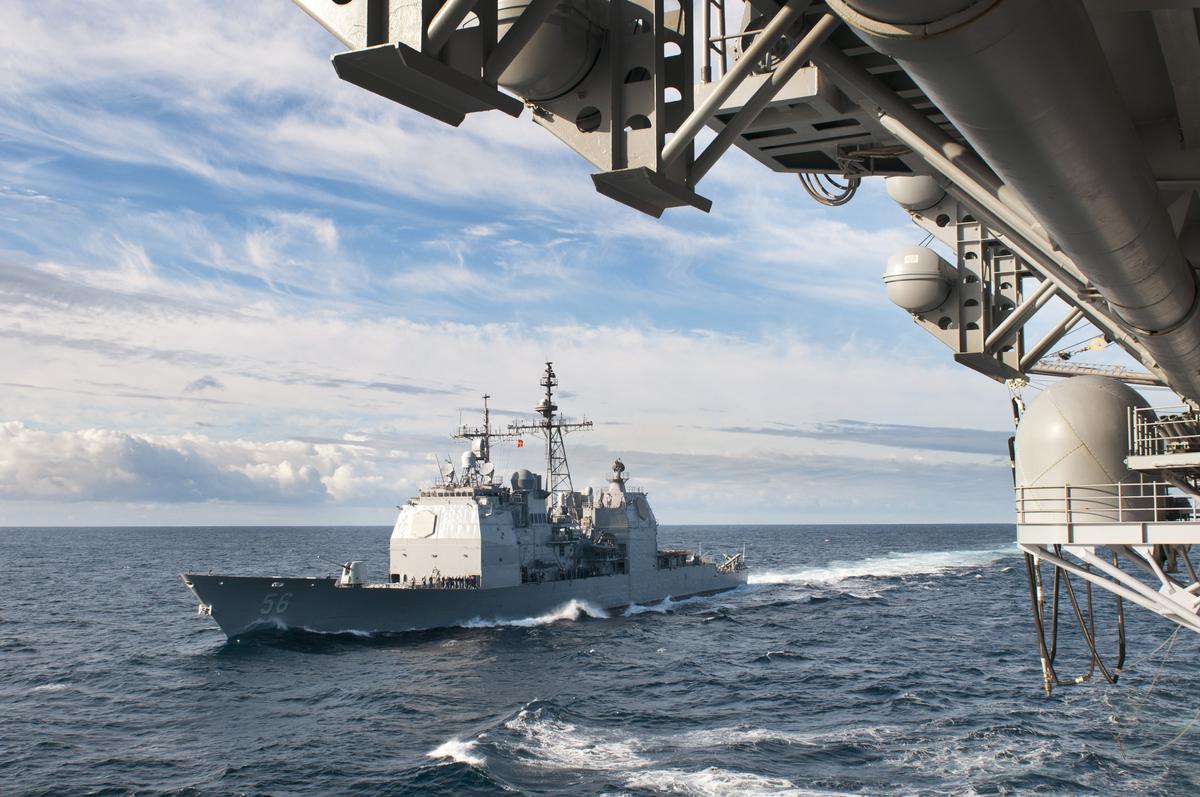
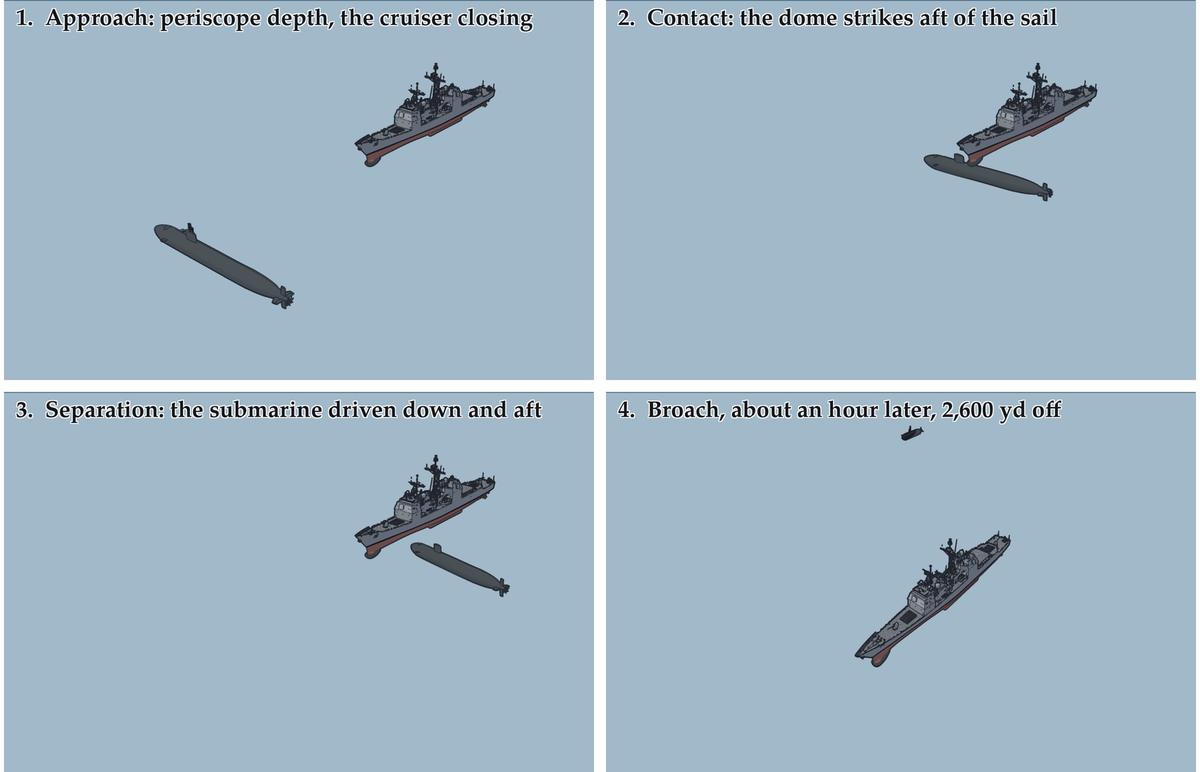
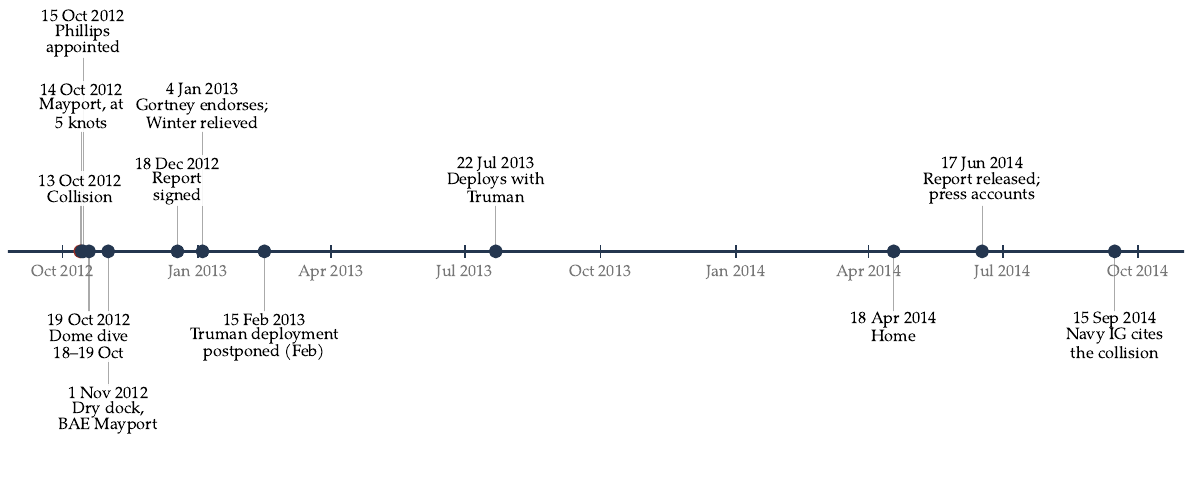
On the afternoon of Saturday, 13 October 2012, USS San Jacinto was off the coast of northeast Florida, running at nearly twenty knots across a six-foot sea to catch up with an aircraft carrier. A few miles away the nuclear-powered attack submarine USS Montpelier was rising toward periscope depth to take a look at the same carrier. At 3:27 p.m. the two collided. The cruiser’s bow struck the submarine aft of her sail and then on her rudder, hard enough to tear it loose, and the big sonar dome beneath the cruiser’s bow split open against the submarine’s hull. No one on either ship was hurt. It was the worst afternoon in the ship’s record.
Two days later U.S. Fleet Forces Command appointed Rear Admiral Ann C. Phillips to investigate. She was a surface officer who had commissioned and commanded the destroyer Mustin (DDG-89) and had led Destroyer Squadron 28, and she was then commander of Expeditionary Strike Group Two.61 Her report, signed on 18 December 2012, runs to 167 pages in its released form: the chain of endorsements, an executive summary, more than a hundred pages of findings of fact, a short account of the damage, her opinions and her recommendations, and an index to the evidence. There are more than a thousand numbered findings. The interview transcripts and the rest of the evidence were not released. The Navy made the report public in June 2014, more than a year after news organizations had asked for it, with most names removed and the billets left in.1, 62
This chapter is written from that report. Where it gives a time, a range, an order or a sentence somebody said, the report is the source unless a note says otherwise, and where the report is blacked out the chapter says so. The report has one large gap of its own, which its author pointed out. The submarine carried an “open mic” system that recorded the voices in her control room, and the investigators used it to rebuild her last minutes almost second by second. The cruiser had nothing like it. Surface ships were not built with a bridge voice recorder, and the equipment that should have recorded San Jacinto’s internal combat nets, including the net the captain and the officer of the deck spoke on in the last seconds, was not working. What was said on her bridge is known only from what the people who were there told the investigators afterward.67
A ship’s long exam
By the autumn of 2012 San Jacinto was twenty-four years old, which in a warship is middle age. She had fired the first Tomahawk missiles of Operation Desert Storm, deployed to the Mediterranean, the Adriatic, the Persian Gulf and the Atlantic coast of Africa, and hunted pirates off Yemen. She was a unit of Carrier Strike Group Ten, built around the aircraft carrier USS Harry S. Truman, and she was based in Norfolk, Virginia. She was also doing what a cruiser does in the months before a deployment: working up.
A strike group is the Navy’s basic package of sea power. At its center is an aircraft carrier, which carries the air wing, the dozens of aircraft that are the group’s principal means of attack. Around the carrier are escorts, cruisers and destroyers, whose job is to defend her from attack by aircraft, missiles, surface ships and submarines. A submarine is the greatest danger to a carrier, because it is quiet, hard to find, and can fire from beneath the water without warning, and so a large part of what the escorts do is search for submarines and keep them away. The escorts form a “screen,” a ring or arc of ships around the carrier at distances of several miles, each ship covering an assigned sector with its sonar, radar and helicopters.
Before any such group deploys, the Navy puts it through a cycle of training and certification known as the work-up. For months the crews must prove, in a prescribed order and in front of graders, that they can do what they will be asked to do: steam, shoot, communicate, fight fires, fight submarines, fight aircraft. The final examination, for a strike group, is a month-long exercise called COMPTUEX, the Composite Training Unit Exercise, in which the whole group fights a simulated war against opponents played by other Navy units. Before it comes a quieter phase called a group sail, in which the ships, the carrier and her air wing go to sea together for the first time with no graders aboard, to discover in private what they cannot yet do. The purpose of a group sail is to make mistakes where it is cheap to make them. This one was not cheap.
The Truman group’s group sail was under way in October 2012 in a training area called the Jacksonville Operating Area, which the Navy uses for exercises off Florida.11 The investigation and the ship’s own records keep time in Zulu, which is Coordinated Universal Time, the same clock everywhere in the world. On 13 October the ship’s clocks were four hours behind it, so 1927 Zulu was 3:27 in the afternoon aboard.
Fifteen days before the collision, on 28 September, Captain William P. McKinley had relieved Captain Marshall D. Nashold as commanding officer.2 McKinley was a destroyer officer; his previous command had been the destroyer USS Mitscher (DDG-57), and he had never served in a Ticonderoga-class cruiser. None of that was unusual or improper. The Navy moves officers between ship types all the time, and the strike-group commander later told the investigators that he had been impressed, at a conference of the group’s warfare commanders in the last two weeks of September, by how well the new captain knew his ship.2 The group sail was also the new captain’s first time at sea in command of the ship: crew members who were aboard remember that he had taken over only a few days before she got under way, and the first time he took San Jacinto to sea as her captain was for the Truman group’s work-up. A change of command in the days before a group sail means that the commanding officer is learning the ship while the ship is being tested in his hands. The executive officer, the captain’s second in command, had reported in May from the destroyer USS Mahan, and had served earlier as a junior officer in the cruiser USS Gettysburg.3
The ship’s watch bill, the list of who stands which watch, put the navigator in charge of the bridge that afternoon. The officer of the deck is the officer who, at any given moment at sea, is responsible to the captain for the safe navigation and handling of the ship; he directs the helmsman and the other watchstanders on the bridge and is the person to whom lookouts report what they see. The officer of the deck on San Jacinto that afternoon was her navigator, a department head who had come into the Navy as an enlisted electronics technician, risen to chief petty officer, been commissioned, and reported to the ship in June 2010 on his first ship as an officer. He had become navigator in December 2011, had earned his surface warfare officer’s pin in May 2012, and had been a qualified officer of the deck for about a year. The report describes him as one of the ship’s better officers of the deck.4
In the ship’s combat information center, the CIC, sat the tactical action officer, who fights the ship from the CIC when the captain is not directing the fight himself. (The CIC is the windowless, dimly lit compartment where radar, sonar and radio information come together on consoles and large displays; it is where a warship’s fight is conducted, and a ship’s captain spends much of an exercise there.) The tactical action officer held an interim qualification, granted by the previous captain, which the new captain had decided to keep interim until he had watched her on more watches. The ship’s CIC officer, a limited duty officer whom the captain described as very good, had been lent to the destroyer USS Gravely for most of the group sail.4
It was a ship in transition: a new captain, a navigator standing watch on the bridge, an interim-qualified tactical action officer, and an experienced CIC officer working on someone else’s ship. None of those facts was a failing in itself. Together they meant that almost nobody in a key seat that afternoon had held it for long.
Between July and September the ship had been through the first block of the work-up, called the Basic Phase, in which each ship is trained and tested by itself. Her anti-submarine certification was dated 20 July, and during the phase she had worked against a live submarine on the Navy’s instrumented range in the Bahamas. She had completed the phase on 4 September, later than planned, delayed by equipment casualties, by other tasking and by her own proficiency.68 The assessment group’s completion report, which the investigation quoted, was not flattering. In maintenance, more than a quarter of the spot checks had failed, and four of the ship’s six departments had failed their department-level scores. A radio-circuit casualty had held up her certification in communications. And in anti-air and surface warfare, her proficiency had been “very weak” on the first attempt at a key event, with the team’s cohesion, and its ability to fuse data from many sources into a single picture, found lacking.5
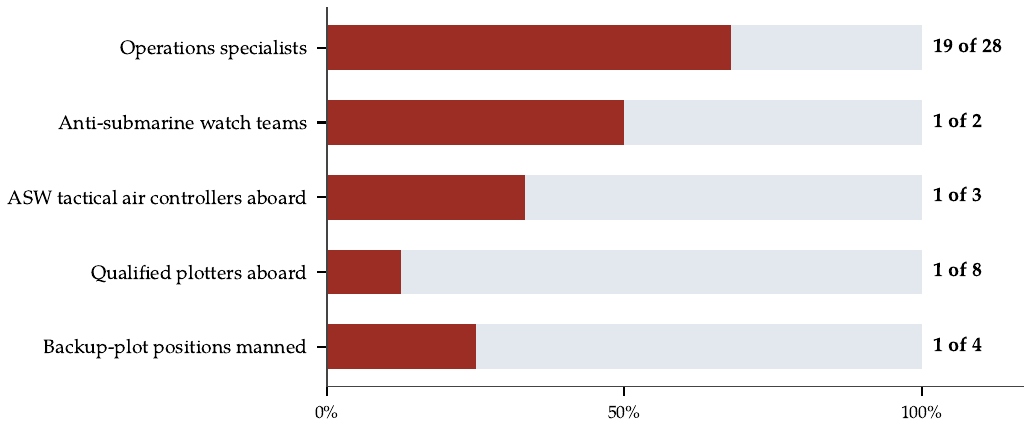
Beneath those results lay a more stubborn one. The ship was short of people, and the shortage was concentrated in the places where the afternoon of 13 October would need them. The investigation counted 19 of the 28 operations specialists the ship was supposed to have. Operations specialists are the sailors who run the CIC: they plot contacts, track aircraft and ships, and maintain the picture on which every decision in a fight depends. With so few, the ship could not put a qualified watch supervisor in the CIC and was restricted in what other stations it could man. Her two operations specialist chiefs were also her only anti-submarine air controller and her only air-intercept control supervisor, the captain said, and so were seldom free to supervise the CIC. The ship had told the Bureau of Naval Personnel in August, in the formal message a ship sends when a manning gap is hurting her, and was waiting. This was optimal manning as it looked from inside one ship. On paper the Navy had cut its cruiser crews by about a sixth over the decade. In the one rating this afternoon depended on, the ship was short by a third.6
The Navy’s own instruction required two complete anti-submarine watch teams, and the ship had manned two to earn her certification in July. By October she could field one. Of three anti-submarine tactical air controllers, the people who direct helicopters hunting a submarine, only one was aboard, and that afternoon nobody was manning the position. Of eight qualified plotters, one was aboard, and three of the four plotter positions that feed the ship’s backup plot were empty. The ship had signed watch bills for her ordinary steaming and battle conditions, for underway replenishment and for streaming her towed gear, and none for a second anti-submarine team. The captain, asked about it, said he knew he had two anti-submarine warfare evaluators aboard but could not say how good they were. He also said that after the Basic Phase the ship had lost key watchstanders to transfer and had “slipped back” in her training. His summary of the ship’s condition became the most quoted sentence in the report’s treatment of the ship: she could do one thing at a time well, he said, but had trouble doing more than that.7
| Equipment | Condition |
|---|---|
| Gas turbine 2A | Undiagnosed casualty |
| Oily-water separators (both) | Out of commission |
| Fire pumps (two) | Out of commission |
| Collection, holding and transfer pump | Out of commission |
| Countermeasure washdown group | Out of commission |
| Bleed-air system | Regulating valve chattering; no casualty report or log entry; secured except for turbine starts, so Prairie and Masker were off |
| AN/SQR-19 towed-array processor | Memory and power faults; under repair when the collision occurred |
| AN/SQS-53B hull sonar | Working, but active on a single frequency to avoid the helicopters’ dipping sonars |
Source: Chapter 19 (Phillips investigation, findings of fact).
The investigators did not leave it at bad luck with transfers. Their opinion was that manpower shortfalls and “inadequate management” of them, with no aggressive effort to qualify replacements, had left the ship operating below the level her July certification implied, and that her executive officer, her senior watch officer and her CIC and anti-submarine teams should have been better prepared for what the exercise turned out to be. It had taken the captain’s own presence in the CIC, after the exercise had started, to get the watch team fully onto it.69
A cruiser in 2012 was meant to do several things at once. That was what the Aegis combat system had been built for in the 1970s and 1980s, to let a ship track and engage dozens of targets at the same time, and it is why a ship that could do one thing at a time well was, by design, working at a disadvantage.
The material picture was no better. Among the engineering equipment out of commission when the ship went to sea that day were one of her four gas turbine engines, the number two A, with an undiagnosed casualty; both oily-water separators, which treat the water in the bilges before it can be pumped overboard; two fire pumps; a collection, holding and transfer pump; a countermeasure washdown group; and, most important for what followed, the bleed-air system. The report states the maximum speed she was capable of that day and blacks out the number.8
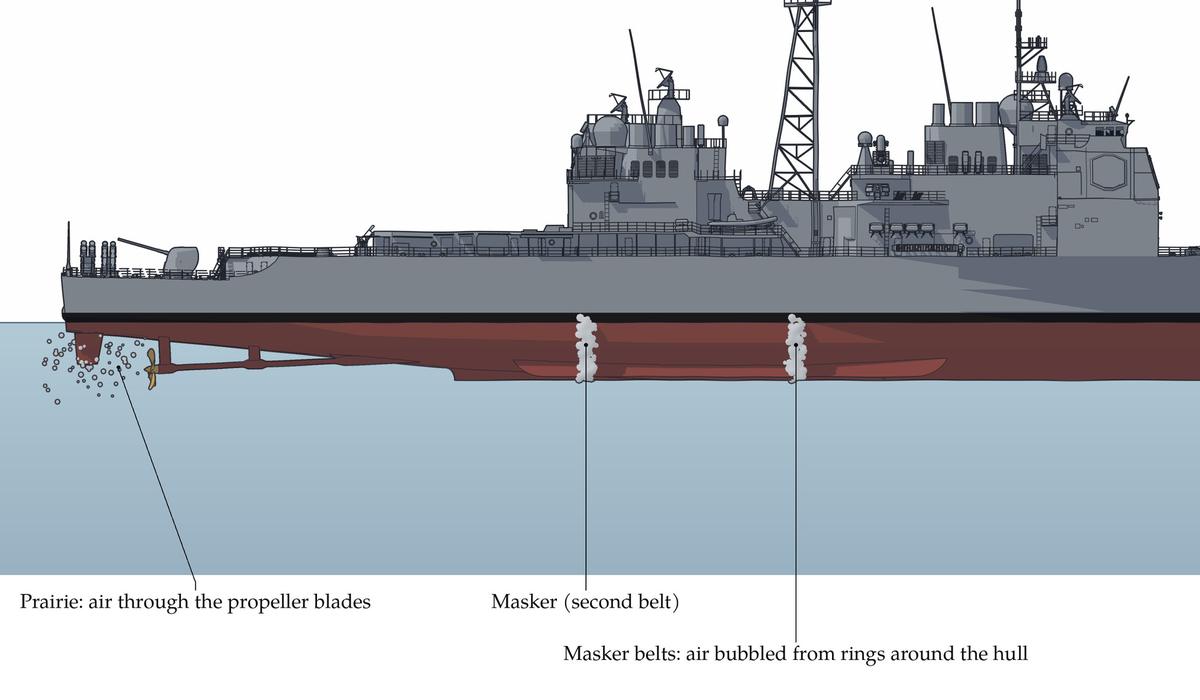
Bleed air matters in an anti-submarine exercise because of what it feeds. The gas turbines that drive a Ticonderoga-class ship produce compressed air, and some of it can be tapped off, or bled, and blown out through perforated belts around the hull and through the propeller blades. The air leaves a curtain of fine bubbles around the ship. The Navy calls the two systems Prairie and Masker. They reduce the noise the ship sends into the water, so that an enemy submarine’s sonar hears less of her and, just as much to the point, her own sonar hears more. A ship making a great deal of noise cannot hear.
A regulating valve in the bleed-air system had been chattering. No casualty report had been written, and there was no log entry. The engineering officer of the watch knew about it and, on his own judgment, had left the system secured except while starting turbines. So on 13 October, while a submarine hunted a carrier and her escorts and a group of ships tried to hunt the submarine, San Jacinto’s Prairie and Masker were not running.9
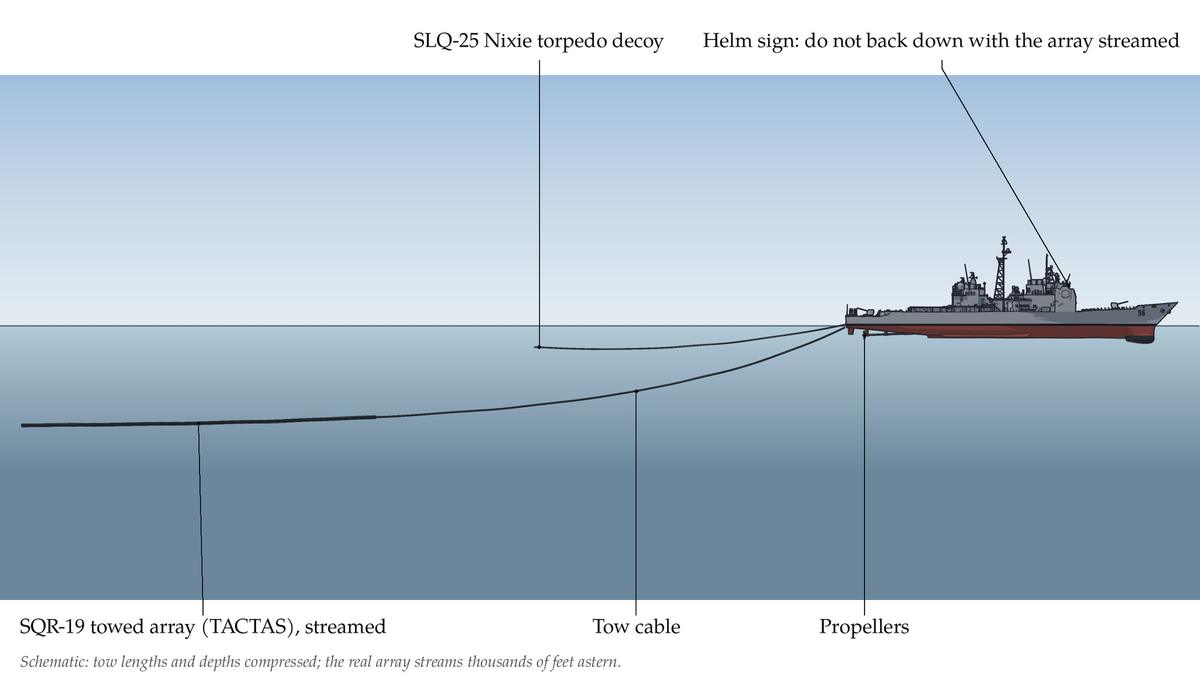
There was one more limit, in the sonar. A ship hunts submarines with sonar, which finds objects under water by sound. Active sonar sends out a pulse, the familiar ping, and listens for the echo. Passive sonar sends nothing and listens for the noise a submarine makes. San Jacinto carried two systems. The AN/SQS-53B, a large hull-mounted sonar in the dome beneath her bow, could work either way. The AN/SQR-19 was a towed array, a long cable of hydrophones, or underwater microphones, streamed far behind the ship so that it could listen away from the noise of her own engines and propellers. Shortly before the exercise began, the towed array’s processor suffered a memory fault and a power fault that kept it from handling the array’s acoustic data, and two sonar technicians were still working on it when the collision occurred. The hull-mounted sonar was running in an active mode, at the commodore’s direction, but on a single frequency, so as not to interfere with the destroyer’s sonar and the dipping sonars that the helicopters lowered into the sea.10 A surface ship is a poor place to listen from on her best day, and this was not her best day.
The exercise
The group sail had been planned, replanned and compressed. By the schedule in the investigation’s findings of fact it ran from 1 to 25 October; the executive summary gives 2 to 20 October, and the ship’s own chronology records a group sail beginning on 7 October. Behind all of the dates lay three months of revisions that the investigation described as an “accelerated and compressed” training phase, a group hurrying from one commitment to the next, with COMPTUEX and then a deployment ahead of it.11
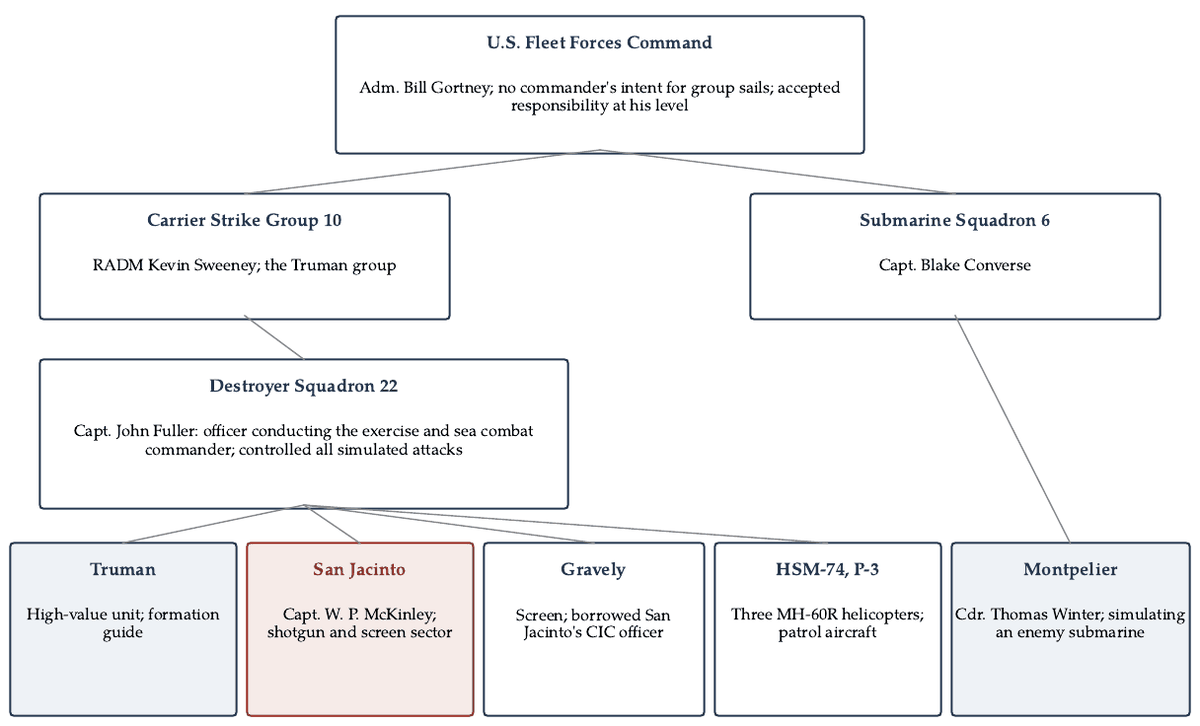
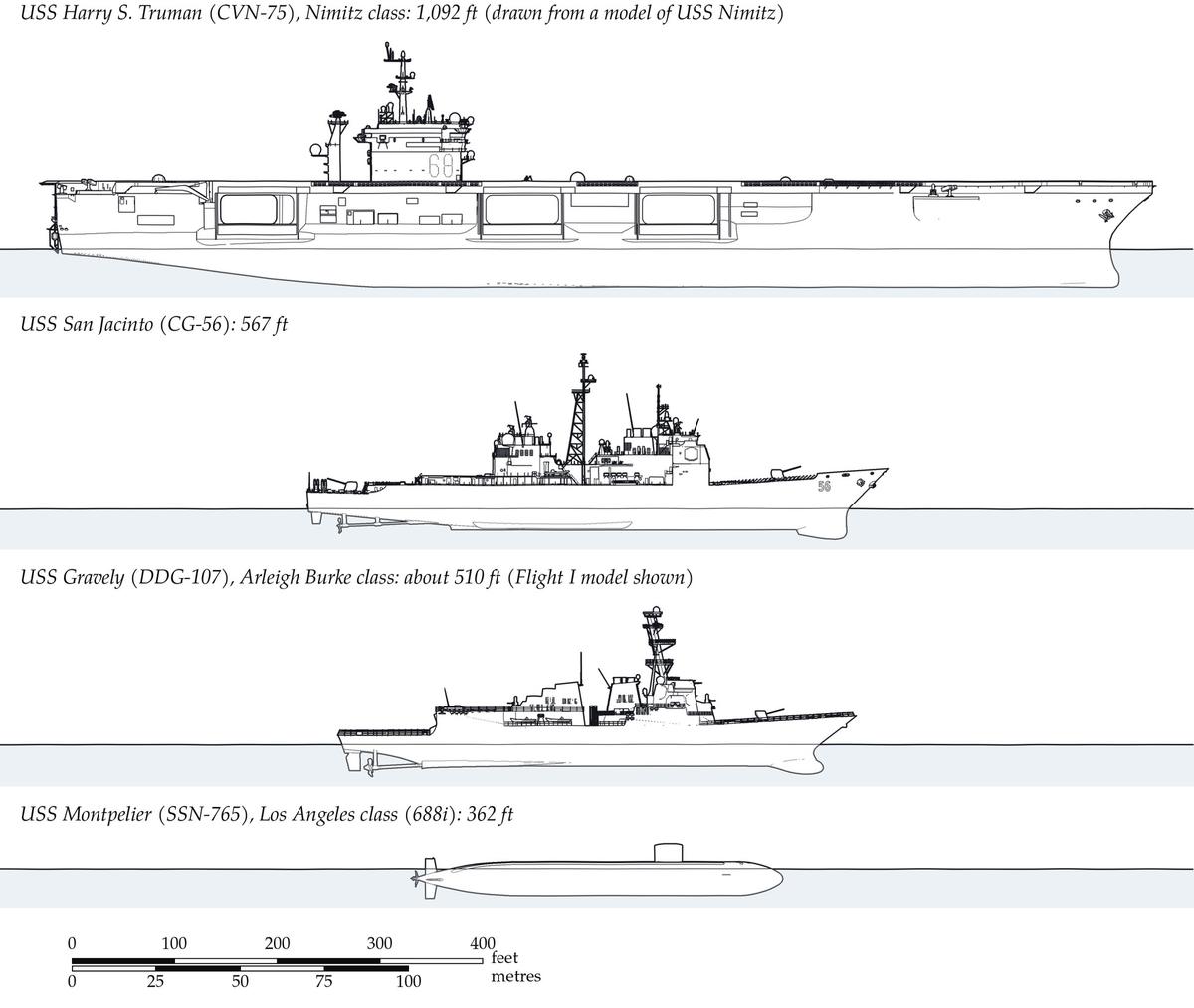
The event on 13 October was the Navy’s Anti-Submarine Warfare Exercise 13070, the second anti-submarine event of the group sail and the first with a live submarine. It was also the first live anti-submarine event for San Jacinto under her new captain. It was a “free play” exercise, in which a submarine plays the enemy and tries to get at the carrier, while the ships and aircraft of the screen try to find it first. Free play means that the players are not following a script. The commodore of Destroyer Squadron 22 was the officer conducting the exercise. In its design the Truman was the “high-value unit,” the ship the submarine was supposed to attack. San Jacinto and Gravely would take defensive positions between her and the submarine, backed by a P-3 patrol aircraft and three MH-60R helicopters from Helicopter Maritime Strike Squadron 74. The submarine was Montpelier, a Los Angeles-class attack submarine, a nuclear-powered boat of the type that formed the backbone of the Navy’s submarine force, under the command of Commander Thomas Winter. She had been told to simulate a particular class of enemy submarine, to conduct surveillance, and to try to attack the carrier from periscope depth.12
The staffs that designed the event did not consider it difficult. The strike-group commander, Rear Admiral Kevin Sweeney, had commanded the destroyer Cole and a destroyer squadron, and his chief of staff was a submariner who had commanded a submarine and a submarine squadron. The commodore’s staff had been through four of the Navy’s integrated anti-submarine courses and two rounds of exercises with the submarine force’s command course since 2011. They believed that the exercise was well mapped in its water space and its “relaxations.” A relaxation, in an exercise, is a rule that permits something that would be forbidden in a real fight, usually for safety, such as the rule that keeps a submarine and a surface ship from using the same water, or that stops a submarine from approaching closer than a set distance. They also believed that the submarine, simulating a quiet, slow-moving threat, would move slowly enough that the problem would unfold at a measured and therefore safe pace.12 San Jacinto’s captain expected the same, and told the investigators he was surprised at how much faster the submarine had actually moved.74
This was the central assumption of the whole exercise, and it was wrong. The investigators went through the pre-exercise message line by line and concluded that the staffs had misread their own document. The commodore and his deputy both believed they had written a track into the message for the submarine to follow. Shown the message, both acknowledged that the points in it were only the corners of the carrier’s operating area. With no track there was no tracking exercise. The ship had briefed a “trackex,” and what the message actually described was free play, in which a submarine was told to simulate an attack on a carrier from ranges that could only be reached by going through the screen and coming up inside it. Montpelier’s captain read it that way, and the investigators called his reading reasonable.71
Nobody had talked to him. The submarine had not been at the pre-sail conference. The planners had traded emails with the submarine force about timing, but the detailed concept of operations was never shared with the boat, and there was no brief for all the players before the start. The gentle events that would have let the ships and the submarine get used to one another, a familiarization day for lookouts and a tracking exercise on a known course, were on the schedule for the day after. An underwater telephone watch was required and was manned on every ship, but nobody had tested whether the ships and the submarine could actually hear each other on it. On the submarine’s side, the boat had no guidance aboard for simulating the class of submarine she had been assigned and simulated a different one, and she carried no specific data on what American warships could do. Except for one multinational exercise during her deployment, she had not worked with surface warships in the fourteen months before the collision. And the staffs, the investigators found, either did not know or did not consider what San Jacinto’s manning had done to her training when they handed her the day’s duties.71, 72
On 11 October, at 1900 Zulu, three in the afternoon, the captain of San Jacinto joined the commodore’s video teleconference from his cabin. The commodore told the ships that San Jacinto had no permission to attack the submarine; he would control all of the simulated attacks.13 On 12 October the ship held its first briefing of the exercise, folded into the daily operations and intelligence brief. It covered the commodore’s concept, the streaming of the towed gear and the watch bill for it, internal communications, marine mammals, risk management and the weather. The captain was unhappy with it, because it had left out the stationing arrangement, the safety course, the flare distress signals, the “Bellringer” procedures used when a submarine is in trouble, and the exercise’s relaxations. He ordered a second brief, which was held at 1400 Zulu on the thirteenth, ten in the morning, three hours before the exercise was to begin. He attended, as did the executive officer, the tactical action officer, the navigator, the evaluator and the sonar division. The anti-submarine warfare coordinator, who runs the ship’s search for a submarine, did not attend, and neither did the tactical action officer of the later watch; each said they had reviewed the slides.14
After the brief the captain pulled the anti-submarine warfare officer and the chief sonar technician aside and had them find the relaxations message to make sure all its provisions had been covered. The executive officer and the navigator both understood the day’s event to be a “trackex,” a practice in tracking and not a tactical fight. Because the commodore had told the ships to stream their towed arrays, the captain, at 1500 Zulu, told the ship to stream both the AN/SQR-19 towed array and the NIXIE, a towed noisemaker that the Navy uses to decoy acoustic torpedoes.15
That decision would matter more than any other made that morning. A ship with two long cables streaming astern cannot go backward. If the ship’s propellers were to turn in reverse, the cables, drifting forward along the hull, could foul them. The ship’s standing orders therefore said that while the arrays were in the water she would not back down, and the prohibition was important enough that someone had hung a sign above the helm console to say so. The investigators gave its wording as “TACTASS Deployed, No Backing Bells,” or words to that effect.16, 79
The afternoon: out of position
The morning had not gone the commodore’s way either. His staff noted trouble with a shift of communications, a patrol aircraft that was not on station at the briefed time, and only two of three helicopters available. The weather, they noted, favored the submarine: the sea and the height of the waves would make a raised mast harder to spot.73
The hunt had started before the exercise did. At 1622 the P-3 found Montpelier with a sonobuoy, stationary, at the starting point in the south. At 1625 the commodore directed San Jacinto to go active on her hull sonar, and the tactical action officer asked for and received the captain’s permission to set the anti-submarine watch condition and do it. At about 1654 two helicopters reported contact with their dipping sonars and put it into the data link, and Gravely matched it with her own. The submarine checked in with the staff by chat and was told not to communicate further, because she was the “red” submarine.73
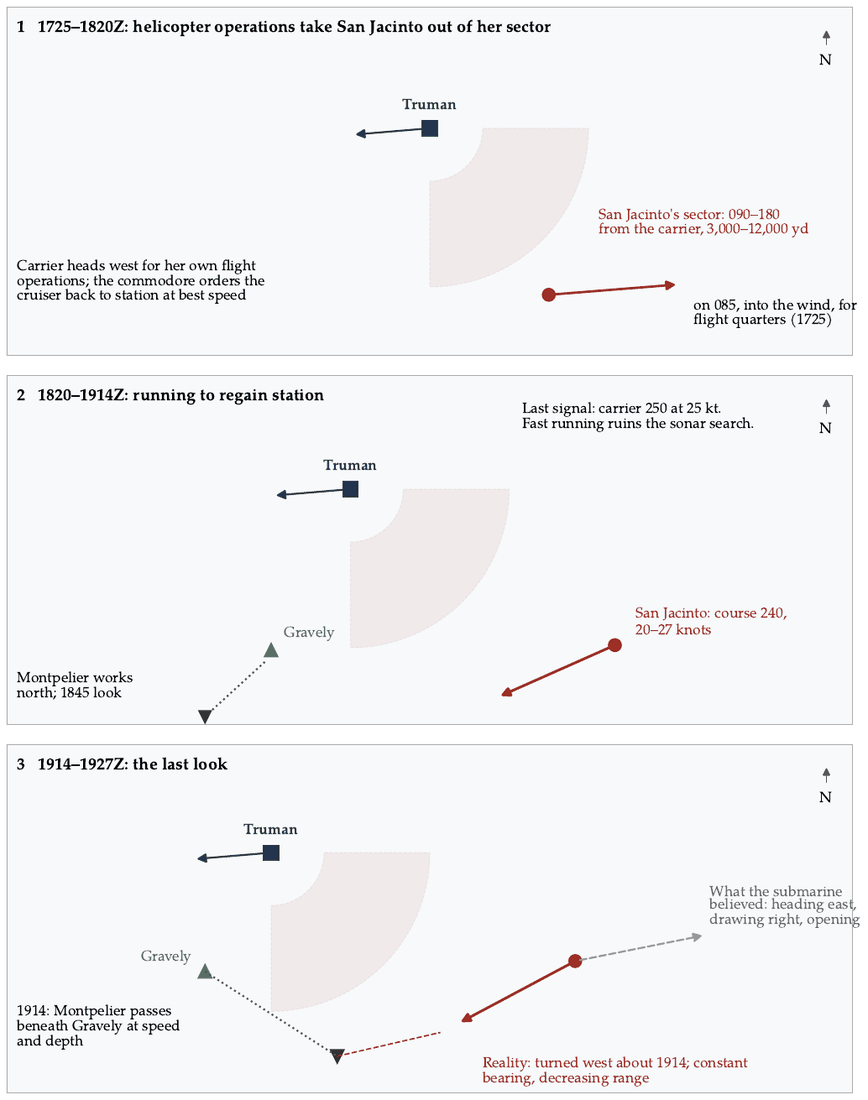
The exercise began at 1700 Zulu, one in the afternoon. San Jacinto had two jobs. She was the carrier’s “shotgun,” a close-in escort that stays near the carrier, and she was part of the screen, with an assigned sector bearing 090 to 180 degrees from the carrier, at a range of three to twelve thousand yards. The Truman was the “guide” of the formation: wherever she turned, the screen turned with her, so that the escorts’ positions were constantly changing. And the carrier was flying. With the wind out of the east she ran generally northeast at about ten knots to launch and recover aircraft, then sprinted back to the southwest at twenty to twenty-five knots to set up for the next cycle. The commodore’s staff, the report says, was struggling to manage the screen sectors around a carrier moving like that, and had ordered both escorts to make best speed to hold them.73
The captain went to the CIC as the exercise began and found the watch team less prepared than he wanted. They did not have the pre-exercise message, the relaxations, or the concept-of-operations briefing in front of them, and by his account the anti-submarine watch condition, the formal state in which the sonar, the helicopters and the CIC are manned and ready for a hunt, was not set. He gave the tactical action officer, the coordinator and the evaluator specific direction on how to set up. The tactical action officer would not receive the concept-of-operations message until an hour after the exercise began.17 The executive officer, on the bridge from 1700 until 1815, quizzed the officers under instruction about how to hunt a submarine.
At 1725 the ship set flight quarters to receive a helicopter, call sign “Dusty Dog 610,” carrying three technical representatives who were joining the ship. Helicopter operations require a ship to turn into the wind, and the wind that afternoon was out of the east. San Jacinto came to 085 degrees, leaving her screen sector. The helicopter was on deck from about 1750 to 1810 and launched at 1820. In the thirty-five minutes or so that it took, the carrier had moved on, and San Jacinto was a long way from where she was meant to be.18
Then the commodore, in his capacity as sea combat commander, the officer who directs the screen’s defense, spoke. His staff asked the ship when she expected to launch the helicopter and directed her back to her sector when she was done. The ship’s own people remembered it more sharply: she had been “chastised” once already, during the flight operations, for being out of position, and told to regain station on the carrier at best speed.19 The cruiser’s captain had returned to the bridge at 1815, and the executive officer left to see to the plan of the day. As the helicopter lifted off, San Jacinto turned to course 240 and ran.
She ran at between twenty and twenty-seven knots. A ship at twenty-five knots makes a great deal of noise and outruns her own sonar, which is why submarine hunters slow down to search. The captain told the tactical action officer that it was not a good speed for searching for submarines, and the two discussed how to come back into the sector and slow down; the tactical action officer passed the thought to the officer of the deck, who later remembered that sonar wanted to go slower. But the last tactical signal on the fleet circuit, which the tactical action officer had passed on and concurred with, had the carrier heading 250 at twenty-five knots, and San Jacinto was going just fast enough to keep up.20
The Navy’s later opinion on that predicament was as brief as it was hard on the staffs that created it. San Jacinto, the investigators wrote, was “tethered” to the carrier; she had been tasked to take a logistics helicopter and keep a plane-guard position while she was also screening, and the fast maneuvering that followed made her anti-submarine capability “less than effective.” They found the same of Gravely, and of the two together. The carrier’s flight operations kept the P-3 away from the water near her. The escorts’ speed, the report said, rendered their sensors deaf. The whole defensive screen near the carrier was, for much of the afternoon, effectively reduced to one ship, or to none.21 The commander of the Atlantic surface force, endorsing the report, put it in one sentence: at the time of the collision San Jacinto “was not fully engaged in ASW,” but was focused on administrative helicopter flights and on getting back to her place in the screen.81
By about 1900 Gravely had helicopters in the air with good tracks on the submarine. San Jacinto’s own helicopters had not launched, and she had no contact. All the contacts reported by others were to the south and east, some twenty-five thousand yards away and closing to twelve thousand. About ten minutes before the collision someone in the CIC called the sonar supervisor to be sure the sonar operators were listening on the underwater telephone, the voice link ships and submarines use to speak to each other under water, in case the submarine tried to call. They were listening, at full volume, and had heard nothing.22
What San Jacinto did not know, on the bridge or in much of the CIC, was how close the submarine was. The investigation found that communication between her bridge and her CIC was poor, and that the bridge was unaware that Montpelier was within twelve thousand yards, less than half an hour before the collision, when that was known in the CIC.23 The watch team on the bridge was doing what it had been trained to do. The officer of the deck had read the pre-exercise message and the briefs before taking the watch, and he had briefed his lookouts on what to watch for when searching for a submarine, how to report one, and what the exercise brief said about flares. The investigators would later single out that training as excellent.24 But the bridge had a ship to drive, at twenty-odd knots, in a formation that changed course every few minutes, toward a carrier it was trying to catch. Nobody had told it that the quarry was close.
The others were closer to knowing. Fifteen or twenty minutes before the collision Gravely held two contacts on one line of bearing, one of them the cruiser and the other, she believed, the submarine, about six thousand yards apart. At 1904 a helicopter gave the staff an estimated position for the submarine. At 1922 the P-3 reported a contact on a sonobuoy three miles south of the surface ships. The staff’s own finding was that there had not been time before the collision to turn those reports into a position the whole force could use. And at about 1925, watchstanders in the commodore’s module aboard the carrier remembered, San Jacinto came up on the radio to call a “feather” in the water, the streak a periscope leaves, and gave part of a report. The staff’s assistant watch officer started to type the log entry, waited about twenty seconds, and asked the ship to repeat it. The ship’s answer was to disregard her last. The entry was deleted.73 The report does not say who on the cruiser made the call or what they had seen.
The other boat
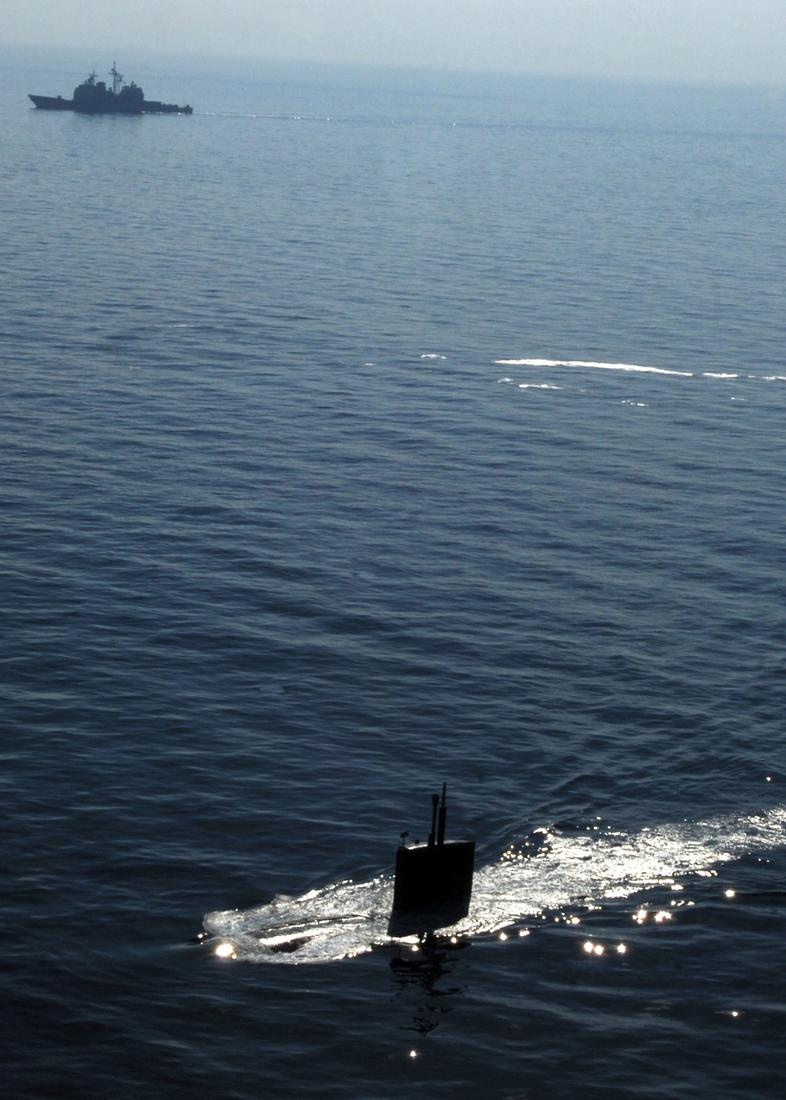
In Montpelier, beneath the surface and a few miles away, the picture was in some ways the mirror of San Jacinto’s. Her commanding officer was a strong and experienced tactician, a demanding leader with high standards, well respected by his crew and, the investigators found, receptive to being corrected when anybody did it. Under him the boat had finished a highly successful deployment to European waters in February. His new executive officer and his new chief of the boat, the senior enlisted sailor aboard, had both come aboard about a week before; their predecessors, the investigators noted, had been weak performers, and one had driven a wedge between the captain and his chiefs. The boat’s best department head had transferred, along with three sonar supervisors and the leading fire-control chief. Her fire-control division was very junior. That summer an inspection had found her sonar and fire-control watchstanders slow at contact analysis. The result, in the report’s view, was a captain who had been made to run much of his ship personally, and a crew that had come to rely on him to do it. The investigation still concluded that she was a capable boat and crew making good progress toward deployment.25, 82
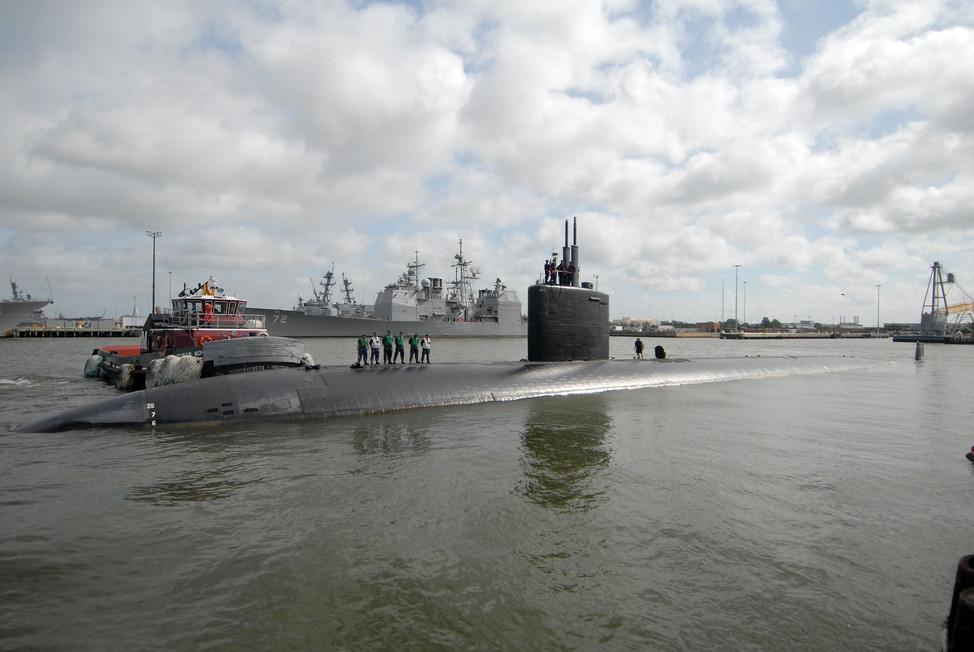
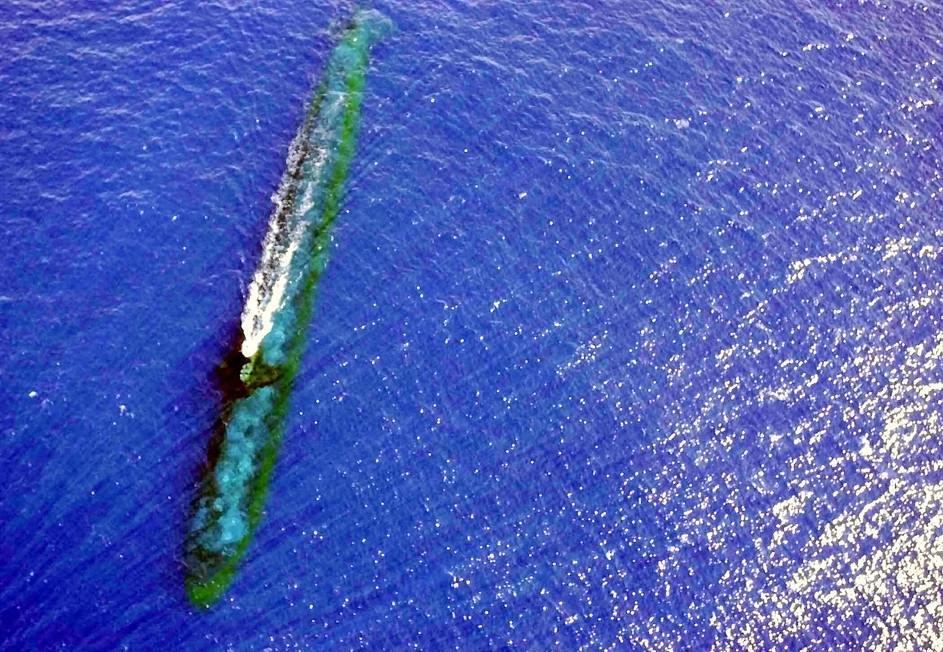
She was also busy. Her daily routine had slipped, so that streaming her own towed array and a scheduled test discharge of her battery both fell into the watch during which the exercise was run. Streaming the array took the better part of the first hour and kept her tracking party from getting familiar with the ships above. An earlier package of sonar data she had collected that year had been judged poor, and so she was intent on the data she had been asked to collect on the carrier. The captain’s night orders had called the engagement a chance to hone the team’s warrior skills. Asked afterward, his watch teams remembered the tactical goals. Most did not remember, or had never understood, the “tripwires,” the set ranges and indications at which the boat was supposed to stop and get safe.82
She had begun the exercise at the southern end of the operating area at periscope depth, loitering for thirty minutes. Then she went deep, streamed her array, and began working north. At 1845 she came up for a second look and, seeing the surface ships far to the north and barely visible, concluded there was no traffic nearby. Her captain decided to go deep and sprint, to get inside the screen and attack the carrier. At 1914, at speed and at depth, she passed beneath Gravely, closer than the stand-off range her own safety rules prescribed, and entered the screen. Her captain said afterward that he should have taken that as a sign. At that moment her picture of the surface ships was a stale one. She believed San Jacinto was to her right, drawing right, heading east. But San Jacinto had turned west at about 1914, and the submarine, deep, had not detected the turn.26
As she came up for her third look, then, she held San Jacinto on a constant bearing with decreasing range, while believing she held a constant bearing with increasing range. Two vessels on a constant bearing with closing range are, as every mariner learns, on a collision course. A submarine at depth has little to look at: sonar tells her where a ship is and roughly which way she is moving, but sonar can be fooled by a turn that the listening boat did not hear. The cruiser’s trace on the submarine’s sonar showed almost no change of bearing for nearly ten minutes before the collision, and nobody analyzed it. The captain had said aloud that San Jacinto was three or four thousand yards away and drawing right, and the watch team, the report found, took that as settled and stopped looking for evidence against it. At 1926 the fire-control technician entered a solution that put the cruiser 2,500 yards away on a westerly course with a closest point of approach of 83 yards in six minutes. Even that had her at less than eight knots. She was making twenty. The junior officer of the deck did not remember the solution being entered. The officer of the deck, his junior, the fire-control chief, the sonar supervisor and the sonar operator all heard a report on the way up that the captain, at the periscope, did not hear, and none of them made sure he knew. What the report was is blacked out.82
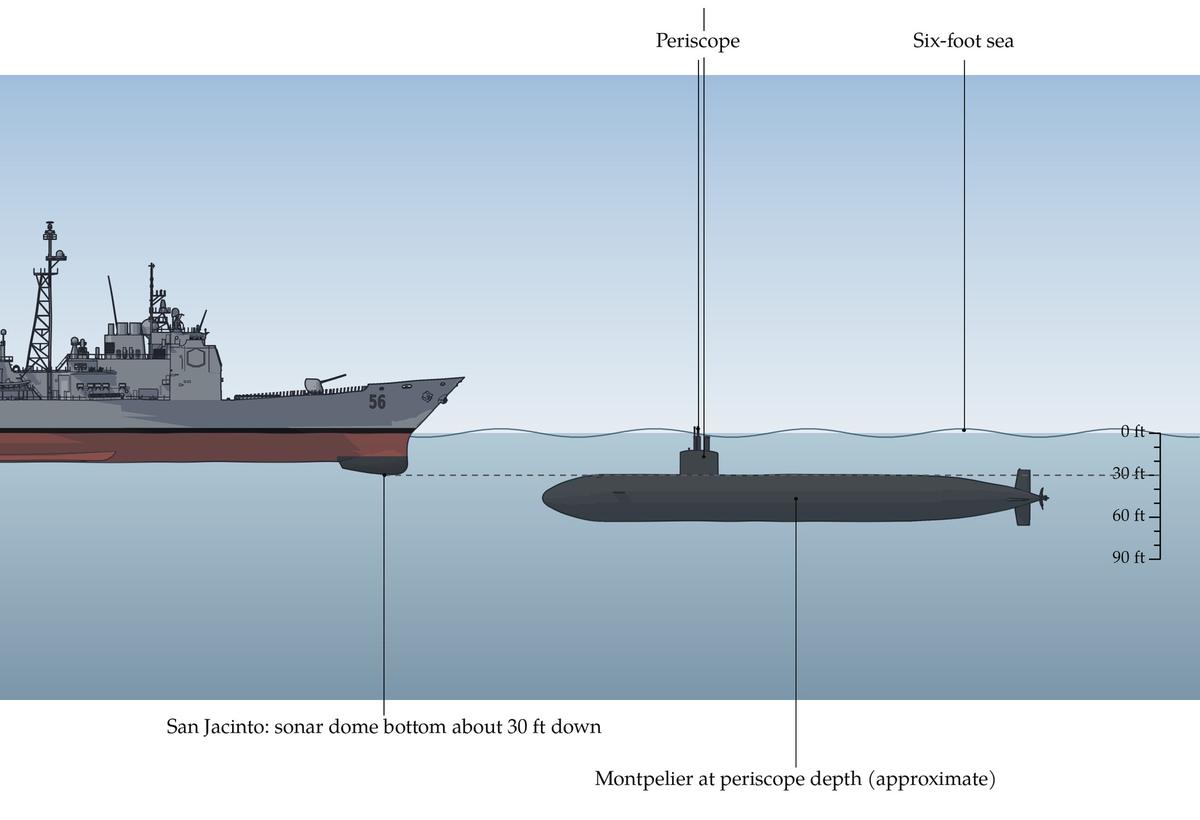
Her captain made one decision that the investigators found striking. Because the surface picture was crowded, he decided to man the periscope himself, rather than watch his displays from the control room, as was his habit. He meant it as a precaution. The investigators thought it took the most experienced set of eyes on the boat away from the screens that showed the cruiser coming.
The periscope broke the surface at 1926:20, with the boat at 62 feet. The video recorded through it shows two full sweeps of the horizon in about sixteen seconds, with the lens under water for parts of both. On the first sweep the captain thought he saw something, and his instinct was to get deep; he ordered 150 feet. The investigators, watching the video, saw nothing on that sweep the first several times. Only when they knew where to look, and stopped the frame, could they make out the top of San Jacinto’s mast above a wave. At the end of the second sweep the captain saw the Truman about where he expected her, decided that she was what he had glimpsed, relaxed, and ordered the boat back up to 60 feet to take his shot. One second later the periscope came around onto San Jacinto, bow-on, with a heavy bow wave. Her mast, 172 feet tall, filled six divisions of the lens in low power. The report works that out to about 575 yards.27, 76
He lowered the periscope and ordered a depth, and then more speed. He believed he had ordered emergency deep, the order that sets off a drilled set of immediate actions throughout the boat. He had not. The fire-control chief recommended it, the officer of the deck called it away on the announcing system at 1926:43, and the captain ordered it at 1926:45. The planesmen, who had gone to full dive on the first order and full rise on the second, went back to full dive. At 1927:05 the recording has the captain saying, “Faster, deeper, flood now, gentlemen.” In the thirty seconds after the order the boat gained a knot and a half.76
1926 to 1927 Zulu
| Time (Z) | Event | Source in the investigation |
|---|---|---|
| 1923 | Ship making 25 knots | Investigation |
| 1926:07 | Formation’s ordered speed cut to 16 kt; ship actually making 19.5 kt | Bell log (corrected) |
| 1926 | Possible active sonar contact at 3,000 yd; judged reverberation; radar clear to 3 miles | Investigation |
| 1926–27 | Forward lookout: “Surface contact bearing 000. It’s a sub.” Conning officer confirms a periscope, 20–90 yd | Lookout; conning officer |
| OOD sees the periscope about 100 yd off the port bow; orders all back full; reports to the captain on Net 15 | OOD | |
| Captain, in CIC: “OOD, TACTAS/NIXIE.” OOD and conning officer: disregard the array, all back emergency | Investigation | |
| 1927:04 | All back one-third: throttles −22% and −13% | Bell log (GPS time) |
| 1927:09 | All back two-thirds: both throttles −49% | Bell log |
| 1927:14 | All stop, throttles 0%: the helmsman, unordered | Bell log; helmsman |
| 1927:15 | Collision: 3:27 p.m. EDT | WSN-7 data, NSWC Dahlgren |
Source: Times are Zulu on the GPS clock; the machinery control system’s clock ran about 53 seconds fast and has been corrected. The ordered all-back was never realized on the shafts. Source: Chapter 19 (Phillips command investigation, findings of fact).
At 1926, San Jacinto’s anti-submarine team received a possible active sonar contact from the sonar supervisor, at three thousand yards. The anti-submarine warfare coordinator checked the radar and found nothing out to three miles, and the team judged the return to be reverberation and not a submarine. By the time the coordinator reported the bearing clear, a voice report from the bridge had come across the circuit: the contact was thirty yards off the port bow.28
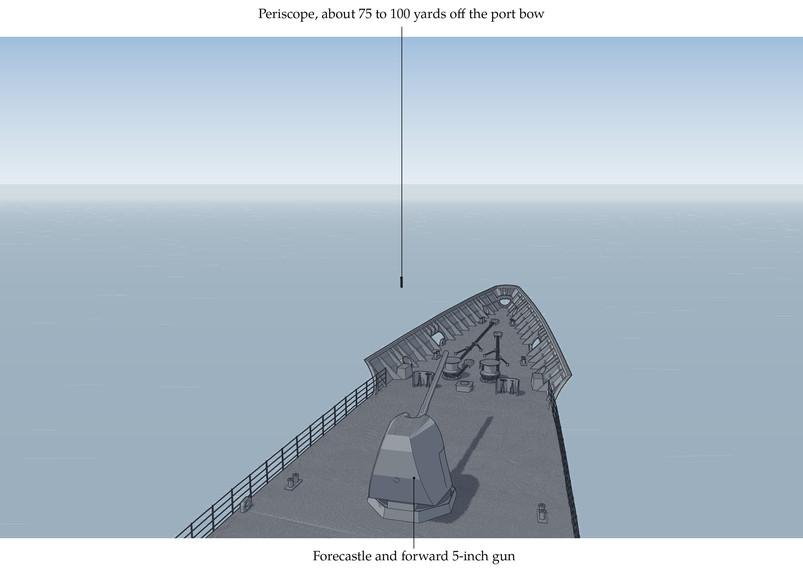
On the bridge, three people mattered. At 1923 the ship had been making twenty-five knots. At about 1926 a signal on the fleet tactical circuit slowed the formation’s ordered speed to sixteen knots, and San Jacinto’s actual speed was 19.5. On the starboard bridge wing stood the forward lookout and the conning officer. (The conning officer is the watchstander who gives the helmsman his orders for course and speed; the officer of the deck supervises and may take over.) The officer of the deck, the navigator, was inside the pilothouse, bent over the SPS-73 surface-search radar, trying to reacquire Gravely.29
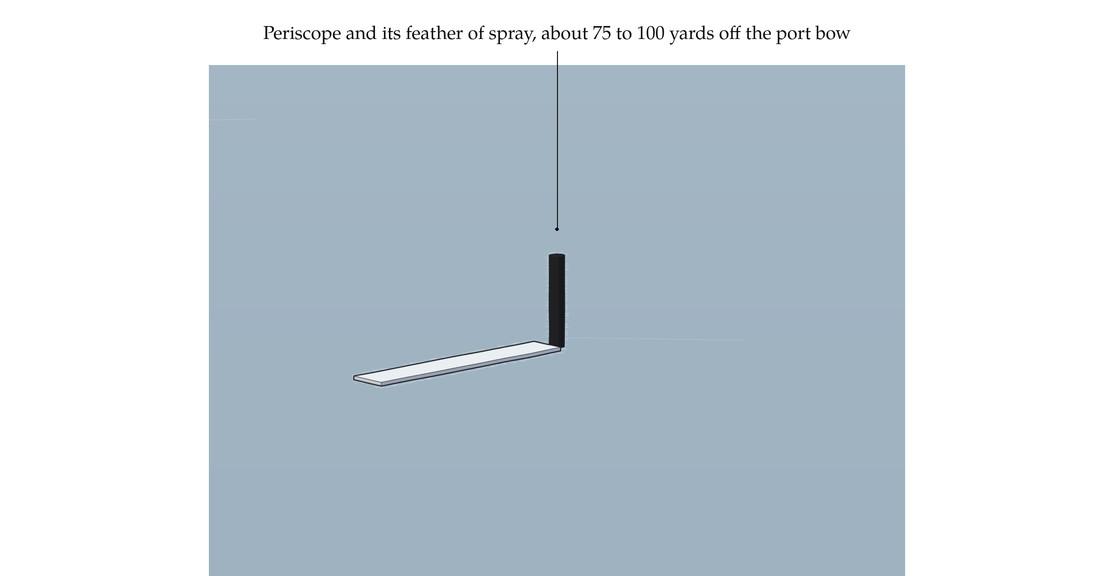
The lookout saw what he described afterward as a small red light, dead ahead, rising out of the water. He reported it at once: “Surface contact bearing 000. It’s a sub.” He showed it to the conning officer and asked, “Is that a sub?” The conning officer looked and confirmed a periscope, somewhere between twenty and ninety yards away.30 He ran into the pilothouse and yelled, “NAV, SUB, SUB, DEAD AHEAD!” The officer of the deck, who had been looking at the radar scope, said, “What? Where?” and then, “Oh, shit.” He stepped to the center of the bridge and saw it himself, a periscope about a hundred yards off the port bow. The sea was about six feet, with whitecaps, so it was hard to tell whether the periscope was rising or sinking. The lookout now called it right ahead at seventy-five to a hundred yards. The helmsman, at his console, thought fifty.31, 75
The distances do not agree with the submarine’s. The periscope was at 575 yards by the measure of its own lens, and the men on the cruiser’s bridge put it between twenty and a hundred and fifty. Both can be honest. The submarine’s figure is for the moment her captain first saw the cruiser, some thirty-five seconds before they met, with the ships closing at better than ten yards a second. The bridge’s figures are estimates of a thin mast in a six-foot sea, made in the seconds after that. The report prints both and does not reconcile them.
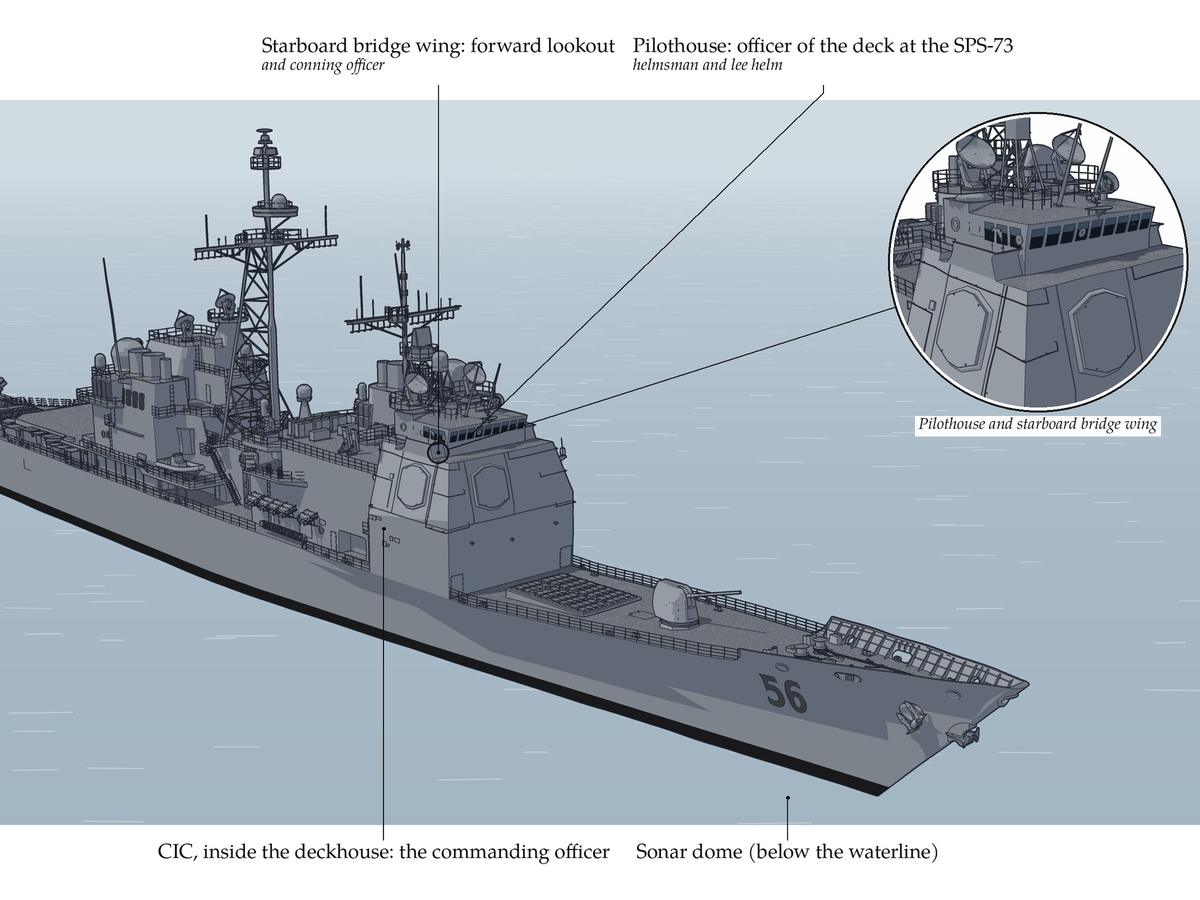
The officer of the deck looked at the periscope for a second, worked out the relative motion, and understood. With so little distance there was no safe way to turn; he knew they were going to hit it, and the only question was where. He was afraid that it was a nuclear submarine. He called “all back full,” the order that puts the engines in full reverse, and then took up the handset of the internal net called Net 15 to report the periscope to the captain in the CIC, and yelled the order again. The conning officer repeated it to the helmsman. The helmsman paused until he heard it from the conning officer, then moved the integrated throttle controls toward all back full and reported that he had.32
Up to this point, the investigators wrote, the bridge team’s coordination and immediate actions were exceptionally well executed.
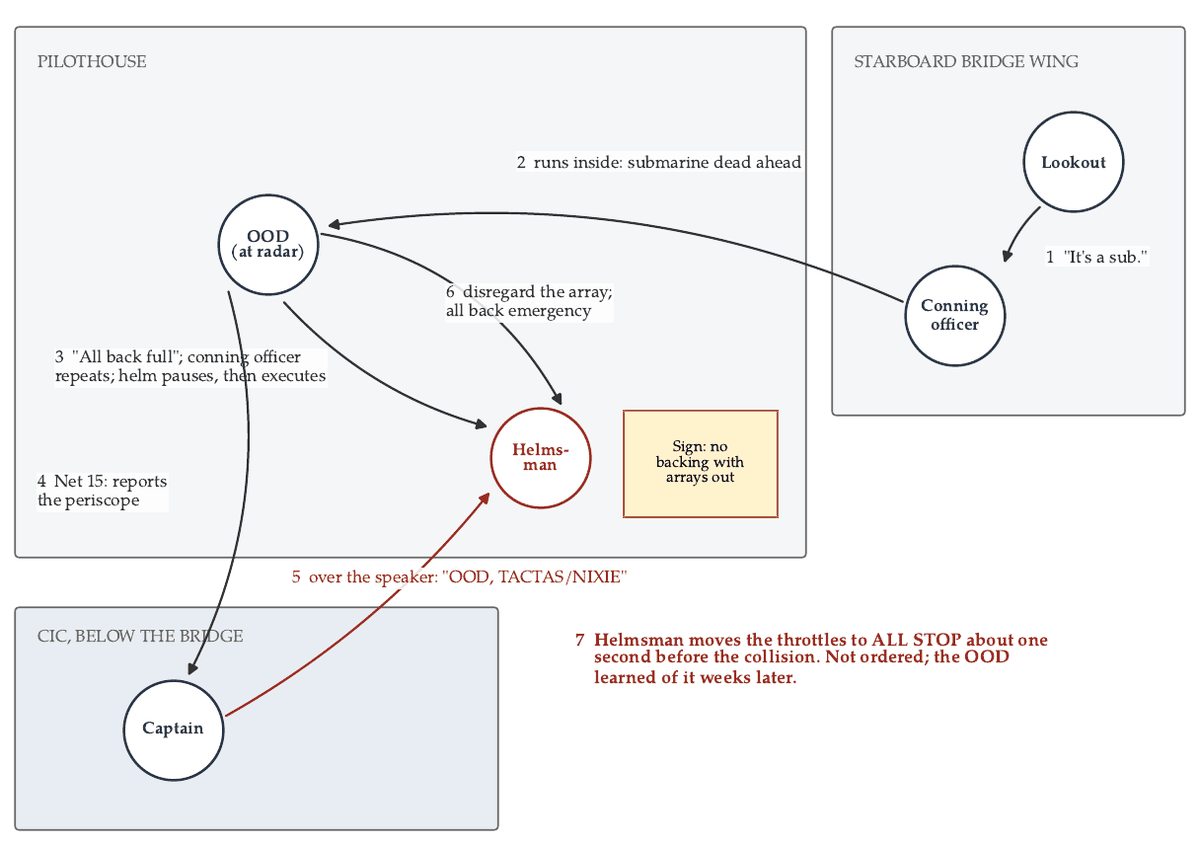
The next seconds are the most carefully reconstructed in the investigation, and the least certain, because there is no recording.
When the officer of the deck reported the periscope on Net 15, the captain, in the CIC, answered with a phrase: “OOD, TACTAS/NIXIE.” TACTAS is the Navy’s name for a towed array sonar. He did not, by his own account, fully comprehend the report. He was reminding the officer of the deck of something both of them knew, that the array and the noisemaker were deployed and that backing was prohibited. The officer of the deck and the conning officer, who had seen the periscope, understood the emergency in a way that the captain at that moment could not. What they said, as they told it, was “Fuck TACTAS! All back emergency, all back emergency!” What the helmsman heard, as he told it, was the officer of the deck saying, “Fuck, the TACTAS and NIXIE are out.” He had the warning sign above his console and the captain’s voice on the speaker. He believed, he told the investigators, that a ship does not back down with the gear streamed, because it will wrap in the screws and be ruined. He saw both officers look at him. He moved the throttles to all stop.33, 75
He reported it to the conning officer. The officer of the deck, who had never ordered all stop, did not know about it until the investigators told him in his interview, and the report says he was very surprised. The helmsman told the investigators it was no more than a second from the time he put the engines at all stop to the collision.
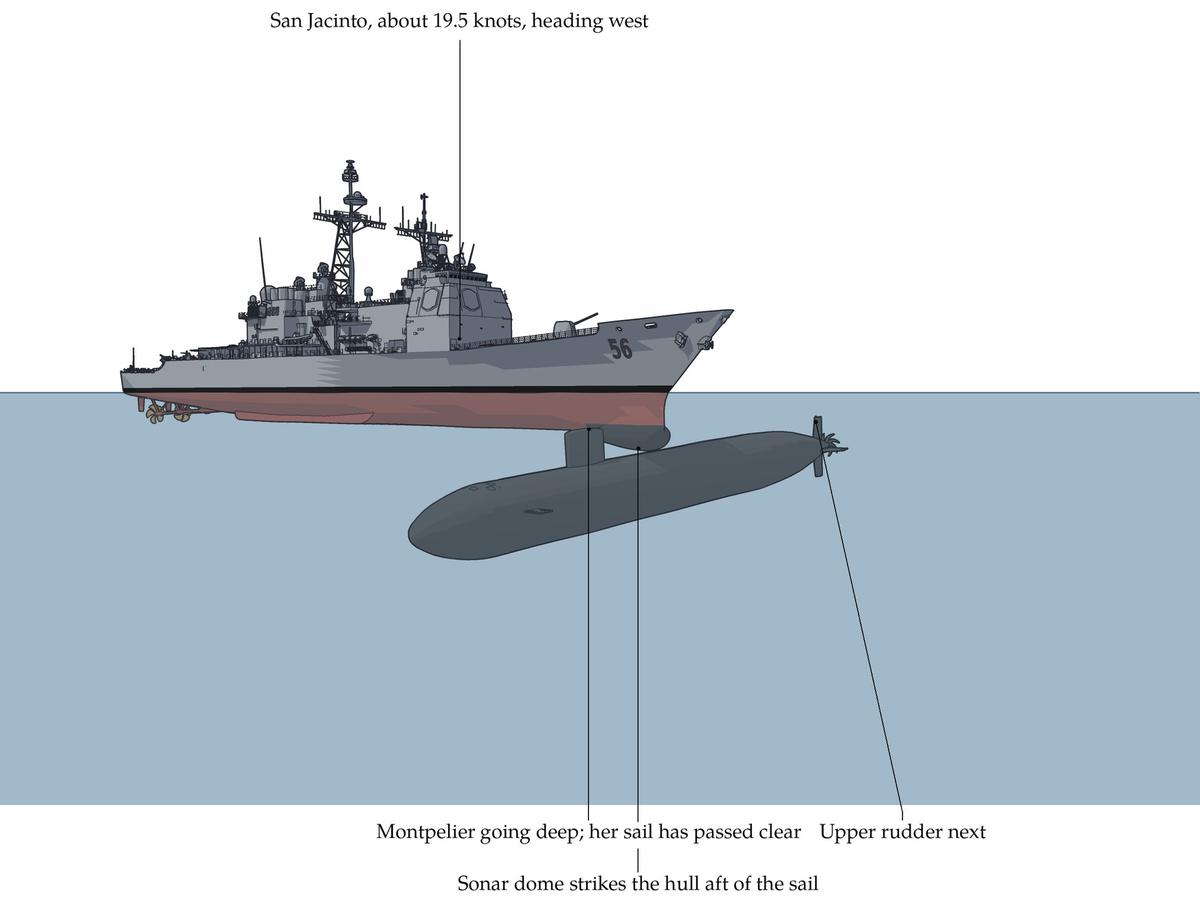
The reconstruction, from the ship’s data, is as exact as two disagreeing clocks allow. The bell log of the ship’s machinery control system ran about fifty-three seconds ahead of the GPS-based time recorded by the voyage management system. On the GPS clock, the ordered speed was sixteen knots and the ship was making 19.5 at about 1926:07. For most of the next minute the log shows the shafts settling toward fifteen knots. At about 1927:04 the order was all back one-third, with the port and starboard throttles at negative twenty-two and negative thirteen percent. At 1927:09, all back two-thirds, with both throttles at negative forty-nine percent. At 1927:14, all stop, with the throttles at zero. The collision, determined from data from the ship’s inertial navigation system, processed by the Naval Surface Warfare Center at Dahlgren, Virginia, occurred at 1927:15 Zulu. In the ship’s local time, it was 3:27 p.m. The throttles never reached all back full, and the backing bell was never realized on the shafts. The officer of the deck said afterward that if the ship had not slowed at all, the two vessels would have struck bow to bow.34
The accounts differ on small points. The yearbook and the newspaper give the range at which the submarine’s periscope appeared as about 200 yards and 100 to 200 yards, where the investigation’s evidence from the bridge runs from twenty to a hundred and fifty, and the Navy’s own release of 14 October gives the time of the collision as approximately 3:30 p.m., where the investigation’s reconstruction from the ship’s data gives 3:27.60
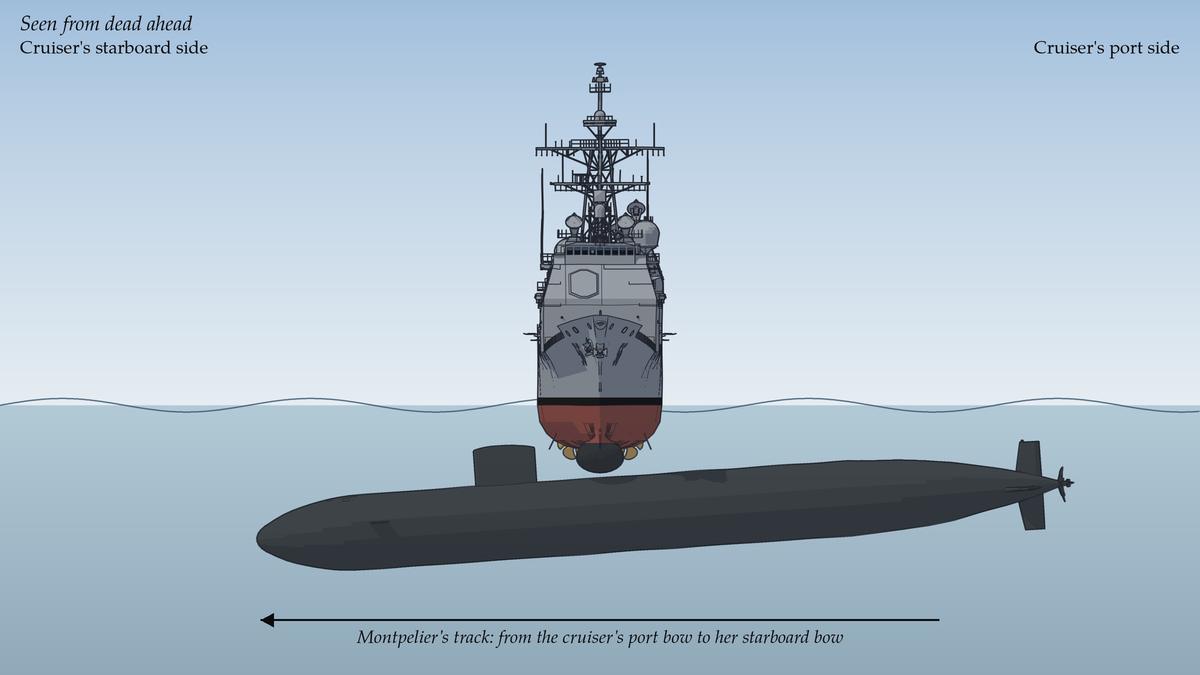
Montpelier’s mast and sail, the tower that rises from the top of a submarine’s hull, passed clear of the ship. San Jacinto’s bow struck the submarine aft of the sail and then on the rudder, with force enough to dislodge it. The submarine’s recording has two impacts about two seconds apart, the second louder and more violent. Her captain remembered a “God awful metal on metal sound.” The cruiser’s lookout, who had watched the periscope cross the bow from left to right, inside seventy-five yards, until it disappeared in the water ten degrees on the starboard bow, felt the shudder about five seconds later.35, 76
On the way to the bridge from the CIC, the captain felt the ship start to slow and back down. Then he felt her shake and heard a loud crack. In his stateroom the executive officer, who had been discussing a hazardous-materials problem with the supply officer, felt the ship shake in a manner that was not normal, and went for the bridge as general quarters sounded.36
Aboard the carrier, the commodore and his deputy were in a planning session in the war room. In their module the radio came up: “Hotel Zulu, we’ve collided with an underwater object.” The watch officer asked what they had said. “They said they collided,” his assistant answered. On the strike group’s side of the space, watchstanders remembered an open call on the radio of “Oh my God, they hit it,” or words to that effect. The watch officer called “knock it off,” the order that stops an exercise.78
The first hour
The officer of the deck sounded general quarters and the collision alarm before the captain arrived on the bridge. General quarters is the call that sends the entire crew to battle stations; the collision alarm is a separate signal that tells everyone in the ship to brace for impact and, afterward, begins the damage-control routine. When the captain got to the bridge the engines were at all stop, and he did not know why they were not at all back full. The ship had lost steering and throttle control. The consoles went blank, though her momentum kept her moving forward. Steering was shifted to manual and restored in the pilothouse within minutes; control of the throttles stayed in the central control station until the bridge got it back at 2117.37 The officer of the deck kept the conn himself and did not hand it back to the conning officer, because they were still looking for the submarine.83
The captain ordered the officer of the deck to man the retrieval teams for the towed array and the noisemaker and bring them in. Both were undamaged, though there was a report of flooding in the array, later traced to the all-back order. The anti-submarine warfare evaluator, watching the dome pressure drop, isolated the dome and recommended a speed of five knots or less. The sonar dome is kept filled with fluid under pressure, and should have been held at between 34 and 36 pounds per square inch; it was reading between 12 and 14, and no amount of work on the bypass valves would raise it.38
In the CIC, the tactical action officer did what the manuals say to do: checked general quarters manning, set material condition ZEBRA, the highest state of watertight integrity, confirmed that the ship was using every means to find the submarine, set the fathometer to maximum power, put the underwater telephone out, and, at the captain’s direction and with the commodore’s concurrence, dropped a signal underwater sound buoy set to a code that means “establish communications with the sea combat commander or submarine operating authority.” The anti-submarine warfare coordinator radioed the commodore that the ship had collided with an underwater object, and a little later that it was a submarine.39 The investigators’ view of San Jacinto’s conduct after the collision was that she did what she was supposed to do. Their one criticism, shared between her captain and the strike group, was that she might have been moved farther north along her safety course once her first efforts to reach the submarine failed, to give the boat room to come up.40
Montpelier did not answer. The cruiser steered the pre-agreed safety course of 000, making about three knots, while sailors went topside to search the water. The captain called for a muster, at the recommendation of the command master chief, to be sure that no one had gone over the side. His voice on the 1MC, the ship’s general announcing system, calmed the crew, the command master chief thought. When the executive officer reached the bridge, he found it fairly calm: the officer of the deck was still giving orders, the captain was on the radio reporting, and the general quarters watchstanders were arriving to take their turnover.41 The ship tried to reach the submarine on the underwater telephone, without success, and tried to reach the commodore on a secure voice circuit, without success. She did reach the Truman.
For seventy minutes nobody on the surface knew what had happened to the submarine. The cruiser reported that the boat had gone “sinker,” under and silent. The strike-group commander reached the commodore’s module five minutes after the collision. The staff told every ship to stop pinging, keep fathometers on high, and stay away from the submarine’s last known position, on the reasoning that a ship overhead might keep her from coming up. Helicopters dropped buoys and sound signals. Gravely was told to search with her mine-avoidance sonar, got one return and nothing after it, and was told to call on the underwater telephone, “Are you safe to surface?” Nothing came back.78
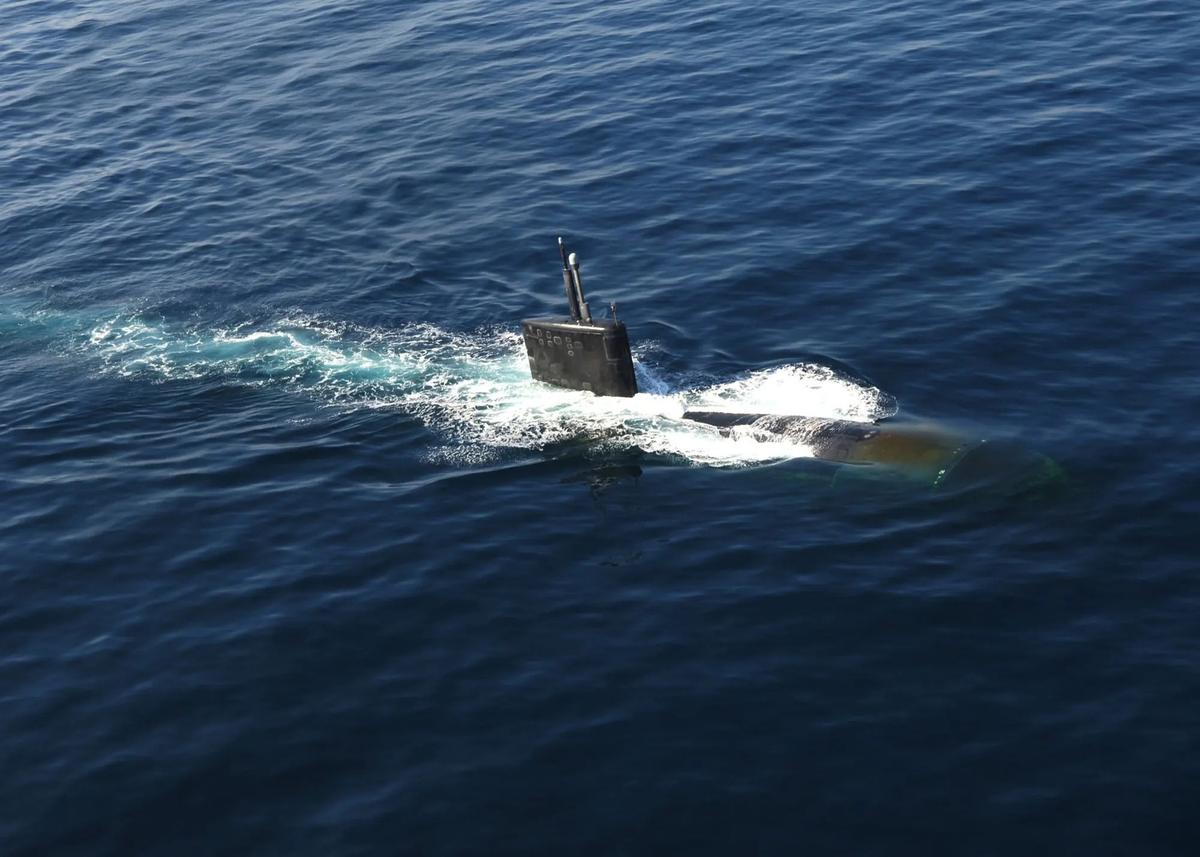
Under water, the submarine was turning in circles. The collision had left her rudder jammed to the right, and the helm had lost control of it. Her captain told the crew on the announcing system that the boat had been struck by a surface warship and asked for damage reports. The executive officer, who had been in the engine room, came forward to the control room and then oversaw the effort to work the rudder by hand from aft. It could be moved right and not left. The crew reeled in the towed array, then lowered the outboard, a small auxiliary motor that can be trained to push the stern sideways, and started it against the turn. It did not hold her. Then the men controlling her trim noticed that the boat had suddenly become about four thousand pounds light aft. They took it to mean that the top of the rudder had fallen off. After that the outboard could hold her, and at 2022 her log records that she had steerageway again. She steadied on a course to the southeast.77
She could hear the surface ships. Her officers heard the sound signals and the underwater telephone calls, and answered on the telephone and by keying an SOS on her main sonar. The executive officer thought he heard a garbled “say again.” The investigators interviewed the sonar operators of both ships and the helicopter crews and found nobody who had heard anything from her. Her captain and his officers talked about firing a red flare and decided against it, because in the exercise manual a red flare could mean either an emergency surfacing or a submarine on the bottom unable to surface, and they did not want the ships above to think the second. They did not consider the yellow flare, which means keep clear, I am surfacing. The captain was not sure the periscope had survived, or that raising it would not let water in. He raised the fairing alone first, then the periscope, found it working, and at 2037 brought the boat to periscope depth.77
She called San Jacinto on bridge-to-bridge radio from 2,600 yards off the cruiser’s starboard quarter. The cruiser’s crew could see her, broached, the bow of the submarine rising out of the water, and she said she meant to surface, which she did. She reported no steering, propulsion fine, no injuries, and a request that all ships remain clear. The officer of the deck, given her position by the CIC, plotted her to the southeast at about four miles. The investigators judged that the submarine’s leaders had focused their crew well, stabilized the boat and brought her up in a controlled way. They also judged that in an hour and twelve minutes she should have made a more determined effort to reach the many ships and aircraft looking for her, and that the submarine force’s headquarters, with a boat unaccounted for that long, should have considered sending the formal message that starts a search for a missing submarine.42, 83
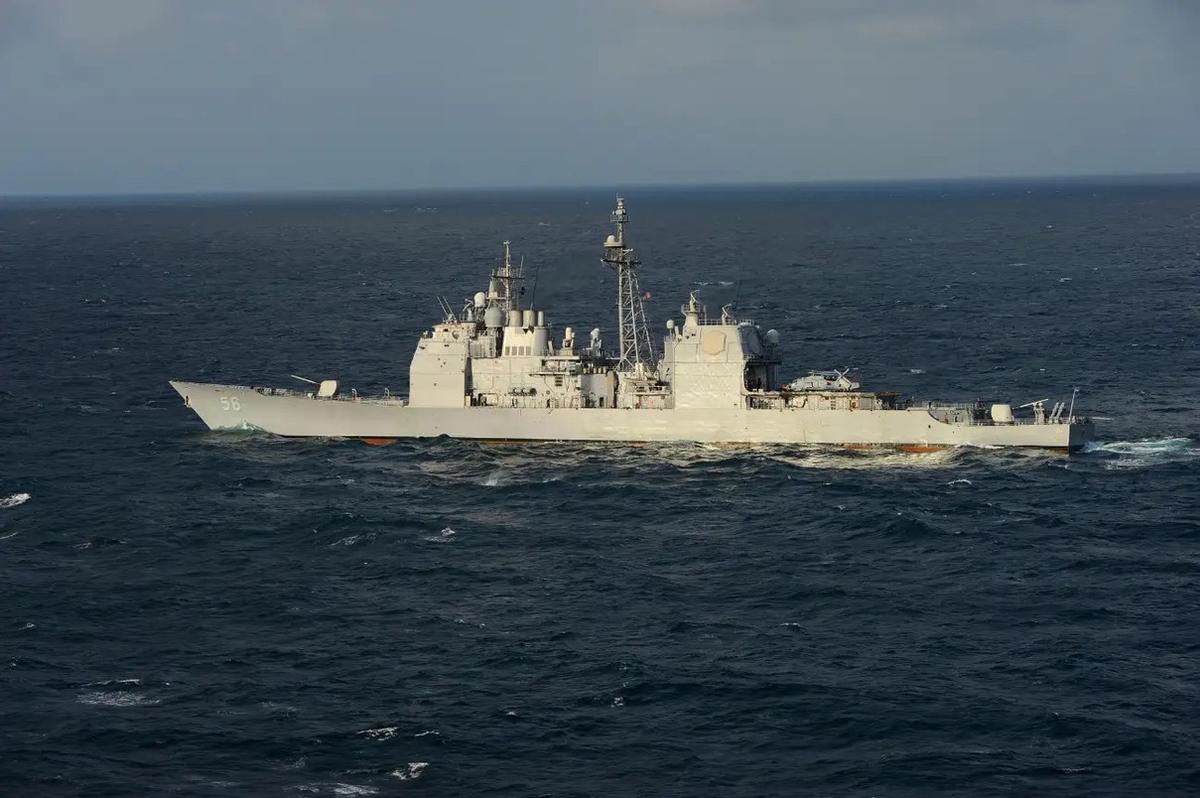
Then the formation reorganized. San Jacinto escorted the submarine at first, until Gravely closed to take over. The cruiser was directed to proceed to Mayport, Florida, at no more than five knots.
That evening the Navy put out a short statement from Norfolk. There were no injuries, it said; the collision had happened at about 3:30 p.m. Eastern Daylight Time; the submarine’s propulsion plant was unaffected; both ships were operating under their own power; the damage was being assessed and the incident was under investigation; and both ships had been conducting routine training.65
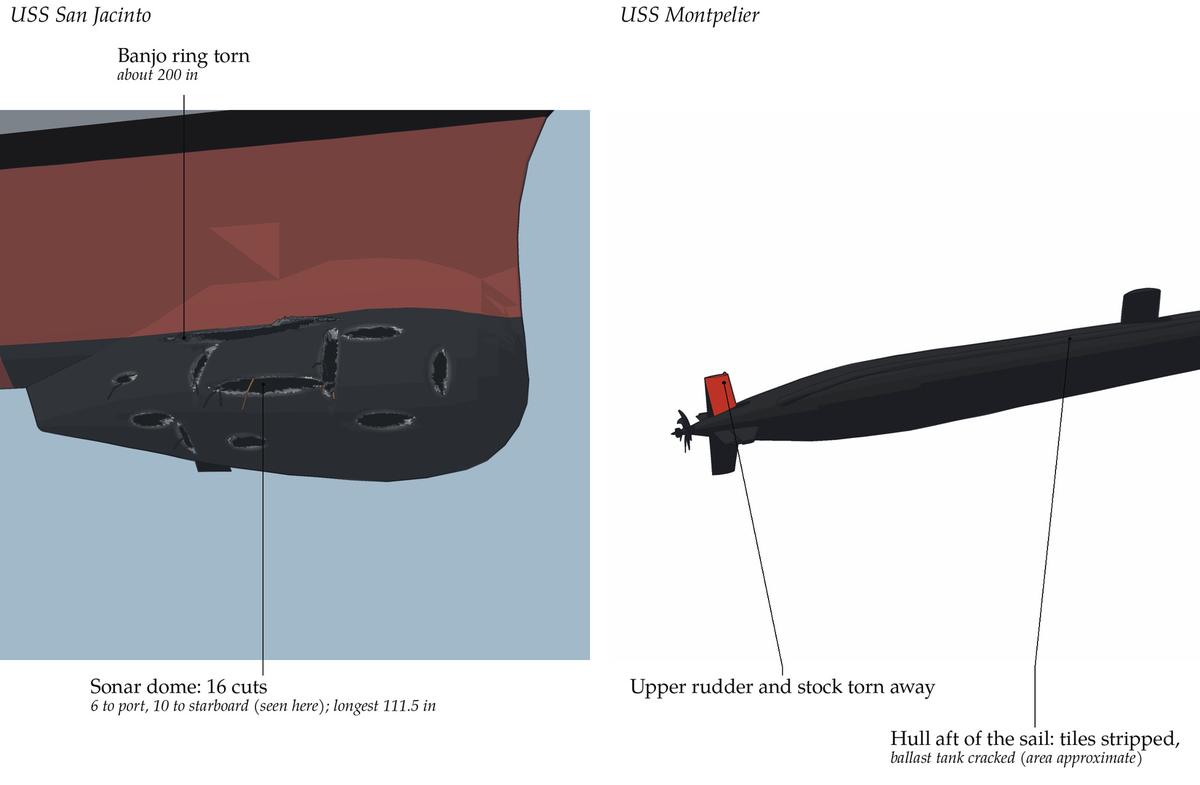
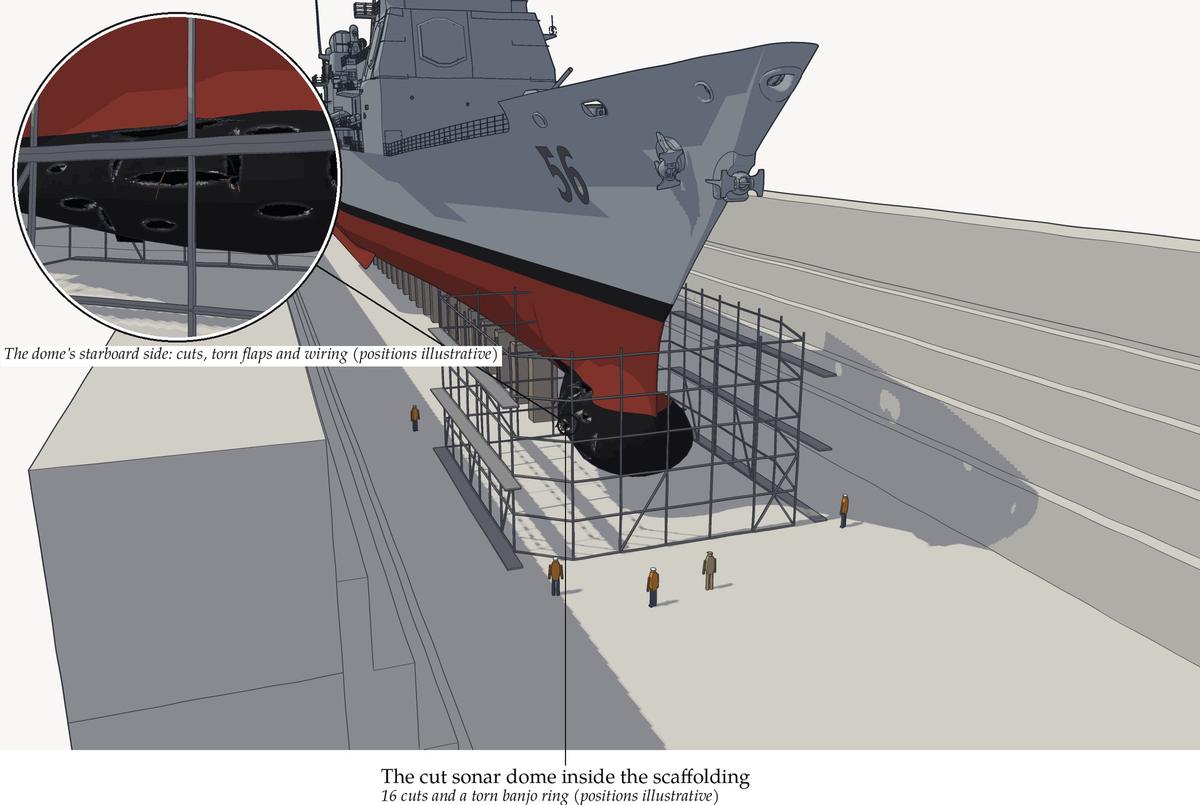
When a diving contractor inspected the cruiser’s dome in the water, on 18 and 19 October, the inspectors listed damage in sixteen separate places, six on the port side of the dome and ten to starboard. The cuts were horizontal and vertical, and the longest was a hundred and eleven and a half inches. There was metal flapping with exposed wiring, a separation of layers, and a transducer pulled free. On the steel ring, called the banjo, that holds the dome to the hull, there were tears two hundred inches long. When the ship was docked, the high-frequency transducer of the underwater telephone was found crushed, and the cable to it cut.43
The submarine’s damage was worse. Her upper rudder and its stock, the shaft on which it turns, were gone, and the rudder post that passes through the non-pressure hull was severely damaged. There was a crack nearly two feet long in a main ballast tank, a hole over the mud tank, structural cracking in the bulkheads between ballast tanks, dented hull plating, thirty feet of her acoustic tile stripped away, and her anchor-light cable missing.44
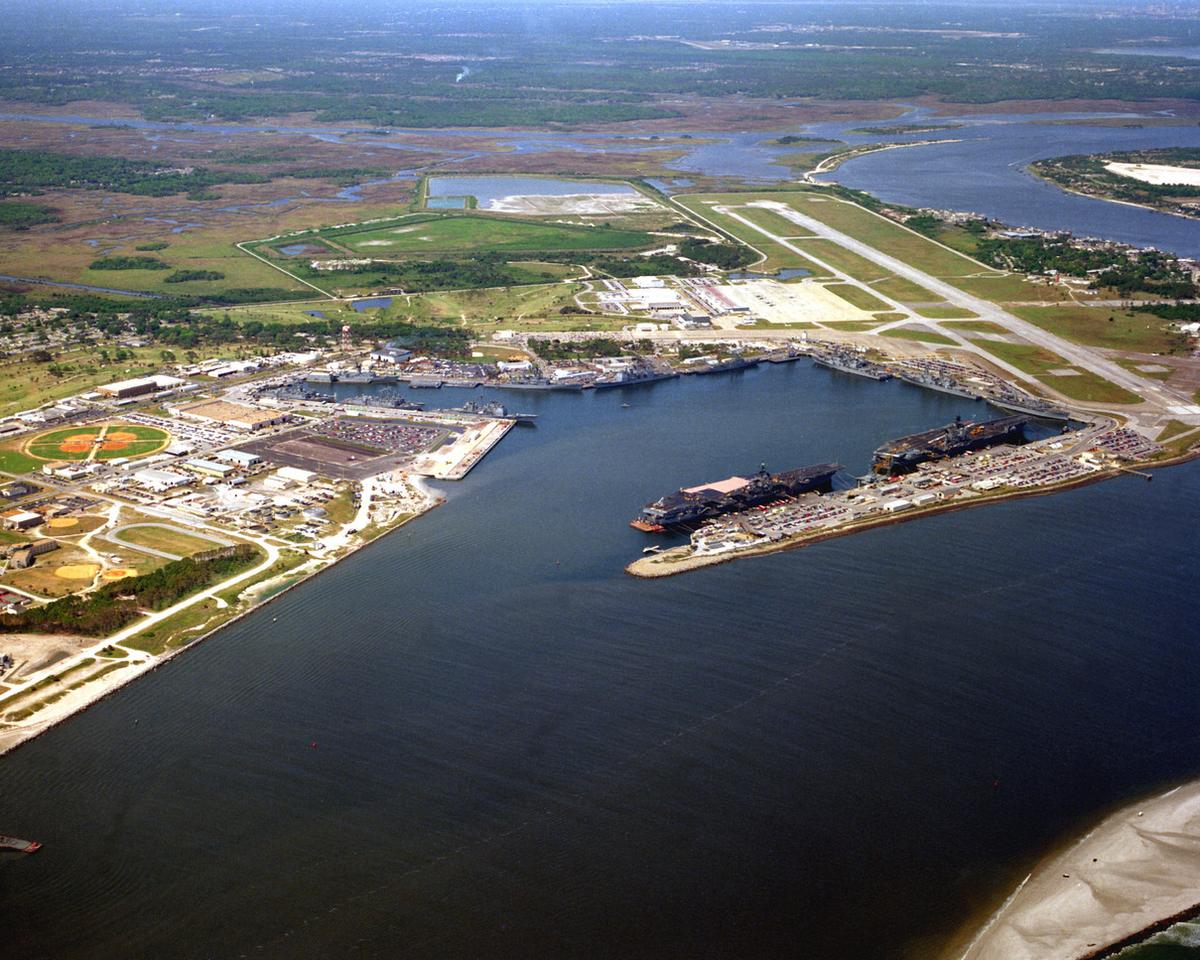
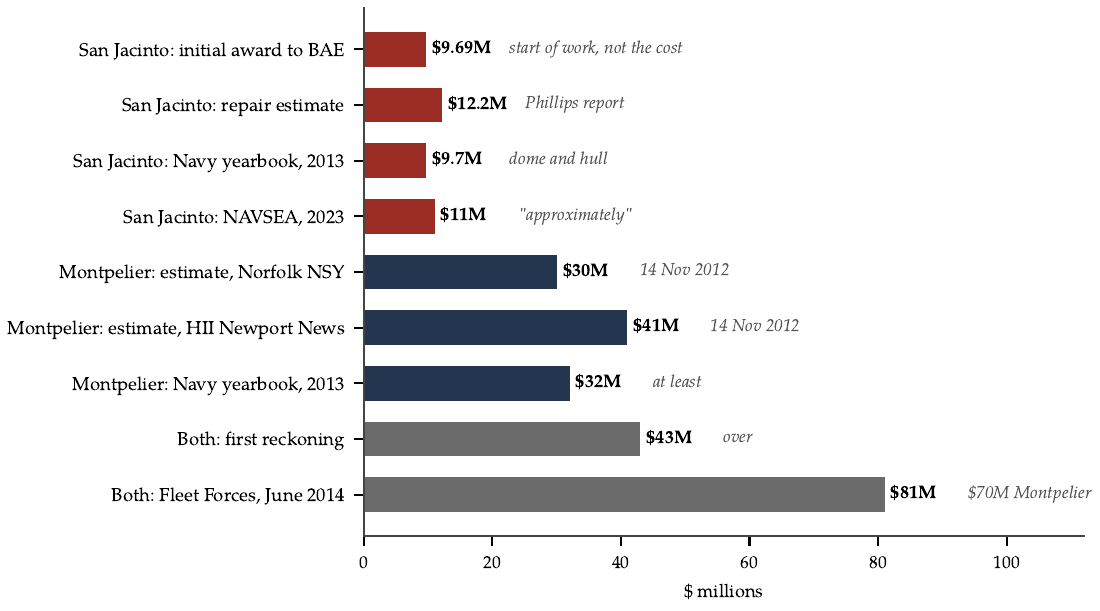
San Jacinto entered dry dock at the BAE Systems yard in Mayport on 1 November, for what the Navy called an emergent dry-docking availability, a repair period arranged at short notice. Its first purpose was the sonar dome and the surrounding hull and equipment, and the Navy said it expected the work to finish in February 2013.54 The repair estimate from the shipyard, passed through the regional maintenance center, stood at about $12.2 million on 7 November. The Navy’s release on the docking named a different figure, an initial award to the yard of $9,691,713 under its existing multi-ship, multi-option contract, which it described as the amount to begin the work and not the cost of the repair; the full cost, it said, would not be known until inspections were complete.54 Montpelier’s estimate, as of 14 November, ran from $30 million at the Norfolk Naval Shipyard to $41 million at Huntington Ingalls Industries in Newport News. The investigators’ first reckoning for both ships was over $43 million. In June 2014 a Fleet Forces spokeswoman put the cost of repairs so far at $81 million, with $70 million of it Montpelier’s.45, 62 A yearbook of the Navy’s year, published in May 2013, gave at least $32 million for the submarine’s inspection, repair and support services, with completion expected by July 2013, and on the order of $9.7 million for the cruiser’s sonar dome and the damage to her hull and equipment.55 The sources do not agree, and the record does not reconcile them.
The investigation
Rear Admiral Phillips was appointed on 15 October 2012. Her deputy was a submariner, whose name is withheld. Her team interviewed more than a hundred witnesses, a number of them after a formal warning of their rights, and visited every ship that had taken part, two of them at sea. It rebuilt the afternoon from the ships’ voyage data, from the combat-system recordings of both surface ships and the helicopters, and from a reconstruction of the submarine’s recorded data by the Johns Hopkins University Applied Physics Laboratory. The report credits Gravely’s accurate data and logs with making much of the reconstruction possible. A separate safety investigation ran at the same time and, under the Navy’s rules for such boards, shared none of its privileged testimony. Phillips signed her report on 18 December, after two extensions, and endorsements followed from the surface force, the submarine force and, on 4 January, from the commander of U.S. Fleet Forces Command.46, 67
The report’s central finding, on the first page of its opinions, was about the submarine. Montpelier’s commanding officer, the investigating officer concluded, had blurred the distinction between an exercise and a tactical or wartime engagement. He rushed the ascent to periscope depth without a good enough solution on the cruiser. He and his watch team failed to detect San Jacinto’s turn to the west and misread her near-zero bearing drift. He lacked a watch team that could back him up. He manned the periscope himself and missed the indicators that might have kept the boat safe. He overrode his own first instinct that something was close. His order after seeing the cruiser was a depth order and not the “emergency deep” that would have begun the immediate-action procedures. And the officers around him, who heard what he did not, did not speak up forcefully. The report called these the direct and proximate causes of the collision. Had he acted on his gut feeling on the first sweep, it said, the boat would most likely have avoided the collision.82
It was not a portrait of a bad officer. The investigators found no abusive or dysfunctional relationships in the boat and nothing abrasive in her captain. They recommended that he be relieved of command and taken to non-judicial punishment for dereliction of duty or negligently hazarding a vessel, and in the same paragraph that he not be made to show cause for staying in the Navy, so that he could go on serving as he had through what they called an otherwise outstanding career. They recommended non-judicial punishment for three of his watchstanders, among them the officer of the deck and the sonar supervisor, and letters of caution for four others, who by their level of experience, the report said, had been unable to keep up with the problem.82
On 4 January 2013 Captain Blake Converse, commander of Submarine Squadron 6, relieved Commander Winter of command because of a loss of confidence in his ability to command. Winter was reassigned to administrative duties on the staff of the Atlantic submarine force, and Commander Stephen Mongold took over the submarine. The Navy’s announcement summarized the findings in three phrases: human error, poor teamwork by the submarine’s watch team, and the commanding officer’s failure to follow established procedures for submarines at periscope depth, with contributing factors among the headquarters that provide training and operational oversight.47, 56 Besides Commander Winter, six of Montpelier’s sailors were formally disciplined, a Fleet Forces spokeswoman said when the report was released.62
The submarine force’s own endorsement went further than the investigator had. The captain, it said, had created an environment that neutralized the force’s long-standing watchstanding practices of “forceful backup” and “defense-in-depth.” The failings looked like the root causes of earlier collisions and groundings, and the endorsement said they called into question commanding officers’ decision-making and the enforcement of standards across the force.81
The report also looked at the people above the two ships. It found that the strike-group commander and the destroyer squadron commodore, trusting their own experience, did not fully appreciate or consider the risk of warships, submarines and aircraft maneuvering at high speed in close proximity, and did not proactively manage that risk in a free-play exercise at a time when the strike group’s surface ships and its submarine had so little experience of one another. The risk-management analysis in the commodore’s concept of operations had considered collisions between surface ships. It had left out a collision between a surface ship and a submarine. The investigating officer held, all the same, that no one in the strike group, the squadron, San Jacinto or Gravely was personally responsible for the direct causes of the collision, and that none of the staffs’ failures relieved the submarine’s captain of his duty to keep his boat clear of surface ships when he came up.48, 84
Two of her opinions, numbers 89 and 90, and two of her recommendations, 6 and 7, are blacked out in the released report. The newspaper account of June 2014 named the two senior officers whose conduct she had judged most harshly: Rear Admiral Sweeney and Captain John Fuller, commodore of Destroyer Squadron 22. What survives is what Admiral Bill Gortney, commander of U.S. Fleet Forces Command, did with those passages. He disapproved both opinions and both recommendations. The two officers had failed to apply rigid operational risk management to the planning and execution of the exercise, he wrote, but their actions did not constitute negligence, and he would personally discuss the day and the investigation with each of them.48, 62, 81
Then he took it on himself. Fleet Forces Command was at the top of the chain, he wrote, and “the failure in the chain of command to properly plan and execute this exercise rests firmly with this endorser.” His command had never issued a commander’s intent for a group sail, so nothing defined the event’s objectives, its command and control, or who owned it; he quoted the surface force commander’s line that a group sail was “an ill-defined concept.” The exercise had been meant as a basic one. Because the units’ experience varied so much, and because surface, air and submarine operations overlapped in ways the planners did not recognize, it had been more complex than anyone intended. A novice, he wrote, may find fundamental exercises complex. The leadership shortfalls were his to fix.63, 81
The surface force commander, Rear Admiral David M. Thomas Jr., added a finding of his own about the commodore’s staff. From June to November 2012 Destroyer Squadron 22 had been the only destroyer squadron in the Atlantic Fleet not deployed, and had carried the administrative load of fifteen ships: inspections, basic training, engineering certifications, maintenance planning. The staff had been split in two to do it, with the deputy commodore left in Norfolk, and its proficiency in anti-submarine warfare, Thomas wrote, was overstated in the investigation. The Atlantic Fleet did not have enough destroyer squadrons.63, 81
Gortney’s endorsement also rewrote a sentence of the executive summary to put the geometry plainly: as Montpelier came to periscope depth, San Jacinto was on a constant bearing with decreasing range, while the submarine’s captain believed she had a slight right drift and an opening range. And it singled out the cruiser’s forward lookout, whose attentive watch in spotting and reporting the periscope about 75 to 100 yards off the port bow had given the ship a last-second chance to avoid the collision. The officer of the deck had acted at once and effectively on the report, it said, but a misunderstanding by a junior watchstander on the bridge kept the ship from taking full advantage of the chance. Emergency procedures had to be instinctive, he wrote, and the only way to make them so was continuous and rigorous drill.63
San Jacinto’s share of the responsibility is in the report too. Her CIC team, the report said, was not fully prepared and showed below-average situational awareness, and its communications with the bridge were poor. But the CIC team’s performance, it added, did not directly or proximately cause the collision. The ship’s two competing priorities, shotgun for the carrier and landing pad for a helicopter, had forced her to move faster than any anti-submarine ship should. Her bridge team’s training had been excellent. And on the final seconds the report was unambiguous in praise: the lookout identified a periscope with no warning and reported it at once, the conning officer reported at once, and the officer of the deck recognized the danger, assessed it correctly, and called for the right bell at once. His quick response, the investigators wrote, slowed the ship and mitigated the effects of the collision.49
Then there was the helmsman. The report said that he had failed to understand that an order from the officer of the deck overrides the presence of the conning officer, and so paused briefly before executing the first order. It said that moving the throttles from all back full to all stop, without being ordered to, was making a decision he was neither trained nor qualified to make. It said that his only intent was to respond to the captain’s comment about the array. It judged him negligent in the performance of his duties. And it noted, in its own opinion, that the collision might have been avoided or further mitigated had the submarine’s emergency deep not been delayed and had the throttles remained at all back full.50
The recommendations at the end of the report read differently from that opinion. Phillips recommended that the helmsman not be punished. He had acted on hearing his captain over the speaker, she wrote, and had believed, for lack of adequate training, that the captain’s wishes about the array were what he should follow.64 The fix she asked for was aimed at the ship and not at him: a full review of San Jacinto’s training and qualification programs, “with emphasis on helmsman and lee helmsman qualification.” A junior sailor at the helm had a sign in front of his face, his captain’s voice on the speaker and two officers giving the opposite order, all inside about five seconds. The report judged him negligent and recommended that he not be punished, and both of those can be true. The released portions of the report do not say who put up the sign, or whether the ship’s standing orders said that a collision overrode it.79
Her other recommendations reached across the fleet. Every surface ship, she wrote, should have a digital voice recorder on the bridge, for training and debriefing every day and to keep a record for future investigators; her own reconstruction of the cruiser’s last seconds would have been far more certain with one. The submarine force should teach the collision to its crews, using the video recorded through Montpelier’s periscope that afternoon, and should check its progress on a 2009 Naval Reactors report on submarine collisions and groundings, which had found common threads in eleven accidents, among them slipping shipboard standards and weak interpretation of sensor data; many of the same threads, she wrote, ran through this collision. Both the surface and submarine forces should teach their prospective commanding officers about forceful backup, and about a captain’s “gut feel” as the most experienced ship driver aboard. The strict safety preparations that preceded the large certification exercises should be required for any exercise in which submarines and surface ships operated together: a familiarization or tracking event before anything more complex, every player including the submarine at the pre-sail conference, and agreed communications checks as a condition of starting at all. And the surface force should keep at the problem the Navy called fit and fill, the business of keeping a ship’s manning stable in the months before she deploys.64, 80
The crew had their own way of putting it. In the years afterward, men and women who had been aboard described the collision to one another in a few phrases. One, as shipmates recalled it, was that it was less like being hit than like having a deer walk into the road in front of your car. A submarine that comes up from below, inside the screen, at close range, at periscope depth, in a moderate sea, leaves a bridge team about as many choices as a driver has with a deer. Another, from a sonar technician, was that even with Prairie and Masker running the ship had never been quiet, and that the submarine should have heard her. The investigation is on the sonar technician’s side. The cruiser was on the submarine’s sonar for the whole approach, and the report’s long list of what the boat’s watch team missed is a list of ways of not hearing a ship that was there to be heard. Others raised a different question about the sonar itself: the rumor that the ship was one of two cruisers still carrying her original sonar suite, and whether the Navy would give her a newer one.51 Years later a sailor who had been aboard marked the anniversary by recalling the long wait for word from the submarine.66 These are recollections, not findings, and no published document answers the question about the sonar.
What followed
The ship went at five knots to Mayport, where, the Navy’s release says, she arrived on 14 October, the same day that Montpelier reached the submarine base at Kings Bay, Georgia.57 Mayport was not her home port, which was Norfolk, but the Florida base nearest the training area, and she would spend her repair period there. She went into dry dock at the BAE Systems yard on 1 November. In January 2013 the press reported that about three hundred of her sailors would not deploy as planned the next month, that San Jacinto would remain in Florida under repair, and that another ship would take her place; on 18 January a crew member’s family reported that she was still in dry dock.52 She would be repaired. She would deploy with the Truman strike group on 22 July 2013, a little more than nine months after the collision, and she would come home in April 2014.
Admiral Gortney’s endorsement is dated 4 January 2013. The Navy released the investigation, heavily redacted, in June 2014, in answer to a Freedom of Information Act request by news organizations, by which time the ship was home from the deployment the collision had delayed. Gortney’s endorsement was blunt about the lesson. “The number one priority in any exercise is safety,” he wrote. “This must be ingrained in our naval force. Regrettably, it is not.” And at the end: “We will not repeat this failure.” In September 2014 the Navy’s Inspector General, inspecting the Naval Safety Center, listed the collision among recent mishaps in which operational risk management had failed. There had been, the inspectors wrote, no overarching risk assessment for the exercise, for its scheme of maneuver, or for its separation of water space.53, 81
The collision was counted among the Navy’s worst afloat accidents of the year. The yearbook of May 2013 placed it with the collision of the amphibious assault ship Essex and a Military Sealift Command oiler off California in May 2012 and the collision of the destroyer Porter with a merchant tanker in the Strait of Hormuz in August, among the accidents of the most serious class, which the Navy defines as one that costs more than a million dollars, destroys a vessel or aircraft, or causes a death or total disability. It quoted Admiral Gortney as saying that mishaps at sea, of ships and submarines, had left him an “$850 million, unforecasted maintenance bill,” a total that included a submarine set on fire by a shipyard worker, an event that was not an afloat mishap.58
A newspaper in New London, Connecticut, home of the submarine force, studied Naval Safety Center data on submarine accidents in 2014. It counted 906 from late 2004 through 2013, of which the most severe, this collision among them, were about two percent. The submarine force had no accident of the most serious class in fiscal 2012 and four in fiscal 2013. The submarine force commander, Vice Admiral Michael Connor, said that the collision and other near misses had got his attention in a very big way, and he listed what had changed since: submarine crews trained more often for scenarios harder than they were likely to meet at sea; junior officers stayed on their first submarine for 36 months instead of 32; the work rotation was altered so that sailors slept eight hours at about the same time each day, not six, on the findings of the Navy’s submarine medical research laboratory; reporting of small problems was made easier; and the planning of exercises with several ships was improved so that every participant knew the safety plan.59
For San Jacinto herself the lessons came as orders. The surface force was told to review her training, her qualification programs, her watch bills and her personnel management, to re-establish her certifications against what the investigation had found, and to support whatever extra training it took to get her back on her schedule when the repairs were done. It was also told to check the time inputs to every automated system aboard, from the machinery control system and the bell logger to the gyrocompasses and the command and display consoles. The fifty-three seconds between two of her clocks had been corrected for in the reconstruction and never explained. All of them were supposed to take their time from one source, and the investigators wrote that after considerable effort they could not say why they had not.64, 70 In June 2014 Rear Admiral Pete Gumataotao, who commanded the Atlantic surface force, told a Norfolk newspaper that the Navy had updated its procedures and that ships and submarines now completed more basic exercises together before attempting a full group sail.62
The collision took a few seconds, and the Navy spent the better part of two years explaining it. For the crew it settled into the ship’s reputation: the cruiser that fired the first Tomahawk became the cruiser that hit a submarine. The investigation does not support the joke. It found a submarine that came up under a ship it had lost track of, a strike group that had sent a short-handed cruiser sprinting after a carrier in the middle of a submarine hunt, and a bridge team that did nearly everything right in the few seconds it was given. The ship the report describes, short of operations specialists, with more than a quarter of her maintenance spot checks failing and equipment out of commission from the engine room to the sonar, is the ship the rest of this history follows into her last decade.
Notes
- Rear Adm. Ann C. Phillips, USN, Command Investigation into the Collision involving USS San Jacinto (CG 56) and USS Montpelier (SSN 765), 18 December 2012, as released in redacted form by the Navy in June 2014 (hereafter “Phillips”). The account of the release is from Human Factors Industry News 10:13 (29 June 2014), “Navy: Human error led to submarine collision.” Findings of Fact are cited as FOF, Opinions as Op. Where the released scan is garbled, the text of the findings is preferred to the numbering. ↩
- Phillips, FOF 107 (the captain had been in command 15 days; the date of 28 September agrees with the uscarriers.net chronology) and FOF 108 (the strike-group commander’s remarks and the warfare commanders’ conference of 17–28 September). ↩
- Phillips, FOF 109. ↩
- Phillips, FOF 110–112. The officer of the deck’s career is given in the report; he is identified here only by billet. ↩
- Phillips, FOF 113–114. ↩
- Phillips, FOF 121–131 (the report’s manning table is garbled in the released scan; the figures used are those in the text of FOF 124–130). ↩
- Phillips, FOF 127–128, 132–134. ↩
- Phillips, FOF 138. ↩
- Phillips, FOF 138–139, 794. The description of the Prairie and Masker systems is general naval engineering. ↩
- Phillips, FOF 799, 814, and the footnote to FOF 135. The description of active and passive sonar is general. ↩
- Phillips, Preliminary Statement and FOF 113 (group sail schedule, 1–25 October); Executive Summary (2–20 October); uscarriers.net chronology (group sail of 7 October 2012). The three sources do not agree and the discrepancy is not resolved here. ↩
- Phillips, Executive Summary ¶2 and ¶8; FOF on the design of ASWEX 13070. The characterization of the Los Angeles class and the explanation of “relaxations” are general. The submarine’s homeport is not given in the released portions consulted and is omitted. ↩
- Phillips, FOF 781. ↩
- Phillips, FOF 782–784. ↩
- Phillips, FOF 786–790. The description of the NIXIE is general. ↩
- Phillips, FOF 851 and Op 11. ↩
- Phillips, FOF 800–803, 809. ↩
- Phillips, FOF 805–811. ↩
- Phillips, FOF 812. ↩
- Phillips, FOF 818–820. ↩
- Phillips, Op 67–69. ↩
- Phillips, FOF 813–815, 821. ↩
- Phillips, Op 66; FOF 794, 816, 818–819. ↩
- Phillips, FOF 796; Op 70. ↩
- Phillips, FOF 26–45, 74–106; Op 15–29. ↩
- Phillips, Executive Summary ¶4–5. The submarine’s depth is redacted in the released report. ↩
- Phillips, Executive Summary ¶6; Op 6–10. ↩
- Phillips, FOF 822–823. ↩
- Phillips, FOF 826–828. ↩
- Phillips, FOF 829–832 (the conning officer’s estimate of the distance is given in feet in the report and varies between interviews; the range in yards used here is the lower to the upper estimate). ↩
- Phillips, FOF 833–839. ↩
- Phillips, FOF 840–844. ↩
- Phillips, FOF 846–849, 851; Op 11. The words used on the bridge are recorded in the report and are paraphrased here. ↩
- Phillips, FOF 850–856, 859–861 and the table following FOF 861. The Dictionary of American Naval Fighting Ships, vol. III, gives the collision at about 1550; that figure does not agree with the data-derived time in the report (1927:15 Zulu, 1527 local) and the report is preferred. ↩
- Phillips, FOF 845, 859. ↩
- Phillips, FOF 857–858. ↩
- Phillips, FOF 862–863, 867. ↩
- Phillips, FOF 864, 869–871, 874. ↩
- Phillips, FOF 865–866, 868. ↩
- Phillips, Op 77. ↩
- Phillips, FOF 872–877. ↩
- Phillips, FOF 878–884; Op 76. ↩
- Phillips, FOF 1024–1027. ↩
- Phillips, FOF 1021–1023. ↩
- Phillips, FOF 1023, 1028; Executive Summary ¶9. The later cost figures are from press reporting in 2014; the first reckoning of “over $43 million” is also reported in Human Factors Industry News 10:13. ↩
- Phillips, Preliminary Statement; the endorsement dates are from the Navy’s release. ↩
- Phillips, Op 1–10, 16–18 and the Direct and Proximate Causes sections; the relief of the submarine’s commanding officer is reported in Human Factors Industry News 10:13 and in Navy announcements of 2012–13. ↩
- Phillips, Op 13–14; the endorsement of Adm. William E. Gortney, 4 January 2013. ↩
- Phillips, Op 65–71. ↩
- Phillips, Op 12, 72–74; the finding of negligence is in the report’s opinions on individual conduct (the number is unclear in the released scan). ↩
- Crew recollection (online posts by former crew members, 2012–2020). The rumor concerning the sonar suite is not corroborated by any document consulted. ↩
- Press reports of January 2013; crew recollection; uscarriers.net chronology (deployment of 22 July 2013 and return of 18 April 2014). ↩
- Endorsement of Adm. William E. Gortney, 4 January 2013, as quoted in Human Factors Industry News 10:13; Naval Inspector General, Command Inspection of Naval Safety Center, 15 September 2014 (the collision is cited twice, as an operational-risk-management failure). ↩
- Navy news release, “USS San Jacinto Enters Dry Dock,” from the Naval Sea Systems Command Office of Corporate Communication, Mayport, Fla., story NNS121102-14, 2 November 2012 (U.S. Department of Defense Information/FIND, ProQuest document ID 1129584164): entry on 1 November; the initial award of $9,691,713 under the yard’s existing multi-ship, multi-option contract; completion expected in February; full cost not yet known. The $12.2 million estimate is from the command investigation (see note 45). ↩
- Scott C. Truver and Gary E. Holzer, “U.S. Navy in Review,” U.S. Naval Institute Proceedings 139, no. 5 (May 2013): 60–68 (ProQuest document ID 1355953302): at least $32 million for the submarine, completion expected by July 2013, and repairs to the cruiser “on the order of $9.7 million.” The $81 million total and the division of $70 million to the submarine are from press reporting of 2014 (note 45). ↩
- Navy news release, “USS Montpelier Commanding Officer Relieved of Duty,” from U.S. Fleet Forces Command Public Affairs, Norfolk, story NNS130104-11, 4 January 2013 (U.S. Department of Defense Information/FIND, ProQuest document ID 1266805464). The release gives the principal cause as human error, poor teamwork by the watch team and the commanding officer’s failure to follow established procedures for submarines operating at periscope depth. ↩
- Navy news release, “USS Montpelier and USS San Jacinto Pierside,” from U.S. Fleet Forces Command Public Affairs, story NNS121014-09, 14 October 2012 (U.S. Department of Defense Information/FIND, ProQuest document ID 1112254353). The release places both ships’ arrival in port on 14 October, Montpelier at Naval Submarine Base Kings Bay (the state is not named in the release) and San Jacinto at Naval Station Mayport. ↩
- Truver and Holzer, “U.S. Navy in Review” (note 55), section on mishaps, quoting Christopher Cavas of Defense News (early February 2013) and Admiral William Gortney. The article names the Guardian incident, the Essex–Yukon collision of May 2012, the Porter collision of August 2012 and this collision as the afloat accidents of the highest class in 2012–13, and its definition of that class is the one given in the text; the class letter is garbled in the copy read. ↩
- Jennifer McDermott, “Major submarine accidents remain isolated but costly,” The Day (New London, Conn.), distributed by McClatchy-Tribune, 31 March 2014 (ProQuest document ID 1511373744): 906 submarine accidents from late 2004 through 2013, from Naval Safety Center data obtained under the Freedom of Information Act; the most severe about 2 percent; no Class A mishap in fiscal 2012 and four in fiscal 2013, this collision among them; Vice Adm. Michael J. Connor’s account of the changes. ↩
- Truver and Holzer (note 55): the bridge watch saw the submarine rise to periscope depth “about 200 yards ahead”; McDermott (note 59): 100 to 200 yards; the command investigation (notes 30 and 31): periscope between twenty and ninety yards by the conning officer and lookout, about 100 yards by the officer of the deck. Time: pierside release (note 57), “approximately 3:30 p.m. Eastern Daylight time”; investigation, 1927:15 Zulu. ↩
- U.S. Senate, Committee on Commerce, Science, and Transportation, nominee questionnaire of Ann Claire Phillips, December 2021 (nomination as Maritime Administrator, 21 October 2021): commands of USS Mustin (DDG-89), 2001–2004, Destroyer Squadron 28, 2007–2008, and Expeditionary Strike Group Two, 2012–2013; her appointment as investigating officer on 15 October 2012 and the conclusion of the investigation on 18 December 2012. ↩
- Corinne Reilly, “’Sub, dead ahead!’ New Navy report dissects collision at sea,” The Virginian-Pilot, 17 June 2014, as published by Stars and Stripes (archived 1 December 2017): release of the report more than a year after it was requested; Rear Admiral Kevin Sweeney and Captain John Fuller; Admiral Gortney’s endorsement on negligence; six Montpelier sailors disciplined besides the commanding officer and repairs of $81 million, $70 million of it for Montpelier, both from a Fleet Forces spokeswoman; the statement of Rear Admiral Pete Gumataotao, Naval Surface Force Atlantic. ↩
- Command investigation (note 1), endorsements, PDF pp. 1–11: the Fleet Forces Command endorsement of 4 January 2013 on the absence of a commander’s intent for group sail, its modification of the executive summary on bearing and range, and its remarks on the forward lookout, the officer of the deck and “a junior bridge watch stander”; an earlier endorsement on Destroyer Squadron 22 as the only non-deployed destroyer squadron in the Atlantic Fleet from June to November 2012, with administrative control of fifteen ships. ↩
- Command investigation (note 1), recommendations, PDF pp. 154–163: recommendation 5, that the helmsman not be punished; bridge digital voice recording for all surface ships; review of periscope-depth search techniques using the video recorded from Montpelier’s periscope; review of the Naval Reactors 2009 report on submarine collisions and groundings (eleven accidents); safety preparations for any combined submarine and surface-ship exercise; and the Naval Surface Force Atlantic recommendations on San Jacinto’s training, qualification, watch bills, personnel management, certification and the time inputs to her machinery control system, bell logger, WSN-7 gyrocompasses and command and display system. ↩
- U.S. Navy, “No injuries as two US Navy vessels collide off Eastern US Coast,” Defense Visual Information Distribution Service story 96137, Norfolk, 13 October 2012. ↩
- Crew recollection, posted on the ninth anniversary of the collision. ↩
- Preliminary statement, PDF pp. 14 to 16 (over 100 witnesses; rights advisements; two extensions; concurrent Safety Investigation Board; reconstructions by APL, Submarine Squadron 12’s tactical analysis group, the Aegis center at Dahlgren and the Surface Warfare Officers School; Gravely’s data). Opinion 92, PDF p. 153: no digital voice recording in surface combatants, San Jacinto’s ability to record Net 15 inoperable, the submarine’s “open mic” recording “highly valuable.” ↩
- FOF 113 to 118, PDF pp. 34 to 36: anti-submarine training complete 20 July 2012; Basic Phase complete 4 September, delayed by equipment casualties, tasking and proficiency; work with a live submarine at AUTEC during the Basic Phase; first live anti-submarine event under the current captain. ↩
- Opinions 33 and 34, PDF p. 138. FOF 129 to 133, PDF p. 39 (the two chiefs; the manning message of August 2012; which watch bills were signed). ↩
- Recommendations 23c, 28 and 34, PDF pp. 160 to 163: the 53-second difference between the inertial navigation system and the bell log “could not be fully explained after considerable efforts by the investigation team.” ↩
- Opinions 36, 37, 40 to 43 and 46 to 51, PDF pp. 139 to 142: first live submarine event for a newly formed strike group; the event “mis-labeled as a TRACKEX”; familiarization and tracking events scheduled for the following day; no track in the message; the submarine captain’s reading “reasonable”; the staffs unaware of or not considering the ship’s state of training; the submarine not at the pre-sail conference; underwater telephone communications never tested. ↩
- Executive summary, paragraph 9, PDF p. 19 (no pre-exercise brief; no fathometer familiarization; no guidance aboard the submarine for the class she was to simulate). Fleet Forces endorsement, paragraph 5(c), PDF p. 3 (fourteen months). ↩
- FOF 885 to 923, PDF pp. 119 to 122 (the staff’s morning; the P-3 at 1622; the carrier’s flight cycle; best speed ordered; Gravely’s two contacts; reports at 1904 and 1922; the “feather” call and its retraction, FOF 919). FOF 793 and 797, PDF p. 110 (active sonar directed at 1625; the helicopters’ contact at about 1654). FOF 803 says the captain found the anti-submarine watch condition not set at the start; FOF 793 says permission to set it was given at 1625. The report records both. ↩
- FOF 792, PDF p. 110. Staff backgrounds: FOF 140 to 143, PDF p. 41; Opinion 32, PDF p. 138. ↩
- FOF 829 to 851, PDF pp. 113 to 115. The words quoted are as the report prints them from the witnesses’ statements. ↩
- FOF 435 to 471, PDF pp. 75 to 78 (62 feet at 1926:20; two sweeps in about 16 seconds; the mast seen only on a paused frame; 150 feet, then 60 feet; mast height 172 feet, six divisions, about 575 yards; emergency deep called at 1926:43 and ordered at 1926:45; the captain’s words at 1927:05; a knot and a half; two impacts two seconds apart). ↩
- FOF 473 to 512, PDF pp. 78 to 81 (the jammed rudder; the outboard; four thousand pounds light aft; steerageway at 2022; the underwater telephone and the SOS; the flares; the periscope; periscope depth at 2037). ↩
- FOF 925 to 943, PDF pp. 122 and 123. ↩
- Opinion 11, PDF p. 135 (the sign’s wording, given by the report as “or words to that effect”). Opinions 72 to 74 and 88, PDF pp. 149 and 152. Recommendations 5 and 31, PDF pp. 155 and 163. ↩
- Recommendations 8 to 22, PDF pp. 156 to 159. ↩
- Endorsements, PDF pp. 1 to 11: Commander, U.S. Fleet Forces Command, 4 January 2013 (pp. 1 to 5); Commander, Submarine Force Atlantic, 21 December 2012 (pp. 6 to 9); Commander, Naval Surface Force Atlantic, 21 December 2012 (pp. 10 and 11). The surface force endorsement is signed “D. M. Thomas, Jr.”; the full name and rank given in the text are from general knowledge and should be confirmed unconfirmed. ↩
- Opinions 1 to 10, 16 to 31 and 52 to 64, PDF pp. 134 to 147 (the submarine’s captain, crew, turnover, routine, data collection, night orders and tripwires; the 1926 fire-control solution is FOF 432, PDF p. 75). Opinion 59 (no abusive or dysfunctional relationships). Recommendations 1 to 4, PDF pp. 154 and 155. ↩
- FOF 872 and 882, PDF p. 118. Opinions 75 to 79, PDF pp. 149 and 150. ↩
- Opinion 80, PDF p. 150. Opinions 89 and 90 and recommendations 6 and 7 are redacted (PDF pp. 152 and 156); their disapproval is in the Fleet Forces endorsement, paragraphs 6(c) and 7(b), PDF p. 4. ↩