Part Six: Second Wind (2013–2022)
Chapter 20Mending
The cruiser came into Mayport, Florida, at five knots in the days after the collision. The damage was to her bow and to the rubber-and-steel dome beneath it that held her main sonar. Her engines were sound, her missiles were in their cells, her combat system worked and none of her crew had been hurt, but until the dome was rebuilt she could not listen for submarines.
In the seven years that followed she was repaired, sent on two more deployments, sent to sea ahead of two hurricanes and to the Florida Keys after a third, given four new captains, and visited in a Norfolk shipyard, on a January weekend in 2018, by the men who had first taken her to sea. The collision was one of four serious accidents at sea that the Navy suffered in 2012 and 2013, each costing more than a million dollars, and in the magazine Proceedings’ review of the Navy’s year the unbudgeted repair bills were counted among the pressures on a fleet’s maintenance budget already squeezed by the defense spending crisis of those years.35
The winter in the yard
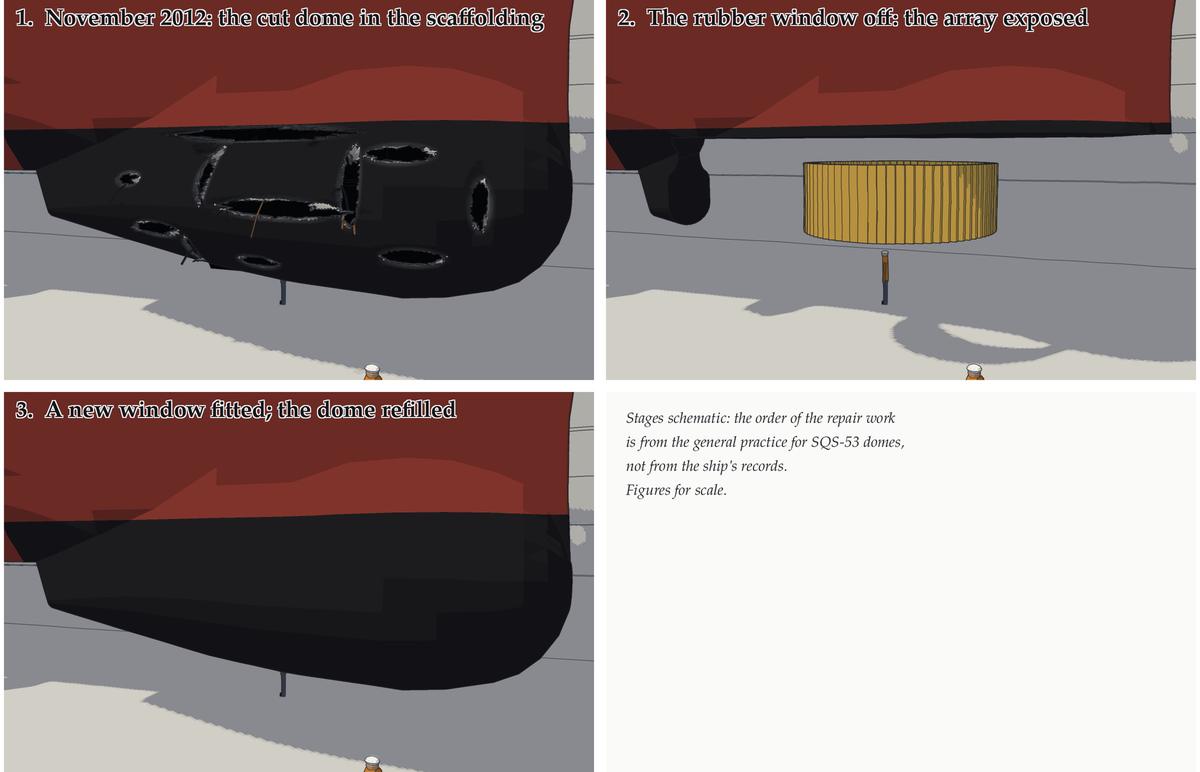
A cruiser’s sonar dome is her ear. A ship that hunts submarines carries her principal sonar in a streamlined blister beneath the bow, where it is clear of the noise of the engines and the water flowing along the hull. Inside the dome are the transducers, hundreds of elements that send out sound and listen for the return, and around them the dome is filled with water held at a carefully regulated pressure. When the dome is cut open, as hers had been in sixteen places, the pressure cannot be held and the sonar is useless. The dome, moreover, is part of the hull’s underwater shape: damaged, it makes the ship noisy as well as deaf.
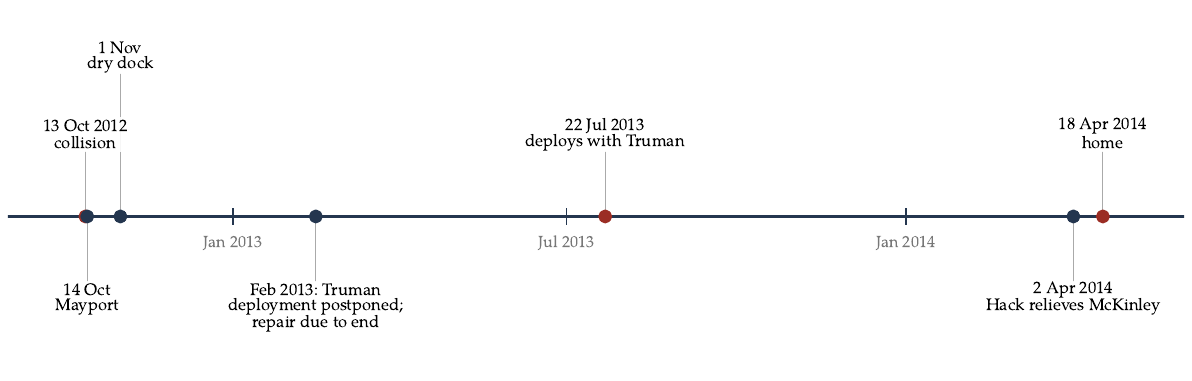
The shipyard’s first task, after the inspectors had measured the damage, was to dock her. A dry dock is a basin that can be flooded to let a ship float in and then pumped dry, so that the ship sits on blocks with her whole underwater hull exposed to the workers. By 1 November 2012 San Jacinto was in the dry dock of the BAE Systems yard at Mayport, with scaffolding around her bow. The Navy’s release on the docking, issued on 2 November, announced an initial award of $9,691,713 to the yard under its existing multi-ship, multi-option contract. It described the work as an emergent dry-docking availability, a repair period arranged at short notice, whose first purpose was the sonar dome and the surrounding hull and equipment, gave February as the expected end of the repair, and added that the full cost would not be known until inspections were complete. A repair estimate of about $12.2 million passed through the regional maintenance center in the second week of November. The Navy’s own historical evaluation of the ship, written eleven years later, would put the repairs after the accident at approximately $11 million.1
In dry dock a ship’s electrical power, water and sewage come from the shore, and her galley and heads may be out of service, so the crew moves out. The investigation was being written while the welders worked.
Mayport lies on Florida’s Atlantic coast, near Jacksonville, many hours’ drive south of Norfolk, and it was not San Jacinto’s home. Her home port was Norfolk, and the husbands, wives and children of her crew lived in and around it. By the recollection of crew members, the Navy did not move those families to Florida. The crew stayed there for the whole of the yard period while their households stayed in Virginia, and the ship came back to Norfolk only briefly before she was sent out again on deployment. Why the Navy chose a Florida yard no document in the surviving record says; the explanations that went around the crew were their own. What sailors remember with more certainty is the cost. A long separation from home, followed almost at once by a deployment, strained marriages, and sailors from the ship recall that a number of them ended in divorce.
Count it from the crew’s side. The ship sailed on 7 October 2012 for what was meant to be a few weeks of exercises. She did not come home to Norfolk for months, and when she did it was to get ready to leave for nine more. A sailor who was aboard for all of it spent the better part of a year and a half away from home because of fifteen seconds on a Saturday afternoon.
The winter was also a time of anxiety about the schedule. The Truman strike group was due to deploy in February 2013 and the cruiser had been meant to go with it. The Navy’s account of that deployment records that it had originally been scheduled for February 2013 and was delayed just before the group’s planned departure.2 In January 2013 the regional press reported that roughly three hundred sailors would not deploy the following month as originally planned, that San Jacinto would stay in Florida, where she was under repair, and that another ship would take her place. A family member wrote on 18 January that she was still in dry dock. Another, whose wife served in a different ship, wrote that her ship was taking the cruiser’s place. The ship had lost her turn.2
Crew members later spoke of a rumor, which no document confirms, that San Jacinto was one of two cruisers still carrying her original sonar system, and that the Navy might replace it with a newer one after the accident. A sonar technician of those years puts the number at three ships. Either way the newer sonar did not come. What they remembered with more certainty was that the dome was rebuilt, tested and returned to service, and that when the ship went to sea again, her sonar worked.3
The Navy’s supply system left a small trail of notices in the same months. On 25 March 2013 the Defense Logistics Agency’s supply center in Columbus, Ohio, posted a solicitation for motor stators for the ship, with responses due on 9 April, and on 25 April it posted another for a fluid pressure regulating valve, due on 10 May. The notices do not say what the parts were for, and the record does not connect them to the collision repairs.22
While the ship sat in the dock, an account of the watchbill her former commanding officer had tried in 2010 reached print in the Naval Institute’s Proceedings for January 2013. The Surface Navy Association gave the article its literary award for 2013 at its symposium on 15 January 2014, while the ship was deployed.23 The watchbill the article praised was no longer in use aboard the ship it had been written about.
The 2013–2014 deployment
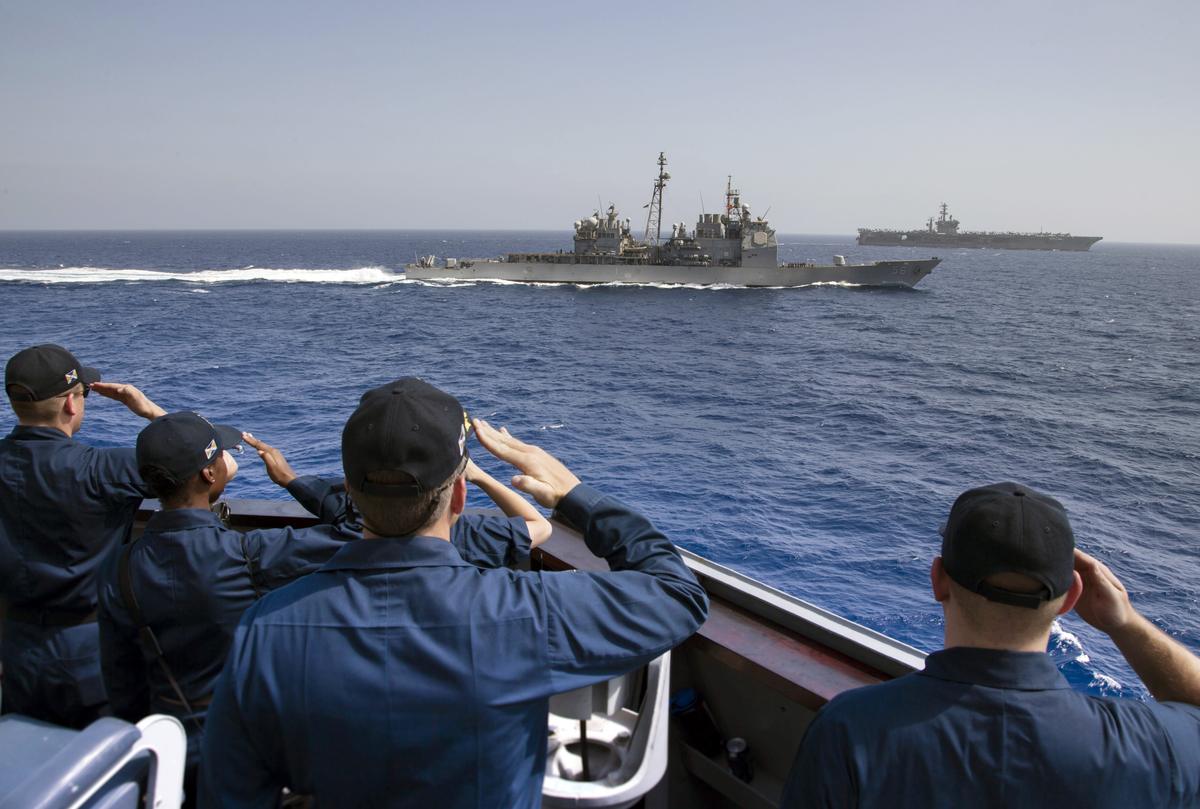
The ship left Norfolk on 22 July 2013 with the Harry S. Truman Carrier Strike Group, about nine months after the collision, for what the Navy announced as an eight- to nine-month deployment to the U.S. Fifth and Sixth Fleets.4 (A Navy “numbered fleet” is a regional command: the Sixth Fleet covers the Mediterranean and surrounding waters, and the Fifth Fleet the Red Sea, the Persian Gulf and the Arabian Sea.) The strike group that sailed that July comprised the carrier Truman, the cruisers San Jacinto and Gettysburg, the destroyers Bulkeley and Mason, and Carrier Air Wing 3 with its nine squadrons of aircraft. The captain who took San Jacinto out, William McKinley, was the same officer who had commanded her on the day of the collision.4
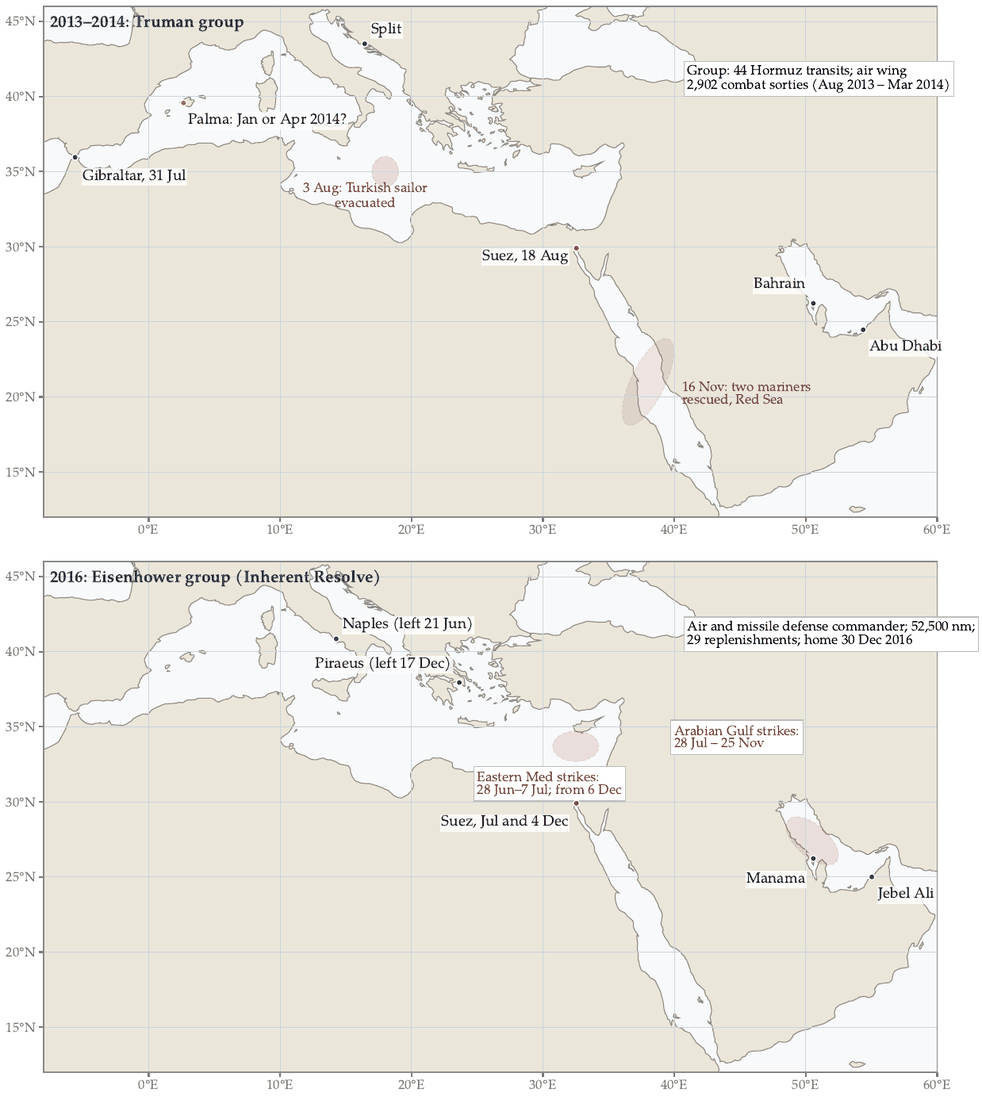
The group entered the Sixth Fleet area in the last days of July, San Jacinto with Mason and Bulkeley on the twenty-sixth and the carrier on the twenty-ninth, and passed through the Strait of Gibraltar into the Mediterranean on the thirty-first. A bridge team, a Navy release noted afterward, handled that windy transit well, and the group’s ships, on finishing their time in the Sixth Fleet area, would move on to the Fifth Fleet area for maritime security operations and cooperation with regional navies.4
The air wing in the carrier consisted of Strike Fighter Squadrons 32, 37 and 105, Marine Fighter Attack Squadron 312, Airborne Early Warning Squadron 126, Electronic Attack Squadron 130, Helicopter Sea Combat Squadron 7 and Helicopter Maritime Strike Squadron 74. The group also carried the staff of 1st Combined Destroyer Squadron and was accompanied by the Military Sealift Command fast combat support ship Arctic, a large supply ship that carries fuel, ammunition and stores for the ships around her.4, 8
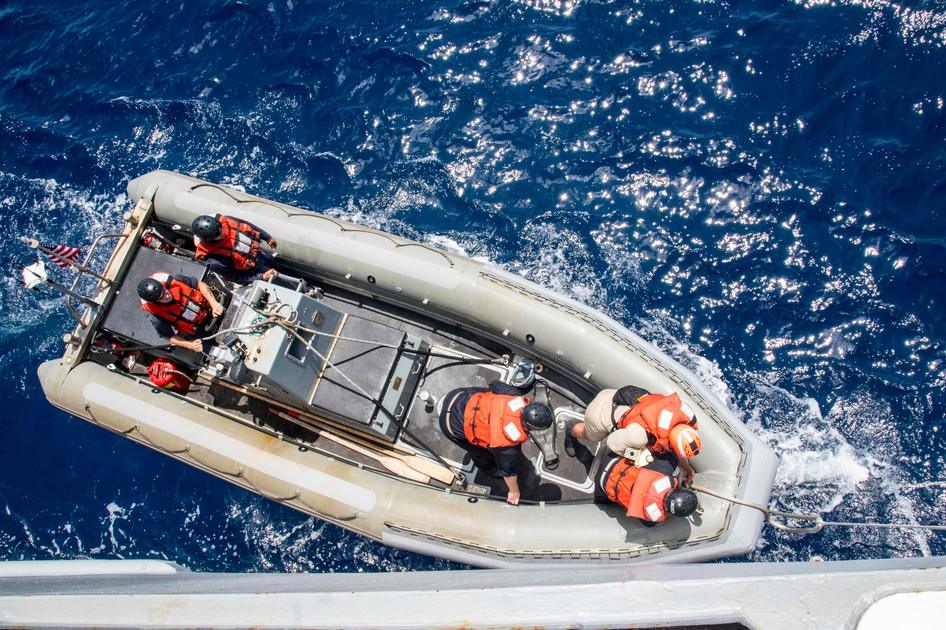
At a few minutes before eleven o’clock on the night of 3 August, the Turkish Navy ship Cezayirli Gazi Hasan Paşa called San Jacinto, which was crossing the central Mediterranean, to ask for transport for a mariner who needed immediate medical attention. Her commanding officer said afterward that his watch team took the call at more than 130 nautical miles, which is extreme range for bridge-to-bridge radio. The cruiser turned toward the Turkish ship, and the Truman’s senior medical officer, speaking over the radio, advised the cruiser’s people on how to stabilize the patient. The cruiser sent her rigid-hull inflatable boat across, brought the patient back aboard, and passed him to a helicopter to the naval hospital at Sigonella, Sicily. The Navy’s release reported the patient in stable condition. Rear Admiral Kevin Sweeney, the strike-group commander, praised the cruiser’s crew for the rescue, as did Captain McKinley, who praised his own crew and the strike-group staff alike.5
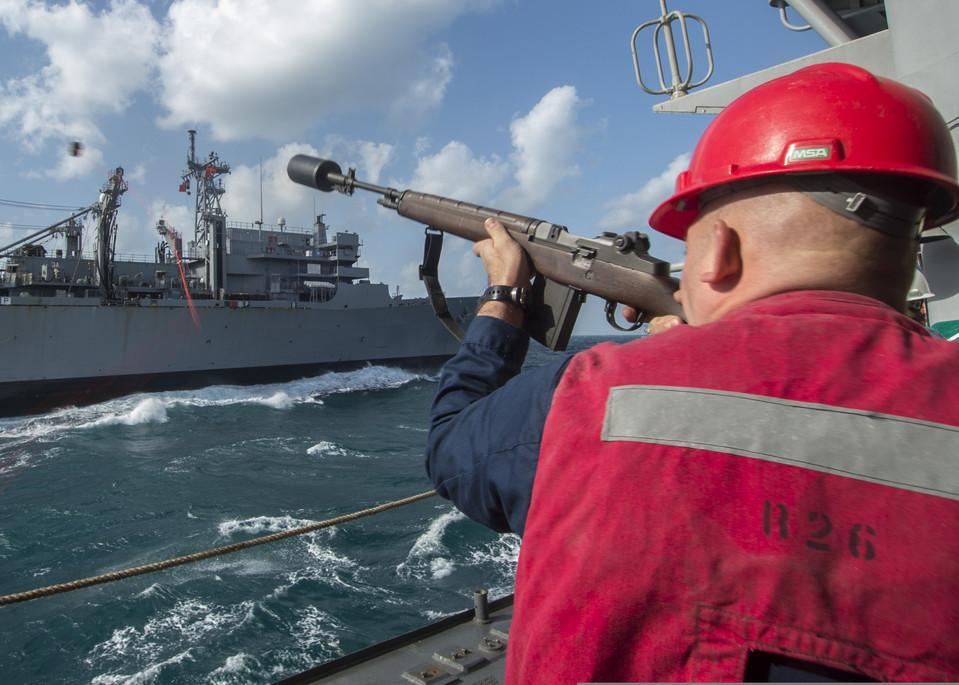
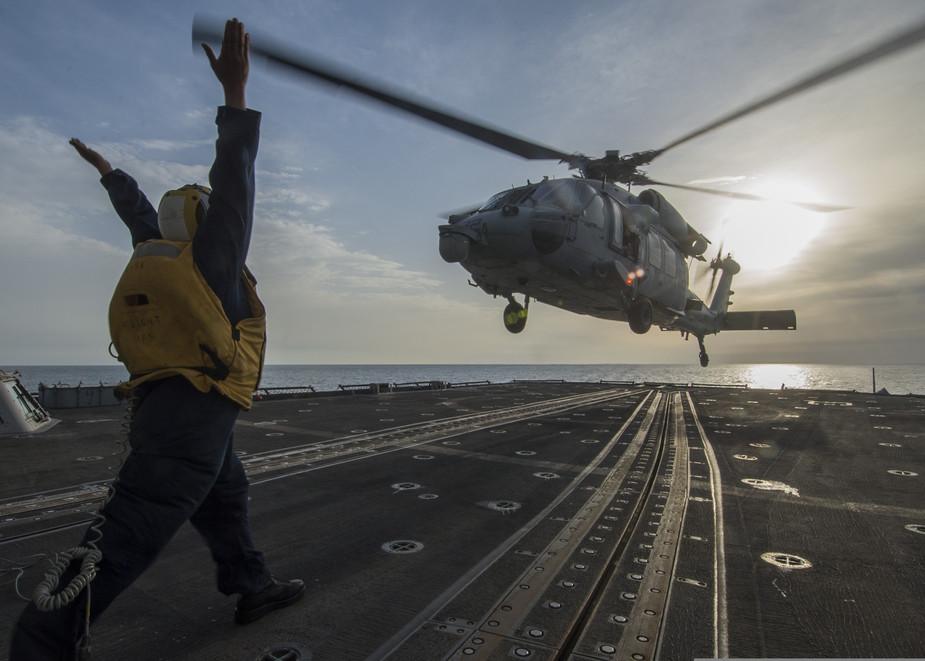
On 18 August the cruiser led two destroyers through the Suez Canal, in a transit the Navy photographed, and the strike group entered the Fifth Fleet area and the Red Sea. The photograph shows a warship in a desert. On 21 August the cruiser’s deck crew was refueling a Seahawk helicopter of Helicopter Maritime Strike Squadron 74 at sea.6
The group’s mission was, formally, maritime security operations, cooperation with regional navies, and support for Operation Enduring Freedom, the American-led war in Afghanistan, to which the carrier’s air wing contributed. The air wing flew 2,902 combat sorties, more than 16,450 flight hours, between 27 August 2013 and 19 March 2014. The ships of the group made forty-four transits of the Strait of Hormuz, the narrow entrance to the Persian Gulf, and two of the Suez Canal.7
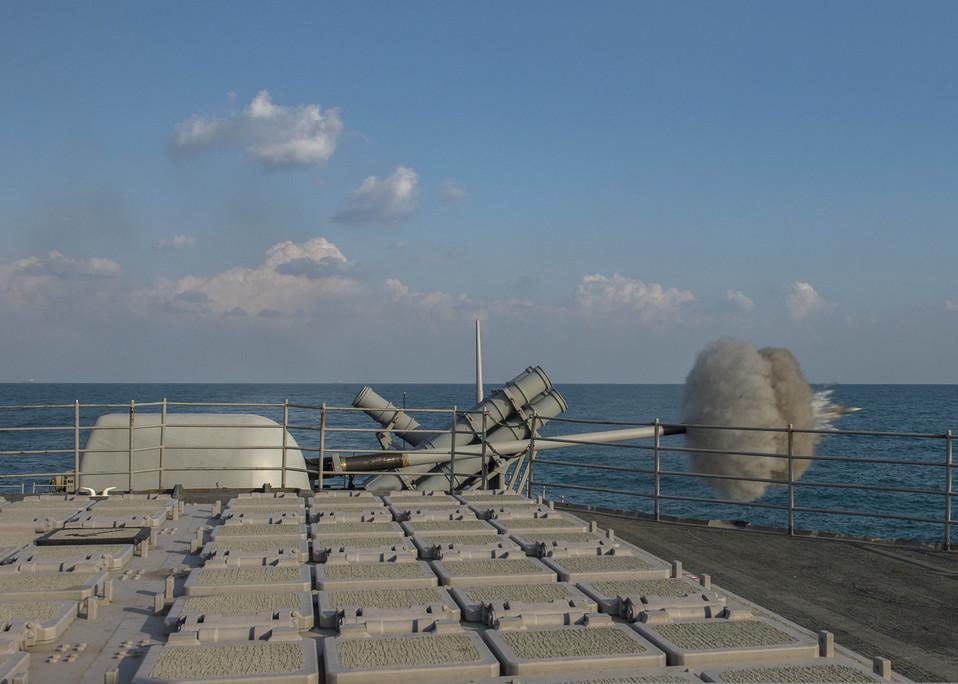
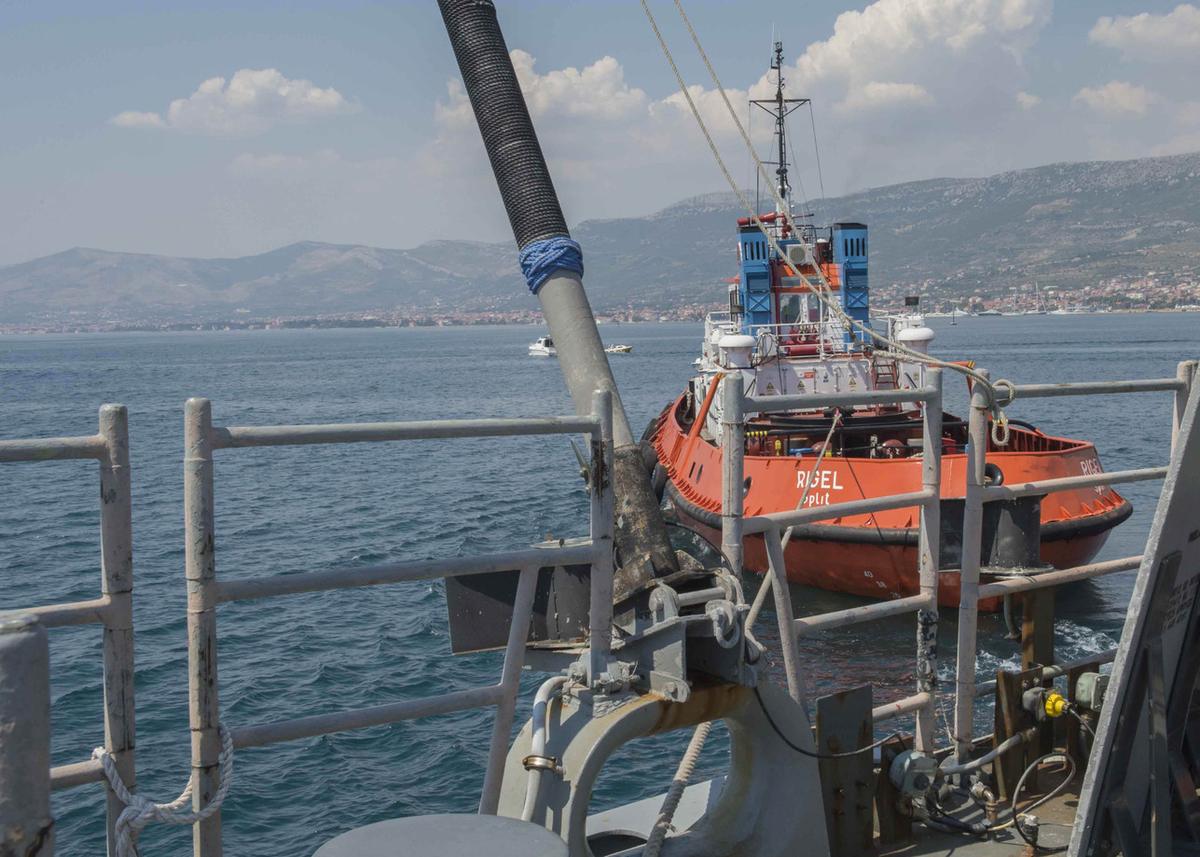
The chronology of the cruise records other scattered events. On 16 November 2013 San Jacinto was reported to have rescued two mariners who had been adrift in the Red Sea for two days. On 23 December she carried out a live gunnery shoot with her five-inch gun. Crew photographs also place her at Split, in Croatia, during the deployment.37 Earlier in the month, on 2 December, the Navy Exchange Service Command had listed her among forty ships and submarines deployed over the holidays whose crews were each to receive a free ten-dollar phone card. In January 2014 she operated with the French Task Force 473, and the chronology places calls at Bahrain, Abu Dhabi and Palma de Mallorca in that month. A Navy release dated 3 April 2014, however, reports her arrival at Palma for a scheduled port visit, as part of the strike group’s deployment, meant to strengthen maritime partnerships with European nations; it calls her a destroyer, which she was not. The record does not settle whether she called at Palma twice or one of the dates is wrong.8
The cruise had one episode of that kind that families remember too. In January 2014 the ship, by the recollection of crew members and families, went into a communications blackout. A ship may be put into emissions control, “EMCON,” a condition in which her radio, internet and telephone traffic is restricted to the minimum that operations require, in order to protect an operation or the ship’s position. For families at home the effect is a sudden silence. Families, by their own account, traded anxious questions about what the silence meant until contact resumed. It was a small episode, and it survives only in recollection.9
On 2 April 2014, two weeks before she reached home, Captain Patrick M. Hack relieved Captain McKinley, who had commanded her through the collision and the deployment that followed.36 The strike group arrived at Norfolk and Mayport on 18 April 2014, after nine months away, and a family member wrote that same day that the ship was home.10 The pier had banners and balloons and children on shoulders. Sailors with nobody waiting sold their first night’s liberty to shipmates who had families there, for a few hundred dollars a duty.
Two months later
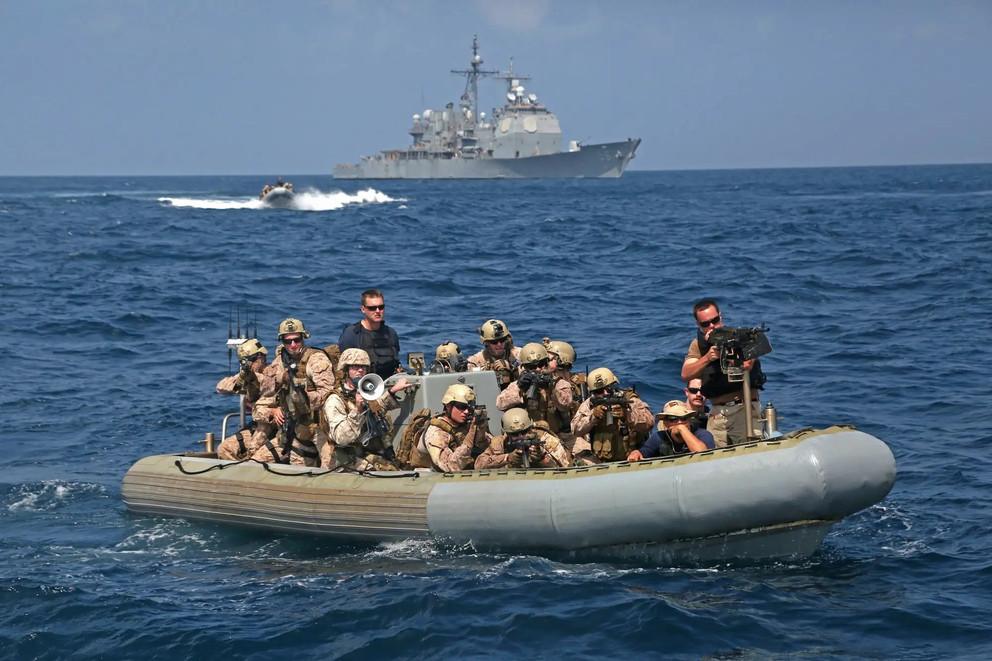
In June 2014, two months after the ship’s return, the Navy released the Phillips report, in redacted form, in response to a Freedom of Information Act request from news organizations that was more than a year old, and the Norfolk Virginian-Pilot and other papers published long accounts. In outline they set out what the investigation had found: that the exercise had gone forward without an adequate assessment of its risks, and that San Jacinto, at the moment of the collision, had been out of position. The crew who had been aboard could now read the throttle orders, the officer of the deck’s decisions and the helmsman’s actions in the newspaper.11 They had waited twenty months and made a deployment before they were told officially what had happened to them.
A contract of $29.8 million for the ship’s depot-level availability was awarded to BAE Systems Norfolk on 15 July 2014. A depot-level availability is the Navy’s term for a long scheduled maintenance period in a shipyard, in which work is done that a ship’s own crew cannot do at the pier: major overhauls of machinery, replacement of piping and cabling, work on the hull and underwater fittings. The yard period that began that summer took her into 2015. In October 2014 her commanding officer told the crew that she had won the Retention Excellence Award for the previous year, a prize the Navy gives to ships that keep their sailors from leaving the service. In March 2015 a video of her undocking was posted, and in September 2015 a sailor photographed her starboard propeller, out of the water in the dock before she went back in, and wrote that he had about a month left aboard.12
The ship’s own future was being discussed in Washington in the same weeks. On 10 July 2014 the Assistant Secretary of the Navy for research, development and acquisition, Sean Stackley, told a House Armed Services subcommittee that the oldest eleven Aegis cruisers, hull numbers 52 through 62, a group that included San Jacinto, had been modernized and would deploy with carrier strike groups until the end of their service, which would begin in 2019. The other eleven, numbers 63 through 73, were the subject of the Navy’s phased modernization plan, under which they would be taken out of active service in stages over about a decade for hull, mechanical and electrical work and later combat-system upgrades, with their crews drawn down, a saving the Navy put at $4.7 billion. The subcommittee’s chairman, Representative Randy Forbes, called the term misleading, because the plan asked Congress to take half the cruiser fleet out of service in the hope that the ships would return in the 2020s. Stackley said that a cruiser’s complement was about 330 to 340 officers and enlisted sailors, and that of the oldest eleven ten would remain in 2019 and nine in 2020, with all of them gone by 2026. The testimony does not name San Jacinto, and it did not fix the date of her retirement.24
It did fix her place. She was in the older half, the ships that would be run until they wore out. The newer half would get the long modernization. From that summer on, every dollar spent on her was a dollar spent on a ship the Navy had already scheduled to leave. In the same week the Defense Logistics Agency posted a notice for magnetic contactors, a kind of electrical switch, for the ship.25
2016: Inherent Resolve
| Group | Plan | Numbers |
|---|---|---|
| CG-52 to CG-62 (eleven oldest, San Jacinto among them) | Already modernized; to deploy with carrier groups until retirement, which would begin in 2019 | Ten left in 2019, nine in 2020, all gone by 2026 |
| CG-63 to CG-73 (eleven newest) | Phased modernization: taken out of service in stages over about a decade for HM&E and combat-system work, crews drawn down | Navy put the saving at $4.7 billion; Rep. Forbes called the term misleading |
Source: Testimony of Assistant Secretary Sean Stackley to the House Armed Services Seapower subcommittee, 10 July 2014. A cruiser’s complement: about 330 to 340. The testimony does not name San Jacinto or fix her retirement date. Source: Chapter 20.
In February 2016 Captain Dennis Velez relieved Captain Hack as the ship’s seventeenth commanding officer. Between his arrival and the summer, San Jacinto and the cruiser Monterey completed the workups necessary for deployment, which the Navy described, in a release about the carrier Eisenhower, as done in record time.13 On 1 June 2016 she deployed with the Dwight D. Eisenhower Carrier Strike Group, commanded by Rear Admiral Jesse Wilson and later by Rear Admiral James Malloy. The group’s flagship, the carrier Eisenhower, carried Carrier Air Wing 3, and its escorts included, besides the two cruisers, the destroyers Roosevelt, Mason and Nitze.14
In March, in the Eisenhower group’s composite training unit exercise, the final examination before deployment, the ship’s visit, board, search and seizure team boarded the training support vessel Hugo on the seventeenth, in a drill that began with a simulated distress call about pirates. The team showed that it could also take the helm of a vessel and bring it into port. The ship’s commanding officer said that the training kept the team’s skills sharp for enforcing freedom of the seas. The Navy’s release explained that Carrier Strike Group 4 mentored and assessed the group, and that U.S. Fleet Forces Command would decide whether it was ready to deploy. It listed the group as the carrier, the staffs of Carrier Strike Group 10 and Destroyer Squadron 26, Carrier Air Wing 3, the cruisers San Jacinto and Monterey and the destroyers Nitze, Mason, Roosevelt and Stout.26
The war in which the carrier’s aircraft flew was Operation Inherent Resolve, the American-led campaign against the Islamic State in Iraq and Syria. The group entered the Mediterranean on 13 June and, from 28 June to 7 July, launched its first strikes from the eastern Mediterranean. It then passed through the Suez Canal, entered the Fifth Fleet area on 8 July, and flew strikes from the Arabian Gulf from 28 July to 25 November. On 4 December it came back through Suez and resumed strikes from the eastern Mediterranean on 6 December, operating for part of that time in company with the French carrier Charles de Gaulle. It left the Sixth Fleet area on 26 December.14 Within the group, San Jacinto served as the air and missile defense commander, the ship that coordinates the defense of the group against aircraft and missiles, a role that a cruiser with an Aegis system is built for. She supported three combined task forces, 51, 55 and 61, of the Navy’s regional commands.15
It was her third war over Iraq in twenty-five years. In 1991 she had fired the first missile. In 2003 she had fired thirty. In 2016 she fired none, and guarded the carrier whose aircraft did the work. It was the job the class had been designed for, and by then it was the only one the Navy asked of her.
In June the cruiser spent several days at sea with Italian naval vessels in a combined passing exercise with the group’s ships, and then four days in Naples, which she left on 21 June. The crew took tours to Rome and Pompeii, climbed Mount Vesuvius and went by ferry to Capri, as the crew of 1989 had done. The Navy described the group as the centerpiece of its Great Green Fleet initiative, which treats energy conservation as a combat advantage that lets ships go farther, stay longer and bring more combat capability.27
On 30 October, with the ship in the Arabian Gulf, the Chief of Naval Personnel, Vice Admiral Robert Burke, and Master Chief Petty Officer April Beldo visited her to hear fleet reaction to recent changes in the system of enlisted ratings, the job titles by which the Navy’s enlisted sailors had long been known, and to the Navy’s Sailor 2025 initiative. Burke told junior sailors in an all-hands call on the flight deck that the Navy was not trying to strip them of the heritage of their communities. The two also met the chiefs’ mess about the new blended retirement system, and Burke spoke in the wardroom about possible future policy on family life.28
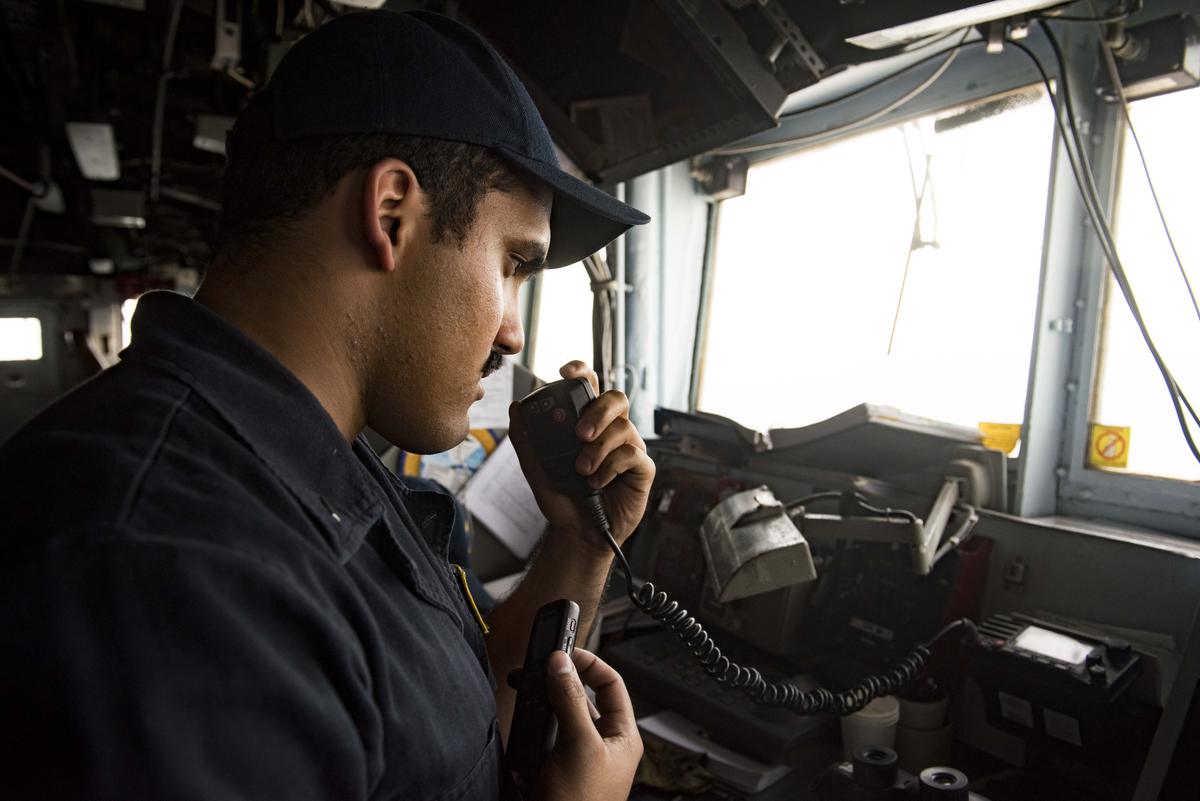
The “recent changes” were the decision, a month earlier, to abolish rating titles altogether, so that a boatswain’s mate or a sonar technician would be addressed only by rank. An admiral had come to the flight deck of a deployed cruiser to tell her sailors that they were not losing their heritage. Seven weeks later the Navy gave the titles back.40
She returned to Norfolk on 30 December 2016, after a seven-month deployment, and had steamed more than 52,500 nautical miles through the Mediterranean, the Red Sea and the Arabian Gulf. The Navy’s release on her return quoted her captain as calling the cruise a huge win for the crew and the Navy, and noted that qualifications in the crew were at an all-time high. Visitors during the cruise included Representative Jason Chaffetz of Utah, the Navy’s chief of naval personnel, the commander of Carrier Strike Group 10, and the harbor master of Piraeus.15
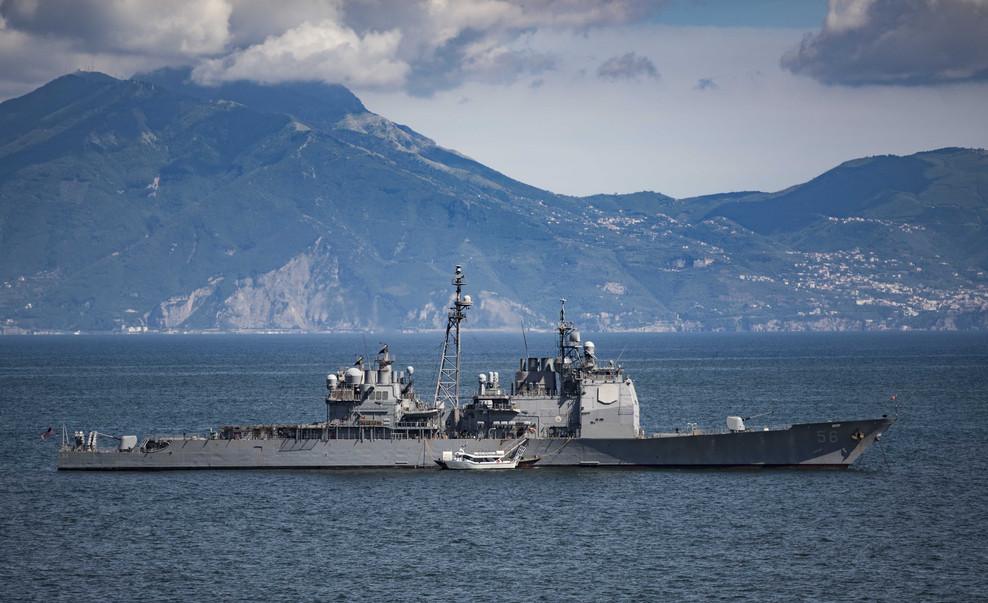
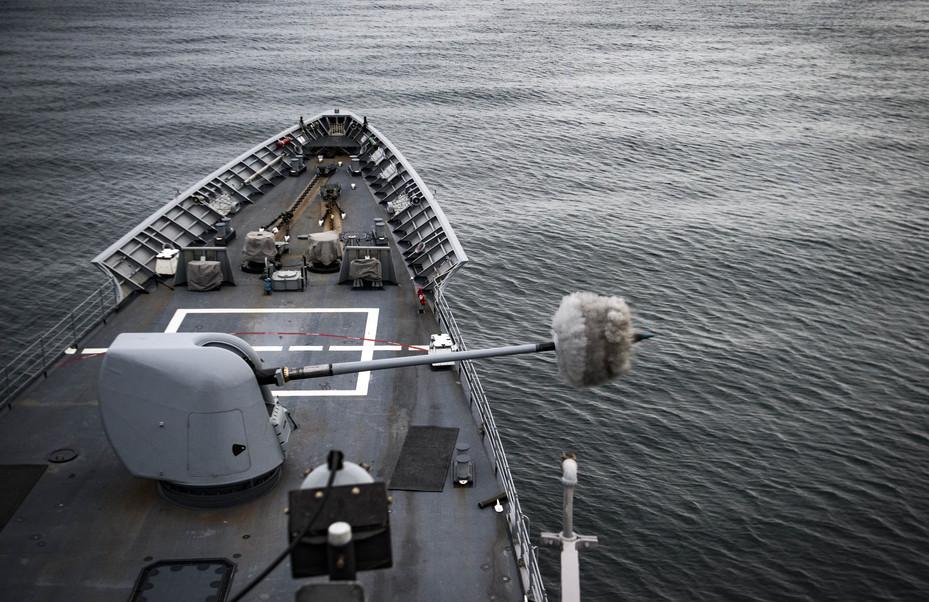
The ship’s own release on the return listed her port visits as Naples, Manama in Bahrain, Jebel Ali in the United Arab Emirates and Piraeus, Greece. Four ports in seven months was what a deployment had come to. She had made 29 replenishments at sea, taking on more than 5.2 million gallons of fuel and more than 1,000 pallets of stores. The two MH-60R Seahawk helicopters of Detachment 1 of Helicopter Maritime Strike Squadron 74 flew almost daily and logged more than 950 flight hours on surface search and classification and anti-submarine missions. In the crew, eighty-five sailors had qualified as enlisted surface warfare specialists, four officers as surface warfare officers and one as a surface warfare supply corps officer; four new chief petty officers were pinned, and 45 sailors advanced a pay grade.29 At Piraeus, which she left on 17 December, her captain hosted a luncheon for local and Greek officials, and the crew toured the Acropolis and the Temple of Poseidon.30
2017: Irma, and a tow
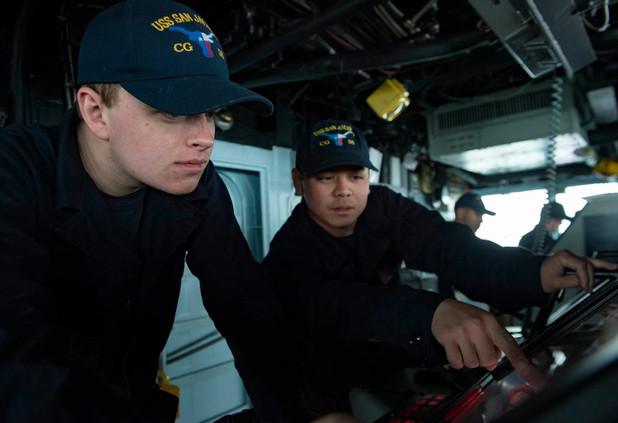
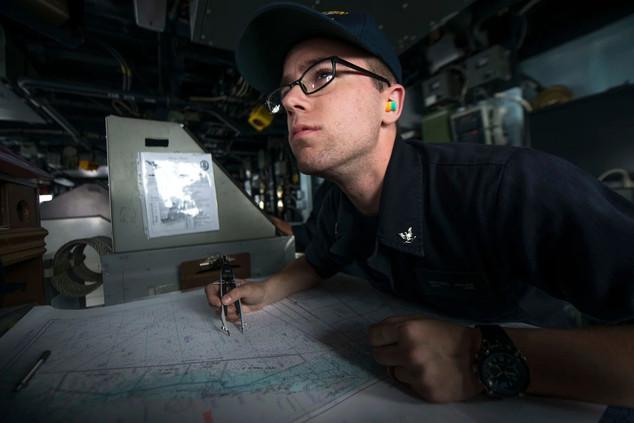
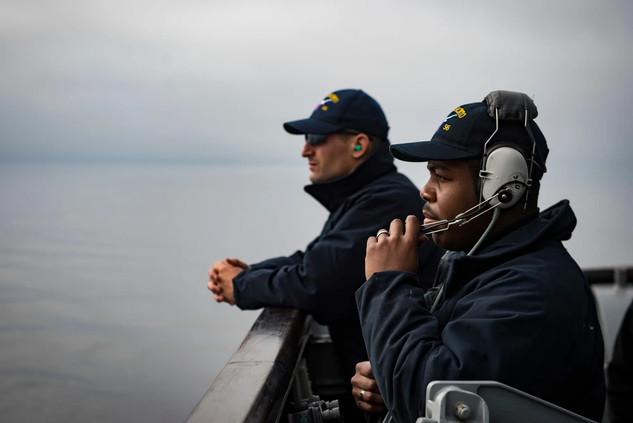
The ship’s 2017 was a tour of the East Coast. The chronology has her at Boston, Halifax, Nassau and Mayport, and at New York’s Fleet Week on 24 May; a sailor from the ship, according to a crew member’s account, placed second in the “Bos’n Olympics,” a boatswain’s mate competition.16
On 10 April, in a sustainment exercise, the training that keeps a strike group ready after it returns from deployment under the Navy’s Optimized Fleet Response Plan, the ship led air-defense exercises with the Eisenhower group. Super Hornets of Strike Fighter Squadrons 86, 105 and 32 and Hornets of Strike Fighter Squadron 131 took part with the cruisers San Jacinto and Monterey and the carrier. Her captain, who was also the group’s air and missile defense commander, said that the commander’s mission was the defense of the whole strike group. The Navy’s release said the daily exercises exposed the crew to advanced threats of the kind a navy might meet from an adversary of comparable strength, and that the ship defended the carrier against multiple simulated air and surface threats.31 After twenty-five years of pirates, dhows and oil platforms, the Navy was training again for an enemy with a fleet, which was what the ship had been built for in the first place. In July the Navy Supply Systems Command posted a solicitation, open to small businesses only, for the modernization of various compartments of the ship. The notice does not say which compartments, and the record does not show what was done.32
On 8 September, with Hurricane Irma heading for Florida, the carrier Abraham Lincoln left Norfolk to be in position to help. She was the first Defense Department responder on the scene off the Florida Keys after the storm struck, and her helicopters flew water and supplies to Naval Air Station Key West, Marathon, Port Everglades and Homestead Air Reserve Base and provided search-and-rescue and medical evacuation support. San Jacinto was in company with her. When the two ships left the coast of Key West on 13 September, Navy sea-based support there passed to Carrier Strike Group 10, embarked in the amphibious assault ship Iwo Jima and operating with the amphibious transport dock New York and the destroyer Farragut, and the Navy’s release said that Abraham Lincoln and San Jacinto were scheduled to be home on Friday, 15 September. The release said that the three ships off the Keys carried 2,400 sailors and Marines and that their mission was to support the civil authorities. The ship’s own chronology, by contrast, lists San Jacinto among the ships arriving off Key West on 12 September under Carrier Strike Group 10, and the record does not settle the difference. On the fifteenth the cruiser refueled from the oiler USNS Laramie at sea.17, 33
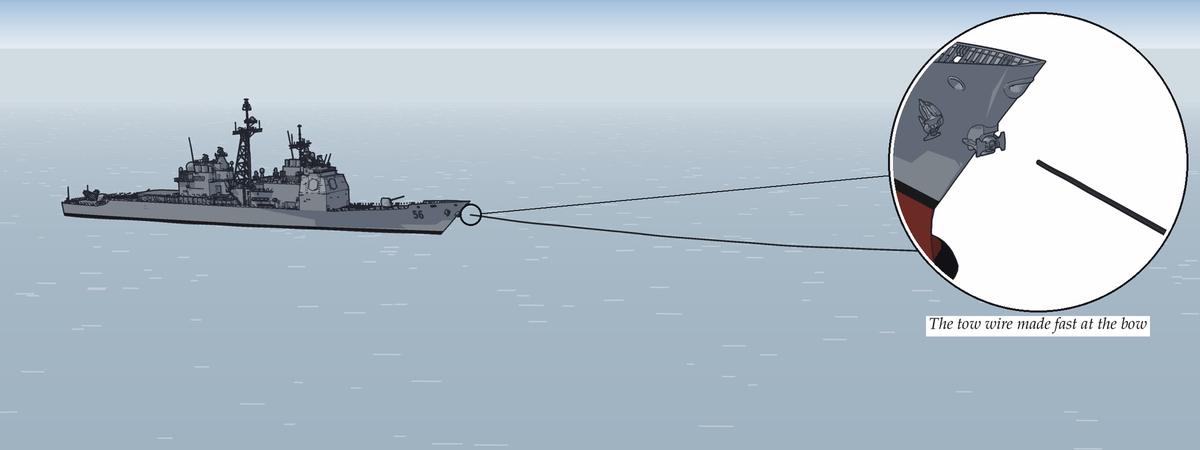
In October, a mechanical failure left her without propulsion, according to crew recollection, and she was towed to the BAE yard in Norfolk. On 19 December 2017 Captain Dennis Farrell relieved Captain Velez.18 A cruiser that had steamed fifty-two thousand miles the year before came into the yard on the end of a towline. No document explains the failure. The plant was twenty-nine years old.
A Navy release of 18 December 2017 places the ship in the shipyard for scheduled maintenance, in the maintenance phase of the Optimized Fleet Response Plan. In the yard her officers kept up their ship-handling on a portable bridge simulator, three screens and a helm set up in an office on the main deck, which her captain had challenged them to repair the year before after years of disuse. Bridge watchstanders worked on it twice a week with the navigator, and the training and readiness officer said that every member of the wardroom would run an evolution on it at least once a month.34 That summer two destroyers of the Pacific Fleet had collided with merchant ships and seventeen sailors had died, and every wardroom in the Navy was being asked how well its officers could drive.41
A reunion in the yard
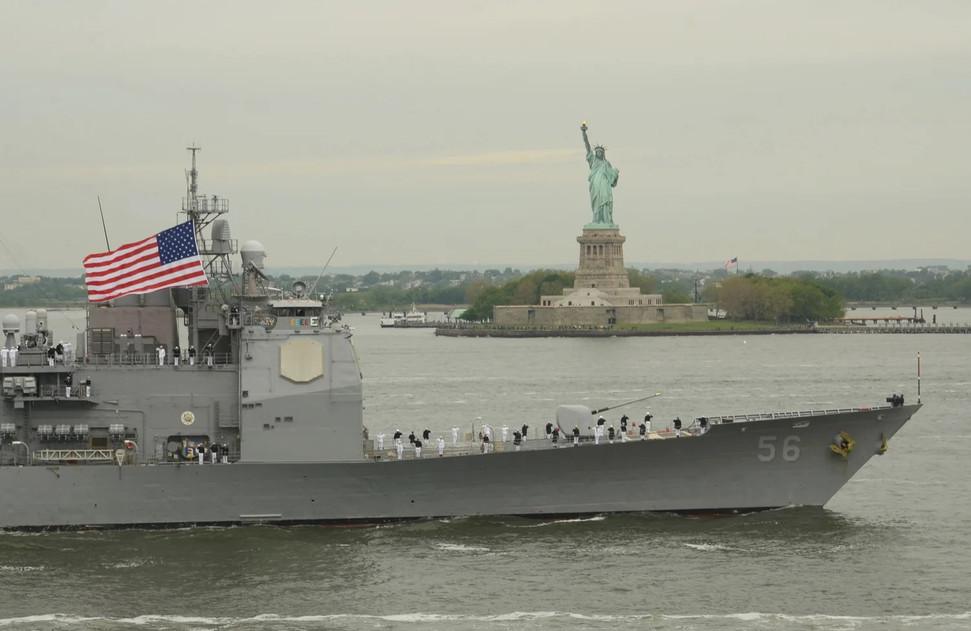
In January 2018 the ship was in the BAE yard, in the middle of a maintenance period, and a group of her first crew came back to see her. It was the thirtieth anniversary of her commissioning. The reunion ran from 18 to 22 January in Norfolk and had been organized over several months by a handful of former crew, one of whom had started the idea, one who ran a conference-call line for the planning, one who built the itinerary and one who did the outreach. Captain Farrell hosted them and the ship’s command master chief coordinated the visit. Hard hats were required, parking was limited, and the ship’s store took only cash. Because the ship was in the yard, with open spaces and scaffolding, a number of the old crew said they hoped to see her whole again. Some wrote afterward of what it was like to walk across the brow after thirty years. One wrote that he had shed a tear at the sound of the bell rung to welcome him back aboard.19
The men who came aboard that weekend had known her when everything in her was new. They had stood the first watches in her, written her first watch bills and taken her up the Houston Ship Channel in the fog. They found her cut open in a shipyard with staging around her, thirty years of paint on her bulkheads and a crew young enough to be their children.
There was an idea, which did not come off, of a “tiger cruise” that October out of Baltimore for Fleet Week, with the plank owners aboard. (A tiger cruise is a short passage in which a ship carries civilian guests, usually family members of the crew, for a leg of a voyage.) The captain’s reply, according to the organizer, was that the schedule was uncertain. That winter someone circulated a planning chart, as former crew remembered it, showing the ship leaving the fleet in 2022, and the plank owners, who had been together less than a week, began talking about a reunion for her decommissioning. It would eventually be held in September 2023.20
Florence, Dorian, and the end of the decade
The ship’s sea trials after the yard period began on 9 November 2018. In September of that year, according to the ship’s chronology, she sortied from Norfolk ahead of Hurricane Florence. Early in 2019 she was at sea supporting the Abraham Lincoln strike group’s certification exercise. She went out again ahead of Hurricane Dorian on 4 September 2019, took part in a Surface Warfare Advanced Tactical Training event, the Navy’s advanced course in surface tactics, from 9 to 17 September, and left Norfolk on 20 September for a group sail with the Eisenhower group.21
On 9 December 2019 Captain Edward Crossman relieved Captain Farrell. The next deployment was a month away.21 Nobody aboard knew that it would set the modern Navy’s record for consecutive days at sea.
Notes
- Phillips command investigation, findings of fact 1024–1028 (drydock entry and repair estimate); NAVSEA, Naval Vessel Historical Evaluation, CG-56, 21 September 2023 (approximately $11 million in repairs after the collision). The $12.2 million estimate and the $9,691,713 award come from the Navy’s release of 2 November 2012 (Chapter 19, note 54), which confirms the dock entry, the emergent availability, the initial award of $9,691,713 and the February 2013 completion expectation; the three figures are of different kinds (an estimate, a starting award and, in 2023, an after-the-fact evaluation) and are not reconciled. ↩
- Truman Carrier Strike Group deployment summary (GlobalSecurity.org, “HST CSG MED 01”): deployment “originally scheduled for February 2013 but delayed just prior to the strike group’s scheduled departure.” The cause of the delay is not stated in that source. The January 2013 press report that about 300 sailors would not deploy, and the family posts of 18 January 2013, are press and crew recollection. ↩
- Crew recollection (posts of December 2012 to July 2013). The rumor that the ship carried an older sonar suite that might be replaced is uncorroborated by any document consulted. ↩
- Navy News Service, 18 July 2013 (announcement of the deployment) and 1 August 2013 (“USS Bulkeley, USS San Jacinto Transit Strait of Gibraltar,” 31 July); Naval Today deployment notice; DANFS, vol. III. Command of the ship at departure: Capt. William McKinley. The release of 1 August 2013 also gives the group’s onward movement to the Fifth Fleet area and the squadron and USNS Arctic details (ProQuest 1417190420, NNS130801-22). ↩
- Navy News Service, via MarineLink, 7 August 2013, “USS San Jacinto Aids Turkish Mariner”: call received shortly before 11 p.m. local time, 3 August; RHIB transfer early on 4 August; helicopter to U.S. Naval Hospital Sigonella; Truman’s senior medical officer, Cmdr. William Mann; praise from Rear Adm. Kevin Sweeney. The report names the Turkish vessel “Cezayirli Gazi Hasan Pasa”; its type is given variously as a training ship and a merchant ship. The Navy release of 5 August 2013 (NNS130805-04) calls it a Turkish Navy ship, says the call was taken at more than 130 nautical miles, and describes the patient as stable; the Navy’s wording is followed in the text. ↩
- DVIDS photo caption, 18 August 2013 (San Jacinto leads Mason and Bulkeley through the Suez Canal); Navy News Service, 19 August 2013, “Harry S. Truman Carrier Strike Group Enters 5th Fleet”; DVIDS caption of 21 August 2013 (refueling of an HSM-74 helicopter). ↩
- Truman Carrier Strike Group summary (GlobalSecurity.org): 44 Strait of Hormuz transits; two Suez Canal transits; Carrier Air Wing 3 flew 2,902 combat sorties, more than 16,450 hours, 27 August 2013 to 19 March 2014; return 18 April 2014 after nine months. ↩
- USCarriers.net ship chronology (rescue of two mariners 16 November 2013; five-inch gun shoot 23 December 2013; French Task Force 473 and port calls, January 2014). Not independently confirmed in Navy releases, with one exception in conflict with it: Navy News Service, NNS140403-09, 3 April 2014 (ProQuest 1512620369), describes a San Jacinto visit to Palma de Mallorca, calls the ship a destroyer, and places her still deployed on that date; the chronology places Palma in January 2014, and the record available does not settle the difference. NEXCOM’s list of ships able to use its phone-card service, Navy News Service NNS131202-07, 2 December 2013 (ProQuest 1464011146), shows the ship deployed on that date. ↩
- Crew and family recollection (January 2014). No official record of the communications restriction was found. ↩
- Command-change date of 2 April 2014 (Capt. Patrick Hack relieving Capt. McKinley) from the ship’s command list; the surname is spelled “Huck” in some sources. Return date from the Truman group summary and a family post of 18 April 2014. ↩
- Phillips command investigation, released in redacted form in June 2014 (see Chapter 11 notes); Virginian-Pilot coverage, June 2014; Gen. Gortney’s endorsement of 4 January 2013; Navy Inspector General, September 2014. ↩
- BAE Systems Norfolk depot-level availability contract of 15 July 2014, $29.8 million (a figure not checked against the contract announcement). The Retention Excellence Award for 2013, the March 2015 undocking video and the September 2015 propeller photograph are crew recollection. ↩
- Eisenhower Carrier Strike Group pre-deployment release, 2016 (“San Jacinto and Monterey completed workups in record time”; COMPTUEX beginning 16 March); ship’s command list for Capt. Dennis Velez as seventeenth commanding officer. ↩
- Navy release on the Eisenhower group’s departure, 1 June 2016 (composition; Rear Adm. Jesse Wilson); Navy release of 30 December 2016 (Rear Adm. James Malloy); GlobalSecurity.org, “Dwight D. Eisenhower Strike Group – MED 16” (dates of the first strikes from the Mediterranean, 28 June 2016; Suez transits; Gulf operations 28 July to 25 November 2016; return to the Mediterranean 4 December; departure from 6th Fleet 26 December). Entry into the Mediterranean on 13 June 2016 is from the Navy’s 13 June 2016 release. ↩
- Navy News Service, “USS San Jacinto Returns from Deployment,” 30 December 2016: seven months, more than 52,500 nautical miles, combined task forces 51, 55 and 61, qualifications “at an all-time high,” quotation of Capt. Velez (“a huge win for our crew and for the Navy”), and the visitors Rep. Jason Chaffetz, Vice Adm. Robert Burke, Rear Adm. James Malloy and Commodore Konstantinos Leondaras. The air and missile defense commander role is as stated in the ship’s own deployment summary. ↩
- Ship’s chronology (USCarriers.net); crew recollection for the Bos’n Olympics placing, which an old chronology dates to the summer. ↩
- Navy News Service, 14 September 2017 (Hurricane Irma relief, Carrier Strike Group 10 under Rear Adm. Samuel Paparo); Navy release of 13 September 2017 (departure from Key West on 13 September; scheduled arrival Friday, 15 September); the ship’s chronology says San Jacinto arrived off Key West on 12 September under Carrier Strike Group 10, which conflicts with the Navy’s account; U.S. Naval Institute News, 15 September 2017; DVIDS captions of 14 and 15 September 2017 (live-fire exercise; replenishment from USNS Laramie). ↩
- Crew recollection of a loss of propulsion and tow to the BAE yard, October 2017; the Navy’s release of 18 December 2017 (note 33) places the ship in the shipyard for scheduled maintenance but does not mention a tow; the cause and exact date are not documented. Command change of 19 December 2017 from the ship’s command list. ↩
- Crew recollection and the reunion organizers’ notices: reunion dates 18–22 January 2018; hosted by Capt. Dennis Farrell; ship in maintenance at BAE. ↩
- Crew recollection: the proposed tiger cruise (October 2018, Baltimore Fleet Week) and a planning chart said to show retirement in 2022. ↩
- Ship’s chronology (USCarriers.net) for sea trials of 9 November 2018, the Florence sortie of September 2018, the Lincoln group certification of early 2019, the Dorian sortie of 4 September 2019, the Surface Warfare Advanced Tactical Training event of 9–17 September 2019 and the group sail of 20 September 2019; command change of 9 December 2019 (Capt. Edward Crossman) from the ship’s command list and a Navy release. ↩
- Defense Logistics Agency solicitation notices reported by Targeted News Service, 27 March 2013 (motor stators) and 27 April 2013 (fluid pressure regulating valve), each naming San Jacinto as the ship concerned (ProQuest). The notices show supply activity for the ship in the repair period and say nothing about the cause of the work. ↩
- Sea Change, the ship’s account of her circadian-rhythm watchbill, and the Naval Postgraduate School study of it: see Chapter 18, notes 21 and 22. The Surface Navy Association’s literary award for the 2013 article was presented at the association’s January 2014 symposium. ↩
- U.S. House of Representatives, Committee on Armed Services, Subcommittee on Seapower and Projection Forces, hearing of 10 July 2014 on cruiser and dock-landing-ship modernization (H.A.S.C. 113-116), testimony of the Assistant Secretary of the Navy (Research, Development and Acquisition), Sean J. Stackley, and the chairman’s remarks. The testimony speaks of the oldest eleven cruisers, hull numbers 52 through 62, and does not name San Jacinto; her inclusion follows from her hull number, CG-56. The counts remaining in 2019 and 2020 are the witness’s own. ↩
- Defense Logistics Agency notice of 9 July 2014, magnetic contactors for San Jacinto, solicitation SPE7MC14TA405, reported by Targeted News Service (ProQuest). ↩
- Navy News Service, NNS160321-11, 21 March 2016 (composite training unit exercise, boarding of Hugo, group order of battle including Stout) (ProQuest 1774852491). ↩
- Navy News Service, NNS160622-11, 22 June 2016 (Naples visit, combined exercise, Great Green Fleet) (ProQuest 1799031046). ↩
- Navy News Service, NNS161031-26, 31 October 2016 (visit of the Chief of Naval Personnel and Master Chief Petty Officer April Beldo to San Jacinto in the Arabian Gulf; the release gives her title in the Navy’s personnel organization) (ProQuest 1834481048). ↩
- Navy News Service, NNS161230-05, 30 December 2016 (return to Norfolk; deployment statistics) (ProQuest 1854132993). ↩
- Navy News Service, NNS161221-02, 21 December 2016 (Piraeus visit, departure of 17 December) (ProQuest 1850882339). ↩
- Navy News Service, NNS170411-09, 11 April 2017 (sustainment exercise with the Eisenhower group, 10 April) (ProQuest 1886375753). ↩
- Targeted News Service, 14 September 2017 (ProQuest 1938916789), for the Navy’s account of Abraham Lincoln, San Jacinto and Carrier Strike Group 10 off Key West. The ship’s chronology (note 17) differs on the date of arrival off Key West; the Navy’s release is followed. ↩
- Navy News Service, NNS171218-04, 18 December 2017 (ship in the yard for scheduled maintenance; portable bridge simulator) (ProQuest 1977898305). ↩
- Naval Supply Systems Command solicitation N0018917Q0187, “Modernization of Various Compartments,” July 2017, responses due 10 August 2017, small-business set-aside (ProQuest 1924545604). The notice does not list the compartments. ↩
- Scott C. Truver and Robert Holzer, “U.S. Navy in Review,” U.S. Naval Institute Proceedings, May 2013: the four Class A afloat mishaps of 2012–13 (a Class A mishap being one costing more than $1 million or causing a death, total disability or the loss of a ship or aircraft); repairs to San Jacinto “on the order of $9.7 million” for the sonar dome and surrounding hull and equipment, against at least $32 million for Montpelier; and the repair bills as a pressure on fleet maintenance. The $9.7 million agrees with the initial award of $9,691,713 in note 1. ↩
- The commanding officers of 2014–2021: uscarriers.net chronology (Capt. Patrick M. Hack, 2 April 2014; Capt. Dennis Velez, February 2016, as seventeenth commanding officer); NavSource Online, cruiser photo index for CG-56 (archived 23 May 2025), which gives the 2014 officer as Michael Patrick Huck, 2 April 2014 to February 2016, and lists Dennis Velez to 19 December 2017, Dennis L. Farrell to 9 December 2019 and Edward M. Crossman to 21 May 2021. The spelling Hack or Huck is unresolved; the text follows uscarriers.net. ↩
- Crew recollection and photographs: the dry dock at Mayport after the collision; a port visit to Split, Croatia, in 2013; a family day cruise in 2017 at about thirty knots; a replenishment alongside Dwight D. Eisenhower in 2016. ↩
- Rating titles were removed by NAVADMIN 218/16 on 29 September 2016 and restored by NAVADMIN 283/16, “Navy Rating Modernization Next Steps,” on 21 December 2016; USNI News, 21 December 2016. “Seven weeks later” counts from the 30 October visit. ↩
- The 2017 collisions of Fitzgerald (17 June) and John S. McCain (21 August), seventeen dead: source needed (Navy Comprehensive Review, 2017). The link to the bridge simulator is an inference from timing; the release does not make it. unconfirmed ↩