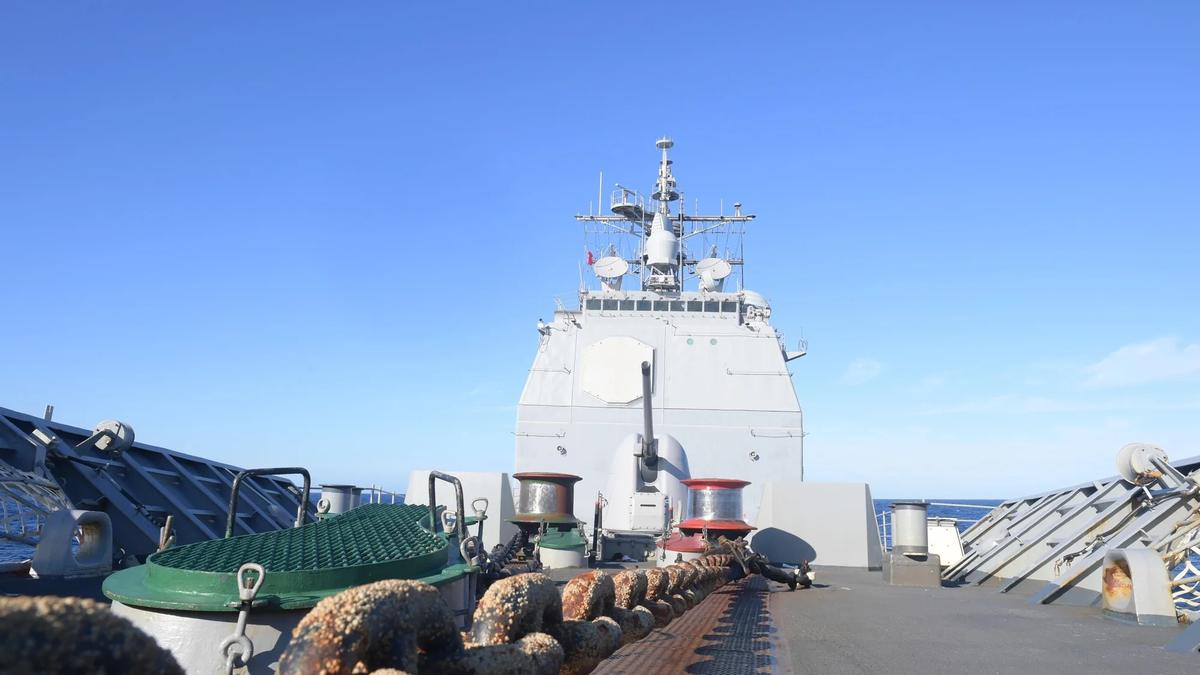
Part Six: Second Wind (2013–2022)
Chapter 21206 Days
On 17 January 2020, a Friday, the aircraft carrier Dwight D. Eisenhower and the guided-missile cruiser San Jacinto left Naval Station Norfolk together. They were bound, for the moment, for nothing more distant than the Atlantic off the Virginia and Carolina coasts, where the strike group they belonged to was to spend about a month being tested. Neither ship would touch a pier again until August.1
The ship’s captain was Edward Crossman, who had taken command on 9 December, a little over five weeks earlier. The strike group was the Eisenhower Carrier Strike Group, built around the carrier and the nine squadrons of Carrier Air Wing 3 and commanded by the staff of Carrier Strike Group 10. Besides the carrier and San Jacinto, it included the cruiser Vella Gulf and a destroyer squadron, Destroyer Squadron 26, whose ships were the destroyers James E. Williams, Truxtun and Stout.2
Most of a deployment is the same day over and over, and the ports are what a sailor has to show for it. This is the story of a deployment that was only the first half of that sentence.
Leaving Norfolk
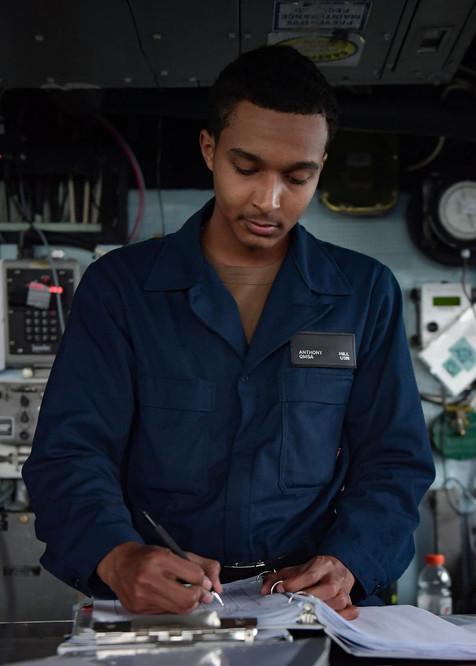
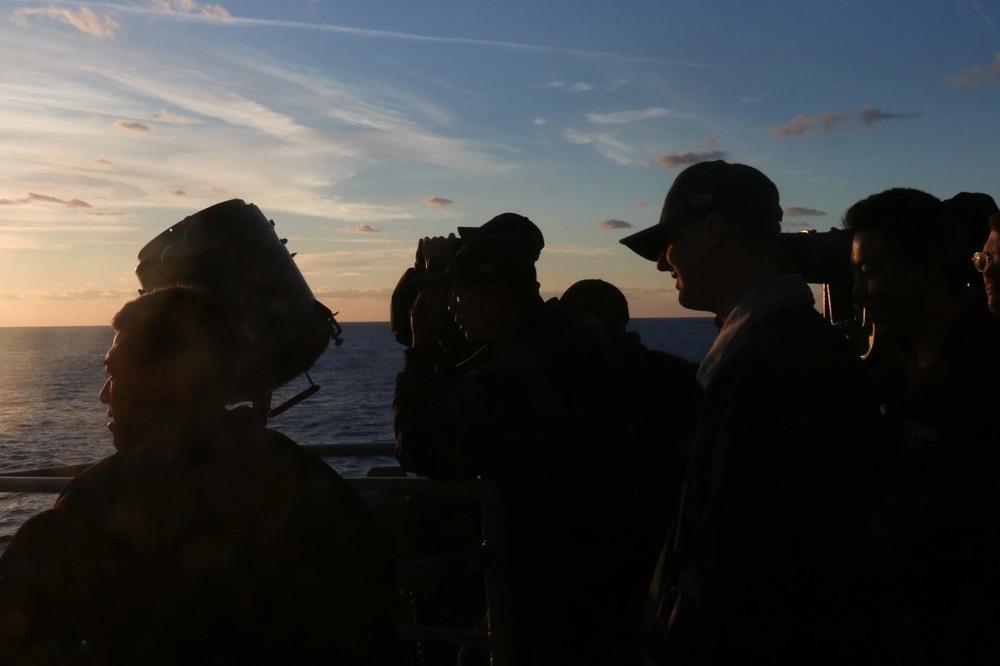
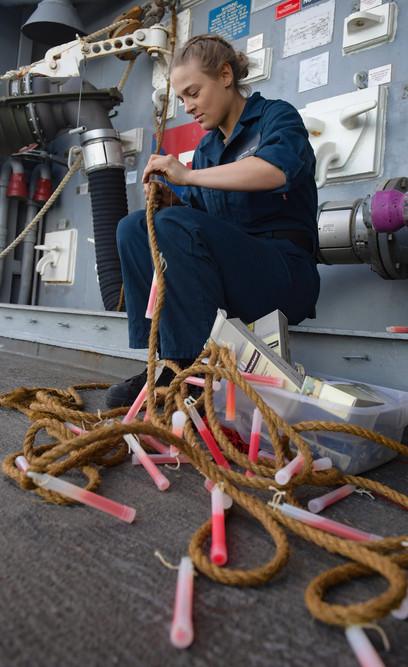
Before a carrier strike group deploys it must show the Navy that it can fight as a single organization. The test is a large exercise at sea called COMPTUEX, short for Composite Training Unit Exercise, in which over several weeks the carrier, the cruiser, the destroyers and the air wing are put through simulated air attacks, submarine threats, missile salvos and casualties, observed and graded by evaluators from shore commands. A group that passes is certified for deployment. Ordinarily it then sails back to its home port, where the crews have a short time with their families and restock their ships before leaving again.
In 2020 the Eisenhower group did something different. It sailed for its COMPTUEX on 17 January, finished the exercise in the Atlantic and then, according to the Navy, began its deployment without returning home. The Navy’s later accounts give February as the month the deployment began and describe the group as bound for the Sixth Fleet area, which covers the Mediterranean, and the Fifth Fleet area, which covers the Red Sea, the Persian Gulf and the Arabian Sea.3 A cruise of six or seven months was expected. The sailors who said goodbye on the pier on 17 January had said it for a month’s exercise. There was no second goodbye.
The ship’s own chronology fills in the stages. She had left Norfolk five days before the carrier to take on ammunition at the weapons station at Yorktown, Virginia, from 12 to 14 January. The exercise, in the operating areas off Cherry Point, Jacksonville and Charleston, was finished by 13 February. She refueled from the oiler Patuxent on 18 February, passed the Strait of Gibraltar on 29 February, went south through the Suez Canal on 9 March and through the Bab el-Mandeb, the strait at the southern end of the Red Sea, on 13 March.13
The virus
When the ships left, a novel respiratory virus had been identified in China, but it had not yet been given the name it would carry. By the time they had crossed the Atlantic and moved into the Mediterranean, the Associated Press later wrote, the virus was escalating.4 By March it had become a pandemic, and ships of the United States Navy were not immune. The aircraft carrier Theodore Roosevelt, after a port call in Vietnam, suffered an outbreak that infected well over a thousand of its crew and ended in the removal of its commanding officer; the ship was forced to tie up at Guam in late March.4
A warship is about as good a place for a respiratory virus as could be designed: racks stacked three high, sixty to eighty men to a compartment, shared heads, one mess line, and passageways where sailors move nose to tail. One infected sailor coming back from liberty could put a ship out of action, and Theodore Roosevelt had just shown that it would.
The Navy’s answer, for ships already deployed, was to avoid the thing that spreads a virus: contact with the shore. In March the Navy’s Fifth Fleet commander, Vice Admiral James Malloy, the same officer who had led the Eisenhower strike group in 2016, suspended liberty port visits across his region, to reduce the chance of the virus spreading and being contracted across the fleet.5 A ship that is at sea and has no contact with land cannot catch a disease from a port. The result was that two ships that had set out for a month of exercises would spend the whole deployment without touching a pier.
The captains of the two ships understood what it meant at once. The Associated Press, which spoke to both of them a few days before the record was set, reported that Captain Kyle Higgins of the Eisenhower and Captain Crossman of the San Jacinto knew that their sailors would not set foot on land for some time.4 For the crews the effect was most vivid in the Mediterranean. The ships passed along the coasts of Europe and North Africa without stopping; the Associated Press recorded that disappointed sailors watched the countries go by, and quoted a petty officer on her first ship and first deployment as saying it was a struggle, since she had been looking forward to the port calls.4
Meanwhile the families they had left were living through the same months ashore, in lockdowns, with schools closed, and the sailors could do nothing for them but send email when the ship’s link allowed it.
A ship that does not stop
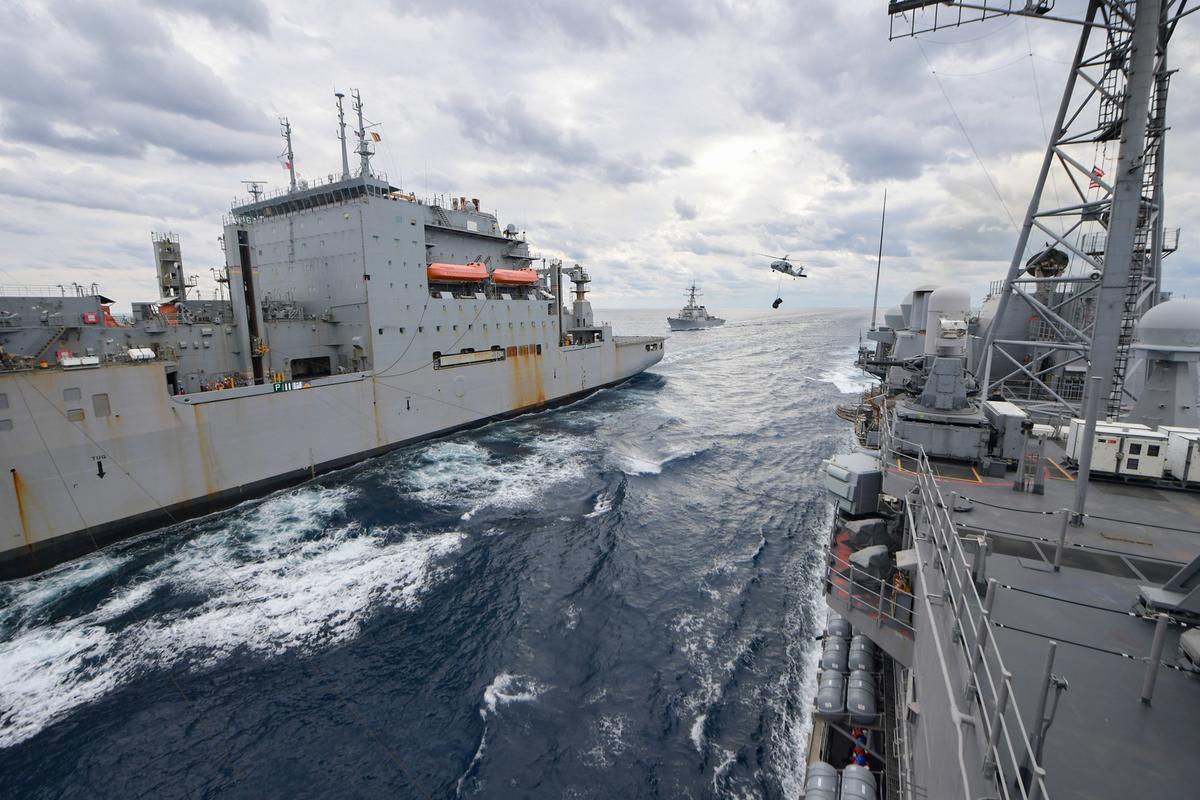
A port is where a ship takes on food, fuel, spare parts, mail and, from time to time, people, where her crew goes ashore for the few hours that sailors mean by liberty, and where shore workers repair her. A ship that does not go into port must do all of that some other way, and the Navy’s way is the underway replenishment.
An underway replenishment, or UNREP, is the transfer of supplies from one ship to another while both are under way. A supply ship, usually an oiler or a stores ship operated by the Navy’s Military Sealift Command, steams on a steady course at a steady speed, and the ship to be supplied comes up alongside, a short distance away, and matches her course and speed exactly. Lines are shot across, heavy cables are rigged between the two ships, and over those lines fuel hoses and pallets of stores are passed from one to the other. In a few hours a cruiser can take on hundreds of thousands of gallons of fuel and tons of food and parts. It is a skilled and rather dangerous operation, practiced constantly, and with it a Navy ship can go on indefinitely so long as the oilers keep coming. The Navy’s ability to keep ships at sea for months is the reason it has the oilers.
For the two ships of the Eisenhower group the replenishments went on all through the spring and summer. The captain of the San Jacinto said in June that both crews had been resupplying and refueling, performing repairs and upkeep, and maintaining readiness while continuously at sea.6 The ships had no visitors, the Associated Press noted, and the deliveries made to them by aircraft were subject to strict controls.4 Every one of those replenishments was a morning in the dark for the boatswain’s mates who rigged the stations and the sailors of every division who stood on the lines, and in 206 days there was no port in which anyone else could do the loading for them.
What had to be repaired was repaired by the crews themselves. Captain Higgins said afterward that the carrier’s sailors had accomplished repairs never before attempted at sea.7 The AP story described the cruiser’s own version: in the middle of the night the door to the helicopter hangar broke, the crew discovered that they needed to replace a large sprocket, and they found a way to do it themselves.4 The ship was thirty-two years old. On an ordinary deployment, the things that broke on a ship that age were fixed by contractors and repair teams who met her in port. On this one there was the crew, the tools aboard and whatever a helicopter could carry.
A crew lives, in these months, in a steady routine of watches, maintenance, training and drills, with the days distinguished from one another mostly by the ship’s schedule. A Navy ship is on a rotating watch cycle in which part of the crew is always on duty, and part is asleep or off watch. What took the place of the foreign port was whatever the crew could invent. On the flight deck of the Eisenhower, a photograph from 6 June shows sailors playing sports in the open air. On the San Jacinto, according to the AP, the sailors substituted a mustache contest for the March Madness basketball tournament, a 64-person bracket to decide who could grow the ugliest.4 The crews of earlier years had bought no-shave chits to grow beards between ports and had been made to shave them off before going ashore. In 2020 there was no shore to shave for.
The line
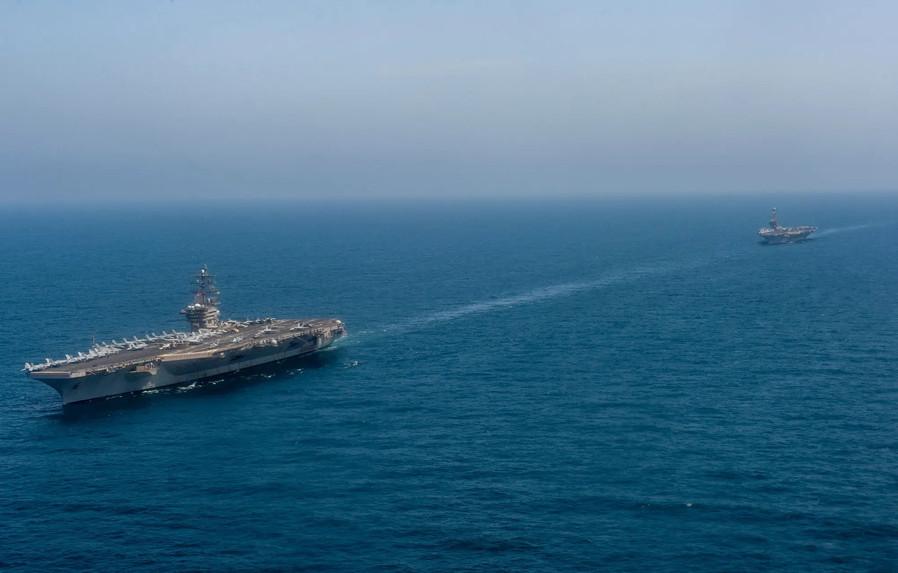
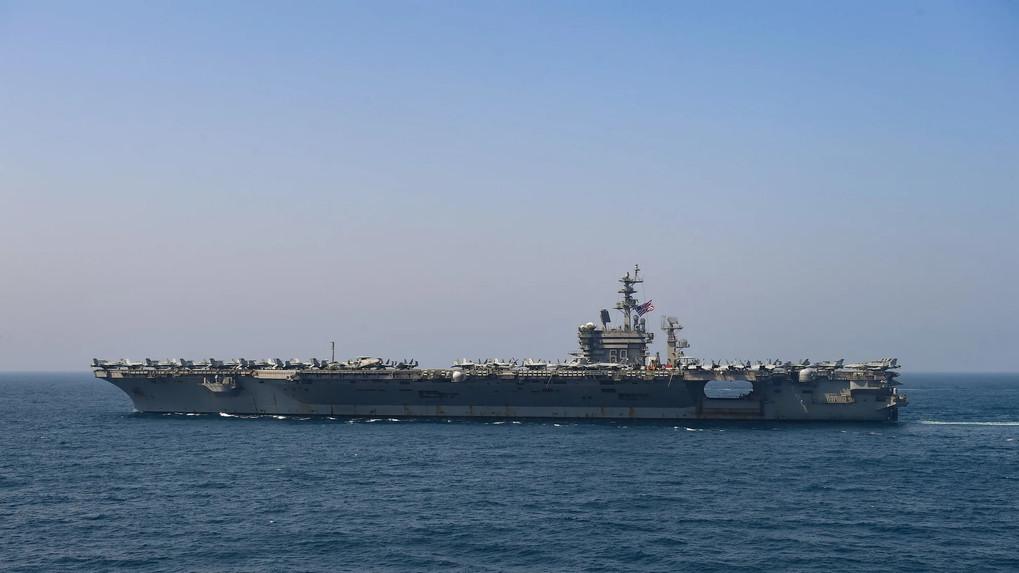
In the middle of this stretch the ships marked an occasion of the Navy’s own. On 21 March, in the North Arabian Sea, San Jacinto had steamed in a photo exercise with Eisenhower, the carrier Harry S. Truman, the cruiser Normandy and the destroyers Lassen and Farragut, two carrier groups together in what the ship’s chronology calls a show of force, and on 3 June she replenished there from the dry cargo ship Robert E. Peary.13 Between those dates came the line.
On 14 May 2020 the sailors of Eisenhower and San Jacinto went south to the equator and held a crossing-the-line ceremony, the rite in which those who have never crossed, the pollywogs, are made shellbacks by those who have. They had been at sea for more than a hundred days, and the Navy gave those who took part a title of the occasion’s own invention: they were the Navy’s first “Iron Shellbacks.”8 The ship had held the ceremony before, in 1992 and in 2010.
The record
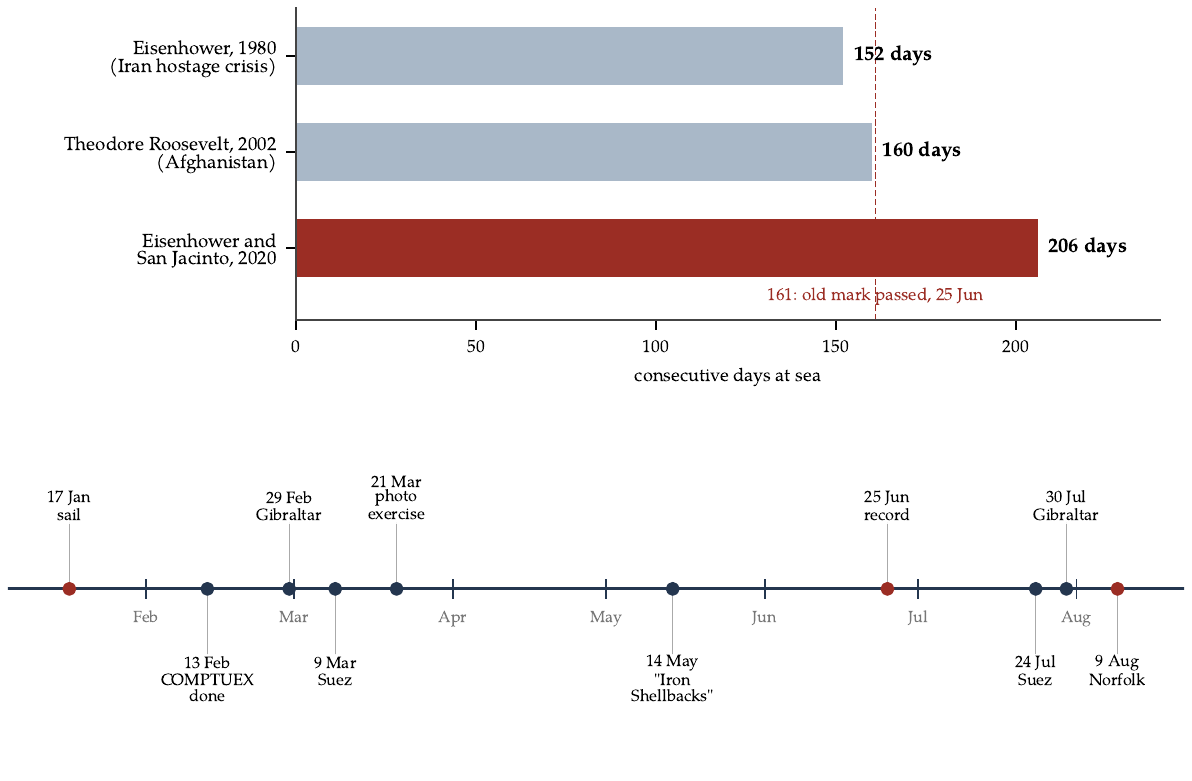
There were two records in the way. The first was held by the Eisenhower herself: in 1980, during the Iran hostage crisis, the carrier had stayed at sea 152 consecutive days. The second had been set in February 2002 by the carrier Theodore Roosevelt, in the opening months of the war in Afghanistan, when she remained at sea 160 days in a row.9 Neither had been broken since.
On 25 June 2020 the Eisenhower and the San Jacinto passed the old mark. They had been continuously at sea for 161 days. The Navy announced it from the Arabian Sea, quoting the captain of the San Jacinto, who described the two ships as a “flexible, adaptable and persistent force” that had held its station, and added that his sailors were the most motivated and professional he had ever served with. He also said that his ship’s work was not done and that the crews were on a path to beat the old record by a wide margin.6 He told the Associated Press, with a laugh, that he had had a couple of requests to see whether the cruiser could stay out longer than the carrier, so as to hold the record alone.4 The same report recorded the kind of repair a crew makes when no port is coming. The door of the helicopter hangar failed one night and needed a large sprocket the ship did not carry. Her machine shop made one out of ninety-pound dumbbells, which happened to be of a suitable metal. Machinist’s Mate First Class Joshua Grimes, whose team worked out the fix, called it the most unusual repair they had pulled off, and the captain compared his crew to magicians pulling rabbits out of hats. Before this cruise, a sailor told the reporter, the longest he had been under way at a stretch was a little over forty days.4
The ships did not stop. The group’s ships went on through Hormuz, the narrow strait at the mouth of the Persian Gulf, and through the Bab el-Mandeb. By the time the cruise was over, the Navy said, the ships of the strike group had sailed more than sixty thousand nautical miles and had passed through the Strait of Gibraltar, the Suez Canal, the Strait of Hormuz and the Bab el-Mandeb.7
Home
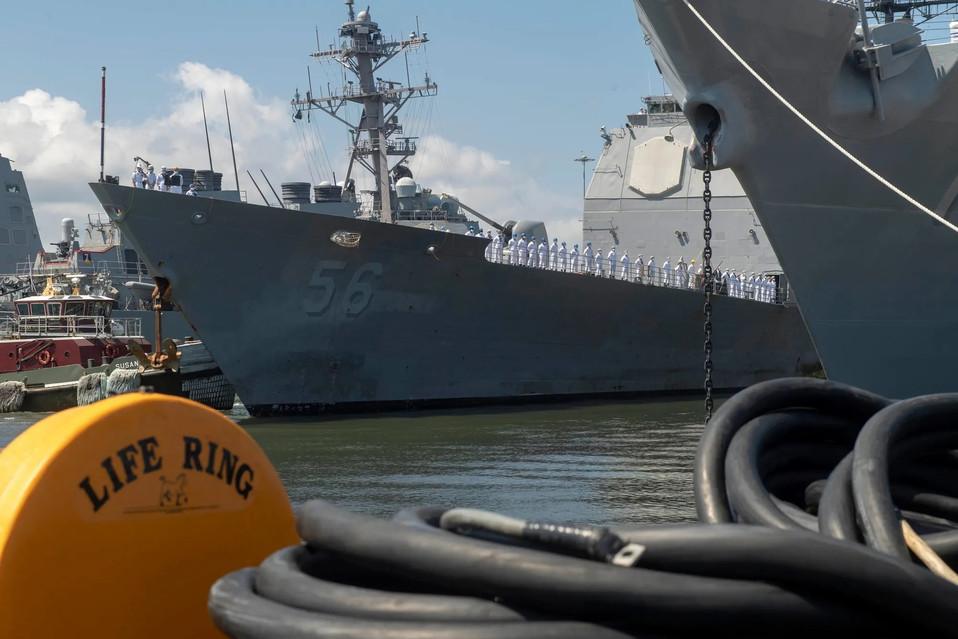
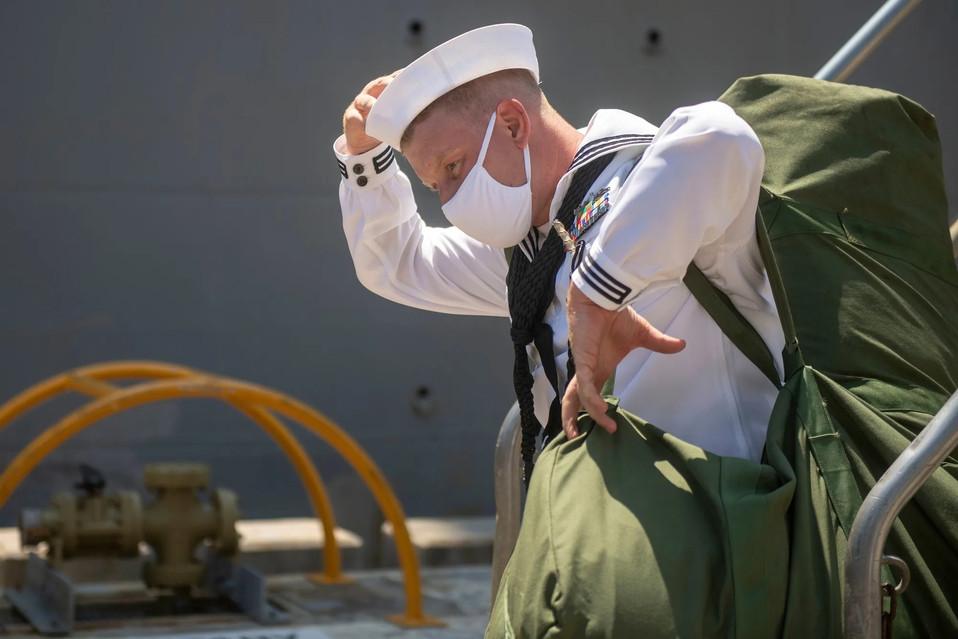
The carrier’s air wing went home first, to bases in Virginia, Washington State and Florida, on 6 and 7 August. On Sunday, 9 August, the Eisenhower and the San Jacinto came up the channel into Norfolk together and tied up. The Vella Gulf, the James E. Williams and the Truxtun followed on the Monday. The destroyer Stout stayed deployed and would come home later.7
The two ships had been at sea for 206 consecutive days, without a port visit. The Navy described the deployment, in more ordinary units, as seven months in the Fifth and Sixth Fleets, and the 206 days were, by the Navy’s own account, a record for the modern Navy.7 It stood for six years. In July 2026 the carrier Abraham Lincoln, held on station in the Middle East since January, passed her 207th consecutive day at sea.14
The crew was later awarded a Navy Unit Commendation for its work on the cruise, presented aboard the ship on 2 August 2021.10
San Jacinto came north through the Suez Canal on 24 July and west through the Strait of Gibraltar on 30 July.13 Counting the first and last days, the interval from 17 January to 9 August is 206 days, and from 17 January to 25 June it is 161, so the Navy’s figures agree with its dates; the earlier departure in the ship’s chronology is the ammunition run to Yorktown. Of what the cruiser did between the straits, beyond the photo exercise and the replenishments, the record says little. The Navy’s accounts speak in general terms of maritime security and of operations with the strike group, name no particular tasking, contact or engagement for San Jacinto, and give no figures for her own fuel, stores or steaming as distinct from the group’s.
So the record she is best known for after 1991 is a record for endurance. In 1991 the Navy remembered her for what she fired. In 2020 it remembered her for how long her crew could go without stopping. The older of the strike group’s two cruisers, the one her own sailors called an unlucky old boat that was always broken, stayed at sea for 206 days and came home under her own power. Nothing in her history says more for the people who kept her running.
Cape Verde
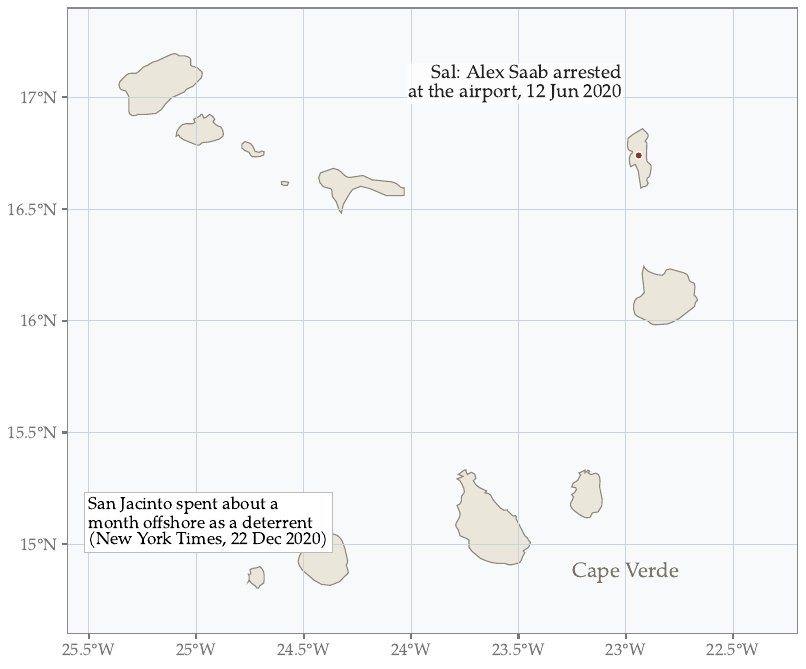
The ship’s 2020 was not finished. In the autumn, three months after coming home, San Jacinto went to sea again, on a mission that the public learned of only when the New York Times reported it on 22 December 2020.11
She had spent a month, the Times wrote, off Cape Verde, an island nation in the eastern Atlantic, on a secret mission to deter any attempt to free a man held there. The man was Alex Saab, a Colombian businessman and associate of the Venezuelan government of Nicolás Maduro, who had been arrested at Sal airport on 12 June 2020, when his aircraft stopped there to refuel, and who was awaiting extradition to the United States on money-laundering charges. The Defense Department had taken the possibility of an attempt to free him seriously enough to send a Coast Guard cutter, the Bear, to the area in August. In November the acting Secretary of Defense, Christopher Miller, who had taken office after President Trump dismissed Mark Esper earlier that month, approved the cruiser’s mission. U.S. Africa Command described it as an effort to combat illicit transnational maritime activity. Her crew numbered 393. The Navy’s Second Fleet told the Times that the ship cost about $52,000 a day to operate. She was ordered home before Christmas.11
The Navy’s own historical evaluation of the ship, written years later, describes the mission in the same terms: it was a deterrent to any attempts to aid Saab in fleeing.12 Saab was extradited to the United States in October 2021.12
The ship’s chronology gives the dates. She left Norfolk on 23 September for carrier escort duties, took on ammunition at Yorktown from 27 September to 2 October, sailed again on 3 November and was back at her pier on 21 December after thirty-nine days at sea in the Second and Sixth Fleet areas.13 Little else about the mission was ever made public.
A crew that had just spent 206 days at sea was sent out again for thirty-nine more, to steam in circles off an island and guard one man in a jail. They were home four days before Christmas. In the calendar year 2020 the ship had spent something like two hundred and seventy days under way.
Notes
- Departure of 17 January 2020: Carrier Strike Group 10 release, 25 June 2020 (“both ships departed their homeport of Norfolk, Va., on Jan. 17”); Navy release of 9 August 2020 (Commander, Naval Air Force Atlantic / CNIC Norfolk). The ship’s chronology on USCarriers.net gives 12 January; the Navy’s dated releases are followed here. Command of Capt. Edward Crossman from 9 December 2019 (see Chapter 20 notes). ↩
- U.S. Naval Institute News, 9 August 2020 (strike group composition: Eisenhower; Carrier Air Wing 3; Vella Gulf and San Jacinto; Destroyer Squadron 26); Task & Purpose, reprinting the Virginian-Pilot, 10 August 2020 (Vella Gulf, Truxtun and James E. Williams due on 10 August; Stout remaining on deployment). ↩
- Military Times, 10 August 2020 (“initially departed ... on Jan. 17 to complete its Composite Unit Training Exercise ... then deployed in February”); Task & Purpose / Virginian-Pilot, 10 August 2020 (went from the exercise directly to deployment instead of returning home first, “as is customary”); U.S. Naval Institute News, 9 August 2020. ↩
- Associated Press, “Dodging virus, Navy ships break record for staying at sea,” 25 June 2020 (virus escalating as the ships entered the Mediterranean; no onboard visitors; strict controls on aircraft deliveries; the hangar-door sprocket repair; the March Madness mustache bracket; the petty officer’s remarks; Capt. Crossman’s remark about staying out longer than the Eisenhower; Theodore Roosevelt outbreak). NPR, 25 June 2020, for the Theodore Roosevelt’s stop at Guam in late March, the infection of more than 1,000 of its crew, and the removal of its commanding officer. ↩
- Carrier Strike Group 10 story by Lt. j.g. Lewis Aldridge, 25 June 2020 (DVIDS news 372986), quoting Vice Adm. James Malloy, commander, U.S. Naval Forces Central Command and U.S. Fifth Fleet, on suspending liberty port visits in March. Malloy’s earlier command of Carrier Strike Group 10: see Chapter 20 notes. ↩
- Same CSG-10 story; Seapower magazine, 26 June 2020 (Capt. Crossman: “flexible, adaptable and persistent force”; the crews’ resupplying, repairs and upkeep; his remark that the cruiser’s work was not done and that the ships were on a path to beat the old record by a wide margin). ↩
- Navy release, 9 August 2020 (Capt. Kyle Higgins on repairs “never before attempted at sea”; air wing return on 6–7 August); Military Times, 10 August 2020 (more than 60,000 nautical miles; Gibraltar, Suez, Hormuz and Bab el-Mandeb); USNI News, 9 August 2020; Navy release of 9 August 2020 on the 206 consecutive days. The destroyer Stout’s later total of 215 days is a press figure and is not used in the narrative. ↩
- Navy release, 9 August 2020 (“becoming the Navy’s first ‘Iron Shellbacks,’ with more than 100 days at sea May 14”; the ships “transited to the equator”); UPI, 10 August 2020. ↩
- Navy release, 25 June 2020 (the 160-day record of USS Theodore Roosevelt, February 2002; the Eisenhower’s own 152-day record in 1980); AP, 25 June 2020. ↩
- Navy release, “San Jacinto Recognized with Navy Unit Commendation,” 3 August 2021: ceremony of 2 August 2021 aboard the ship at Naval Station Norfolk, Rear Adm. Brendan McLane presenting; the award recognized the crew’s work in support of the Eisenhower deployment. ↩
- The New York Times, 22 December 2020 (the month-long mission off Cape Verde; approval by Acting Secretary of Defense Christopher Miller after Mark Esper’s dismissal in early November; Coast Guard cutter Bear sent in August; cost of about $52,000 a day per U.S. Second Fleet; crew of 393; return before Christmas; AFRICOM spokeswoman’s description of the mission as an effort to combat illicit transnational maritime activity). Alex Saab’s arrest on 12 June 2020 at Sal, Cape Verde, is from contemporary press reports, and the airport detail is not confirmed by an official source. ↩
- NAVSEA, Naval Vessel Historical Evaluation, CG-56, 21 September 2023 (the Cape Verde mission as a deterrent “to any attempts to aid” Saab in fleeing); Saab’s extradition to the United States in October 2021 from press reports. One account gives 39 days underway ending 21 December 2020; it is not confirmed by a Navy source. ↩
- uscarriers.net chronology for USS San Jacinto (CG 56) (archived 5 March 2026), entries for 12 January to 9 August 2020 (ammunition onload at Naval Weapons Station Yorktown, 12–14 January; COMPTUEX in the Cherry Point, Jacksonville and Charleston operating areas, complete by 13 February; replenishment from USNS Patuxent, 18 February; Gibraltar eastbound, 29 February; Suez southbound, 9 March; Bab el-Mandeb, 13 March; photo exercise with Eisenhower, Harry S. Truman, Normandy, Lassen and Farragut in the North Arabian Sea, 21 March; replenishment from USNS Robert E. Peary, 3 June; Suez northbound, 24 July; Gibraltar westbound, 30 July; moored at Berth 2, Pier 5, Naval Station Norfolk, 9 August) and for 23 September to 21 December 2020 (carrier escort departure; ammunition onload at Yorktown, 27 September to 2 October; underway 3 November; moored 21 December after a 39-day underway in the Second and Sixth Fleet areas). The compilation does not say that the autumn underway was the Cape Verde mission; the dates fit the New York Times account (note 11). ↩
- Stars and Stripes, 9 July 2026, on USS Abraham Lincoln reaching her 207th consecutive day at sea and passing the 206-day mark set by Dwight D. Eisenhower in 2020. “The older of the strike group’s two cruisers”: Vella Gulf (CG-72) was commissioned in 1993. ↩